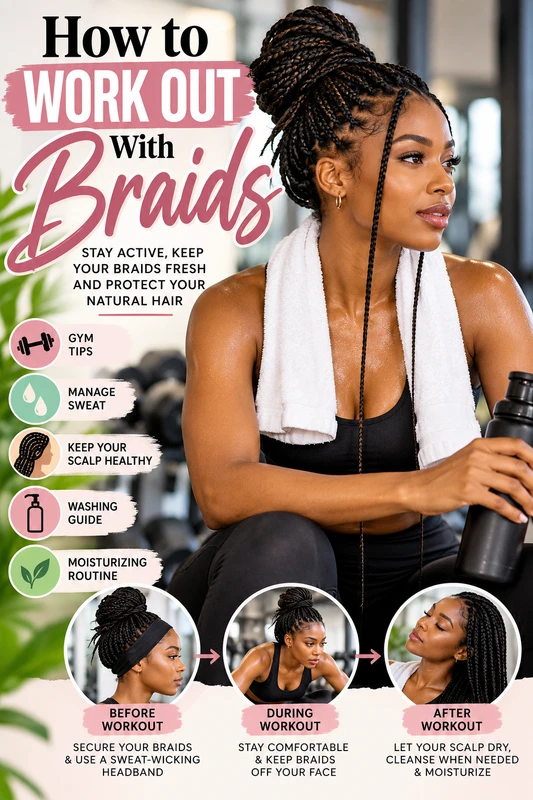
Braids are one of the most convenient protective hairstyles for an active lifestyle. Whether you wear knotless braids, box braids, cornrows, stitch braids, feed-in braids, or bohemian braids, you can go to the gym, run, cycle, dance, lift weights, and complete high-intensity workouts without having to restyle your natural hair every day.
But there is one challenge: sweat.
A hard workout can leave your scalp damp, your roots sweaty, and your braids frizzy. If you exercise several times a week, sweat can also combine with scalp oils and styling products, contributing to buildup around your roots.
That doesn't mean you have to choose between maintaining your fitness routine and keeping your braids looking good.
The key is learning how to work out with braids while controlling sweat, minimizing friction, allowing your scalp to dry, and adjusting your braid-care routine to match your activity level.
In this complete guide from Hairobics All Natural, we'll explain how to exercise with braids, what to do with your braids before and after a workout, how frequently active people may need to wash their braids, how to prevent odor and buildup, and how to keep your natural hair moisturized underneath your protective style.
Can You Work Out With Braids?
Absolutely.
In fact, braids can be one of the easiest hairstyles to maintain when you exercise regularly.
Unlike a loose natural hairstyle that may require daily refreshing, braids keep your hair organized and reduce the amount of manipulation required before and after workouts.
Braids can be particularly convenient for activities such as:
- Weightlifting
- Walking
- Running
- Cycling
- Hiking
- Yoga
- Pilates
- Dance workouts
- HIIT
- Boxing workouts
- Cardio
- Strength training
- Outdoor exercise
The biggest issue isn't the workout itself.
It's what happens to your scalp and braids after you sweat.
Sweat doesn't automatically damage your hair. However, repeatedly allowing sweat, oil, dead skin, and hair products to accumulate around your scalp can make your braids feel dirty, itchy, coated, or uncomfortable.
People who exercise frequently may therefore need a slightly different braid-care routine than someone who rarely sweats.
Why Does Your Scalp Sweat So Much With Braids?
Your scalp contains sweat glands just like other areas of your skin.
When your body temperature rises during exercise, sweating helps your body regulate temperature.
Having braids doesn't stop this process.
Depending on your workout intensity, you may notice moisture collecting around your:
- Hairline
- Nape
- Crown
- Parts
- Roots
People who perform intense cardio or exercise in hot weather may experience considerably more scalp sweating than someone completing a light strength-training session.
Your braid type can make a difference as well.
For example, large individual box braids may feel heavier when damp, while cornrows and stitch braids leave more of the scalp exposed to air.
Whatever style you're wearing, the most important thing is allowing the scalp to dry after exercising.
What Happens When You Sweat in Braids?
One sweaty workout isn't going to ruin your braids.
Problems are more likely to develop when sweat repeatedly accumulates and the scalp doesn't have an opportunity to dry or be cleansed.
Over time, sweat can mix with:
- Natural scalp oils
- Dead skin cells
- Hair products
- Dirt
- Environmental debris
This mixture can contribute to buildup around your roots.
If you're exercising four, five, or six days a week, scalp maintenance becomes particularly important.
Our complete Braids Washing Guide explains how to cleanse braided hair without aggressively disturbing the style.
How to Prepare Your Braids Before a Workout
A good post-workout routine starts before you exercise.
You don't need to spend 30 minutes preparing your hair. A few simple steps can make your braids considerably easier to manage afterward.
1. Get Your Braids Off Your Face and Neck
Long braids can become distracting during exercise.
They may stick to sweaty skin, swing around while running, or get caught underneath your back during floor exercises.
Gather your braids into a comfortable style that keeps them controlled.
Depending on their length and weight, you could try:
- A loose ponytail
- Low bun
- High ponytail
- Loose braided bun
- Half-up style
The key word is loose.
Your workout hairstyle shouldn't pull aggressively against your roots.
Remember that your braids already place some weight on your natural hair. Pulling them into an extremely tight ponytail adds another source of tension.
This is especially important around your edges.
If your scalp hurts when you pull your braids back, loosen them.
For more information about identifying excessive braid tension, read How to Tell if Braids Are Too Tight.
2. Don't Make a Heavy Bun Too Tight
Long box braids can become surprisingly heavy when gathered into one large bun.
That weight may pull against your hairline throughout your workout.
Instead of twisting your braids as tightly as possible, create a comfortable bun that holds the hair without forcing your roots backward.
If your braids are extremely long or heavy, a low ponytail may sometimes feel more comfortable.
Experiment until you find a position that doesn't create scalp tension.
Your workout hairstyle should feel secure—not painful.
3. Consider a Sweat-Wicking Headband
A workout headband can help absorb some of the sweat around your forehead and hairline before it reaches your braids.
Choose something comfortable and breathable.
Avoid extremely tight headbands that continuously rub or compress your edges.
Remember that the purpose is controlling sweat—not squeezing your hairline.
After exercising, remove the headband rather than leaving a damp band around your scalp.
Wash your workout headbands regularly as well.
Putting a dirty, sweaty headband back against a freshly cleaned hairline defeats the purpose.
4. Avoid Adding Heavy Products Immediately Before Exercising
Your scalp doesn't need to be coated with several layers of oil, grease, cream, or styling product before every workout.
When heavy products combine with sweat, they can contribute to buildup.
Keep your braid routine simple.
If your natural hair needs moisture, use an appropriate lightweight product rather than repeatedly coating the scalp.
Hairobics Raaw Roots Antiseptic Moisturizer Spray is designed for natural hair, locs, twisties, and braids and can be incorporated into a lightweight braid-maintenance routine.
You don't need to completely saturate your braids.
Concentrate on the portions containing your natural hair and use only what your hair needs.
How to Wear Long Braids at the Gym
Long braids can be beautiful, but working out with waist-length or hip-length braids requires a little planning.
Leaving them completely loose may cause them to:
- Swing during cardio
- Stick to sweaty skin
- Get caught in equipment
- Drag across benches or mats
- Become tangled
- Rub against clothing
A loose ponytail or bun generally makes long braids easier to control.
When using gym equipment, always make sure your braids aren't near moving parts.
If you're lying on a bench, move the length of your braids away from your back so you're not repeatedly lying or pulling on them.
The objective is to control the hair without putting unnecessary tension on your scalp.
The Best Post-Workout Routine for Braids
What you do after exercising can make a major difference in how your braids look and how your scalp feels.
Here's a simple routine.
Step 1: Take Your Braids Down From the Workout Style
Once you've finished exercising, don't leave your braids tightly bundled if your scalp is sweaty.
Take down the ponytail or bun.
Allow your braids to hang freely.
This increases airflow around the scalp and roots.
Step 2: Remove Your Headband
If you wore a headband, take it off.
A sweat-soaked headband shouldn't remain pressed against your hairline for hours.
Place it with your workout clothes so it can be washed before your next session.
Step 3: Let Your Scalp Breathe
This may be the most important part of your post-workout braid routine.
Let your scalp dry.
Don't immediately finish your workout, put on a satin bonnet, and trap a damp scalp underneath it.
Give moisture an opportunity to evaporate.
Separate or gently move your braids if necessary so air can reach your scalp.
4. Use Cool Air if Necessary
If your scalp is very sweaty, airflow can help accelerate drying.
A fan is one simple option.
If you're using a hair dryer, keep the setting appropriate and avoid concentrating excessive heat on one area.
Your goal is simply to help the roots dry.
People who exercise at night should pay particular attention to this step.
You don't want to finish an evening workout and immediately go to bed while your scalp and braids are still damp.
5. Don't Automatically Add Oil After Every Workout
A sweaty scalp doesn't necessarily need oil.
Oil doesn't remove sweat.
If your scalp is dirty, applying another layer of oil may simply add to the accumulation already present.
Instead, determine what your hair actually needs.
Does your scalp simply need to dry?
Does your natural hair feel dry and need lightweight moisture?
Or have you accumulated enough sweat that it's time to cleanse your scalp?
Treat the actual issue instead of automatically reaching for oil.
How Often Should You Wash Braids if You Work Out?
This is one of the most common questions people have about exercising with braids.
There isn't one washing schedule that works for everybody.
Someone exercising intensely five days per week may need to cleanse more frequently than someone doing two light workouts each week.
Factors to consider include:
- How frequently you exercise
- How heavily you sweat
- Your braid style
- Your scalp condition
- How much product you use
- Whether you exercise indoors or outdoors
- Your climate
- How quickly buildup develops
For many people, washing braids approximately every two to three weeks may be a reasonable starting point, but active people who sweat heavily may need to cleanse sooner.
Pay attention to your scalp.
Signs that cleansing may be necessary include:
- Visible buildup
- Excessive oiliness
- Persistent itching
- Unpleasant odor
- Sweat accumulation
- Flaking
- Coated roots
Don't avoid washing solely because you're afraid of making your braids frizzy.
A healthy scalp should take priority over keeping every braid looking freshly installed.
Read our guide on How to Wash Braids Without Ruining Them for a complete washing routine.
Should You Wash Your Braids After Every Workout?
Usually, you don't need to shampoo your entire head after every workout.
That could mean washing your braids five or six times a week for some people, which may create unnecessary manipulation and frizz.
Instead, evaluate how much you actually sweated.
After a light workout, allowing your scalp to dry thoroughly may be sufficient.
After repeated intense workouts, however, you may notice that your scalp needs cleansing sooner than your usual schedule.
Your scalp should determine your routine.
Don't follow a calendar so rigidly that you ignore obvious buildup or discomfort.
How to Wash Sweaty Braids
When it is time for a full wash, concentrate primarily on the scalp.
You don't need to aggressively scrub every braid.
Step 1: Wet Your Hair
Allow lukewarm water to flow over your scalp and braids.
Step 2: Apply Shampoo to the Scalp
Diluting shampoo in an applicator bottle can make it easier to reach between braided sections.
Apply the cleanser along your parts and scalp.
Step 3: Massage Gently
Use your fingertips rather than scratching with your nails.
Focus on loosening sweat, oil, and buildup.
Step 4: Rinse Thoroughly
Allow the water to travel downward through your braids.
Continue rinsing until the cleanser has been completely removed.
Step 5: Remove Excess Water
Gently squeeze the braids.
Don't twist or wring them aggressively.
Use a microfiber towel or soft T-shirt to absorb excess water.
Step 6: Dry Completely
This step is especially important.
Your braids may feel dry on the outside while the roots remain damp.
Allow plenty of drying time.
A hooded dryer or blow dryer on an appropriate low or cool setting may help.
Whenever possible, wash your braids earlier in the day instead of immediately before bedtime.
How to Prevent Your Braids From Smelling After Workouts
One concern among people who exercise frequently is braid odor.
The best approach isn't trying to cover odor with fragrance.
Address what's causing it.
Persistent odor may indicate that sweat and buildup need to be cleansed or that your braids aren't drying completely.
To help keep braids fresh:
- Let your scalp dry after workouts.
- Don't immediately cover sweaty braids.
- Cleanse when buildup develops.
- Rinse shampoo thoroughly.
- Dry your braids completely after washing.
- Avoid excessive layers of heavy products.
- Keep bonnets, scarves, pillowcases, and workout headbands clean.
Your accessories matter.
Putting clean braids into a bonnet that has absorbed weeks of scalp oil and product can reintroduce residue.
How to Keep Braids From Getting Frizzy at the Gym
Some frizz is unavoidable.
Your natural hair continues growing, and repeated exposure to moisture, sweat, and movement can gradually change the appearance of your braids.
However, you can reduce unnecessary frizz.
First, minimize friction.
Avoid constantly rubbing your scalp with a rough towel during exercise.
If sweat is running down your forehead, gently blot it instead.
Second, avoid constantly restyling your braids.
Putting them into five different ponytails throughout the day creates additional manipulation.
Third, protect them at night.
A satin or silk scarf or bonnet reduces friction while you're sleeping.
For additional strategies, read How to Keep Braids Looking Fresh.
How to Keep Your Natural Hair Moisturized When You Exercise
Sweating frequently doesn't eliminate your hair's need for moisture.
Your natural hair is still inside the braided style.
If it becomes excessively dry, it may be more susceptible to tangling and breakage when you eventually remove your braids.
The solution isn't drowning your braids in heavy products.
Use lightweight moisture strategically.
The Hairobics Raaw Roots Antiseptic Moisturizer Spray provides an easy way to incorporate moisture into your braid-care routine.
Lightly apply as needed to the sections containing your natural hair rather than completely soaking the entire hairstyle.
If you aren't sure how often your braids need moisture, our guide to Keeping Natural Hair Moisturized in Braids provides a more detailed routine.
Should You Moisturize Before or After Working Out?
For many people, after the workout makes more sense.
If you apply a large amount of product immediately before intense exercise, that product may mix with sweat.
Instead:
Before workout: Keep your braids secured and your scalp relatively product-free.
After workout: Allow your scalp to dry.
Later: Apply lightweight moisture if your natural hair actually needs it.
You don't necessarily need moisturizer after every workout.
Your hair's needs should determine the frequency.
Can You Run With Braids?
Yes.
Braids are excellent for running because they keep natural hair contained.
The main challenge with running is movement.
Long braids can swing dramatically with every stride.
Secure them comfortably before running.
A loose ponytail or bun can keep them from repeatedly hitting your face, neck, and back.
Outdoor runners should also remember that heat can increase sweating.
After your run, release your braids and allow your scalp to dry.
Can You Lift Weights With Braids?
Absolutely.
Braids are particularly convenient for strength training because your hair doesn't require much attention during the workout.
However, be careful when using:
- Benches
- Barbells
- Cable machines
- Weight machines
- Floor mats
Move long braids away from equipment before beginning each exercise.
If you're performing bench presses or other exercises while lying down, pull the length of your braids to one side instead of trapping them underneath your back.
Can You Do HIIT With Braids?
Yes, but HIIT can produce significant sweating.
Your post-workout drying routine becomes especially important.
Release your braids after exercising and give your scalp enough airflow to dry.
If you're doing HIIT several times each week, monitor your scalp for buildup.
You may discover that you need to cleanse your braids more frequently than someone with a less intense exercise routine.
Can You Wear a Hat Over Braids While Exercising?
You can, but consider heat, moisture, and friction.
A hat can trap additional heat around the scalp and may become saturated with sweat.
If you exercise in hats regularly:
- Choose breathable options.
- Avoid excessively tight hats.
- Wash them frequently.
- Remove the hat after exercising.
- Allow your scalp to dry.
Be especially careful around your edges.
Repeated friction along the same part of your hairline isn't ideal.
How to Exercise With Fresh Braids
Fresh braids deserve special consideration.
If your braids were installed very tightly, pulling them into a high ponytail immediately may increase tension.
For the first few days, choose loose styles.
More importantly, don't assume severe pain is normal simply because your braids are new.
Fresh braids shouldn't cause persistent headaches, painful bumps, or significant scalp pulling.
If your braids hurt, our guide on How to Tell if Braids Are Too Tight explains the warning signs to watch for.
How to Work Out With Knotless Braids
Knotless braids are popular among active women because they often have more flexibility around the roots than traditional braids installed with a knot.
However, they still require proper care.
Before exercising:
- Gather long braids loosely.
- Avoid excessively tight ponytails.
- Use a clean sweat-wicking headband if desired.
After exercising:
- Release the style.
- Let the scalp dry.
- Avoid piling heavy products onto sweaty roots.
- Cleanse when necessary.
- Moisturize your natural hair as needed.
Knotless braids may gradually become looser at the roots as your natural hair grows, so avoid constantly pulling them tightly backward to make them appear newer.
How to Work Out With Box Braids
Box braids can become heavy, especially when they're long.
Choose a workout hairstyle that distributes their weight comfortably.
If a high bun makes your scalp hurt, don't force it.
Try a lower ponytail instead.
After intense workouts, allow air to circulate through your roots.
When you wash box braids, remember that the extensions can retain substantial amounts of water.
Give them enough time to dry completely.
How to Work Out With Cornrows and Stitch Braids
Cornrows and stitch braids are convenient workout hairstyles because the hair is already secured close to the scalp.
There's often no need to restyle them before exercise.
However, more of your scalp may be exposed.
Sweat can collect along the parts, so post-workout scalp care remains important.
Blot excessive sweat gently and allow your scalp to dry.
Avoid aggressively rubbing the scalp with a towel because friction can make the style fuzzy faster.
How to Work Out With Boho Braids
Bohemian braids require extra attention because of the loose curly pieces incorporated into the style.
Those curls can tangle from sweat and movement.
Before working out, loosely secure the braids and curls.
Avoid extremely tight buns that crush or tangle the loose pieces.
Afterward, gently release the hairstyle and separate any curls that have become tangled.
For detailed maintenance instructions, see our Boho Braids Care Guide.
Don't Forget Your Nighttime Routine
If you work out in the evening, make sure your scalp is dry before covering your hair for bed.
Once dry, protect your braids with satin or silk.
Nighttime protection helps reduce friction and can keep your braids looking neater between workouts.
Read our complete Night Routine for Braids for more ways to protect braided styles while sleeping.
When Should Active People Take Their Braids Out?
Being active doesn't automatically mean your braids need to be removed early.
However, frequent sweating can make scalp cleanliness and root maintenance more important.
You may want to consider taking your braids down if you're experiencing:
- Persistent scalp odor
- Heavy buildup
- Significant matting
- Severe itching
- Painful scalp
- Excessive root tangling
- Thinning edges
- Braids hanging from small sections of natural hair
- Excessive new growth
- Repeated scalp irritation
Don't keep a hairstyle installed solely because you planned to wear it for a certain number of weeks.
Your hair and scalp should determine when it's time for removal.
For a full breakdown, see How Long Should You Keep Braids In?.
Common Mistakes When Working Out With Braids
Mistake #1: Covering a Sweaty Scalp Immediately
Allow your scalp to dry before putting on your bonnet, scarf, or hat.
Mistake #2: Applying Oil After Every Workout
Sweat doesn't automatically mean your scalp needs more oil.
Mistake #3: Never Washing Your Braids
Active people may accumulate sweat and buildup more quickly.
Cleanse when your scalp needs it.
Mistake #4: Washing After Every Single Workout
The opposite extreme isn't necessarily better.
Adjust your washing schedule according to your scalp and activity level.
Mistake #5: Wearing Extremely Tight Workout Ponytails
Braids already add weight.
There's no reason to add unnecessary tension.
Mistake #6: Ignoring Your Edges
Repeated pulling can stress the hairline.
Change the position of your workout hairstyles and keep them comfortable.
Mistake #7: Sleeping With Damp Braids
If you work out at night, make sure your scalp has dried before bed.
Mistake #8: Using Too Many Products
More product doesn't automatically mean healthier hair.
Keep your braid routine simple and purposeful.
A Simple Weekly Workout Routine for Braided Hair
Your exact schedule will depend on how often you exercise and how heavily you sweat, but here's an example.
Light Workout Day
Secure braids loosely → exercise → release braids → allow scalp to dry.
Heavy Workout Day
Secure braids → wear a clean sweat-wicking headband if desired → exercise → remove headband → release braids → dry scalp thoroughly.
Moisture Day
Once the scalp is clean and dry, apply lightweight moisture to your natural hair as needed.
Wash Day
Gently shampoo the scalp → rinse thoroughly → remove excess water → dry completely → moisturize as needed → protect at night.
This keeps your routine straightforward.
You shouldn't have to choose between healthy hair and an active lifestyle.
Frequently Asked Questions About Working Out With Braids
Does sweat ruin braids?
Not automatically.
Repeated moisture, friction, and buildup can make braids become frizzy or dirty faster, but proper post-workout care can help maintain the style.
Should I wash my braids every time I sweat?
Usually not.
Light sweating may only require drying your scalp. Heavy or repeated sweating may mean you need to cleanse sooner.
How do I keep my scalp from smelling after workouts?
Allow your scalp to dry completely and cleanse when sweat and buildup accumulate. Keep workout headbands, scarves, bonnets, and pillowcases clean as well.
Can I wear a bonnet immediately after working out?
It's better to allow a sweaty or damp scalp to dry first.
Should I put oil on my scalp before the gym?
You don't need to oil your scalp specifically because you're going to exercise. Heavy product combined with sweat can contribute to buildup.
What's the best hairstyle for long braids at the gym?
A loose ponytail, low bun, or comfortable high bun can work. Choose whichever option controls your braids without creating scalp tension.
Can working out make braids frizzy?
Yes. Sweat, moisture, movement, and friction can gradually contribute to frizz. Some frizz is normal.
Can I work out every day with braids?
Yes. Your hair doesn't need to determine how frequently you exercise. Instead, adjust your scalp-cleansing, drying, and moisturizing routine to your activity level.
How do I keep my braids moisturized if I'm exercising frequently?
Allow your scalp to dry after workouts and use a lightweight moisturizing product as your natural hair needs it. Avoid constantly layering heavy products.
Should I take my braids out if my scalp keeps itching after workouts?
Persistent itching shouldn't simply be ignored. Check for sweat accumulation, product buildup, tension, irritation, or another scalp issue. Cleanse when necessary, and consider removing the style if symptoms continue or become severe.
Final Thoughts: How to Work Out With Braids Without Ruining Them
Braids and exercise can work extremely well together.
You don't need to skip workouts to preserve your hairstyle, and you don't need to shampoo your braids after every drop of sweat.
The goal is balance.
Before exercising, keep your braids comfortably secured without pulling tightly against your scalp.
After exercising, release the hairstyle and allow your scalp to dry.
When sweat, oil, and product begin accumulating, cleanse your scalp instead of trying to cover buildup with more products.
Continue providing your natural hair with lightweight moisture throughout the life of your protective style, and protect your braids from friction while you sleep.
Most importantly, pay attention to what your hair and scalp are telling you.
An active lifestyle may mean your braid-maintenance schedule looks different from someone else's—and that's perfectly normal.
With a simple routine of secure, sweat, release, dry, cleanse, moisturize, and protect, you can stay active while keeping your braids and the natural hair underneath them looking and feeling their best.