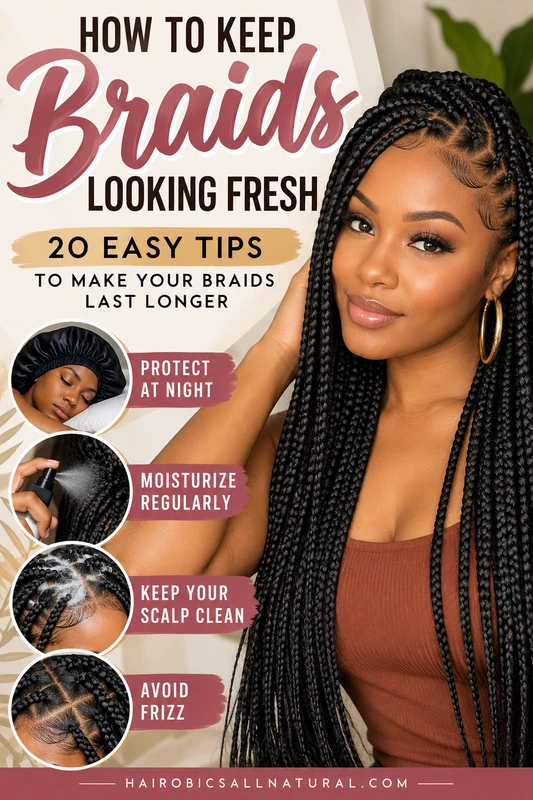
Braids are one of the most popular protective hairstyles for Black women, offering versatility, convenience, and an opportunity to reduce daily manipulation of natural hair. Whether you're wearing knotless braids, box braids, cornrows, stitch braids, or bohemian braids, keeping them looking fresh requires more than simply getting them installed.
Over time, braids can develop frizz, loose roots, product buildup, dryness, and flyaway hairs. Fortunately, a consistent braid maintenance routine can help preserve your hairstyle, keep your natural hair moisturized, and maintain a neat appearance between salon appointments.
Learning how to keep braids looking fresh doesn't require an expensive collection of products or hours of daily maintenance. Small habits, including protecting your hair at night, moisturizing regularly, cleaning your scalp, and avoiding excessive styling tension, can make a noticeable difference.
In this comprehensive guide, we'll explore 20 practical ways to keep your braids neat, moisturized, and beautiful while protecting the health of your natural hair underneath.
The goal isn't just to make your braids last longer. It's to maintain healthy hair while enjoying your protective style.
Why Do Braids Stop Looking Fresh?
Before learning how to maintain braids, it helps to understand why they begin looking older.
Even professionally installed braids naturally change as your hair grows. New growth appears around the roots, shorter natural hairs begin escaping from the braid, and everyday activities create friction.
Several factors can accelerate this process:
-
Sleeping without a satin bonnet or scarf.
-
Allowing natural hair underneath the braids to become excessively dry.
-
Constantly touching, twisting, or restyling braids.
-
Using too much edge control, grease, or styling cream.
-
Sweating without properly cleaning the scalp.
-
Exposure to humidity and moisture.
-
Frequently pulling braids into tight ponytails.
-
Keeping braids installed beyond their appropriate lifespan.
Understanding these causes makes it easier to develop an effective routine rather than constantly trying to repair frizz after it appears.
1. Start With Properly Prepared Natural Hair
The foundation of fresh-looking braids begins before your braiding appointment.
Installing braids over dirty, tangled, or excessively dry natural hair can make maintaining the hairstyle more difficult.
Before your appointment, thoroughly cleanse your scalp and hair to remove existing product buildup.
Follow with a moisturizing conditioner or deep-conditioning treatment, especially if your hair feels dry or brittle.
Detangle carefully and make sure your hair is completely dry before installation.
Avoid applying excessive oils or heavy creams before braiding. Too much product can interfere with neat installation and leave unwanted residue around your roots.
For additional preparation advice, read our complete guide to preparing natural hair for braids .
2. Protect Your Braids Every Night
One of the simplest ways to make braids last longer is to protect them while sleeping.
Throughout the night, your head moves against your pillow. This movement creates friction that can gradually loosen individual hairs and contribute to frizz.
A satin or silk scarf helps keep your roots smooth, while a bonnet protects the lengths of your braids.
For the best results:
-
Gather your braids loosely.
-
Wrap a satin scarf around your hairline.
-
Place a large satin bonnet over your braids.
-
Avoid tightly compressing your braids.
-
Use a satin pillowcase for additional protection.
If your braids are especially long, choose an oversized bonnet designed for protective hairstyles.
Consistency is important. Skipping nighttime protection repeatedly can make your braids appear older much faster.
3. Moisturize Your Braids Regularly
One of the biggest misconceptions about protective styling is that natural hair no longer needs moisture once it has been braided.
Your natural hair remains inside the hairstyle and can still experience dryness.
When your strands become excessively dry, they may feel rough, lose flexibility, and become more vulnerable to breakage.
A lightweight, water-based moisturizing spray makes it easier to hydrate your natural hair without dismantling your hairstyle.
For many people, moisturizing approximately two to four times weekly provides a useful starting point.
However, your actual routine should depend on your hair texture, climate, product selection, and moisture needs.
How to moisturize braids properly
Separate your braids into manageable sections.
Lightly mist the areas containing your natural hair, concentrating on the roots and the portions of the braids where your natural strands extend.
Avoid completely saturating the hairstyle.
Gently press the moisture into your braids, then allow them to dry before covering your hair.
For more information, explore our guide on how to keep natural hair moisturized in braids .
4. Use a Lightweight Moisturizing Spray
Choosing the right products can simplify your entire braid maintenance routine.
Thick creams and heavy butters may accumulate around the roots or become trapped between braided strands.
A lightweight moisturizing spray is often more convenient because it distributes moisture without requiring excessive handling.
For your regular maintenance routine, consider Hairobics Raaw Roots Moisturizing Spray.
It's designed to help refresh dry natural hair, braids, and locs while providing lightweight moisture.
Apply a small amount as needed, paying attention to the natural hair inside your protective style.
Remember that moisturizing products should support your routine rather than replace proper cleansing.
5. Keep Your Scalp Clean
Fresh-looking braids begin with a clean scalp.
Even when your hair is tucked away, your scalp continues producing oil and shedding skin cells.
Sweat, styling products, and environmental debris can also accumulate between your braided sections.
Over time, this buildup may contribute to itching, visible residue, and unpleasant odors.
For many people, cleansing approximately every one to two weeks is a reasonable starting point, although individual needs vary.
People who exercise frequently or sweat heavily may require more frequent cleansing.
How to clean your scalp without ruining your braids
Apply a gentle shampoo directly to your scalp using an applicator bottle.
Massage carefully with your fingertips, avoiding aggressive rubbing or scratching.
Rinse thoroughly and gently squeeze excess water from the braids.
Use a microfiber towel to absorb moisture before allowing your hair to dry completely.
Pay particular attention to the roots, which can remain damp longer than expected.
Read our detailed article on how to wash braids without ruining them for a complete washing routine.
6. Avoid Excessive Product Buildup
Using more products does not automatically mean your braids will look better.
Applying edge control, moisturizing cream, scalp oil, mousse, and styling gel repeatedly can create visible buildup.
This residue may appear as white flakes or sticky deposits around your roots.
Instead, establish a simple routine.
Use a moisturizing product when your natural hair needs hydration, a small amount of styling mousse when necessary, and scalp oil only if appropriate for your scalp.
If your braids feel greasy or coated, consider cleansing rather than adding another product.
Keeping your routine simple helps preserve a cleaner, lighter appearance.
7. Refresh Frizzy Braids With Styling Mousse
Styling mousse can temporarily improve the appearance of older braids by smoothing loose hairs and reducing visible frizz.
Choose a lightweight foam suitable for braided hairstyles.
Apply a modest amount over your braids, smoothing downward rather than rubbing the strands.
Wrap your hair with a satin scarf for approximately 15–20 minutes, then remove the scarf and allow the hairstyle to dry fully.
This technique is particularly useful before an event, photoshoot, or evening out.
However, mousse cannot permanently repair loose braids or reverse significant new growth.
Use it as a cosmetic refresh rather than a substitute for regular maintenance.
8. Protect Your Edges
Your edges are among the most delicate areas of your hair.
Repeated tension from tight braids, ponytails, and aggressive brushing can contribute to hairline damage.
Avoid constantly pulling your braids backward to create a sleek appearance.
When styling your edges, use a soft brush and minimal product.
Never attempt to force short hairs into a hairstyle if doing so creates uncomfortable tension.
Also, avoid repeatedly rebraiding the same delicate sections simply to maintain a freshly installed appearance.
If you notice persistent soreness, bumps, or thinning around your hairline, reduce tension and seek professional advice.
9. Avoid Constantly Touching Your Braids
Touching and playing with your braids may seem harmless, but repeated manipulation can loosen the hairstyle.
This is particularly noticeable around the front sections, where people frequently adjust their hair throughout the day.
Twisting individual braids, pulling at loose hairs, and repeatedly changing your part can contribute to premature frizz.
Try to style your braids once in the morning and leave them alone throughout the day.
When adjusting them, handle the hairstyle gently rather than tugging at the roots.
10. Protect Your Braids While Exercising
Working out doesn't mean you have to sacrifice your protective hairstyle.
However, sweat can accumulate around the scalp and hairline, making regular maintenance especially important.
During exercise, gather your braids into a loose ponytail or comfortable style that keeps them away from your face.
Avoid pulling them tightly.
After exercising, allow your scalp to cool and dry.
If necessary, gently absorb excess moisture with a clean microfiber towel.
Avoid immediately applying heavy oils over sweat.
Frequent exercise may require adjusting your cleansing schedule to prevent buildup and maintain scalp comfort.
11. Avoid Tight Ponytails and Heavy Updos
Braids are versatile, but repeatedly styling them into tight ponytails or buns can place unnecessary tension on your roots.
This tension may gradually loosen individual braids while stressing the hairline.
Large, heavy braided buns can also pull on delicate areas of the scalp.
Choose comfortable hairstyles that distribute weight evenly.
If your scalp feels sore after styling, loosen the hairstyle immediately.
A protective hairstyle should never require discomfort to maintain its appearance.
12. Keep Your Braids Dry After Washing
One of the most overlooked aspects of braid maintenance is proper drying.
Long braids and thick extensions can retain moisture for extended periods.
Leaving your braids damp may contribute to unpleasant odors and make the hairstyle more difficult to maintain.
After washing, gently squeeze excess water from the lengths.
Use a microfiber towel to absorb additional moisture.
Allow your braids to dry in a well-ventilated environment.
A hooded dryer or blow dryer on an appropriate low setting may help accelerate drying, particularly around the roots.
Avoid going to bed with soaking-wet braids.
13. Refresh Your Braids Without Rebraiding Everything
When your braids begin showing new growth, you don't necessarily need to redo the entire hairstyle.
A professional stylist may be able to refresh selected sections around the front or perimeter.
This can improve the appearance of your hairstyle without requiring a complete installation.
However, frequent rebraiding may place additional stress on your natural hair.
Avoid repeatedly tightening sections that already feel sensitive.
If your roots have become severely tangled or your natural hair is beginning to mat, removing the hairstyle may be safer than attempting another refresh.
14. Maintain Your Braids According to Their Style
Not all braided hairstyles require identical maintenance.
Different installation techniques and extension types affect how the style responds to moisture, friction, and everyday movement.
Knotless braids
Knotless braids begin with your natural hair and gradually incorporate extension hair.
Protect the roots carefully, avoid excessive manipulation, and use lightweight moisturizing products.
Traditional box braids
Box braids generally allow convenient access to the scalp.
Keep the sections clean and avoid repeatedly pulling the braids into tight hairstyles.
Cornrows and stitch braids
These styles depend heavily on neat parting and smooth braid placement.
A satin scarf is especially helpful for maintaining their appearance overnight.
Bohemian braids
Bohemian braids feature loose curly strands that may require additional detangling and curl maintenance.
Separate loose curls gently with your fingers and use an appropriate lightweight conditioning product.
Avoid aggressively brushing the curly sections.
15. Control Frizz During Humid Weather
Humidity can affect how your braids look, especially when natural hair begins absorbing moisture from the surrounding environment.
As strands expand, shorter hairs may become more visible around the braid.
You cannot completely eliminate this natural response, but you can reduce unnecessary friction and manipulation.
Protect your hair at night, avoid repeatedly touching the roots, and use styling mousse occasionally when appropriate.
During particularly humid weather, choose hairstyles that require minimal adjustment throughout the day.
Some frizz is normal and does not automatically mean your protective style has failed.
16. Avoid Excessive Edge Control
Edge control can temporarily create a polished appearance, but applying thick layers every day may produce buildup around the hairline.
Repeated brushing can also create unnecessary stress.
Instead of adding more gel over yesterday's application, remove existing residue when necessary.
Apply a small amount of product and gently smooth the hair.
Allow your edges to remain natural on days when additional styling isn't necessary.
Remember that preserving your hairline matters more than maintaining perfectly laid edges every day.
17. Keep Your Braids Away From Excessive Friction
Friction doesn't occur only while sleeping.
Braids frequently rub against clothing, jacket collars, car seats, scarves, and other surfaces.
Over time, this contact can contribute to visible frizz, particularly along the lower sections.
If you wear long braids, consider gathering them loosely when wearing clothing with rough textures.
Avoid constantly dragging the braids across your shoulders or twisting them around your fingers.
These small adjustments may help maintain a smoother appearance.
18. Use Leave-In Treatment When Needed
A leave-in treatment can be useful when your natural hair needs additional softness and manageability.
The Hairobics Leave-In Hair & Scalp Treatment is formulated with botanical ingredients and is designed to help condition dry hair while adding sheen.
For braided styles, use it sparingly according to the product directions, concentrating on appropriate areas rather than saturating the entire hairstyle.
Avoid layering excessive amounts of leave-in conditioner with multiple heavy products.
The goal is to maintain comfortable, moisturized natural hair without leaving your braids sticky or coated.
19. Know When It's Time to Remove Your Braids
Keeping braids fresh should never mean leaving them installed indefinitely.
Even with excellent maintenance, your natural hair continues growing and shedding.
Over time, shed hairs can accumulate within the braided sections, increasing the possibility of tangling during removal.
Many individual braided styles are worn for approximately four to eight weeks, although the appropriate duration varies depending on installation, hair condition, and scalp health.
Remove your braids sooner if you notice:
-
Significant tangling or matting around the roots.
-
Persistent scalp discomfort.
-
Excessive buildup that cannot be properly removed.
-
Braids hanging from fragile or thinning sections.
-
Unusual hairline tension or breakage.
Never sacrifice healthy natural hair simply to extend the life of a hairstyle.
20. Develop a Consistent Braid Maintenance Routine
Consistency is more effective than attempting to repair several weeks of neglected hair in one afternoon.
A simple routine helps you maintain your braids without excessive styling or product application.
The ideal routine should include regular scalp checks, lightweight hydration, nighttime protection, and cleansing whenever necessary.
Your braids should remain comfortable, manageable, and relatively free from excessive buildup throughout their lifespan.
Weekly Braid Maintenance Schedule
Use this simple schedule as a starting point. Adjust according to your hair's moisture needs, scalp condition, and activity level.
|
Day |
Maintenance routine |
|---|---|
|
Monday |
Lightly moisturize natural hair inside braids |
|
Tuesday |
Check scalp and gently refresh edges |
|
Wednesday |
Apply moisturizing spray if needed |
|
Thursday |
Inspect roots for buildup or irritation |
|
Friday |
Refresh frizzy sections with lightweight mousse |
|
Saturday |
Moisturize and check braid ends |
|
Sunday |
Cleanse when needed and assess overall condition |
Every night: Protect your braids with a satin scarf or bonnet.
For additional nighttime maintenance techniques, read our complete night routine for braids .
How to Make Old Braids Look Fresh Again
If your braids are beginning to look older but remain in good condition, a simple refresh can temporarily improve their appearance.
Start by checking your scalp. If buildup is present, cleanse your hair before adding additional styling products.
Once your braids are clean and dry, apply a small amount of lightweight mousse to the frizzy sections.
Smooth the product downward using your hands.
Wrap your roots with a satin scarf and allow the mousse to set.
Remove the scarf once your hair is dry.
For particularly loose sections, consult your stylist about whether a limited touch-up is appropriate.
Avoid trying to tighten older braids by repeatedly twisting or pulling them at the roots.
For more detailed frizz-control techniques, explore our article on how to prevent frizz in braids .
Common Mistakes That Make Braids Look Old Faster
Sometimes the products you're using aren't the problem. Your everyday habits may be contributing to premature frizz.
Common mistakes include:
-
Sleeping without protecting your hair.
-
Applying excessive amounts of styling products.
-
Neglecting your scalp between washes.
-
Frequently pulling braids into tight hairstyles.
-
Leaving braids damp after washing.
-
Ignoring natural hair moisture needs.
-
Constantly brushing or manipulating your edges.
-
Keeping braids installed too long.
Avoiding these mistakes can make your maintenance routine easier while helping preserve the health of your natural hair.
If your main concern is maintaining moisture, our article on how often you should moisturize braids explains how to develop a schedule based on your individual needs.
Frequently Asked Questions About Keeping Braids Fresh
How do you keep braids looking fresh for weeks?
Protect your braids every night, maintain regular moisture, cleanse your scalp when needed, and minimize unnecessary manipulation. A lightweight mousse can also help temporarily smooth visible frizz.
How often should you moisturize braids?
For many people, moisturizing two to four times weekly is a reasonable starting point. Adjust based on how your natural hair feels and avoid saturating the hairstyle unnecessarily.
What can I put on my braids to make them look new again?
A lightweight styling mousse can help smooth flyaways, while a moisturizing spray can help maintain softness. Wrapping your hair with a satin scarf after applying mousse may temporarily improve the appearance of frizzy sections.
Should I spray my braids every day?
Daily moisturizing isn't necessary for everyone. Some hair types benefit from frequent light hydration, while others maintain moisture with less frequent application.
Can I wash my braids without ruining them?
Yes. Focus on gently cleansing your scalp, avoid aggressive rubbing, rinse thoroughly, and dry the hairstyle completely.
How do I stop my braids from getting frizzy overnight?
Use a satin scarf around your roots and a large bonnet to protect the lengths. A satin pillowcase provides additional protection against friction.
Why do my braids look old after one week?
Possible causes include loose installation, natural hair texture, friction, humidity, frequent manipulation, or inadequate nighttime protection.
How long should I keep my braids installed?
Many individual braided hairstyles are maintained for approximately four to eight weeks. However, installation technique, hair condition, and scalp health determine when removal is appropriate.
Can I refresh my braids without visiting a salon?
Yes. Gentle cleansing, lightweight moisture, mousse, and proper nighttime protection can improve their appearance. However, significantly loose or damaged sections may require professional attention or removal.
Final Thoughts: Beautiful Braids Start With Consistent Maintenance
Keeping braids looking fresh doesn't require complicated routines or an expensive collection of styling products.
The most important habits are protecting your hairstyle at night, keeping your natural hair moisturized, maintaining a clean scalp, and avoiding excessive tension.
Remember that a protective hairstyle should support the health of your natural hair—not simply look beautiful on the outside.
With consistent care, you can enjoy neat, comfortable, beautiful braids while helping protect your natural hair throughout the life of your hairstyle.
Healthy hair underneath is just as important as beautiful braids on top.
Explore natural hair and protective-style care products at Hairobics All Natural .