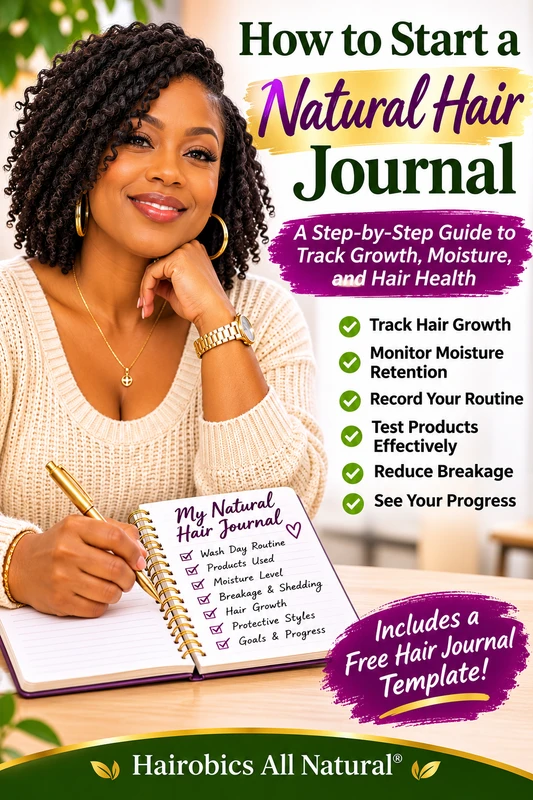
Have you ever wondered why your natural hair seems to grow during certain months but struggles with dryness, breakage, or length retention during others? Perhaps you have purchased countless hair products, experimented with different hairstyles, and changed your hair care routine without knowing which changes actually made a difference.
One of the most effective ways to better understand your hair is to start a natural hair journal.
A natural hair journal allows you to document your hair care routine, monitor your progress, identify potential problems, and discover which products and techniques work best for your unique hair.
Whether you have 3C curls, 4A coils, 4B hair, tightly coiled 4C natural hair, locs, or transitioning hair, keeping a journal can help you make more informed decisions throughout your natural hair journey.
Instead of relying on guesswork, you can develop a personalized hair care routine based on your own experiences.
In this comprehensive guide, you will learn how to start a natural hair journal, what information to record, how to track hair growth, and how to use your observations to maintain healthier, stronger, more manageable natural hair.
What Is a Natural Hair Journal?
A natural hair journal is a personal record of your hair care activities, observations, challenges, and progress.
It provides a place to document everything from your wash-day routine and favorite products to changes in your scalp, hair length, moisture retention, and breakage.
Your journal can be as simple or detailed as you want.
Some people prefer writing in a traditional notebook, while others use a smartphone, spreadsheet, digital planner, or photo album.
The format is less important than your ability to maintain it consistently.
A natural hair journal might include information about:
-
Hair growth and length retention.
-
Hair products and ingredients.
-
Moisture retention.
-
Hair shedding and breakage.
-
Wash-day routines.
-
Protective hairstyles.
-
Scalp comfort.
-
Hair trimming.
-
Weather conditions.
-
Nighttime hair care.
-
Progress photographs.
-
Hair care goals.
-
Product sensitivities.
Over time, these records can help you understand your natural hair in ways that simply following someone else's routine cannot.
Why Should You Keep a Natural Hair Journal?
Natural hair care often involves experimentation. However, experimenting without documenting your results can make it difficult to recognize what is helping your hair.
You may remember that a particular conditioner made your hair feel soft, but forget how long that softness lasted.
You might notice increased breakage without remembering when you started wearing tighter hairstyles.
A hair journal helps connect these experiences.
1. Identify Which Hair Products Actually Work
Many natural hair enthusiasts accumulate shelves filled with shampoos, conditioners, oils, moisturizers, gels, and styling creams.
Unfortunately, using too many products simultaneously can make it difficult to determine which ones are beneficial.
Recording each product and your hair's response helps you make better purchasing decisions.
You might discover that a lightweight moisturizer performs better than a heavy cream, or that your favorite styling product creates buildup after repeated applications.
Before introducing several new products, read our guide on how long you should test a hair product before deciding if it works.
2. Track Hair Growth and Length Retention
Natural hair shrinkage can make it difficult to recognize changes in length.
Your hair may be growing even when it appears to remain the same length.
Recording monthly measurements and taking consistent photographs can help you see progress that might otherwise go unnoticed.
Your journal can also help you identify whether breakage is interfering with your ability to retain length.
3. Understand Your Hair's Moisture Needs
Some people need to refresh their natural hair every few days. Others maintain softness for much longer.
Tracking how your hair feels throughout the week can help you establish a moisturizing schedule based on your actual needs.
This can prevent both insufficient conditioning and excessive product application.
4. Recognize Potential Hair Problems Earlier
Documenting your scalp condition, hairline, ends, and shedding patterns may help you recognize changes before they become more noticeable.
For example, you might discover that your crown becomes increasingly uncomfortable whenever you wear a particular hairstyle.
Recognizing these patterns gives you an opportunity to adjust your routine or seek professional guidance when necessary.
5. Save Money on Hair Products
A natural hair journal can help reduce unnecessary spending.
Instead of repeatedly buying products that promise dramatic results, you can focus on products that have consistently performed well for your hair.
A smaller collection of suitable products may be more effective than an extensive collection that you rarely use.
Step 1: Choose Your Natural Hair Journal Format
The first step is deciding how you want to document your hair journey.
There is no single correct format.
Traditional Notebook
A physical notebook works well for people who enjoy handwriting their observations.
You can create separate sections for product reviews, wash days, photographs, hair measurements, and monthly goals.
A notebook also allows you to design your own tracking system without relying on technology.
Smartphone Notes
Your phone is one of the most convenient tools for maintaining a hair journal.
You can quickly record product applications, take progress pictures, and make observations whenever necessary.
Create a dedicated folder for your natural hair journey so your information remains organized.
Digital Spreadsheet
A spreadsheet is especially useful if you enjoy comparing measurements and tracking long-term progress.
You can create columns for dates, products, hairstyles, moisture scores, breakage, scalp condition, and hair length.
Over several months, your spreadsheet may reveal patterns that are difficult to recognize from memory alone.
Photo Journal
A photo journal emphasizes visual documentation.
This format is useful for monitoring changes in hair length, hairline appearance, density, and overall styling results.
However, photographs work best when combined with written notes that explain what was happening during each period.
Step 2: Establish Your Starting Hair Profile
Before making changes to your routine, document your current hair characteristics.
This becomes your baseline for future comparisons.
Your starting hair profile should describe the hair you have today rather than the hair you hope to have in the future.
Record Your Hair Texture
Identify your general curl or coil pattern.
You may have:
-
Type 3A curls.
-
Type 3B curls.
-
Type 3C curls.
-
Type 4A coils.
-
Type 4B natural hair.
-
Type 4C natural hair.
-
Multiple curl patterns.
Remember that curl pattern alone does not determine which products are right for you.
People with similar-looking hair can have completely different conditioning and styling needs.
Record Your Hair Density
Hair density refers to the number of hair strands growing within a particular scalp area.
You can describe your density as relatively low, medium, or high.
Record whether certain areas appear less dense than others, particularly around your crown, temples, hairline, or nape.
These observations are useful for comparison but cannot diagnose the cause of hair thinning.
Record Your Strand Thickness
Individual hair strands may be fine, medium, or coarse.
Fine strands may become weighed down by heavy products, while some thicker strands tolerate richer conditioning formulas.
Document how your hair responds rather than assuming that all hair with a particular texture requires the same treatment.
Record Your Current Hair Challenges
Write down the concerns you want to address.
Examples include chronic dryness, difficult detangling, frequent breakage, split ends, excessive tangling, scalp discomfort, product buildup, or difficulty retaining length.
If you need help establishing your starting routine, explore our complete natural hair routine for beginners.
Step 3: Set Realistic Natural Hair Goals
Your natural hair journal should have a clear purpose.
Rather than simply writing that you want longer hair, identify specific improvements you would like to achieve.
For example, your goals might include:
-
Maintaining softer hair between wash days.
-
Reducing unnecessary breakage.
-
Improving the condition of your ends.
-
Spending less time detangling.
-
Avoiding hairstyles that pull on your edges.
-
Establishing a consistent cleansing routine.
-
Reducing unnecessary product purchases.
-
Improving overall hair manageability.
-
Retaining more length over the next six months.
Choose goals that focus on healthy hair care habits rather than unrealistic growth promises.
You cannot completely control how quickly your hair follicles produce new hair. Genetics, age, nutrition, hormonal changes, health conditions, and other factors all influence the hair growth cycle.
However, you can improve many of the habits that affect how well you maintain your existing hair.
Step 4: Document Your Wash-Day Routine
Wash day is an excellent opportunity to evaluate your natural hair.
During cleansing, conditioning, and detangling, you have a chance to observe your entire head of hair.
Each wash-day journal entry should include the date, products used, cleansing schedule, conditioning method, detangling experience, styling choice, and overall results.
Pay particular attention to how your hair feels before and after washing.
Was your scalp comfortable before cleansing? Did your hair feel coated? Were your ends more tangled than usual? Did your conditioner provide adequate slip?
These details can help you determine whether your current wash-day routine is meeting your needs.
Example Wash-Day Journal Entry
Date: January 7
Days since last wash: Seven days
Shampoo: Moisturizing shampoo
Conditioner: Hydrating rinse-out conditioner
Detangling time: 25 minutes
Deep conditioning: Yes
Scalp condition: Comfortable
Breakage: A few short strands
Hairstyle: Eight two-strand twists
Overall results: Hair felt soft, manageable, and easy to separate.
Next adjustment: Use slightly less styling cream during the next wash day.
After several entries, compare how your hair responds to different cleansing intervals and conditioning techniques.
For additional guidance, read how often you should wash natural hair.
Step 5: Track Moisture Retention
Moisture retention is an important consideration for people with natural hair, particularly tightly curled and coily textures.
Your hair journal can help you identify how long your strands remain soft and manageable after moisturizing.
Instead of automatically applying products every morning, observe your hair's condition throughout the week.
You can create a simple moisture rating system:
| Score | Hair Condition |
|---|---|
| 1 | Extremely dry and brittle-feeling |
| 2 | Noticeably dry |
| 3 | Moderately soft |
| 4 | Soft and manageable |
| 5 | Excellent softness and flexibility |
This score is subjective, but using the same system consistently makes your observations easier to compare.
Example Weekly Moisture Tracker
| Day | Moisture Score | Observation |
|---|---|---|
| Sunday | 5 | Freshly washed and conditioned |
| Monday | 5 | Hair remains soft |
| Tuesday | 4 | Ends still manageable |
| Wednesday | 3 | Ends beginning to feel dry |
| Thursday | 4 | Light moisturizing refresh |
| Friday | 4 | Hair remains manageable |
| Saturday | 3 | Preparing for wash day |
If your hair consistently begins feeling dry on the fourth day, you may benefit from a targeted refresh around that time.
For a convenient water-based conditioning option, consider our Hairobics Leave-In Treatment, formulated to help improve the softness and manageability of dry natural hair.
Record when you apply it, how much you use, and how your hair feels during the following days.
Step 6: Track Hair Growth Every Month
Many people become frustrated because they expect to see noticeable hair growth every week.
However, measuring your hair too frequently can create unnecessary disappointment and manipulation.
Monthly measurements are generally more useful for recognizing long-term trends.
How to Measure Natural Hair Length
Choose several consistent sections of your hair, such as the front, crown, left side, right side, and nape.
Gently stretch each section without pulling excessively.
Measure from the scalp to the ends using a measuring tape.
Record whether your hair was dry, damp, stretched, or in another condition so future measurements remain comparable.
Avoid repeatedly using heat simply to measure your hair.
Monthly Hair Growth Chart
| Month | Front | Crown | Nape |
|---|---|---|---|
| January | 6 inches | 7 inches | 5 inches |
| February | 6.4 inches | 7.4 inches | 5.3 inches |
| March | 6.7 inches | 7.8 inches | 5.7 inches |
| April | 7 inches | 8 inches | 6 inches |
These measurements are illustrative examples, not guaranteed growth expectations.
Scalp hair commonly grows approximately half an inch per month on average, although individual growth rates vary.
Your recorded length also depends on breakage, trimming, shrinkage, and measurement consistency.
Focus on your individual progress rather than comparing your measurements with other people's results.
Step 7: Take Monthly Hair Progress Pictures
Pictures can provide valuable information that written descriptions cannot always capture.
Take photographs approximately once a month using consistent lighting, camera angles, hairstyles, and distances.
Useful photographs include the front hairline, both temples, crown, back of the head, stretched hair length, and overall natural texture.
Try to avoid filters that change the appearance of your hair.
If your goal is to monitor your hairline, use a similar parting and hairstyle in each photograph. Different amounts of tension or stretching can make the same area appear fuller or thinner.
You may be surprised by how much your hair has changed after six months, even when the differences were difficult to recognize from day to day.
Remember that visible growth is not the only meaningful improvement.
Softer-looking ends, easier styling, and reduced breakage can also represent progress.
Step 8: Monitor Hair Breakage and Shedding
Shedding and breakage are not necessarily the same thing.
Shedding occurs when a hair strand is released from the follicle as part of the hair growth cycle.
Breakage occurs when the hair shaft snaps or fractures.
Your journal can help you recognize changes in these patterns.
Record whether you notice predominantly full-length strands, short broken fragments, split ends, or an unusual amount of hair during detangling.
Also document how long it has been since your last thorough detangling session.
Hair naturally released over several days may remain trapped within curls, coils, braids, or twists until wash day.
You do not need to count every strand. A simple description such as minimal, moderate, or noticeably increased is often sufficient for personal tracking.
Read our detailed guide on shedding versus breakage and how to tell the difference.
If you experience sudden excessive shedding, bald patches, persistent scalp pain, or progressive thinning, consult a dermatologist rather than relying exclusively on your journal or hair products.
Step 9: Create a Hair Product Testing Journal
Introducing a new product is an opportunity to learn something about your hair.
Whenever possible, avoid introducing several unfamiliar products simultaneously.
Changing one product at a time makes it easier to identify which changes may be responsible for your results.
What to Record When Testing Hair Products
Include the product name, date introduced, intended purpose, application method, quantity used, frequency of application, immediate results, and longer-term observations.
Pay attention to softness, manageability, residue, fragrance sensitivity, and scalp comfort.
Example Product Testing Entry
Product: Hairobics Hair & Scalp Booster
Purpose: Additional conditioning for dry hair and scalp areas.
Application: A small amount applied according to product directions.
Areas monitored: Hairline, crown, and dry portions of hair.
Observation period: Four weeks, provided the product remains well tolerated.
Results to evaluate: Softness, shine, scalp comfort, and product buildup.
Our Hairobics Hair & Scalp Booster contains botanical conditioning ingredients, including coconut oil, jojoba oil, rosemary oil, peppermint oil, and vitamin E oil.
Its oil-based formula can complement a water-based moisturizing routine when additional conditioning is needed.
Always review ingredients, perform a patch test, and discontinue products that cause burning, irritation, or an allergic reaction.
A cosmetic conditioning product should not be mistaken for a clinically established hair loss treatment.
Step 10: Track Your Protective Hairstyles
Protective hairstyles can reduce daily manipulation, but their effectiveness depends on how they are installed and maintained.
A hairstyle that creates excessive tension or makes cleansing difficult may introduce new problems.
Your natural hair journal should document your experiences with box braids, knotless braids, twists, cornrows, wigs, crochet braids, buns, and locs when applicable.
Record the installation date, hairstyle duration, scalp comfort, moisturizing routine, cleansing frequency, tension around the hairline, and hair condition after removal.
For example, you may discover that larger, looser twists make your hair easier to maintain than tightly installed braids.
You might also notice that certain styles leave your ends more tangled after removal.
These observations help you choose hairstyles based on how they affect your hair rather than appearance alone.
Step 11: Record Weather and Environmental Changes
Natural hair may respond differently depending on your environment.
Cold weather, dry indoor heating, humid conditions, wind, frequent swimming, and air conditioning can all influence how your hair feels and behaves.
Recording environmental conditions alongside your hair care routine can help explain unexpected changes.
For example, you might notice that your hair feels drier after spending several days in an air-conditioned office.
Alternatively, you may experience increased frizz during humid weather even though your moisturizing routine has not changed.
Instead of immediately replacing your favorite products, consider whether environmental exposure could be contributing to the difference.
Your journal can help you develop seasonal adjustments without completely abandoning a routine that normally works well.
Step 12: Monitor Your Nighttime Hair Care Routine
What happens to your hair while you sleep can affect its condition the following morning.
Frequent friction, uncomfortable hairstyles, and inconsistent nighttime protection may contribute to tangling and unnecessary damage.
Record whether you slept with a satin bonnet, silk scarf, satin pillowcase, loose twists, braids, or another protective arrangement.
The next morning, note how your hair feels.
Is it excessively tangled? Are your ends dry? Did your bonnet come off during the night? Was your hairstyle uncomfortable?
After several weeks, you may recognize which nighttime habits help preserve your hairstyle and reduce morning manipulation.
How to Start a Natural Hair Journal for 4C Hair
A natural hair journal can be particularly useful for people with tightly coiled 4C hair.
Significant shrinkage can make visual length comparisons difficult, while variations in density and strand thickness can influence product preferences.
When journaling about 4C hair, pay particular attention to:
-
Moisture retention between wash days.
-
Single-strand knots.
-
Detangling difficulty.
-
Hair shrinkage.
-
Product buildup.
-
End protection.
-
Styling tension.
-
Breakage during manipulation.
-
Length retention.
Avoid treating shrinkage as evidence of unhealthy hair.
Shrinkage is a normal characteristic of curly and coily hair.
Your journal should help you care for your natural texture rather than encourage excessive stretching or straightening.
If your routine feels overwhelming, our guide on how to build a simple natural hair routine can help you establish manageable habits.
How to Keep a Hair Journal During Your 40s, 50s, and 60s
Hair characteristics can change throughout adulthood.
Some women notice changes in texture, density, moisture needs, or scalp condition during perimenopause, menopause, and later life.
A hair journal can help document these changes and identify whether your existing routine needs adjustment.
Record noticeable differences in strand thickness, shedding, hairline appearance, scalp sensitivity, and styling tolerance.
You can also document significant health or medication changes privately if you believe they may be relevant.
However, a journal cannot determine whether hormonal changes, nutritional deficiencies, medication, or a medical condition is responsible for hair loss.
Bring your documented observations to a healthcare professional if you experience persistent or unexplained changes.
A 30-Day Natural Hair Journal Challenge
If you have never kept a hair journal before, begin with this simple four-week challenge.
Week 1: Establish Your Starting Point
Take baseline photographs, record your current hair length, identify your main concerns, list your existing products, and document your normal wash-day routine.
Avoid making unnecessary changes during this first week.
Week 2: Track Moisture and Scalp Comfort
Observe how your hair feels throughout the week.
Record when your ends become dry, when your scalp becomes uncomfortable, and whether refreshing your hair improves manageability.
Week 3: Make One Thoughtful Adjustment
Choose one change based on your observations.
Perhaps you need smaller detangling sections, less styling product, better nighttime protection, or a more appropriate cleansing schedule.
Keep other parts of your routine relatively consistent.
Week 4: Review Your Results
Compare your experiences with the first week.
Did your hair become easier to detangle? Did you experience less noticeable breakage? Did your scalp remain comfortable? Did your routine become easier to maintain?
You may not see dramatic length changes after 30 days, but you can develop a much better understanding of your hair.
Free Natural Hair Journal Template
Copy this template into your notebook or smartphone and complete it whenever you perform a significant hair care activity.
Date:
Current hairstyle:
Days since last wash:
Products used:
Moisture score (1–5):
Scalp comfort score (1–5):
Hair softness score (1–5):
Detangling difficulty:
Amount of noticeable breakage:
Shedding observations:
Condition of ends:
Hairline and crown observations:
Weather or environmental conditions:
Nighttime protection:
What worked well today:
What did not work:
Product or technique to adjust:
Next wash-day goal:
Monthly Hair Journal Review
At the end of each month, answer the following questions:
-
What improvements have I noticed?
-
Which products performed consistently well?
-
Which hairstyles were easiest to maintain?
-
Did I experience increased dryness or breakage?
-
Did my scalp remain comfortable?
-
Did my hair retain length?
-
Which habits should I continue?
-
What is one change I should make next month?
These questions help turn your journal into a practical tool rather than simply a collection of observations.
Common Natural Hair Journaling Mistakes to Avoid
One of the biggest mistakes is trying to document too much information every day.
Your journal should make natural hair care easier, not become another stressful responsibility.
Other common mistakes include constantly measuring hair length, changing multiple products simultaneously, expecting immediate results, comparing progress with influencers, ignoring scalp irritation, and focusing exclusively on hair growth.
Avoid assuming that every change in your hair is caused by the last product you applied.
Hair condition can be influenced by several overlapping factors.
Also, do not pressure yourself to maintain a perfect routine. Missing a journal entry does not erase your progress.
If wash day is already time-consuming, consider our guide on how to reduce natural hair wash-day time to develop a more manageable schedule.
Frequently Asked Questions About Natural Hair Journals
How often should I write in my natural hair journal?
Two or three times per week and after wash day is a reasonable starting point. Daily entries are optional.
The most important factor is documenting meaningful changes consistently enough to recognize patterns.
How long should I keep a natural hair journal?
Start with 30 days, but consider continuing for three to six months or longer.
Longer tracking periods are generally more useful for evaluating length retention and seasonal changes.
Can a hair journal make my hair grow faster?
A journal does not directly accelerate hair growth. However, it can help you identify habits associated with less unnecessary breakage and better maintenance of your existing hair.
Should I measure my natural hair every week?
Monthly measurements are generally sufficient. Frequent measuring can introduce unnecessary manipulation and make normal measurement variations seem more significant than they are.
Can I keep a natural hair journal on my phone?
Absolutely. Your smartphone can store photographs, product reviews, measurements, reminders, and weekly observations in one convenient location.
Should I track every hair product I use?
Record products that are part of your regular routine, especially unfamiliar products or those you are actively evaluating.
Include the approximate quantity and frequency of application whenever practical.
Is a natural hair journal helpful for thinning hair?
A journal can help document changes in density, shedding, and scalp appearance. These observations may also be useful during a dermatology appointment.
It should not replace professional evaluation of persistent or unexplained hair loss.
What if my hair is not growing according to my journal?
Review your measurement technique, trimming schedule, breakage, and styling habits.
If you notice progressive hair loss, significant shedding, or changes in scalp condition, consult a qualified healthcare professional.
Can men keep a natural hair journal?
Yes. Natural hair journals can help men maintain waves, curls, locs, short natural hairstyles, and scalp care routines.
Do I need expensive hair products to start a hair journal?
No. You can begin with the products you already own.
The purpose of journaling is to understand your hair's needs and make informed choices rather than purchase unnecessary products.
Final Thoughts: Your Natural Hair Journey Is Worth Documenting
Starting a natural hair journal is a simple and affordable way to become more knowledgeable about your hair.
Instead of constantly searching for the next miracle product or copying someone else's routine, you can focus on discovering what works for your individual needs.
Document your wash days, track moisture retention, monitor your scalp, photograph your progress, and evaluate your products thoughtfully.
Celebrate improvements in softness, manageability, scalp comfort, and length retention, even when your hair growth journey takes longer than expected.
At Hairobics All Natural, we believe that beautiful, healthy-looking natural hair begins with consistent care, suitable products, gentle handling, and a better understanding of your own hair.
You do not need to achieve perfect hair overnight.
Every positive adjustment, every successful wash day, and every improvement in your routine is a meaningful step forward.
Start your natural hair journal today and give yourself the opportunity to discover what your hair truly needs to thrive.
Your hair. Your routine. Your journey. Your progress.
Explore natural hair care products at HairobicsAllNatural.com and start building a routine that works for you.