Hair coming out in your hands can be alarming—especially when you’re trying to grow longer, thicker, healthier hair. You may notice strands in your comb, on the bathroom floor, wrapped around your fingers during wash day, or sitting in the sink after styling.
But before assuming that something is wrong, there’s an important question to answer:
Is your hair shedding, or is it breaking?
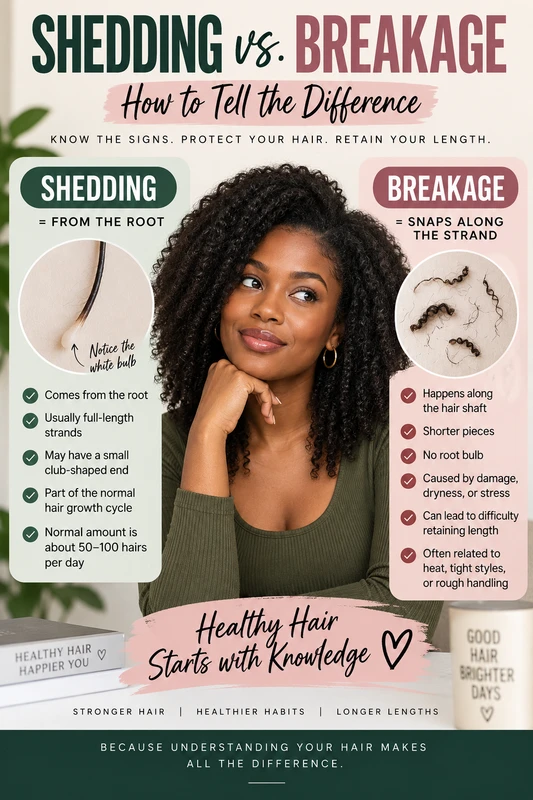
Although shedding and breakage can look similar at first, they are two very different processes. Hair shedding is a normal part of the hair growth cycle. Breakage, on the other hand, happens when a strand becomes damaged or weakened and snaps somewhere along the hair shaft.
Knowing the difference can help you determine whether your hair is simply going through its natural cycle or whether your hair-care routine needs some attention.
For people with natural, curly, coily, or Afro-textured hair, the difference can sometimes be especially difficult to recognize. Shed hairs may remain trapped within curls, braids, twists, or locs instead of falling away immediately. This can make a normal amount of shedding look excessive when you finally wash or detangle your hair.
In this complete guide, we'll explain shedding vs. breakage, how to tell them apart, what causes each one, and what you can do to keep your hair stronger and healthier.
What Is Hair Shedding?
Hair shedding occurs when a complete strand of hair naturally separates from the scalp.
Your hair does not grow continuously forever. Every strand goes through a growth cycle consisting of different phases.
These include the:
- Anagen, or growing phase
- Catagen, or transitional phase
- Telogen, or resting phase
- Exogen, or shedding phase
Eventually, older hairs are released so that the follicle can continue through its natural cycle.
This means that seeing some hair in your brush or shower does not automatically mean you're experiencing hair loss.
Some shedding is completely normal.
The key difference is that a shed hair has separated at or near the root rather than snapping somewhere along its length.
What Is Hair Breakage?
Hair breakage occurs when a strand physically snaps.
Instead of the entire strand naturally releasing from the follicle, part of the hair breaks away because the hair shaft can no longer withstand the stress being placed on it.
For example, imagine that you have 12-inch-long hair.
If the entire 12-inch strand comes out from the root, you're likely looking at shedding.
But if you notice a large number of pieces that are 1, 2, 4, or 6 inches long, some of those hairs may be breaking.
Breakage can happen anywhere along the strand.
It is especially common around areas exposed to repeated manipulation or friction, including the:
- Hairline
- Crown
- Nape
- Ends
- Areas where ponytail holders are placed
- Sections repeatedly brushed or combed
Unlike normal shedding, significant breakage can make it difficult to retain length.
Your hair may still be growing from the scalp, but if the ends are breaking at a similar rate, it can appear that your hair isn't growing.
Shedding vs. Breakage: The Biggest Difference
The easiest way to understand shedding vs. breakage is this:
Shedding happens from the root. Breakage happens along the hair shaft.
A shed strand is generally a full-length strand that has completed part of its natural growth cycle.
A broken strand is a fragment.
This distinction is important because the solutions are different.
If you're experiencing ordinary shedding, you may not need to change anything.
If you're experiencing significant breakage, you may need to examine your moisture routine, detangling technique, heat use, hairstyles, chemical treatments, or overall handling of your hair.
How to Tell If Your Hair Is Shedding or Breaking
If you notice hair coming out, don't immediately throw it away.
Take a closer look at several strands.
You can learn a surprising amount by examining them.
1. Look at the Length of the Hair
Start by comparing the loose strands with the approximate length of your hair.
If most of the strands are roughly full length, shedding is more likely.
If you're seeing lots of short pieces of different lengths, breakage may be occurring.
For example, someone with shoulder-length hair may find long strands during detangling.
That's not necessarily concerning.
However, if the sink is covered with tiny one- to three-inch pieces, those strands obviously didn't fall from the root at that length unless those areas of the hair were already very short.
They likely snapped.
2. Examine the Root End
A naturally shed hair may have a small, pale or club-shaped structure at one end.
People sometimes refer to this as a "white bulb."
Seeing this does not mean that your entire hair follicle has fallen out.
The follicle remains in the scalp.
The appearance simply reflects the end of the shed hair.
Broken hair generally won't have this same club-shaped root end because the strand snapped somewhere above the scalp.
However, don't depend on the bulb test alone.
It can be difficult to see on very fine hair, light-colored hair, or strands covered in hair products.
Use several clues together.
3. Look for Short Pieces
Lots of tiny pieces are one of the strongest visual clues of breakage.
Check your:
- Bathroom counter
- Sink
- Pillowcase
- Shirt
- Comb
- Brush
- Shower
- Styling area
If you're constantly finding small pieces of hair, your strands may be snapping.
This is particularly important for natural hair because broken pieces can easily blend into curls and go unnoticed.
4. Examine Your Ends
Your ends are the oldest portion of your hair.
Because they have been exposed to months or even years of washing, styling, weather, friction, and manipulation, they're naturally more vulnerable.
Signs of damage may include:
- Split ends
- Rough ends
- Knots
- Frayed strands
- Thin or see-through ends
- Ends that constantly snap
- Multiple splits on individual strands
If your ends appear significantly damaged, at least some of the hair you're losing may be breakage.
5. Look at Your Overall Length
Another clue is what your hair is doing over several months.
If your roots are clearly growing but your overall length barely changes, breakage may be interfering with length retention.
For example, you might notice two inches of new growth after several months while your hair remains almost exactly the same length.
Your hair is growing.
You're simply not keeping all the length you're producing.
This is why hair growth and length retention aren't exactly the same thing.
Quick Shedding vs. Breakage Comparison
Shedding
Usually:
- Comes from the root
- Produces mostly full-length strands
- May have a small club-shaped end
- Is part of the normal hair cycle
- Can vary from person to person
- May appear greater after protective styles
- Doesn't necessarily indicate damaged hair
Breakage
Usually:
- Happens along the hair shaft
- Produces shorter pieces
- Can occur at different lengths
- Is associated with weakened or stressed strands
- Can reduce length retention
- May create uneven areas
- Is often influenced by hair-care practices
How Much Hair Shedding Is Normal?
You'll often hear that losing around 50 to 100 hairs per day can be normal.
However, don't become overly focused on counting individual strands.
The amount of hair a person sheds varies.
More importantly, curly and coily hair behaves differently from straight hair after it sheds.
With straight hair, loose strands may fall away throughout the day.
With tightly curled or coily hair, shed strands can become trapped among neighboring hairs.
They may remain there until you:
- Shampoo
- Condition
- Detangle
- Comb
- Brush
- Take down a hairstyle
As a result, someone who detangles once a week may see several days' worth of shed hair all at once.
That can look like a lot of hair.
Why You May See More Shedding After Braids
This is one of the biggest sources of confusion for people wearing protective hairstyles.
Suppose you keep your braids installed for six weeks.
During those six weeks, your scalp continues going through its normal hair cycle.
Some hairs naturally shed.
But because those strands are incorporated into the braids, they can't simply fall onto the floor.
They remain trapped inside the hairstyle.
When you finally remove your braids, you may see a surprisingly large amount of loose hair.
That doesn't automatically mean your braids destroyed your hair.
You may simply be seeing weeks of accumulated shedding.
However, braids can also contribute to breakage when they're too tight, too heavy, left in too long, or removed aggressively.
That's why examining the strands themselves is helpful.
Long, complete strands suggest shedding.
Numerous short pieces suggest breakage.
You can experience both at the same time.
Can You Have Shedding and Breakage at the Same Time?
Absolutely.
In fact, many people do.
Some strands may be naturally shedding from the root while others are snapping because of dryness, heat, manipulation, or mechanical damage.
This is why looking at one strand isn't enough.
Examine a collection of hairs.
If you see long strands mixed with many tiny pieces, you may have a combination of normal shedding and breakage.
Your goal isn't necessarily to eliminate every hair that comes out.
That's impossible.
Instead, focus on reducing preventable breakage while monitoring any unusual changes in shedding.
What Causes Hair Breakage?
There isn't one universal cause of breakage.
Usually, breakage develops because the hair shaft has been weakened, repeatedly stressed, or both.
Here are some of the most common causes.
1. Dry Hair
Dryness is one of the most common problems associated with breakage, particularly for curly and coily textures.
The natural oils produced by your scalp have a harder time traveling down highly curved strands.
This can leave the mid-lengths and ends more vulnerable to dryness.
Dry hair tends to have less flexibility.
When pulled, combed, or manipulated, it may snap more easily.
A consistent moisture routine can therefore play an important role in maintaining healthy natural hair.
2. Rough Detangling
Detangling should remove knots and shed hairs—not rip through healthy strands.
Aggressive detangling can create unnecessary mechanical damage.
Common mistakes include:
- Starting at the roots
- Pulling through knots
- Detangling extremely dry hair
- Using inappropriate tools
- Working with sections that are too large
- Trying to detangle too quickly
For many natural-hair textures, working in sections and starting near the ends is gentler.
Gradually move upward as tangles are released.
3. Excessive Heat
Flat irons, curling irons, blow dryers, and hot combs can all be useful styling tools.
But repeated high-temperature styling can weaken hair over time.
Signs of heat-related damage may include:
- Increased breakage
- Rough texture
- Excessive dryness
- Split ends
- Curls that don't return normally after washing
- Sections that remain unusually straight
You don't necessarily have to avoid heat forever.
The goal is to use it thoughtfully.
Limit unnecessary passes, avoid temperatures higher than needed, and use an appropriate heat protectant.
4. Tight Hairstyles
A hairstyle doesn't have to hurt to look good.
Styles that repeatedly pull on the same areas can place unnecessary stress on the hair.
Pay particular attention to the:
- Edges
- Temples
- Nape
- Hairline
Braids, ponytails, buns, extensions, and other styles shouldn't cause persistent pain, headaches, bumps, or extreme scalp tightness.
If a protective style is damaging your hair, it isn't truly protective.
5. Over-Manipulation
Sometimes the problem isn't a specific product.
It's simply too much handling.
Constantly:
- Brushing
- Combing
- Restyling
- Separating
- Twisting
- Pulling
- Smoothing
can increase mechanical stress.
Natural hair often benefits from periods where it can simply remain in a low-manipulation style.
6. Chemical Damage
Relaxers, permanent color, bleaching, and other chemical processes alter the hair structure.
When these processes are performed incorrectly, overlapped excessively, or combined with other damaging practices, the hair may become significantly weaker.
Chemically processed hair may require extra attention to conditioning, moisture, protein balance, and gentle handling.
7. Friction
Breakage doesn't only happen while you're styling your hair.
It can happen while you're sleeping.
Cotton pillowcases, rough fabrics, hats, collars, and repeated rubbing against clothing can create friction.
This is particularly important for people with longer hair.
Hair rubbing against sweaters, jackets, scarves, and shirt collars day after day can gradually damage the ends.
Using satin or silk nighttime accessories can help reduce unnecessary friction while you sleep.
8. Neglected Ends
If you're trying to grow long hair, trimming may seem counterproductive.
But severely split ends don't repair themselves permanently.
A split can continue traveling farther up the strand.
Removing damaged ends when necessary can improve the overall appearance and manageability of your hair.
9. Poor Moisture-Protein Balance
Hair needs both moisture and structural strength.
Too little moisture may leave strands dry, rough, and prone to snapping.
On the other hand, using strengthening or protein-heavy products more often than your hair needs may leave some hair types feeling stiff or brittle.
Your routine should be based on how your hair responds rather than blindly following a fixed schedule.
What Causes Increased Hair Shedding?
Unlike breakage, shedding originates at the scalp and follicle level.
Changes in shedding can occur for many reasons.
Some are temporary, while others deserve professional evaluation.
Possible factors include:
- Normal changes in the hair cycle
- Stress
- Hormonal changes
- Pregnancy or postpartum changes
- Illness
- Fever
- Significant weight changes
- Nutritional deficiencies
- Certain medications
- Changes in thyroid function
- Scalp conditions
- Genetics
Because unusual shedding can sometimes be related to health conditions, it shouldn't automatically be treated as a cosmetic problem.
If shedding becomes sudden, severe, persistent, or is accompanied by noticeable thinning or bald patches, consider talking with a dermatologist or qualified healthcare professional.
Shedding vs. Hair Loss
It's also important to distinguish normal shedding from actual hair loss.
Shedding is part of the natural hair cycle.
Hair loss refers more broadly to situations where hair density decreases or hair stops growing normally in certain areas.
Warning signs may include:
- Widening part
- Receding hairline
- Bald patches
- Visible scalp that wasn't previously visible
- Significant reduction in ponytail thickness
- Persistent excessive shedding
- Thinning concentrated in specific areas
If you notice these changes, getting an accurate diagnosis is more important than simply buying another hair product.
Why Natural Hair Can Look Like It's Breaking More
Natural hair has unique characteristics that can make breakage more noticeable—or harder to interpret.
Curly and coily strands contain bends and curves.
Those bends can create points where the strand is more vulnerable to mechanical stress.
Natural hair also experiences shrinkage.
A broken strand that looks two inches long while curled could actually be considerably longer when stretched.
This makes visual inspection slightly more complicated.
Another issue is single-strand knots.
Highly textured strands can curl around themselves and create tiny knots.
If those knots become caught during combing, the strand may snap.
Gentle detangling is especially important.
How to Reduce Hair Breakage
Once you've determined that breakage is the main problem, your goal should be to reduce the amount of unnecessary stress placed on your strands.
Here are several strategies.
1. Improve Your Moisture Routine
Dry hair generally needs more flexibility and lubrication.
A simple routine may include:
- Cleansing your scalp and hair as needed.
- Applying conditioner.
- Detangling gently.
- Using a leave-in product if appropriate.
- Applying moisturizing products based on your hair's needs.
- Protecting the hair between wash days.
You don't necessarily need ten different products.
Consistency matters more than complexity.
2. Deep Condition When Needed
Deep conditioning can be especially useful when hair feels dry, rough, or difficult to manage.
Focus the product primarily on the lengths and ends unless the directions specify scalp application.
Use the treatment according to the manufacturer's instructions.
More time isn't always better.
3. Detangle in Sections
Instead of trying to detangle your entire head at once, divide the hair into manageable sections.
For example:
- 4 sections for loose curls
- 6 sections for thicker hair
- 8 or more sections for very dense hair
The exact number doesn't matter.
Use enough sections to maintain control.
Work from the ends toward the roots.
If you hit a difficult knot, don't repeatedly rake through it.
Slow down and separate it carefully.
4. Keep Your Ends Protected
The ends are the oldest part of your hair.
Treat them accordingly.
Try reducing constant exposure to:
- Rough clothing
- Dry air
- Excessive heat
- Frequent brushing
- Repeated manipulation
Styles that keep the ends tucked away can help some people retain length, provided the style itself isn't tight or damaging.
5. Protect Your Hair at Night
Nighttime protection is one of the easiest habits to add to your routine.
Consider using:
- Satin bonnet
- Satin scarf
- Silk scarf
- Satin pillowcase
- Silk pillowcase
You don't necessarily need all of them.
The goal is simply to reduce friction while keeping the hair contained comfortably.
6. Reduce Heat Frequency
If your hair breaks frequently and you use heat every week, try reducing the frequency temporarily.
Observe what happens.
If breakage decreases, heat may have been contributing to the problem.
When you return to heat styling, consider using lower temperatures and fewer passes.
7. Rotate Tight Hairstyles
Wearing the same tight ponytail or bun in exactly the same location can repeatedly stress the same strands.
Change the position of your styles.
And give your hairline breaks from high-tension hairstyles.
Your edges are particularly delicate.
8. Trim Damaged Ends
Trimming doesn't make hair grow faster from the scalp.
But removing severely damaged ends can help prevent splits from worsening and can make hair easier to detangle.
You don't need to trim according to someone else's calendar.
Watch your own ends.
How to Reduce Unnecessary Shedding
Normal shedding cannot—and should not—be completely stopped.
Those strands have completed part of their natural cycle.
However, supporting overall hair and scalp health is still worthwhile.
Focus on:
- Eating a balanced diet
- Managing your hair gently
- Keeping the scalp clean
- Avoiding excessive tension
- Getting adequate rest
- Managing stress where possible
- Addressing persistent scalp problems
- Seeking medical advice for unexplained changes
Be cautious of products promising to "stop shedding instantly."
If hair is shedding because of an underlying health condition or physiological change, topical products alone may not address the cause.
Why Your Hair May Look Like It's Not Growing
One of the biggest misconceptions about natural hair is that hair "isn't growing."
In many cases, growth is occurring normally at the scalp.
The problem is length retention.
Imagine your hair grows several inches over the course of a year.
If the ends repeatedly break during that same period, you may only retain a fraction of that new length.
Your roots grow.
Your ends break.
Your overall length barely changes.
This creates the illusion that your hair isn't growing.
If you notice new growth but no increase in length, focus less on trying to "force" faster growth and more on preserving the hair you already have.
A Simple Breakage Test for Wash Day
Your next wash day is a great opportunity to examine what's happening.
Before throwing away the hair from your detangling brush, take a look at it.
Ask yourself:
Are most strands long or short?
Mostly long strands may indicate shedding.
Lots of short fragments suggest breakage.
Do the strands look similar in length?
Shed hairs often reflect the overall length of the hair in that area.
Broken hairs can be dramatically different lengths.
Are my ends split or frayed?
Damaged ends increase the likelihood of breakage.
Does my hair feel dry and brittle?
That can be another clue.
Have I recently taken down braids or another long-term style?
If so, accumulated shed hair may explain why you're seeing more loose strands than usual.
What About Hair in the Shower?
Seeing a large clump of hair in the shower can be frightening.
But context matters.
Ask yourself:
When was the last time you detangled?
Someone who detangles every day will typically see fewer accumulated shed hairs during each session than someone who detangles every seven to ten days.
Likewise, someone removing a six-week protective style may see far more hair at once.
Look at the strands rather than judging only the size of the hairball.
A pile of long strands is very different from a pile of tiny fragments.
What About Hair on Your Pillow?
Small pieces of hair on your pillowcase can sometimes indicate breakage caused by dryness or friction.
If this happens frequently, examine your nighttime routine.
Ask yourself:
- Do I sleep directly on cotton?
- Is my hair rubbing against rough bedding?
- Am I sleeping with my hair loose and tangled?
- Is my bonnet extremely tight?
- Are my ends dry before bed?
Switching to satin or silk and putting the hair into a comfortable nighttime style may reduce friction.
Why Your Edges May Be Breaking
The hairline is one of the most vulnerable areas.
Edge breakage may be associated with:
- Tight braids
- Tight ponytails
- Wig adhesive practices
- Excessive brushing
- Frequent edge-control use combined with manipulation
- Tight headbands
- Bonnets with overly tight bands
- Repeated tension from the same hairstyles
If your edges are becoming shorter, thinner, or more sparse, reduce tension immediately.
Persistent hairline loss deserves professional evaluation because some forms of hair loss can become more difficult to reverse over time.
Shedding After Taking Down Protective Styles
When removing braids, twists, or other protective styles, patience is critical.
Do not immediately shampoo heavily tangled hair.
First, carefully separate the hair and remove accumulated shed strands.
Use your fingers or an appropriate detangling tool along with a product that provides enough slip.
Work slowly.
Shed hairs can become wrapped around healthy strands.
If you aggressively comb through them, normal shedding can turn into unnecessary breakage.
A Healthy Natural Hair Routine for Reducing Breakage
Your routine doesn't have to be complicated.
Here's a basic framework:
Wash Day
Cleanse the scalp and hair thoroughly enough to remove buildup.
Condition
Apply conditioner to improve softness and manageability.
Detangle
Work in sections from ends toward roots.
Moisturize
Use products appropriate for your hair's current needs.
Style
Choose a hairstyle that doesn't create unnecessary tension.
Nighttime Protection
Protect the hair with satin or silk.
Between Wash Days
Refresh moisture when needed without constantly manipulating the hair.
Periodically
Inspect your ends and trim significant damage when necessary.
Simple routines performed consistently often work better than complicated routines that change every week.
When Should You Be Concerned About Shedding?
Normal shedding shouldn't create obvious bald spots or dramatic changes in density.
Consider speaking with a dermatologist or healthcare professional if you experience:
- Sudden heavy shedding
- Bald patches
- Noticeable scalp exposure
- Rapidly widening part
- Persistent scalp pain
- Burning or severe itching
- Significant hairline recession
- Shedding that continues at an unusual level
- Hair changes following illness or medication
- Other unexplained physical symptoms
A professional can help determine whether the problem involves the hair shaft, scalp, follicles, nutrition, hormones, medication, or another underlying factor.
Frequently Asked Questions About Shedding vs. Breakage
How can I tell if my hair is shedding or breaking?
Examine several loose strands. Shed hairs are generally closer to your full hair length and may have a small club-shaped root end. Broken hairs are often shorter pieces without a root end.
Is shedding normal?
Yes. Some shedding is a normal part of the hair growth cycle.
Is breakage normal?
Occasional breakage can happen, especially with long or textured hair. However, frequent or severe breakage can indicate that the hair is being damaged or stressed.
Why am I seeing so much hair after taking out braids?
Shed hairs can remain trapped inside braids for weeks. When you remove the style, all those accumulated strands may come out during one detangling session. Some breakage can also occur, so inspect the length and condition of the strands.
Does a white bulb mean my hair won't grow back?
No. The small club-shaped material at the end of a naturally shed strand doesn't mean you've pulled out the entire follicle.
Can dry hair cause breakage?
Dryness can make hair less flexible and more vulnerable to snapping during manipulation.
Can protective styles cause breakage?
Yes. Protective styles can cause damage when they're too tight, too heavy, installed improperly, maintained poorly, or removed aggressively.
Why do I have short hairs around my head?
Not every short hair is breakage.
Some may be new growth.
New hairs generally grow outward from the scalp and often have tapered ends.
Broken hairs may appear at inconsistent lengths and may have blunt, split, or damaged ends.
Can too much protein cause breakage?
Hair products containing protein can be useful for some hair types and situations, but using strengthening treatments more frequently than your hair needs may leave some hair feeling stiff or brittle. Balance strengthening treatments with adequate conditioning and moisture.
Why does my natural hair break at the ends?
Your ends are the oldest and most weathered part of your hair. Dryness, friction, split ends, manipulation, heat, and inadequate protection can all contribute to end breakage.
Shedding vs. Breakage: Final Takeaway
Seeing hair in your hands doesn't automatically mean you're losing your hair.
The most important thing is identifying where the strand separated.
Remember:
Shedding = hair releases from the root.
Breakage = hair snaps somewhere along the strand.
Long, complete strands are more consistent with shedding.
Short pieces, uneven fragments, split ends, and difficulty retaining length point more strongly toward breakage.
For natural, curly, and coily hair, don't forget that shed hairs can remain trapped for days or weeks. That's why wash day—or taking down braids—can sometimes produce a surprisingly large amount of hair.
Instead of focusing only on how much hair you see, examine what those strands actually look like.
If breakage is the problem, concentrate on moisture, gentle detangling, nighttime protection, healthy ends, lower manipulation, and avoiding excessive tension and heat.
If shedding suddenly becomes much heavier than usual, persists, or leads to visible thinning or bald areas, consider consulting a dermatologist or healthcare professional.
Healthy hair isn't about never losing a strand.
It's about understanding your hair, recognizing meaningful changes, and creating a routine that helps you protect the strands you're growing and retain as much healthy length as possible.