Finding the right hair products can be one of the most frustrating parts of maintaining natural hair. With countless shampoos, conditioners, hair oils, scalp treatments, moisturizers, and hair growth products available, it can be difficult to determine which products are actually helping your hair.
Many people purchase a new hair product, use it for a few days, and immediately switch to something else when they don't see dramatic results. Others continue using products for months even when their hair shows signs that the formula isn't suitable for them.
So, how long should you test a hair product before deciding if it works?
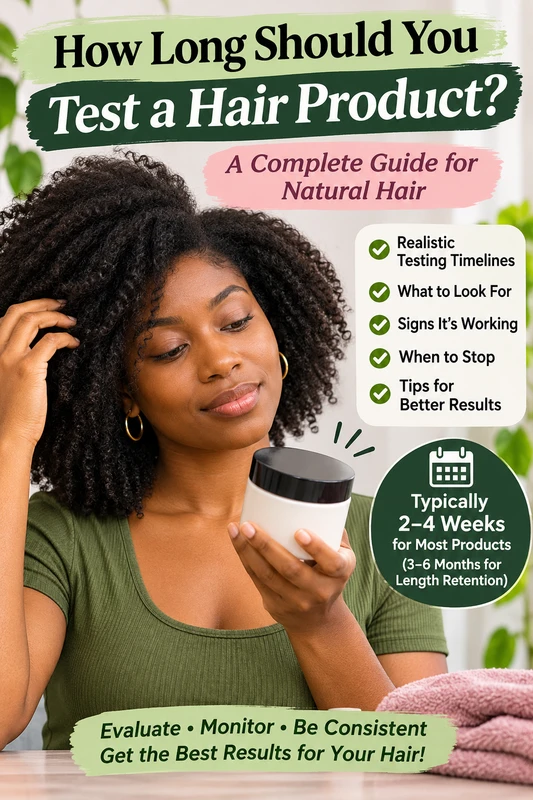
Most everyday hair care products should be evaluated over two to four weeks of consistent use. However, products intended to support length retention and improve overall hair condition may require several months of observation.
The appropriate testing period depends on the product's purpose, your hair texture, scalp condition, application method, existing damage, and overall natural hair care routine.
Whether you have 3C curls, 4A natural hair, 4B coils, 4C hair, braids, locs, or transitioning hair, understanding how to evaluate products can help you save money, reduce unnecessary experimentation, and develop a more effective hair care routine.
How Long Does It Take for Hair Products to Work?
Not all hair products work in the same way. Some provide immediate cosmetic benefits, while others are best evaluated over an extended period.
For example, a moisturizing conditioner may make your hair feel softer immediately. A routine designed to reduce breakage may require several weeks before you notice a meaningful difference.
Here are suggested testing periods for different hair products.
| Hair Product | Suggested Testing Period |
|---|---|
| Shampoo | 1–3 washes |
| Rinse-out conditioner | 1–3 washes |
| Deep conditioner | 2–4 treatments |
| Leave-in conditioner | 2–4 weeks |
| Hair moisturizer | 2–4 weeks |
| Hair oil | 2–4 weeks |
| Styling cream | 1–3 styling sessions |
| Scalp conditioning treatment | 2–4 weeks |
| Breakage prevention routine | 4–8 weeks |
| Hair length retention routine | 3–6 months |
These are general observation periods, not guaranteed timelines for results.
You should never continue using a product that causes significant irritation simply because you haven't completed the recommended testing period.
Why You Shouldn't Give Up on Hair Products Too Quickly
One of the biggest mistakes people make when caring for natural hair is constantly switching products.
A new product may initially perform differently from your previous shampoo, conditioner, or moisturizer. You may also need to experiment with the appropriate amount and application technique.
Your existing routine can influence how a new product performs.
Factors that may affect your initial results include:
-
Previous product buildup
-
Hair porosity
-
Existing heat damage
-
Chemical processing
-
Environmental conditions
-
Incorrect product application
-
Excessive styling
-
Inconsistent use
-
Hair strand thickness
-
Insufficient conditioning
Giving a well-tolerated product a reasonable testing period allows you to observe how it performs under different circumstances and throughout multiple wash cycles.
For help determining when adjustments are necessary, read our guide on How Often Should You Change Your Hair Routine?.
What Happens During the First Week of Testing a Hair Product?
The first week is primarily about understanding how your hair and scalp respond to the new formula.
You may notice immediate differences in softness, shine, manageability, or styling performance. However, it is generally too early to evaluate changes in hair growth or long-term length retention.
During the first week, pay attention to the following characteristics.
Hair Softness
Does your hair feel softer after application?
A suitable conditioning product may improve the way your strands feel and reduce friction during handling.
Manageability
Is your hair easier to separate, detangle, and style?
Improved manageability can reduce the amount of pulling and manipulation required during your daily routine.
Scalp Comfort
Does your scalp feel comfortable after application?
Watch for persistent itching, redness, burning, swelling, or unusual sensitivity.
These symptoms may indicate irritation or an allergic reaction.
Product Residue
Does the product leave your hair feeling excessively greasy, sticky, heavy, or coated?
If so, you may be applying too much, or the formula may not be suitable for your hair.
Moisture Retention
Observe how your hair feels several hours after application and again the following day.
A product that feels wonderful immediately but consistently leaves your hair difficult to manage later may require an adjustment in application or product selection.
What Happens After Two Weeks of Using a Hair Product?
After approximately two weeks, you may begin noticing patterns in how your hair responds.
Rather than judging the product based on one successful wash day, you can evaluate its performance across multiple applications.
Ask yourself:
-
Does my hair remain soft between wash days?
-
Is detangling becoming easier?
-
Am I experiencing less unnecessary breakage?
-
Does my scalp remain comfortable?
-
Is my hair easier to style?
-
Do I need to apply less product throughout the week?
-
Is the product creating excessive buildup?
These observations are more useful than simply judging whether your hair looks shinier.
Natural hair does not need to appear perfectly smooth or glossy to be healthy.
Understanding your hair's individual characteristics is important when evaluating results.
What Happens After 30 Days of Consistent Hair Care?
A 30-day testing period provides a useful opportunity to evaluate most everyday conditioning and moisturizing products.
By this point, you may have completed several wash cycles and used the product under different environmental and styling conditions.
Possible improvements may include:
-
Softer-feeling strands
-
Improved styling performance
-
Easier detangling
-
Better moisture management
-
Less excessive friction
-
More manageable ends
-
Reduced unnecessary breakage
-
Improved scalp comfort
However, significant changes in hair length and density generally cannot be accurately assessed within 30 days.
If your hair consistently feels worse after using a particular product, there is no benefit in continuing simply to complete the month.
Read our article on Signs Your Hair Routine Isn't Working to learn how to recognize common problems.
How Long Should You Test a Hair Growth Product?
Hair growth is a gradual biological process.
On average, scalp hair grows approximately half an inch per month, although individual growth rates vary considerably.
Genetics, age, nutrition, hormones, medical conditions, medications, and follicle health can all influence hair growth.
If you are testing a cosmetic hair product intended to support healthier-looking hair and length retention, consider observing your routine for approximately three to six months, provided the product is well tolerated.
After 30 Days
You may notice changes in softness, conditioning, manageability, and scalp comfort.
After 60 Days
You may have a better understanding of whether your routine is helping reduce unnecessary breakage during washing and styling.
After 90 Days
Comparing progress photographs and stretched hair measurements may reveal changes in retained length.
After Six Months
You can assess whether your overall routine is helping you maintain healthier-looking ends, improve manageability, and retain more of the hair you naturally grow.
Remember that cosmetic hair products cannot guarantee new hair growth or reverse every form of hair loss.
If you experience sudden shedding, bald patches, progressive crown thinning, or a receding hairline, consult a dermatologist rather than delaying evaluation while testing cosmetic products.
Testing Hairobics Hair & Scalp Booster
If you are looking for an oil-based conditioning product to incorporate into your natural hair routine, consider the Hairobics Hair & Scalp Booster.
This botanical formula contains a combination of plant oils and other conditioning ingredients, including coconut oil, olive oil, jojoba oil, wheat germ oil, rosemary oil, peppermint oil, and vitamin E oil.
The Booster can complement a consistent hair and scalp care routine.
When introducing it into your regimen, follow the product directions, begin with a small amount, and monitor your scalp's response.
Over the following weeks, evaluate your hair's softness, manageability, and overall condition.
Avoid excessive application. Applying more product does not necessarily produce better results.
Consistency, gentle styling, appropriate cleansing, and realistic expectations remain important components of maintaining natural hair.
How Long Should You Test a Leave-In Conditioner?
A leave-in conditioner can often provide noticeable cosmetic benefits after the first application.
However, testing it over two to four weeks can help you determine whether it consistently meets your hair's conditioning needs.
A suitable leave-in product may help:
-
Improve softness
-
Reduce friction between strands
-
Make styling easier
-
Improve manageability
-
Condition dry-feeling hair
-
Support a gentle detangling routine
The Hairobics Leave-In Treatment contains botanical ingredients, plant oils, aloe vera, and herbs in a formula intended for hair and scalp care.
Introduce it according to the manufacturer's directions and evaluate its performance before adding unnecessary products to your routine.
For more information about botanical conditioning formulas, explore The Benefits of a Herbal Leave-In Hair Treatment.
How Long Should You Test a Shampoo?
Shampoo is one of the easiest hair products to evaluate.
Because shampoo is primarily intended to cleanse the hair and scalp, you can usually make a preliminary assessment after one to three washes.
A suitable shampoo should remove an appropriate amount of sweat, dirt, excess oil, and product residue.
After washing, your scalp should feel comfortable, and your hair should be reasonably manageable after conditioning.
If your shampoo consistently leaves your hair extremely rough, tangled, or difficult to manage, consider whether its cleansing strength or your washing technique is appropriate.
Your shampooing frequency also matters. Someone who exercises regularly or uses heavy styling products may have different cleansing needs from someone who uses lightweight products and manipulates their hair infrequently.
How Long Should You Test a Deep Conditioner?
A deep conditioner can temporarily improve softness and manageability after one treatment.
However, evaluating it over two to four treatments provides a better understanding of its performance.
Pay attention to how your hair feels immediately after rinsing and during the following days.
The goal is not simply to achieve soft hair while the conditioner is still present.
You want to determine whether your overall routine makes your hair easier to handle and less vulnerable to unnecessary mechanical damage.
Always follow the recommended processing time. Leaving a rinse-out conditioner on overnight does not automatically increase its effectiveness.
How Long Should You Test Hair Oils?
Hair oils can provide immediate lubrication and shine, but determining whether an oil complements your routine may take two to four weeks.
Different oils and oil-based formulas perform differently depending on hair characteristics and application amounts.
Fine strands may become weighed down easily, while coarse or highly textured strands may benefit from richer conditioning products.
When testing an oil, observe:
-
How easily it spreads
-
Whether your hair becomes excessively greasy
-
Whether it reduces friction during styling
-
How your scalp responds
-
Whether residue accumulates
-
Whether your hair becomes easier to manage
Remember that oil is not a substitute for water-based hydration.
If your hair constantly feels dry, applying additional oil without addressing your conditioning and cleansing routine may not solve the problem.
10 Signs a Hair Product Is Working
Determining whether a product works requires looking beyond advertising claims and dramatic before-and-after photographs.
Here are ten practical signs that a product may be suitable for your natural hair.
1. Your Hair Feels Softer
Improved softness can indicate that a conditioning formula is providing useful cosmetic benefits.
2. Detangling Becomes Easier
If you can separate your strands with less pulling, your routine may be helping reduce unnecessary friction.
3. You Notice Less Breakage
Fewer short broken strands during styling may suggest that your overall routine is becoming gentler.
4. Your Scalp Feels Comfortable
A suitable cosmetic product should not repeatedly cause uncomfortable irritation.
5. Your Hair Remains Manageable Longer
You may find that your hair requires fewer adjustments throughout the week.
6. Your Ends Feel Less Rough
Conditioning products may temporarily improve the feel of weathered ends, making them easier to manage.
7. You Experience Less Excessive Tangling
Improved lubrication and gentle handling can help reduce some forms of tangling.
8. Your Hair Doesn't Feel Overloaded
A suitable product should complement your routine without creating unnecessary heaviness or residue.
9. Your Routine Becomes Easier
An effective routine should make hair maintenance more manageable rather than increasingly complicated.
10. You Retain More Length Over Time
When your routine helps reduce unnecessary breakage, you may retain more of the hair you naturally grow.
Learn more about evaluating your hair's condition in our guide on How to Tell if Natural Hair Is Healthy.
8 Signs You Should Stop Using a Hair Product
Not every product deserves a full 30-day trial.
Some warning signs indicate that you should discontinue use much sooner.
These include:
-
Persistent scalp burning
-
Redness or swelling
-
Severe or persistent itching
-
Rash or skin irritation
-
Increasing hair breakage
-
Excessive stiffness or worsening brittleness
-
Significant recurring buildup despite correct use
-
Worsening scalp symptoms
Natural ingredients can cause allergic reactions just like other cosmetic ingredients.
A cooling or tingling sensation is not proof that a product is stimulating hair growth.
Stop using products that cause irritation, and seek medical advice if symptoms persist. Facial swelling or difficulty breathing requires emergency medical attention.
Should You Patch Test a New Hair Product?
Testing a new cosmetic product on a small area before widespread application can help identify some potential sensitivities.
Follow the manufacturer's directions or guidance from your dermatologist.
A small preliminary test does not guarantee that an allergic reaction will not develop later.
A hair strand test is also useful when evaluating how a conditioner, moisturizer, or styling product affects your natural texture.
The two tests serve different purposes. A skin test assesses possible irritation, while a strand test helps you evaluate cosmetic performance, softness, residue, and styling compatibility.
Avoid introducing several unfamiliar scalp treatments on the same day.
How to Test a Hair Product Properly
A structured testing process makes it easier to determine whether a product is worth keeping.
Step 1: Identify Your Hair Goal
Decide what you want the product to accomplish.
Are you trying to improve moisture retention, reduce tangling, make styling easier, or condition dry-feeling hair?
Clear goals allow you to evaluate the product based on its intended purpose.
Step 2: Document Your Starting Point
Take photographs and record your current hair condition.
Include information about dryness, breakage, scalp comfort, detangling time, and the condition of your ends.
Step 3: Introduce One New Product at a Time
Changing your shampoo, conditioner, moisturizer, oil, and styling cream simultaneously makes it difficult to determine which product is responsible for your results.
Step 4: Follow the Product Directions
Use the product at the recommended frequency and apply it to the intended areas.
Avoid unnecessarily increasing the amount.
Step 5: Maintain a Consistent Routine
Keep your other hair care habits reasonably stable during the testing period.
Step 6: Record Weekly Observations
Document improvements and problems rather than relying entirely on memory.
Step 7: Evaluate Your Results
After the appropriate testing period, decide whether to continue, adjust, or discontinue the product.
If you need help establishing a consistent foundation, read How to Build a Simple Natural Hair Routine.
A Simple 30-Day Hair Product Testing Schedule
Week 1: Observe Your Initial Response
Introduce the new product according to the directions.
Monitor scalp comfort, softness, residue, fragrance sensitivity, and styling performance.
Week 2: Evaluate Consistency
Continue using the product if it is well tolerated.
Determine whether the initial benefits are occurring consistently rather than only after the first application.
Week 3: Monitor Manageability
Pay attention to detangling, moisture management, the condition of your ends, and the amount of manipulation required during styling.
Week 4: Make Your Decision
Review your observations and compare your hair's current condition with your starting point.
Determine whether the product deserves a permanent place in your routine.
You can rate each characteristic on a scale of one to five.
| Hair Characteristic | Starting Score | Day 30 Score |
|---|---|---|
| Softness | ||
| Manageability | ||
| Scalp comfort | ||
| Moisture retention | ||
| Ease of detangling | ||
| Condition of ends | ||
| Breakage control | ||
| Product buildup control |
This simple evaluation method can help you make more informed purchasing decisions.
Can Your Hair Become Immune to Hair Products?
Hair does not develop immunity to ordinary shampoos, conditioners, or moisturizers in the way the immune system responds to certain biological threats.
However, a product that previously worked well may appear less effective because your hair or routine has changed.
Possible reasons include product buildup, seasonal weather changes, increased hair length, chemical processing, heat damage, or changes in application frequency.
Before replacing your favorite products, evaluate whether your hair care habits have changed.
Sometimes adjusting the amount of product or improving your cleansing routine is all that is necessary.
Does Constantly Switching Hair Products Cause Damage?
Switching between suitable hair products is not automatically damaging.
However, frequently experimenting with unfamiliar products can make your routine less predictable.
Repeated use of harsh cleansers, incompatible styling products, excessive treatments, or irritating scalp formulas may contribute to problems.
Constant restyling while experimenting with products can also increase mechanical stress.
If you frequently experience snapping or short broken hairs, read our guide on Why Natural Hair Breaks and How to Stop It.
Why Hair Products Work Differently on Different Hair Types
A product that works beautifully for someone else may not deliver the same results for you.
Natural hair varies in porosity, density, strand thickness, curl pattern, length, and existing damage.
Low-Porosity Natural Hair
Some people with low-porosity hair prefer lightweight formulas and smaller application amounts to avoid excessive surface residue.
High-Porosity Natural Hair
Highly porous or damaged strands may benefit from conditioning products that improve lubrication and help manage moisture loss.
Fine Natural Hair
Fine strands can become weighed down by excessive oils, creams, and heavy styling products.
Thick and Dense Natural Hair
Dense hair may require more sectioning during application to ensure that products are distributed evenly.
The best natural hair products are the ones that meet your individual needs rather than simply being popular online.
What If Your Hair Product Isn't Making Your Hair Grow?
A product may be performing its intended conditioning function even when you don't notice an immediate increase in length.
Hair growth and length retention are different processes.
Growth occurs within the follicle, while length retention depends partly on protecting the existing strands from unnecessary damage.
If your hair grows at the roots but breaks at the ends, your overall length may remain unchanged.
Evaluate your detangling methods, styling habits, heat exposure, and the condition of your ends.
For additional guidance, read Is My Hair Growing or Breaking?.
When Your Hair Needs a Break Instead of Another Product
Sometimes the solution to damaged or difficult-to-manage hair isn't purchasing another product.
Your hair may benefit from less brushing, less heat, fewer tight hairstyles, and reduced daily manipulation.
If you constantly change hairstyles while testing different products, it can be difficult to identify the source of breakage.
Consider simplifying your routine and choosing comfortable hairstyles that do not place excessive tension on your scalp.
Explore our guide on 15 Signs Your Hair Needs a Styling Break for tips on reducing unnecessary styling stress.
Frequently Asked Questions About Testing Hair Products
Is two weeks enough to test a hair product?
Two weeks may be sufficient to identify early improvements in softness and manageability. Longer observation is generally useful for evaluating breakage and length retention.
Is 30 days enough to see hair growth results?
Most people will experience only a modest amount of natural growth within 30 days. Three to six months provides a more useful period for comparing retained length.
Should I finish a hair product before deciding whether it works?
No. You do not need to finish an entire bottle or jar if the product consistently performs poorly or causes irritation.
Can hair products make your hair worse before making it better?
Worsening irritation, increased shedding, or excessive breakage should not automatically be considered a normal adjustment period. Stop and investigate concerning symptoms.
Should I use hair growth products every day?
Follow the instructions for the specific product. More frequent application does not necessarily improve results.
Can I test two hair products at the same time?
You can, but introducing one new product at a time makes it easier to identify which formula is producing particular effects.
How long should I test products on 4C hair?
Most everyday conditioning products can be evaluated over two to four weeks. Length retention should be monitored over several months.
Do expensive hair products work faster?
Not necessarily. Product performance depends on formulation, suitability, application, and your individual hair care needs rather than price alone.
Should I continue using a product that makes my scalp itch?
Discontinue use if the product causes irritation, and consult a healthcare professional if symptoms persist or worsen.
How often should I take hair growth pictures?
Monthly photographs taken under similar lighting, styling conditions, and camera angles can help you track changes more consistently.
Final Thoughts: Give Your Hair Products Time to Work
Knowing how long to test a hair product can help you avoid wasting money, constantly changing your routine, and purchasing unnecessary treatments.
Most everyday hair care products can be effectively evaluated within two to four weeks, while routines focused on reducing breakage and improving length retention may require several months of consistent care.
The key is paying attention to how your hair actually responds.
Focus on softness, manageability, scalp comfort, moisture management, and the condition of your ends instead of expecting overnight transformations.
At Hairobics All Natural, we believe healthy-looking natural hair begins with thoughtful product selection, consistent conditioning, gentle handling, and realistic expectations.
Whether you are caring for tightly coiled natural hair, curls, braids, twists, locs, or transitioning hair, products should complement a routine that supports your individual hair care needs.
Be patient, remain consistent, monitor your progress, and give suitable products a reasonable opportunity to demonstrate their benefits.
Healthy natural hair is a long-term commitment, not an overnight process.
Start building a more consistent hair care routine with Hairobics All Natural today.