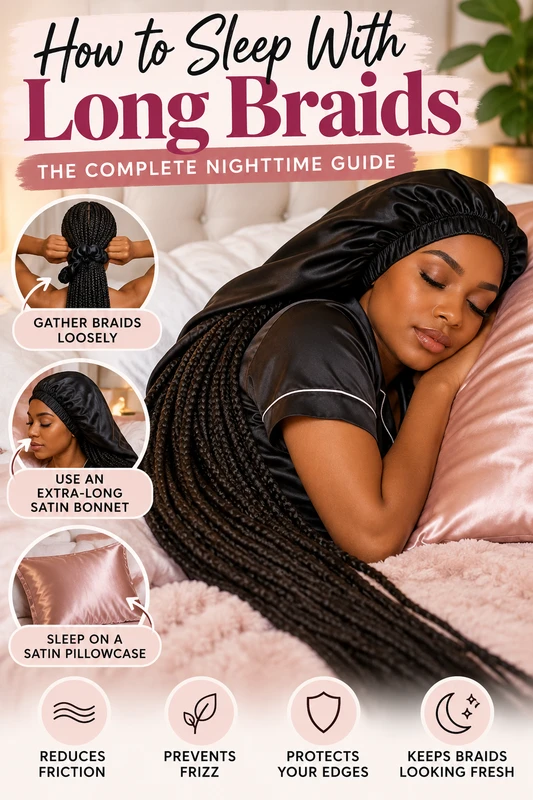
Long braids are beautiful, versatile, and convenient, but bedtime can become a challenge when your braids reach your waist, hips, or even longer. If you have ever climbed into bed with fresh box braids or knotless braids and wondered where all that hair is supposed to go, you are definitely not alone.
Should you put long braids in a bun? Should you leave them hanging down? Is it okay to sleep directly on them? What kind of bonnet is large enough? And most importantly, how can you sleep comfortably without creating frizz, pulling your edges, or putting unnecessary tension on your scalp?
Learning how to sleep with long braids is an important part of maintaining a protective hairstyle.
The way you handle your braids at night can affect how fresh they look, how comfortable your scalp feels, and how much friction your natural hair experiences. A simple nighttime routine can also help reduce tangling and keep extremely long braids from wrapping around your neck, getting trapped underneath your body, or constantly rubbing against your bedding.
In this complete guide, we'll explain the best ways to sleep with long braids, how to wrap them, which sleeping positions work best, what to avoid, and how to keep your natural hair moisturized underneath your protective style.
Why Does Sleeping With Long Braids Matter?
During the day, you can easily move long braids out of the way. At night, you have much less control over them.
While you sleep, you naturally turn your head and change positions. Your braids may rub against your pillow, sheets, pajamas, headboard, and even your own shoulders.
Night after night, this friction can contribute to:
- Frizzy braids
- Fuzzy roots
- Loose hairs
- Tangling
- Dryness
- Dull-looking extensions
- Stress around your edges
- Uncomfortable pulling at the scalp
- Braids becoming trapped underneath your body
Long braids have another issue: weight.
The longer and heavier your braids are, the more important it becomes to position them in a way that doesn't unnecessarily pull against your roots while you're sleeping.
This is why simply throwing extremely long braids into a tight bun every night isn't always the best solution.
Your nighttime routine should focus on three things: reducing friction, minimizing tension, and keeping your natural hair comfortable.
For a broader nighttime braid-care routine, read our Night Routine for Braids: The Complete Guide to Keeping Your Braids Looking Fresh.
The Best Way to Sleep With Long Braids
For most people, the easiest method is:
- Make sure your braids are completely dry.
- Lightly moisturize your natural hair if it needs hydration.
- Gently gather your braids without pulling your roots.
- Secure them loosely with a satin scrunchie if necessary.
- Place the braids inside an oversized satin bonnet or long braid bonnet.
- Sleep on a satin pillowcase as backup protection.
The key word is loosely.
Your braids don't need to be tightly tied against your head to remain protected.
In fact, excessive tension can defeat part of the purpose of wearing a protective style.
Step 1: Make Sure Your Long Braids Are Dry Before Bed
This is especially important after washing, swimming, working out, or heavily misting your braids.
Long braids can hold a surprising amount of water.
The outside of your braids might feel dry while the interior sections—particularly near your natural hair—remain damp.
Going to sleep repeatedly with very wet braids can contribute to unwanted odor, scalp discomfort, prolonged dampness, and frizz.
Give your braids enough time to dry thoroughly before covering them for the night.
If you recently washed your braids, gently squeeze out excess water instead of rubbing them with a regular towel.
Then allow plenty of drying time.
Our Braids Washing Guide explains how to cleanse and dry braided styles while minimizing unnecessary frizz.
Whenever possible, wash long braids earlier in the day rather than immediately before bedtime.
That gives the roots and lengths significantly more time to dry.
Step 2: Check Whether Your Hair Needs Moisture
Braids reduce daily manipulation, but your natural hair still needs appropriate care underneath the style.
Pay particular attention to:
- Your scalp
- Your roots
- The sections containing your natural hair
- Your hairline
- Your nape
If your hair feels dry, use a lightweight moisturizer rather than coating the entire hairstyle with multiple heavy products.
The Hairobics Raaw Roots Locs & Braids Moisturizer Spray is specifically formulated for braids, locs, extensions, weaves, synthetic hair and natural hair. Lightly apply it according to the product directions and press the moisture into your braids rather than soaking them.
You don't necessarily need to moisturize heavily every single night.
How frequently you need moisture depends on your hair, scalp, climate, products, and how quickly your hair becomes dry.
Read our complete guide on How Often Should You Moisturize Braids? for a more detailed routine.
Step 3: Divide Extremely Long Braids Into Sections
If your braids reach your waist or hips, gathering the entire hairstyle into one bundle may feel heavy.
Try separating your braids into two loose sections.
Place one section over each shoulder temporarily while preparing for bed.
Dividing the weight can make the hairstyle easier to control and prevent you from pulling unnecessarily on one side of your scalp.
Once the braids are divided, you can decide whether to place them inside a bonnet, loosely secure them, or position them above your head.
Step 4: Gather Your Braids Loosely
If you want to secure your braids before putting on a bonnet, use a large satin or silk scrunchie.
Avoid small rubber bands.
You don't need several tight loops around your braids. The goal is simply to keep them together.
Try creating a very loose low ponytail.
Another option for extremely long braids is dividing them into two loose ponytails.
Whichever method you choose, check your scalp before lying down.
You shouldn't feel strong pulling around:
- Your temples
- Your hairline
- Your crown
- Your nape
If securing the braids immediately makes your scalp feel tighter, loosen them.
Step 5: Use an Extra-Long Satin Bonnet
Standard bonnets can be frustrating with waist-length braids.
Trying to force two or three feet of braided hair into a small bonnet can cause the braids to bunch around your head.
Instead, look for a long satin braid bonnet or an oversized bonnet specifically designed for protective hairstyles.
These longer bonnets allow the braids to extend naturally instead of being tightly folded against your scalp.
To put one on:
Gently gather your braids together.
Place the bonnet over the ends first.
Work the bonnet upward while feeding the braids inside.
Once the lengths are contained, position the elastic portion around your hairline.
The bonnet should remain secure without feeling painfully tight.
If you wake up with a deep line across your forehead or discomfort around your temples, the band may be too tight.
Should You Use a Satin Scarf Too?
You can.
A satin scarf and bonnet perform slightly different jobs.
A scarf can help protect the roots and hairline, while a long bonnet contains the length of your braids.
For maximum nighttime protection, some people use both.
First, gently wrap a satin scarf around the hairline.
Then place the lengths of the braids inside your long bonnet.
You don't have to tie the scarf extremely tightly.
The goal is reducing friction—not immobilizing your hairstyle.
Don't Forget the Satin Pillowcase
Even if you wear a bonnet every night, a satin pillowcase is useful backup protection.
Bonnets sometimes come off while you're sleeping.
If that happens, your braids are still resting against a smoother surface instead of directly against cotton bedding.
A satin pillowcase can also protect the portions of extremely long braids that occasionally escape from your bonnet.
Think of it as your second layer of nighttime protection.
Where Should Long Braids Go When You Sleep?
This is probably the biggest question people have.
There isn't one position that works for everyone, but there are several good options.
Option 1: Place Your Braids Above Your Head
If you sleep on your back, gently direct your braids upward so the lengths extend above the pillow.
This keeps you from lying directly on the bulk of your braids.
Don't pull them tightly upward.
Simply move them out of the area underneath your neck and back.
This can work especially well when your braids are contained inside a long satin bonnet.
Option 2: Move Them to One Side
Side sleepers may prefer moving the braids to the opposite side of the body.
For example, if you're sleeping on your left side, gently move most of the braid length toward your right or above your head.
This prevents your body from resting directly on the braids.
If you switch positions frequently, however, a long bonnet may make things much easier.
Option 3: Divide Them Into Two Sections
Very long or heavy braids can be divided into two sections.
This distributes the bulk instead of placing all of your braids in one large bundle.
This method can be particularly comfortable for people who don't like the feeling of a thick braid bundle behind their head.
Should You Sleep With Long Braids in a Bun?
A loose bun may work for some people, but avoid creating a tight high bun every night.
Think about how much your braids weigh.
Gathering long extension braids into a tightly secured bun can concentrate that weight in one location.
It may also pull on the hairline and roots for hours while you sleep.
If you prefer a bun, keep it extremely loose and pay attention to how your scalp feels.
If your roots feel pulled, choose another method.
Nighttime comfort is more important than making your sleeping hairstyle look perfect.
Never Pull Fresh Braids Tightly at Night
Fresh braids can already place some tension on your scalp.
You don't want to add unnecessary pulling by immediately forcing them into tight nighttime hairstyles.
If your new braids are so painful that you can't comfortably rest your head on a pillow, don't simply assume that severe pain is normal.
Painful pulling, persistent headaches, visible scalp tension, bumps, or significant discomfort can indicate that your style is too tight.
Read How to Tell if Braids Are Too Tight for warning signs to watch for.
Protective styles should not require you to tolerate significant pain.
How to Sleep With Long Knotless Braids
Knotless braids are popular partly because of their flexible appearance and flatter roots.
For long knotless braids:
- Keep your roots loose at night.
- Avoid tight ponytails.
- Use a long satin bonnet.
- Use a satin scarf around the hairline if desired.
- Keep the lengths contained so they don't tangle.
- Use a satin pillowcase as backup.
Because long knotless braids can contain substantial extension hair, pay attention to their weight.
Don't repeatedly pile heavy braids directly on top of your head and tightly secure them overnight.
How to Sleep With Long Box Braids
The same basic principles apply to traditional box braids.
Gently gather the braids.
Use a satin scarf to protect your roots if desired.
Place the lengths inside an oversized or extra-long bonnet.
Avoid lying directly on a large pile of braids underneath your neck.
If the braids are particularly thick, dividing them into two sections can make sleeping much more comfortable.
How to Sleep With Long Boho Braids
Boho braids require extra attention because of the loose curly pieces throughout the style.
Those curls can rub together while you're sleeping, leading to tangling and frizz.
Before bed, gently separate any loose curls that have begun tangling.
Avoid aggressively combing through them.
Then loosely gather your braids and protect the entire hairstyle with satin.
The goal is to reduce movement between the curly pieces while you sleep.
For detailed maintenance instructions, see our Boho Braids Care Guide.
How to Prevent Long Braids From Getting Frizzy Overnight
Friction is one of the biggest contributors to nighttime frizz.
Imagine your natural hair rubbing against a cotton pillow for six to eight hours night after night.
Even though your hair is braided, loose natural strands around the roots and throughout the braid can still experience friction.
Reduce overnight frizz by:
- Wearing satin or silk protection
- Using a satin pillowcase
- Keeping braids contained
- Avoiding excessive tossing of uncovered braids
- Moisturizing appropriately
- Avoiding overly dry hair
- Keeping your roots clean
- Limiting unnecessary manipulation
If frizz is already becoming a problem, read How to Prevent Frizz in Braids.
Keep Your Edges Loose
Your edges are among the most delicate hairs on your head.
Long braids can create additional weight, making it especially important not to add unnecessary nighttime tension.
Avoid tightly pulling every braid backward before putting on your bonnet.
Instead, allow the braids around your hairline to remain comfortably positioned.
If you use a scarf, tie it securely enough to remain in place but not so tightly that it pulls your skin or leaves you uncomfortable.
Your edges don't need to be perfectly slicked down while you're sleeping.
This is the time for your hairline to rest.
Don't Apply Heavy Products Every Night
More product doesn't automatically mean more moisture.
Repeatedly applying thick creams, gels, oils, edge controls, and mousse without cleansing can eventually create buildup around the roots.
Buildup may leave your braids looking dull and can make the scalp uncomfortable.
Instead, keep your routine simple.
Hydrate when your hair needs it.
Use styling products only when necessary.
Clean your scalp when necessary.
If your natural hair needs additional conditioning, Hairobics Leave-In Hair & Scalp Treatment can be incorporated according to its directions. Hairobics specifically recommends the Leave-In Treatment for hair and scalp care, including protective styles such as braids.
How to Stop Long Braids From Pulling While Sleeping
If you wake up because your braids are pulling your scalp, first look at how you're positioning them.
Common causes include:
Lying on the braid lengths. Your body may trap the braids while your head turns in another direction.
Tight ponytails. Your nighttime ponytail may be pulling harder than you realize.
Tight buns. The weight of the extensions may create tension around your roots.
Braids caught underneath your shoulder. Long braids can easily become trapped underneath your upper body.
An undersized bonnet. Forcing very long braids into a tiny bonnet can cause uncomfortable bunching.
Try changing one factor at a time until your scalp feels comfortable.
What If Your Braids Are Too Long for Your Bonnet?
Buy a bonnet designed for long protective hairstyles rather than trying to make a small bonnet work.
Until then, you can loosely wrap your roots with a satin scarf and sleep on a satin pillowcase.
Another temporary method is gently dividing your braids into sections and positioning the lengths above your pillow.
Whatever you do, avoid tightly folding your braids repeatedly just to squeeze them into a small cap.
Should You Moisturize Long Braids Before Bed?
You can moisturize them before bed, but you don't need to soak your hair every night.
Pay attention to how your hair feels.
If your scalp and natural hair feel comfortable and moisturized, adding more product simply because it's bedtime may not be necessary.
When hydration is needed, lightly apply your moisturizing product and give it time to settle before covering your hair.
Your braids should not be soaking wet when you put on your bonnet.
For long braids, the Hairobics Raaw Roots Locs & Braids Moisturizer Spray is an especially relevant choice because it is made for braided and other protective styles and is designed to moisturize and condition the hair and scalp.
How to Keep Long Braids Looking Fresh While You Sleep
Nighttime protection does more than improve comfort.
It can also help preserve the appearance of your style.
Your nightly routine should take only a few minutes:
Check your scalp. Look for excessive buildup, redness, or irritation.
Moisturize when needed. Use lightweight hydration rather than saturating the braids.
Smooth obvious flyaways gently. Avoid repeatedly adding gel to every loose hair.
Gather the braids loosely. Never pull them tightly just for bedtime.
Protect the hairline. Use a satin scarf if desired.
Cover the lengths. Use a long or oversized satin bonnet.
Sleep on satin. A satin pillowcase provides backup protection.
Consistently following these habits can help your braids maintain a neater appearance.
For even more maintenance techniques, see How to Keep Braids Looking Fresh: 20 Easy Tips to Make Your Braids Last Longer.
Common Mistakes When Sleeping With Long Braids
Sleeping With Braids Completely Uncovered
Leaving long braids exposed allows them to rub against bedding for hours.
A bonnet, scarf, or satin pillowcase reduces this friction.
Putting Braids in a Tight Ponytail
A tight ponytail can create continuous pulling around your roots.
Loosen it before sleeping.
Making a Tight High Bun
A high bun may keep long braids out of the way, but tightly wrapping heavy extensions around your head can create unnecessary tension.
Using Rubber Bands
Small rubber bands can grip and snag hair.
A large satin scrunchie is usually a gentler option when you need to gather your braids.
Sleeping With Soaking-Wet Braids
Long braids can take hours to dry.
Wash them early enough to allow thorough drying before bedtime.
Ignoring Scalp Pain
Significant or persistent pain isn't something you should simply cover with a bonnet and ignore.
Check whether your installation or nighttime hairstyle is creating excessive tension.
Overloading the Hair With Products
Heavy product layering can contribute to buildup.
Hydration should be purposeful rather than excessive.
A Simple 5-Minute Bedtime Routine for Long Braids
You don't need a complicated 30-minute routine every night.
Try this:
Minute 1: Check your scalp and roots.
Minute 2: Lightly moisturize areas that actually feel dry.
Minute 3: Gently massage or press the product where needed without aggressively scratching your scalp.
Minute 4: Gather your long braids loosely and protect your edges.
Minute 5: Place your braids inside your satin bonnet and arrange them comfortably before lying down.
That's it.
Consistency matters much more than making your routine complicated.
Frequently Asked Questions About Sleeping With Long Braids
What is the best way to sleep with really long braids?
Loosely gather the braids, place them inside an extra-long satin bonnet, and sleep on a satin pillowcase. Position the braids so you're not lying directly on the bulk of them.
Should I put my long braids up when sleeping?
You can move them upward or loosely secure them, but avoid creating a tight high ponytail or bun that pulls your roots.
Can I sleep with my braids down?
Yes, but leaving extremely long braids completely loose may allow them to become trapped underneath your body or rub against bedding. Satin protection makes sleeping with them down much easier.
Can I sleep without a bonnet if I have a satin pillowcase?
A satin pillowcase is helpful, but a bonnet also keeps long braids contained and prevents them from spreading across the bed. Using both provides additional protection.
Why do my braids hurt when I sleep?
Your braids may be freshly installed, positioned awkwardly, trapped underneath you, or pulled into a tight nighttime hairstyle. Significant or persistent pain can also be a warning that the braids themselves are too tight.
How do you sleep with waist-length braids?
An extra-long braid bonnet is one of the easiest solutions. Gather the braids loosely, feed the lengths into the bonnet, and position them above or beside you rather than underneath your back.
How do you sleep with long knotless braids?
Keep the roots loose, avoid tight buns, use a long satin bonnet, and sleep on a satin pillowcase. Divide very thick braids into two loose sections if that feels more comfortable.
Should I wrap long braids every night?
Nightly satin or silk protection is one of the simplest ways to reduce friction and help maintain the appearance of your braids.
Can I put wet braids in a bonnet?
It's better to allow your braids to dry thoroughly before covering them for the night, particularly when they're very long or thick.
How can I make my braids last longer?
Nighttime protection is only part of braid maintenance. Keeping your scalp clean, moisturizing appropriately, avoiding excessive manipulation, minimizing tension, and removing the style when necessary are also important.
Final Thoughts: Protect Long Braids Without Creating More Tension
Learning how to sleep with long braids doesn't have to be complicated.
The biggest mistake is thinking that your braids need to be tightly secured to stay protected.
They don't.
Instead, focus on keeping your braids loose, covered, dry, moisturized appropriately, and protected from friction.
Use an extra-long satin bonnet if your braids extend to your waist or hips. Add a satin scarf around your hairline when you want additional root protection. Keep a satin pillowcase on your bed as backup.
Most importantly, listen to your scalp.
If a nighttime hairstyle pulls, hurts, or feels excessively heavy, loosen it.
Long braids should allow you to enjoy a beautiful protective style without sacrificing a comfortable night's sleep.
With a simple nighttime routine and consistent care, you can wake up with your braids looking smoother, your scalp feeling more comfortable, and your style better protected for the weeks ahead.