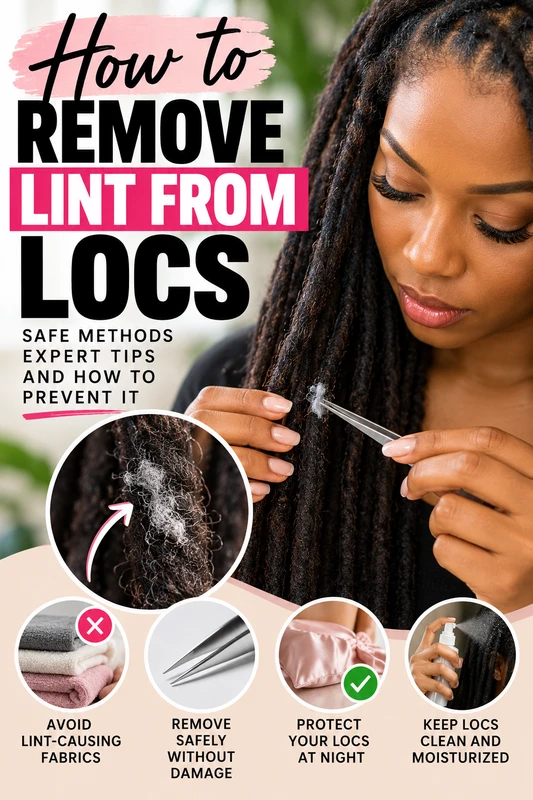
Lint in locs can be incredibly frustrating. You wash your hair, moisturize it, maintain your roots, and keep your locs looking fresh—only to notice tiny white, gray, or colored fibers trapped inside them.
If you have dark locs, even a small amount of lint can be extremely noticeable.
The bigger problem is that lint doesn't always sit on the surface. Because locs are made from thousands of intertwined strands of hair, fibers can gradually work their way inside the loc. Once that happens, simply washing your hair may not remove them.
So, how do you remove lint from locs without damaging them?
The safest approach depends on how deeply the lint is embedded. Surface lint can often be removed gently with your fingers or tweezers, while deeply embedded lint may require more patience—or help from an experienced loctician.
The most important rule is this:
Don't destroy the structure of your loc trying to make it look perfect.
Aggressively picking, cutting, pulling, or digging into a loc can cause more damage than the lint itself.
In this complete guide, we'll cover:
- What causes lint in locs
- Why lint becomes trapped
- How to tell lint from product buildup
- How to remove surface lint
- How to deal with deeply embedded lint
- Whether you should use tweezers
- Whether washing removes lint
- When a loc detox may help
- Mistakes that can thin your locs
- How to prevent lint from coming back
Let's start with why this happens.
What Is Lint in Locs?
Lint is made up of tiny fibers that separate from fabrics and other materials around you.
Common sources include:
- Towels
- Cotton pillowcases
- Blankets
- Hoodies
- Sweaters
- Hats
- Scarves
- Clothing
- Upholstered furniture
- Bedding
You may barely notice these fibers around your home, but locs can catch them surprisingly easily.
A loose strand of natural hair can often release debris during washing, combing, brushing, or detangling.
Locs behave differently.
As hair intertwines and matures, the internal structure becomes increasingly compact. Small fibers that work their way between the hairs may eventually become locked inside.
This is why lint prevention is so important.
If lint accumulation is an ongoing problem for you, read our guide on why locs collect lint and how to prevent it after this article.
Why Do Locs Attract So Much Lint?
There isn't necessarily anything wrong with your locs because they collect lint.
The structure of locs simply makes them more capable of holding onto small fibers than loose hair.
However, certain habits can dramatically increase the problem.
1. Sleeping on Cotton Bedding
Your pillowcase may be one of the biggest lint sources in your routine.
Cotton and other fibrous fabrics can shed tiny particles. Your locs rub against your pillow for hours every night.
That means repeated contact between your hair and fabric.
Night after night, small fibers can attach themselves to the surface of your locs.
Switching to satin or silk and covering your locs at night can reduce this exposure.
2. Drying Locs With Fuzzy Towels
Traditional bath towels can be problematic for locs.
Rub a dark piece of clothing against certain towels and you'll sometimes see tiny fibers left behind.
The same thing can happen to your locs.
After washing, you may accidentally press those fibers directly into wet hair.
Instead, consider using a clean microfiber towel or smooth cotton T-shirt that doesn't shed noticeably.
And don't aggressively rub your locs dry.
Gently squeeze or blot away excess water.
For more washing and drying tips, see our complete guide on how often you should wash locs.
3. Heavy Products Can Make Lint Stick
Sometimes the problem isn't only the fabric.
It's what is on your hair.
Thick waxes, sticky gels, heavy creams, butters, pomades and excessive oil can leave a coating on the outside of your locs.
That coating can act like a magnet for:
- Dust
- Dirt
- Lint
- Clothing fibers
- Pet hair
- Environmental debris
Then the normal locking process can gradually trap that debris inside.
This is one reason simple loc routines are often better than constantly layering products.
If your locs feel coated, hard or unusually stiff in addition to having visible lint, read Why Do My Locs Feel Stiff?.
Is It Actually Lint or Product Buildup?
Before trying to remove anything, make sure you're actually looking at lint.
White material inside locs isn't always fabric.
It could potentially be:
- Dried styling product
- Shampoo residue
- Gel
- Wax
- Flakes
- Sebum mixed with product
- Mineral buildup
- Actual lint
The difference matters.
If you're dealing with product residue, picking at every white spot with tweezers won't address the underlying problem.
Look closely at the material.
Lint often looks fibrous. You may see tiny strands of white, blue, gray or another color.
Product buildup may look more like a coating, paste, residue or hardened deposit.
If you have widespread white residue throughout many locs rather than individual fibers, consider buildup as a possible cause.
Our guide to how product buildup affects your hair and scalp explains how excessive product layering can become a problem.
How to Remove Lint From Locs Safely
Now let's get to the important part.
Your objective should be to remove as much visible lint as reasonably possible without compromising the strength of your locs.
You don't need to attack every loc.
Work slowly.
Step 1: Inspect Your Locs in Bright Light
Start with clean hands and good lighting.
Natural daylight is especially useful.
If necessary, use two mirrors to inspect the back of your head.
Divide your locs into sections and examine them individually.
Pay particular attention to:
- Ends
- Back of the head
- Nape
- Areas touching clothing
- Older portions of mature locs
You may discover that the lint is concentrated in only certain areas.
That can also give you a clue about where it's coming from.
For example, lint concentrated around your shoulders and lower locs could be associated with clothing or bedding.
Step 2: Wash Your Locs Before Aggressive Removal
If your locs haven't been washed recently, start there.
Washing may remove loose surface fibers, dust and residue.
More importantly, cleansing your locs makes it easier to see what remains.
Use a shampoo appropriate for your hair and scalp.
Concentrate primarily on cleansing the scalp, then allow the lather and water to move through the locs.
Don't scrub individual locs aggressively trying to force lint out.
Rinse extremely thoroughly.
Locs can retain shampoo, particularly when they are long or dense.
After washing, gently remove excess water and allow your locs to dry completely.
Then inspect them again.
You may discover that some of what looked like lint has disappeared.
Step 3: Remove Loose Surface Lint With Your Fingers
This should be your least aggressive removal method.
If a fiber is clearly sitting on the outside of a loc, gently grasp it and pull it away.
Don't start separating hairs from the loc just to chase one tiny piece of lint.
If the fiber comes out easily, great.
If it doesn't, stop pulling.
The goal is to remove the lint—not unravel your loc.
Step 4: Use Tweezers Carefully
Clean tweezers can be useful when a visible piece of lint is slightly embedded near the surface.
But this is where people can accidentally damage their locs.
Use good lighting.
Hold the loc steady.
Grab the lint, not the surrounding hair.
Gently pull the fiber outward.
If it releases easily, remove it.
If you have to repeatedly dig into the loc, reconsider.
Your loc consists of interconnected hairs. Repeatedly inserting sharp tweezers and pulling at the internal structure can break individual strands.
Do that enough times and you can create a weak spot.
A tiny speck of lint isn't worth creating a thin section that eventually breaks.
What About Deeply Embedded Lint?
Deep lint is much more difficult.
This is especially true in mature locs.
Imagine a fiber entered your loc two years ago. Since then, your hair has continued matting and compacting around it.
That lint may now be physically intertwined with the internal hairs.
Trying to completely remove it could require pulling apart part of the loc itself.
In that situation, you have to ask:
Is removing this tiny fiber worth weakening my loc?
Often, the answer is no.
A professional loctician may be able to carefully remove some deeply embedded lint using specialized techniques.
But even professionals may decide that certain lint should be left alone if removing it would compromise the loc.
Can You Use a Crochet Hook to Remove Lint?
A small crochet hook is sometimes used by experienced locticians for loc maintenance and lint removal.
The hook may be able to catch an embedded fiber and bring it toward the surface.
However, this method requires skill.
Repeatedly stabbing or digging into your loc with a crochet hook can:
- Break hairs
- Create weak spots
- Cause frizz
- Disturb the loc structure
- Make sections thinner
If you've never used a crochet hook on locs before, deeply embedded lint probably isn't the best place to learn.
Consider visiting an experienced loctician instead.
Should You Cut Lint Out of a Loc?
Generally, you shouldn't cut into a healthy loc simply because you see lint.
Scissors don't know the difference between lint and hair.
You may think you're cutting one fiber when you're actually cutting dozens of interconnected strands.
That can create a weak point.
As your loc grows longer and heavier, that weakened area may become more vulnerable to breakage.
If you're already experiencing thin or weak locs, avoiding unnecessary manipulation becomes even more important.
Can You Wash Lint Out of Locs?
Sometimes.
Loose lint sitting on the surface may wash away.
Deep lint usually won't.
Once fibers become tightly embedded inside a mature loc, water and shampoo may not be able to dislodge them.
However, washing remains extremely important because clean locs are less likely to have the oily or sticky buildup that attracts additional debris.
A consistent washing schedule also prevents dirt, sweat and products from accumulating around existing lint.
Will a Loc Detox Remove Lint?
This is another common question.
A cleansing or clarifying treatment may help remove certain types of buildup, oil and residue.
However, lint is a physical fiber.
Dissolving product buildup around an embedded fiber might make some lint easier to see or remove, but you shouldn't expect a detox to magically dissolve fabric.
Be particularly careful with aggressive DIY treatments.
More isn't always better.
If your locs have significant buildup throughout their interior, speak with an experienced loctician about the safest cleansing approach for your particular locs.
What NOT to Do When Removing Lint
Sometimes the greatest damage occurs because someone becomes determined to remove every visible speck.
Avoid these mistakes.
Don't Constantly Pick Your Locs
Occasionally removing visible lint is one thing.
Sitting for hours picking through every loc is another.
Constant picking can loosen hairs and weaken the internal structure.
Don't Dig With Needles
A sharp needle can break hairs or potentially injure your scalp or fingers.
There are safer approaches.
Don't Pull Apart Mature Locs
If you have to unravel a substantial section of your loc to reach the lint, the removal may cause more cosmetic damage than the lint.
Don't Cover the Problem With More Product
Adding wax, gel or dark-colored products may temporarily hide white lint, but it can create additional buildup.
That buildup may attract even more debris.
Don't Obsess Over Perfection
Locs are hair.
They're exposed to the environment every day.
A few tiny fibers don't mean your locs are dirty or unhealthy.
Healthy locs are more important than perfectly lint-free locs.
How to Prevent Lint From Coming Back
Once you've spent time removing lint, prevention becomes your best strategy.
Cover Your Locs at Night
This is one of the simplest changes you can make.
Wear a satin or silk bonnet, scarf or loc cap.
A satin or silk pillowcase can provide another layer of protection.
This reduces direct contact between your locs and potentially lint-producing bedding.
Watch Your Clothing
Long locs frequently rub against your clothing.
Pay attention to:
- Fleece
- Wool
- Fuzzy sweaters
- Hoodies
- Scarves
- Coats
- Fibrous fabrics
If you wear your locs down over a shedding sweater all day, they may collect fibers.
You don't necessarily have to stop wearing your favorite clothes.
Instead, consider pulling your locs up or protecting them when wearing particularly fuzzy fabrics.
Change the Way You Dry Your Locs
After washing, avoid rubbing your locs with a fuzzy towel.
Use a clean, low-lint material.
Gently squeeze excess water from the locs.
Then give them enough time to dry thoroughly.
Proper washing and drying are foundational parts of maintaining healthy locs.
For a broader maintenance routine, see our complete guide to maintaining healthy locs.
Keep Your Loc Products Lightweight
Healthy locs need moisture.
But moisture doesn't mean coating your hair in layers of heavy products.
Water-based moisture can be particularly useful because water provides hydration without requiring thick creams or waxes.
For more details, read our guide on how to moisturize locs properly.
Hairobics Raaw Roots Locs & Braids Moisturizer Spray is formulated for locs, braids and natural hair. Its water-based formula contains a blend of botanical ingredients and oils and can be lightly applied to the hair and scalp when moisture is needed.
The key word is lightly.
You want moisturized locs—not locs saturated in layers of product.
Why Dry Locs May Collect More Lint
Extremely dry locs can develop a rougher surface with loose hairs.
That rough texture can give small fibers more opportunities to catch onto the hair.
Keeping your locs properly hydrated may help maintain flexibility and reduce excessive roughness.
But don't respond to dryness by pouring oil over your locs every day.
Excessive oil can create its own problems.
Instead, establish a balanced routine built around cleansing, lightweight hydration and minimal product buildup.
If dryness is an ongoing issue, read Why Your Locs Are Dry and How to Fix It.
A Simple Weekly Lint-Prevention Routine
You don't need a complicated routine.
Daily
Pay attention to what your locs touch.
Avoid constantly leaning your locs against fuzzy blankets, furniture and clothing.
Use lightweight moisture when your hair actually needs it.
Nightly
Cover your locs with satin or silk.
If you don't like sleeping in a bonnet or scarf, consider using a satin or silk pillowcase.
Wash Day
Clean your scalp and locs thoroughly.
Rinse extremely well.
Use a clean low-lint material to remove excess water.
Dry your locs completely.
Every Few Weeks
Inspect your locs in bright light.
Remove obvious surface lint before it has an opportunity to become deeply embedded.
This is much easier than trying to remove years of accumulated lint later.
A structured routine can also help you stay consistent. Our Loc Maintenance Calendar provides a broader schedule for maintaining clean, moisturized and strong locs.
Does Lint Mean Your Locs Are Dirty?
No.
Clean locs can still collect lint.
You can wash your locs regularly and still pick up fibers from your:
- Pillow
- Blanket
- Shirt
- Jacket
- Towel
- Car seat
- Couch
That's why you shouldn't automatically assume someone with lint in their locs has poor hygiene.
However, excessive product buildup can make lint easier to trap, so keeping your locs clean and avoiding unnecessary product layers can help.
Why Is Lint So Visible in Black Locs?
Contrast.
A tiny white cotton fiber might barely be noticeable in light-colored hair.
Put that same white fiber inside a dark brown or black loc and it immediately stands out.
The amount of lint may actually be very small.
It simply looks more dramatic because of the color difference.
Can You Dye Locs to Hide Lint?
Some people consider coloring their locs to make embedded lint less noticeable.
While color can sometimes camouflage discoloration or visible fibers, dyeing your entire head solely because of a few pieces of lint is a major step.
Hair color is a chemical process and can affect the condition of your hair.
It doesn't actually remove the lint either.
If lint is severe enough that you're considering coloring your hair just to hide it, speak with a professional loctician or stylist first.
How Do You Remove Lint From Starter Locs?
Be especially gentle with starter locs.
Starter locs haven't developed the compact internal structure of mature locs.
Aggressive picking and manipulation can interfere with the locking process.
For visible surface lint, gently remove fibers that release easily.
More importantly, concentrate on prevention.
Protect your starter locs at night, avoid fuzzy fabrics, keep your scalp appropriately clean and use products sparingly.
As your locs mature, good habits established early can dramatically reduce the amount of debris trapped inside them.
How Do You Remove Lint From Mature Locs?
Mature locs can tolerate somewhat more handling than fresh starter locs, but that doesn't mean they're indestructible.
Start with the least invasive method:
Wash → dry → inspect → gently remove surface fibers.
Use clean tweezers only when you can clearly identify and grasp the lint without repeatedly pulling at surrounding hairs.
For deeply embedded material, professional assistance may be the safer choice.
Your goal should be preserving the strength of the loc.
When Should You See a Loctician?
Consider professional help if:
- Lint is deeply embedded throughout many locs
- You're unsure whether you're seeing lint or buildup
- Your locs are thinning
- Sections feel weak
- You have extensive product buildup
- You're considering cutting into your locs
- You're considering using a crochet hook but have no experience
- Your locs have developed an unusual odor or persistent residue
A skilled loctician can examine your locs in person and determine whether the issue is primarily lint, buildup, structural damage or a combination.
Frequently Asked Questions About Removing Lint From Locs
What is the easiest way to remove lint from locs?
For surface lint, start by washing and thoroughly drying your locs. Then use your fingers to gently remove visible fibers. Clean tweezers can be used carefully for individual fibers close to the surface.
Can lint permanently get stuck in locs?
Yes. Fibers can become deeply embedded as locs mature and compact. In some cases, attempting to completely remove them could damage the loc.
Can shampoo remove lint from locs?
Shampoo and rinsing may remove loose surface lint, but deeply embedded fibers often require manual removal.
Can apple cider vinegar remove lint from locs?
Apple cider vinegar may be incorporated into certain cleansing routines, but it doesn't dissolve fabric fibers. Lint that has physically locked into the hair may remain even after buildup has been removed.
Should I pick lint out of my locs?
Only gently. Surface lint that releases easily can be removed, but repeatedly digging into the loc can break hairs and create weak spots.
Why do my locs have so much lint?
Common sources include cotton bedding, towels, fuzzy clothing, blankets, hats and other fabrics. Heavy or sticky product buildup may also make it easier for fibers to adhere to the hair.
How often should I check my locs for lint?
A quick inspection every couple of weeks can help you catch obvious fibers before they become deeply embedded.
Should I cut a loc because it has lint?
Usually not. A small amount of lint is generally a cosmetic issue. Cutting or severely weakening an otherwise healthy loc may create a much bigger problem.
Final Thoughts: Remove Lint Without Sacrificing Healthy Locs
Lint is one of those frustrating issues almost every long-term loc wearer will encounter at some point.
The important thing is not to panic.
Start by determining whether you're dealing with actual lint or product buildup. Wash your locs, rinse them thoroughly, dry them completely and inspect them under bright light.
Remove easy surface fibers gently.
Use tweezers cautiously.
Avoid aggressively digging into mature locs, and don't cut into healthy locs simply to remove a tiny speck of lint.
Most importantly, focus on prevention.
Cover your locs at night. Avoid fuzzy towels. Pay attention to shedding clothing and bedding. Keep your locs clean. Minimize heavy waxes and sticky products. Use lightweight moisture rather than coating your hair.
Healthy locs don't need to be absolutely perfect.
They need to be clean, hydrated, strong and protected.
Keep Your Locs Soft, Hydrated and Manageable
After cleansing your locs and addressing lint or buildup, lightweight moisture can help keep them from feeling excessively dry or rough.
Hairobics Raaw Roots Locs & Braids Moisturizer Spray is designed for locs, braids and natural hair and can be lightly applied to the hair and scalp as part of your regular loc-care routine.
Keep the routine simple: cleanse, hydrate, protect and prevent buildup.
That combination can help your locs stay soft, fresh-looking and manageable while reducing the conditions that make lint harder to control.