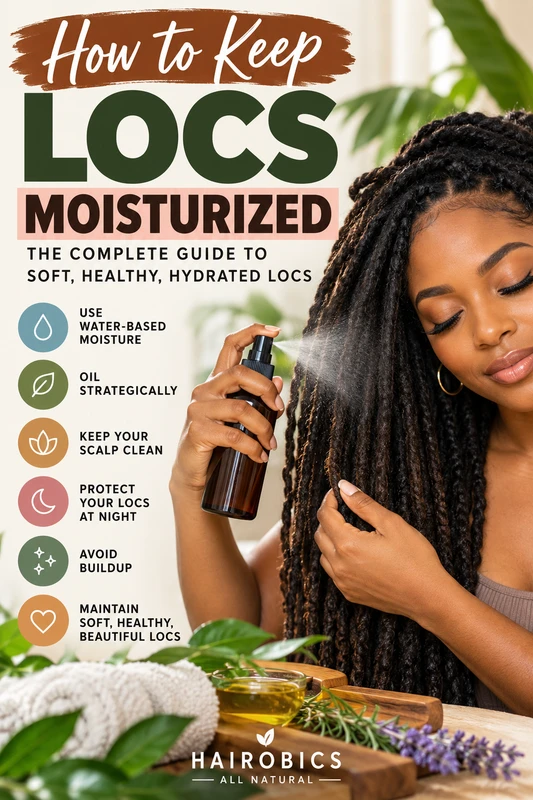
Locs are beautiful, versatile, and relatively easy to maintain once you develop a routine that works for your hair. But one problem can follow people throughout almost every stage of their loc journey:
Dry locs.
You may moisturize your locs in the morning only to notice that they feel dry again by the evening. Your ends may feel rough. Your locs may look dull instead of soft and healthy. In more severe cases, extremely dry locs may become stiff, brittle, and more vulnerable to breakage.
So, how do you keep locs moisturized?
The key is understanding that moisture and oil are not the same thing. Your locs need water-based hydration, while oils can play a supporting role by conditioning the hair, reducing friction, and helping your locs retain some of that moisture.
At the same time, you don't want to continuously coat locs with thick creams, heavy oils, waxes, and butters. Because locs consist of intertwined and compacted strands, excessive product can become trapped inside the hair and contribute to buildup.
The goal is balance:
Hydrate your locs without coating them in unnecessary product.
In this complete guide, we'll explain how to keep locs moisturized, how often you should moisturize them, whether you should use water or oil, how to prevent buildup, how to care for your locs at night, and how to build a simple moisture routine that keeps your locs soft, flexible, and manageable.
Why Do Locs Get So Dry?
Before adding another product to your hair, it helps to understand why your locs are dry in the first place.
Dry locs can be influenced by several factors, including:
- Not moisturizing frequently enough
- Using oil without water-based hydration
- Washing with harsh products
- Washing too frequently for your individual hair
- Product buildup
- Hard water
- Dry weather
- Indoor heating or air conditioning
- Excessive sun exposure
- Sleeping without protecting your hair
- Using cotton bedding that creates friction
- Frequently manipulating your locs
- Applying too much heat
- Chemical or color treatments
- Not drinking enough fluids isn't a substitute explanation for topical hair dryness; your hair-care routine still matters
Sometimes several factors are happening simultaneously.
For example, you may wash your locs with a strong clarifying shampoo, allow them to dry, apply only oil afterward, and sleep on a cotton pillowcase.
Individually, each choice may seem small.
Combined, they can leave your locs feeling noticeably drier.
The solution isn't necessarily adding more and more products.
Often, the best solution is developing a better moisture routine.
Moisture vs. Oil: Understanding the Difference
This is one of the most important concepts in loc care.
Oil is not the same thing as moisture.
Water is the foundation of hydration.
Oils can make locs feel smoother, add shine, reduce friction, and help condition the hair. But simply pouring oil onto dehydrated locs doesn't necessarily give them the water-based hydration they need.
That's how you can end up with locs that feel:
Greasy on the outside but dry on the inside.
If you have been applying oil repeatedly but your locs continue feeling dry, the problem may be that you're using oil in place of moisture.
Our guide on Why Oil Doesn't Moisturize Dry Hair explains this important distinction in greater detail.
Think of your loc routine as two separate steps:
Hydrate first. Seal or condition when needed.
You don't necessarily have to apply oil every time you moisturize, especially if your locs already feel soft and flexible.
How to Keep Locs Moisturized
Keeping your locs moisturized doesn't require a shelf filled with dozens of products.
A simple routine can be extremely effective.
1. Start With Water-Based Moisture
When your locs feel dry, start with hydration.
A lightweight, water-based moisturizing spray is one of the easiest options for locs because you can distribute it throughout your hair without coating each loc in a thick cream.
Lightly mist your locs.
The keyword is lightly.
Your locs don't need to become soaking wet every time you moisturize them.
Apply enough product to refresh the hair, then gently use your hands to distribute the moisture throughout your locs.
Pay particular attention to:
- Dry areas
- Ends
- Older portions of mature locs
- Locs exposed to clothing
- Areas that consistently feel rough
If you're looking for a lightweight moisturizer made specifically for locs and protective styles, consider Hairobics All Natural Raaw Roots Locs & Braids Moisturizer Spray.
Raaw Roots contains purified water along with ingredients including apricot kernel oil, sesame seed oil, almond oil, castor oil, rosemary oil, lavender oil, jojoba oil, vegetable glycerin, botanical herbs, apple vinegar, and other ingredients.
Simply spray lightly throughout your locs and scalp, then gently press or massage the product into your hair.
The goal isn't to saturate your locs.
It's to give dry hair lightweight moisture without unnecessarily coating it in heavy products.
2. Pay Attention to How Your Locs Feel
You don't necessarily need to moisturize your locs simply because a calendar says it's time.
Touch your hair.
Pay attention to it.
Ask yourself:
Do my locs feel soft?
Do they bend easily?
Are my ends rough?
Do my locs feel crunchy?
Do they feel oily?
Do they feel coated?
Do they feel unusually heavy?
Your hair's condition should help determine your next step.
If your locs still feel soft and flexible, you may not need additional product.
If they feel noticeably dry, a light moisturizing refresh may help.
If they feel sticky, greasy, heavy, or coated, adding another layer of moisturizer probably isn't the answer.
They may need cleansing instead.
3. Don't Drench Your Locs Every Day
Water is important, but that doesn't mean your locs should remain wet all day.
Locs can take considerably longer to dry than loose natural hair because their intertwined structure can hold water internally.
This becomes especially important with:
- Thick locs
- Long locs
- Mature locs
- High-density hair
You want hydration—not constantly damp locs.
Lightly misting your hair is very different from completely soaking it every morning.
If your locs are becoming extremely wet whenever you moisturize them, reduce the amount you're using.
And whenever you actually wash your locs, make sure they dry completely.
If you have especially dense hair, read our complete guide on How to Dry Thick Locs.
4. Use Oil Strategically
Oil can absolutely have a place in a healthy loc routine.
But more oil doesn't automatically equal healthier hair.
Depending on your hair, you may use a small amount of lightweight oil after adding water-based moisture.
The oil can help lubricate your locs, improve softness, reduce friction, and add shine.
Popular oils used in natural hair routines include:
- Jojoba oil
- Sweet almond oil
- Grapeseed oil
- Avocado oil
- Apricot kernel oil
- Argan oil
Heavier oils such as castor oil can also work for some people, but they should generally be used carefully if your locs become coated easily.
Remember:
You don't need your locs dripping in oil.
If you touch your locs and your hands become extremely greasy, you may be using more than necessary.
5. Keep Your Scalp Clean
Healthy-looking locs begin with a properly maintained scalp.
Your scalp naturally produces sebum and sheds dead skin cells. Sweat, dirt, oils, styling products, and environmental debris can also accumulate over time.
One mistake people make is trying to solve every scalp problem by adding more oil.
Dry scalp?
Add oil.
Itchy scalp?
Add oil.
Flakes?
Add oil.
But oil isn't always the answer.
Flaking can be associated with dryness, buildup, irritation, dandruff, or other scalp conditions.
Our guide on Why Does My Scalp Flake After Oiling? explains why continually applying more oil can sometimes make the problem worse.
Wash your scalp regularly according to your hair, lifestyle, activity level, and scalp condition.
A clean foundation makes maintaining moisturized locs much easier.
How Often Should You Wash Locs?
There isn't one perfect schedule for everyone.
Some people wash their locs weekly.
Others may prefer every two weeks.
Your ideal schedule depends on factors such as:
- How much you sweat
- Your scalp's oil production
- Exercise
- Product use
- Loc maturity
- Your environment
- Your scalp condition
- How quickly buildup develops
The important thing is not allowing dirt and product to accumulate simply because you're worried about disturbing your locs.
For a detailed explanation, read How Often Should You Wash Locs?.
And remember that washing more frequently isn't automatically better either. If you're concerned that your cleansing routine is contributing to dryness, see Can You Wash Locs Too Often?.
6. Avoid Product Buildup
One of the biggest challenges with moisturizing locs is finding the balance between giving them enough hydration and applying too much product.
Locs can trap residue.
Heavy products may work their way into the compacted hair and become difficult to completely rinse away.
Be cautious about repeatedly layering:
- Heavy creams
- Thick butters
- Wax
- Pomades
- Heavy gels
- Excessive oils
- Multiple leave-in products
Imagine this routine:
Monday: moisturizer.
Tuesday: oil.
Wednesday: cream.
Thursday: more moisturizer.
Friday: gel.
Saturday: oil.
Sunday: butter.
Then repeat the entire process without washing.
Over time, your locs can become coated.
Instead of feeling soft, they may eventually become stiff, dull, sticky, or heavy.
Our guide on How to Prevent Loc Buildup explains how to maintain moisture without constantly layering products.
With locs, simpler is often better.
7. Protect Your Locs at Night
Your nighttime routine can have a major effect on how your locs feel in the morning.
Sleeping with your locs exposed every night can create friction between your hair and your bedding.
Instead, consider protecting your locs with:
- A satin bonnet
- Satin scarf
- Loc sock
- Satin pillowcase
For long locs, choose nighttime protection large enough that your locs aren't tightly folded or compressed.
You don't want to aggressively bend or pull your locs just to fit them underneath a tiny bonnet.
Keeping your hair covered also helps protect it from lint.
Lint can become embedded in mature locs and may be difficult to remove once it works its way deep inside the hair.
If you're already dealing with this problem, read How to Remove Lint From Locs.
8. Pay Special Attention to Your Ends
The ends of your locs contain some of the oldest hair on your head.
That means they deserve attention.
When applying a moisturizing spray, don't focus exclusively on your roots.
Run your hands down your locs and check your ends.
Do they feel:
- Rough?
- Hard?
- Brittle?
- Extremely dry?
- Fragile?
Apply a small amount of lightweight moisture where it's needed.
You don't need to saturate your entire head because a few ends feel dry.
Targeted moisturizing can reduce unnecessary product use.
9. Don't Confuse Stiffness With Healthy Mature Locs
As locs mature, they naturally become more compact.
That doesn't necessarily mean they should become extremely hard.
Healthy mature locs can still have flexibility and movement.
If your locs suddenly become stiff, consider your entire routine.
Potential causes include:
- Dryness
- Product buildup
- Excessive oil
- Mineral buildup
- Harsh shampoo
- Too much protein
- Environmental dryness
- Residue from styling products
Instead of automatically adding more oil, identify the cause.
Our complete guide on Why Do My Locs Feel Stiff? can help you troubleshoot the problem.
How Often Should You Moisturize Locs?
There is no universal schedule.
Some people may benefit from a light moisture refresh every few days, while others may need it more or less frequently.
Factors that influence your schedule include:
Hair porosity: Your hair's ability to absorb and retain moisture can affect how frequently it needs refreshing.
Climate: Hot, dry environments may cause your locs to feel different than humid environments.
Season: Indoor heating during colder months can contribute to a dry environment.
Loc thickness: Thick mature locs may respond differently to products than smaller locs.
Product: A lightweight spray can usually be refreshed more easily than a heavy cream.
Hair condition: Color-treated or chemically processed hair may have different needs.
Instead of blindly following someone else's routine, develop your own.
Start conservatively.
Apply a light amount of moisturizer.
Observe your hair for the next day or two.
If it remains soft, you're probably doing enough.
If it becomes dry quickly, adjust.
If it becomes sticky or coated, use less.
A Simple Weekly Loc Moisture Routine
You don't need a complicated schedule.
Here's an example.
Wash Day
Clean your scalp and locs thoroughly.
Rinse extremely well.
Remove excess water.
Dry your locs completely.
Evaluate how they feel afterward.
Use lightweight moisture as needed.
Between Wash Days
Every few days, check your locs.
If they feel dry, lightly mist them with a water-based moisturizing spray.
Press the moisture into the locs with your hands.
If your hair benefits from oil, apply a very small amount after moisturizing.
At Night
Cover your locs with satin or silk.
Before Adding More Product
Ask:
Do my locs need moisture—or do they need washing?
That single question can prevent a tremendous amount of unnecessary buildup.
Should You Moisturize Locs Every Day?
You can refresh your locs frequently if your hair genuinely needs it, but daily heavy product application isn't necessary for everyone.
If you're moisturizing every morning because your locs feel extremely dry by every evening, investigate why your hair is losing moisture so quickly.
You may need to adjust:
- Your cleanser
- Your moisturizer
- The amount of product
- Your nighttime routine
- Your oil use
- Your wash routine
- Your exposure to dry air
Don't simply keep adding more and more product.
Should You Spray Water on Locs Every Day?
A light water-based mist can work well for some people.
But don't confuse misting with soaking.
Your locs shouldn't remain damp continuously.
If you're spraying enough water that your locs stay wet for hours, reduce the amount.
This is especially important for thick mature locs because they can take considerably longer to dry internally.
Our guide explaining Why Locs Take So Long to Dry can help you understand why thorough drying matters.
Can You Use Leave-In Conditioner on Locs?
This depends on the product.
Some thick leave-in conditioners may leave more residue than you want inside locs.
If you use a leave-in product, consider a lightweight formula that distributes easily and doesn't leave your hair heavily coated.
Pay attention to how your locs respond after several applications.
If your locs become sticky, dull, waxy, or unusually heavy, simplify your routine.
What About Frizzy Locs?
Dryness can sometimes make frizz appear more noticeable, but frizz isn't automatically a moisture problem.
Some frizz is completely normal.
Locs form as individual hairs intertwine and become incorporated into the loc. New growth, washing, humidity, and normal movement can all create loose hairs.
Don't drown your locs in gel or wax trying to eliminate every single strand of frizz.
Read Why Are My Locs Frizzy? for more ways to manage frizz without unnecessarily coating your locs.
How to Keep Starter Locs Moisturized
Starter locs require slightly different care because they're still developing.
Be gentle.
Avoid constantly manipulating your hair or loading it with heavy products.
A lightweight moisturizing mist can help provide hydration without requiring you to pull apart or disturb your starter locs.
Use small amounts.
Protect your hair at night.
Keep your scalp clean.
And understand that frizz, loose hairs, and changes in appearance are normal parts of the locking process.
How to Keep Mature Locs Moisturized
Mature locs may be more stable, but they can still become dry.
Because mature locs are more compact, product selection becomes especially important.
Years of heavy waxes, creams, oils, and gels can eventually leave residue inside locs.
Focus on:
Lightweight moisture + clean hair + minimal buildup + nighttime protection.
Pay attention to the older sections and ends of your locs.
If your locs are very long, work in sections so your moisturizer reaches the entire length instead of only the top portion.
How to Keep Colored Locs Moisturized
Colored locs may require additional attention.
Chemical processing can alter the hair and leave it more vulnerable to dryness and breakage.
If your locs are colored:
- Monitor dryness carefully
- Minimize unnecessary heat
- Avoid harsh cleansing routines
- Moisturize consistently
- Pay attention to weak spots
- Be gentle during retwisting and styling
If you notice significant breakage after coloring, don't simply cover the problem with oil.
Assess whether your hair needs a change in your overall routine.
Common Loc Moisturizing Mistakes
Mistake #1: Using Only Oil
Oil can be useful, but it shouldn't automatically replace water-based hydration.
Mistake #2: Applying Too Much Product
Your locs don't need to be saturated with product to be moisturized.
Mistake #3: Moisturizing Dirty Locs Repeatedly
Sometimes your hair needs cleansing—not another product.
Mistake #4: Ignoring Your Ends
Your ends need attention too.
Mistake #5: Sleeping With Locs Uncovered
Nighttime friction and lint exposure can make maintaining your locs more difficult.
Mistake #6: Using Heavy Wax and Butter for Moisture
A product can make your locs feel coated without actually solving dehydration.
Mistake #7: Allowing Wet Locs to Remain Damp
Moisturized and continuously wet are not the same thing.
After washing, dry your locs thoroughly.
Mistake #8: Copying Someone Else's Exact Routine
Their locs aren't your locs.
Use other routines as starting points, then adjust according to your own hair.
Frequently Asked Questions
What is the best way to moisturize locs?
Start with lightweight, water-based hydration. Apply enough to refresh the locs without soaking them, gently distribute the moisture, and use a small amount of oil afterward if your hair benefits from it.
How often should I moisturize my locs?
It depends on your hair, climate, loc maturity, porosity, and products. Check your hair every few days and moisturize when it actually begins feeling dry rather than applying heavy products automatically every day.
Is water enough to moisturize locs?
Water is fundamental to hydration, but many people prefer a water-based moisturizing formula containing conditioning ingredients that help keep the hair soft and manageable.
Should I oil my locs every day?
Usually, daily heavy oiling isn't necessary. Too much oil can contribute to residue and buildup.
Why are my locs dry even after oiling?
Your hair may need water-based hydration rather than additional oil. You could also be dealing with buildup, harsh cleansing, environmental dryness, or another issue preventing your locs from feeling soft.
Can too much moisturizer cause buildup?
Yes. Repeatedly layering products without adequately cleansing the hair can contribute to residue.
Should I moisturize locs before bed?
You can lightly moisturize them when needed, but don't soak your locs immediately before going to sleep. If your locs become damp, allow them to dry before covering them for the night.
How do I know if my locs are moisturized?
Well-moisturized locs generally feel flexible, manageable, and comfortable rather than extremely brittle, crunchy, sticky, or heavily coated.
The Bottom Line: How to Keep Locs Moisturized
Keeping locs moisturized doesn't require an elaborate routine.
In fact, one of the best things you can do is keep your routine simple.
Remember these basic principles:
Hydrate with water-based moisture.
Use oil strategically rather than treating it as a replacement for moisture.
Keep your scalp and locs clean.
Avoid excessive heavy creams, waxes, butters, and oils.
Protect your locs at night.
Pay attention to your ends.
Dry your locs completely after washing.
Adjust your routine according to how your own hair responds.
Your goal isn't to have locs covered in products.
Your goal is to maintain locs that feel clean, soft, flexible, manageable, and properly cared for.
If your locs need lightweight moisture between wash days, try Hairobics All Natural Raaw Roots Locs & Braids Moisturizer Spray. Its water-based formula is designed for locs, braids, extensions, and natural hair and can be sprayed throughout the hair and scalp, then gently pressed or massaged into the locs.
A little consistency goes a long way.
Cleanse when your locs need cleansing. Hydrate when they need moisture. Use oil in moderation. Protect them at night. And keep your routine simple enough that your locs—not layers of product—remain the focus.