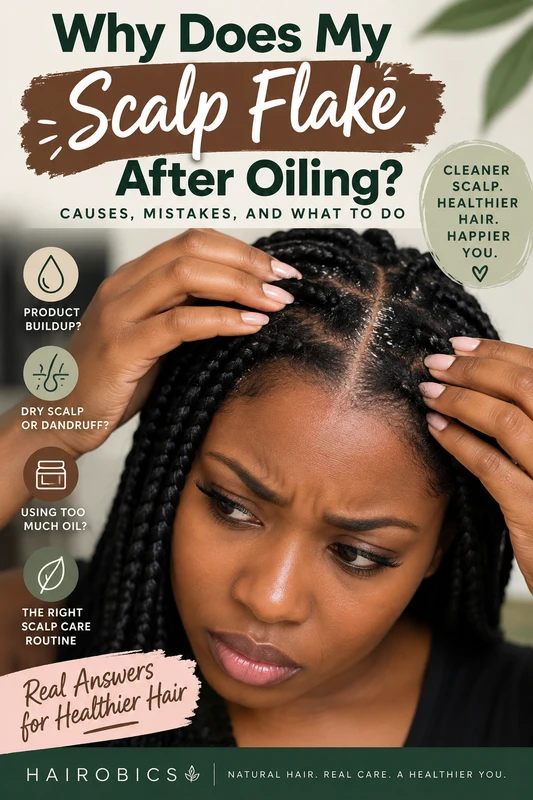
You oil your scalp expecting it to feel moisturized, comfortable, and healthy. Instead, a day or two later, you look closely and notice something frustrating: flakes.
Sometimes the flakes are tiny and white. Other times, they are larger, oily, yellowish, or stuck around the roots of your hair. You may notice them along your parts, underneath braids, between locs, around your hairline, or after scratching your scalp.
This can leave you wondering: Why does my scalp flake after oiling it?
It may seem strange because oil is commonly associated with moisture. However, adding more oil does not automatically fix a dry, flaky scalp. In some cases, oil can actually make existing scalp problems more noticeable or contribute to buildup.
The problem may not be that your scalp needs more oil. It could be product buildup, dead skin cells, an irritated scalp, dandruff, using too much oil, going too long between washes, or simply using a product that does not agree with your scalp.
If you have natural hair, locs, braids, twists, or another protective style, understanding the difference between a genuinely dry scalp and other causes of flaking is especially important.
In this guide, we'll explain why your scalp flakes after oiling, whether you should continue using oil, how often you should oil your scalp, and what you can do to maintain a cleaner, healthier-feeling scalp.
Why Does My Scalp Flake After I Oil It?
A scalp can flake after oiling for several reasons.
The most common possibilities include:
- Product buildup
- Dead skin cells mixing with oil
- Using too much oil
- Not washing the scalp often enough
- Dandruff or seborrheic dermatitis
- Sensitivity to an ingredient
- Using heavy oils or pomades
- Applying oil to an already dirty scalp
- Leaving oil on the scalp for too long
- Residue from gels, edge controls, creams, or sprays
- A scalp condition that oil alone cannot address
One of the biggest misconceptions about scalp care is that flakes always mean dryness.
They don't.
A flaky scalp can certainly be dry, but dandruff, irritation, buildup, and several scalp conditions can also produce flakes.
That distinction matters because repeatedly applying oil to every flaky scalp may not solve the underlying problem.
1. Oil Is Not the Same Thing as Moisture
This is one of the most important things to understand about natural hair and scalp care.
Oil and water are not the same thing.
When people say their scalp needs "moisture," they sometimes immediately reach for oil. Oils can help condition the hair and reduce water loss, but applying oil isn't equivalent to adding water to the scalp.
Imagine applying oil to extremely dry hands without ever washing or hydrating them properly. The skin might temporarily look shinier, but the underlying dryness may remain.
Something similar can happen with your scalp.
You may oil it and initially think:
"My scalp looks much better."
Then, one or two days later, the flakes return.
You apply more oil.
The flakes temporarily become less visible.
Then they come back again.
This can turn into a cycle of repeatedly adding oil without addressing what is actually causing the flaking.
2. You May Be Using Too Much Oil
More oil does not necessarily mean a healthier scalp.
If you're applying oil every day or heavily coating every part of your scalp, the product can accumulate.
Your scalp naturally produces sebum. You may also be using:
- Leave-in conditioner
- Styling cream
- Gel
- Edge control
- Hair grease
- Scalp spray
- Pomade
- Mousse
- Oil
- Dry shampoo
When these products combine with sweat, natural scalp oils, dirt, and dead skin cells, residue can develop.
Adding another layer of oil can make the buildup heavier.
Eventually, you may notice flakes when you scratch or rub your scalp.
The flakes aren't necessarily appearing because the oil instantly dried your scalp out. You may simply be loosening or seeing material that was already accumulating on the scalp.
How much scalp oil should you use?
Your scalp generally shouldn't look drenched after applying oil.
A small amount distributed strategically is usually better than saturating every inch of your scalp.
If oil is running down your forehead, neck, or ears after application, you're probably using more than necessary.
3. You're Applying Oil to a Scalp That Needs Washing
Sometimes your scalp doesn't need another product.
It needs to be cleaned.
This is especially common with protective styles.
Imagine you've been wearing box braids for three weeks.
During those weeks, you've applied scalp oil several times, used braid spray, exercised, sweated, slept, worn hats, and naturally shed skin cells.
Then your scalp begins flaking.
Applying another layer of oil may make the scalp temporarily look better, but it doesn't remove everything that has accumulated.
You are simply putting fresh product on top of old product.
Eventually, washing the scalp becomes more useful than oiling it again.
A clean scalp provides a better foundation for whatever products you decide to use afterward.
4. Dead Skin Cells Can Mix With Oil
Your skin naturally sheds dead cells.
The scalp is no exception.
Normally, many of these cells are removed during shampooing. But if you go a long time between washes, dead skin cells can accumulate.
Add oil to the situation and those cells can stick together.
When you later scratch your scalp, you may see oily white or grayish material underneath your fingernails.
This is one reason someone can say:
"My scalp wasn't flaky until I put oil on it."
The oil may not necessarily have created all of those flakes. It may have loosened or made existing buildup more visible.
Regular cleansing helps prevent excessive accumulation.
5. It Could Be Dandruff Rather Than Dry Scalp
Dry scalp and dandruff are often treated as if they're the same problem.
They aren't always.
Dandruff can be associated with an oily scalp and the activity of Malassezia, a type of yeast naturally found on human skin.
That means someone can have an oily scalp and still experience significant flaking.
This is why continuously adding oil isn't necessarily the right solution for dandruff.
You might notice:
- Persistent flakes
- Itching
- An oily scalp
- Flakes that return quickly after washing
- White or yellowish scales
- Irritated areas
If your scalp consistently flakes regardless of how much oil you apply, it's worth considering whether you're dealing with something other than simple dryness.
An over-the-counter dandruff shampoo containing an appropriate active ingredient may be more useful than continuously applying cosmetic oil. Persistent, severe, painful, or worsening symptoms should be evaluated by a dermatologist or other qualified healthcare professional.
6. Your Scalp May Not Like a Particular Oil
Natural doesn't automatically mean irritation-free.
Coconut oil, castor oil, jojoba oil, olive oil, avocado oil, essential oils, and botanical extracts can all behave differently depending on the person.
An ingredient that works beautifully for your friend's scalp might not work well for yours.
Pay attention to what happens after introducing a new product.
If you consistently experience:
- Itching
- Burning
- Redness
- Tenderness
- Flaking
- Bumps
- Increased irritation
after using a particular oil or scalp product, stop using it and see whether your scalp improves.
This is particularly important with essential oils.
Essential oils are highly concentrated and generally shouldn't be applied directly to the scalp undiluted. Improperly used essential oils can irritate the skin.
7. You're Oiling Your Scalp Too Frequently
"How often should I oil my scalp?"
There isn't one perfect schedule for everyone.
Some people may enjoy using a small amount of scalp oil a few times per week. Others may need it much less frequently. Some people find that regularly putting oil directly on their scalp doesn't benefit them at all.
Your scalp should help determine your schedule.
If you're oiling every day and constantly experiencing buildup, itching, or flakes, experiment with reducing the frequency.
Instead of automatically oiling every morning or night, ask yourself:
Does my scalp actually need oil today?
If the answer is no, leave it alone.
More products do not always equal better hair care.
8. Heavy Oils Can Make Buildup More Noticeable
Different oils have different textures.
A lightweight oil feels very different from a thick, heavy product.
For example, castor oil is considerably thicker than many other popular hair oils. Heavy oils and oil-based pomades can be useful in certain routines, but excessive amounts may leave noticeable residue.
If you already have:
- Dead skin cells
- Gel residue
- Edge control
- Sweat
- Dirt
- Sebum
on your scalp, adding a thick layer of oil can create an even heavier mixture.
This is especially noticeable around braids and locs.
You might see little clumps near the roots that look like dandruff but are actually a mixture of several substances.
9. Your Styling Products May Be the Real Problem
Before blaming your scalp oil, look at your entire routine.
Suppose you're using:
Monday: Leave-in conditioner and gel
Tuesday: Scalp oil
Wednesday: Edge control
Thursday: Scalp oil
Friday: Braid spray
Saturday: More edge control
By Sunday, several products are sitting on or near your scalp.
When flaking appears, it's easy to blame whichever product you used most recently.
But the actual issue could be cumulative product buildup.
Try simplifying your routine.
A healthy hair routine doesn't require constantly adding new layers of product.
10. Oil Can Make Existing Flakes More Visible
Here's another possibility.
The flakes were already there.
You simply couldn't see them as easily.
When you massage oil into the scalp, you're physically moving the skin with your fingers.
That motion can loosen dead skin cells and existing flakes.
Afterward, you may notice flakes sitting on top of your hair.
This can create the impression that the oil suddenly caused them.
In reality, the scalp massage may have loosened material that was already present.
Why Is My Scalp Flaky Even Though I Oil It?
If you constantly oil your scalp and it's still flaky, that's an important clue.
Your scalp may need something other than more oil.
Ask yourself:
When did I last shampoo my scalp thoroughly?
If it's been a while, cleansing may be the next logical step.
Also consider:
Does my scalp itch?
Persistent itching may indicate irritation, dandruff, or another scalp issue.
Are my flakes dry or greasy?
Small dry flakes may behave differently from thick, oily scales.
Did the problem begin after using a new product?
If so, discontinue the product temporarily.
Am I applying oil every day?
You may be using too much.
Do the flakes return immediately after washing?
If persistent flaking continues despite proper cleansing and a simplified routine, consider speaking with a dermatologist.
What Does Product Buildup on the Scalp Look Like?
Product buildup doesn't always look identical.
It may appear as:
- White flakes
- Gray residue
- Sticky material
- Greasy patches
- Small clumps around hair follicles
- Film on the scalp
- Residue along parts
- White material around braid roots
- Buildup trapped inside or around locs
You might also notice that your scalp feels coated rather than simply dry.
Your hair may feel heavy or greasy while your scalp simultaneously feels itchy.
That's one reason adding more oil isn't always the answer.
Why Does My Scalp Flake After Oiling With Braids?
Braids make scalp maintenance a little different because much of your hair is tucked away while your scalp remains exposed.
People wearing box braids, knotless braids, cornrows, or feed-in braids sometimes apply oil frequently because the scalp is easy to access.
But this can lead to overapplication.
Imagine putting oil between every braid several times per week for six weeks.
That's a lot of product.
Meanwhile, you're naturally producing sebum and sweat.
You may also be applying braid spray, mousse, edge control, and other products.
Eventually, buildup can form around the base of the braids.
Keep your braided scalp simple.
Use products strategically rather than automatically.
And remember: wearing braids doesn't mean you can never cleanse your scalp.
Careful scalp cleansing can help remove sweat, oils, dead skin cells, and product residue during longer protective styles.
Why Does My Scalp Flake After Oiling My Locs?
People with locs should be especially conscious of buildup.
Locs can retain products differently from loose hair.
Repeatedly applying heavy oils, creams, waxes, and other products can create residue around the scalp and roots.
If you have locs and notice flaking after oiling, consider whether you're using too much product or going too long between washes.
A little scalp oil may be enough.
You generally don't need to saturate the scalp or locs every day.
Maintaining clean locs and a clean scalp is just as important as adding products.
Can Oiling Your Scalp Cause Dandruff?
Oil doesn't automatically cause dandruff.
However, repeatedly oiling a scalp that's already experiencing dandruff may not solve the problem and, depending on the situation, could make the scalp feel greasier or increase buildup.
This is an important distinction.
If you have dandruff, don't assume:
Flakes = dryness = I need more oil.
That equation is too simple.
Persistent dandruff may require a dandruff-focused scalp-care routine rather than additional cosmetic oil.
Should You Oil a Flaky Scalp?
It depends on why your scalp is flaking.
If your scalp is simply dry and tolerates your chosen product, a small amount of an appropriate oil may feel soothing.
But if the flaking is coming from:
- Heavy buildup
- Dandruff
- An irritated scalp
- A reaction to a product
- A scalp condition
adding more oil may not address the cause.
Instead of immediately reaching for your oil bottle every time you see a flake, investigate the reason the flakes are appearing.
How to Stop Your Scalp From Flaking After Oiling
Let's turn this into a practical routine.
Step 1: Stop layering oil on top of flakes.
If your scalp is visibly coated and flaky, don't immediately add another heavy layer of oil.
Give your scalp a chance to be properly cleansed.
Step 2: Wash your scalp thoroughly.
Use a shampoo appropriate for your hair and scalp.
Focus on the scalp rather than aggressively rubbing the lengths of your hair.
Use your fingertips to gently massage the shampoo around your scalp.
Avoid digging your nails into the skin.
Rinse thoroughly.
If you have significant product buildup, you may need a more thorough cleansing than usual.
Step 3: Make sure the shampoo is completely rinsed out.
Shampoo residue itself can cause problems.
This is particularly important if you have thick natural hair, braids, or locs.
Take your time during rinsing.
Step 4: Let your scalp dry properly.
Keeping the scalp constantly damp isn't ideal.
After washing braids or locs, make sure the hair and scalp have enough time and airflow to dry thoroughly.
Step 5: Don't immediately drench the clean scalp in oil.
After you've finally removed all that buildup, don't replace it with another thick coating.
If you're going to use a scalp oil, start with a small amount.
Step 6: Observe your scalp.
Pay attention over the next several days.
Did the flakes return?
How quickly?
Did itching return?
Did a particular product trigger the problem?
These observations can help you identify patterns.
How Often Should You Wash a Flaky Scalp?
There isn't a universal wash schedule for every person with natural hair.
Your ideal schedule depends on factors such as:
- Scalp condition
- Hairstyle
- Activity level
- Exercise
- Product use
- Oil production
- Hair density
- Personal preference
The key is not allowing weeks of heavy product, sweat, oil, and dead skin to accumulate simply because you have natural hair.
Natural hair still benefits from regular cleansing.
Your scalp is skin.
And skin needs cleansing.
Should You Scratch Flakes Off Your Scalp?
Try not to aggressively scratch your scalp.
It can be tempting, especially when you see visible flakes along a part.
But using your fingernails to repeatedly scrape the scalp can irritate or damage the skin.
Instead, cleanse your scalp gently.
Use the pads of your fingertips when shampooing.
If the scalp is severely itchy, inflamed, bleeding, crusting, or painful, stop aggressively manipulating it and consider seeking professional medical advice.
Why Does My Scalp Flake Right After Washing and Oiling?
If you washed your hair, applied oil, and noticed flakes shortly afterward, there are several possibilities.
First, you may not have removed all of the existing buildup during your wash.
Second, shampoo or conditioner residue could remain on the scalp.
Third, your scalp may be reacting to one of your products.
Fourth, the flaking may be related to dandruff or another scalp condition rather than simple dryness.
And finally, you may have applied too much oil immediately after washing.
Try simplifying your routine to identify the cause.
Can You Over-Oil Natural Hair?
Yes.
Natural hair can absolutely become overloaded with products.
There's a common belief that because Black hair tends to be more vulnerable to dryness, there's no such thing as too much oil.
That's not true.
Your hair and scalp can become coated with excessive product.
Signs you may be overusing oil include:
- Hair constantly feels greasy
- Scalp looks shiny or coated
- Flakes stick to your roots
- Hair feels heavy
- Your hairstyle loses volume
- Products seem to sit on top of the hair
- You experience frequent buildup
- Your scalp feels itchy despite being oily
If this sounds familiar, reducing your oil usage may help.
How Much Oil Should You Put on Your Scalp?
Think light application, not saturation.
You don't necessarily need to draw dozens of parts and completely cover every visible section of scalp.
If using an applicator bottle, apply small amounts where needed.
Then gently massage the product around the area.
Your scalp shouldn't necessarily feel soaked.
This approach also helps your bottle last longer.
Should You Oil Your Scalp Every Day?
Not necessarily.
Daily scalp oiling is often unnecessary.
Some people may tolerate frequent applications, but others quickly develop buildup.
If you're currently oiling every day and experiencing flakes, try decreasing the frequency.
For example, instead of applying oil seven days per week, you might experiment with a much lighter and less frequent application and observe how your scalp responds.
The goal isn't to follow an arbitrary number.
The goal is to understand your own scalp.
What About Dry Scalp?
True dryness can still happen.
A dry scalp may feel:
- Tight
- Uncomfortable
- Rough
- Itchy
- Flaky
Cold weather, dry indoor air, harsh cleansing products, frequent washing, and individual skin characteristics can all influence dryness.
If your scalp is genuinely dry, choose gentle products and avoid stripping it unnecessarily.
But again, don't assume every flake is caused by dryness.
A Simple Scalp Routine for Natural Hair
Scalp care doesn't need to involve ten different products.
In fact, a simpler routine can sometimes make it easier to identify what's working.
1. Cleanse regularly.
Remove accumulated sweat, oil, dead skin, and styling products.
2. Rinse thoroughly.
Don't leave shampoo or conditioner sitting on the scalp.
3. Use styling products strategically.
Avoid putting every product directly on your scalp.
4. Oil lightly if your scalp responds well to oil.
A few targeted applications are very different from saturating the scalp.
5. Monitor your scalp.
If a particular product consistently causes irritation, stop using it.
6. Avoid aggressive scratching.
Treat your scalp gently.
7. Seek professional help for persistent problems.
A dermatologist can help distinguish ordinary dryness from dandruff, dermatitis, psoriasis, allergic reactions, and other scalp concerns.
How to Prevent Scalp Buildup With Braids
Protective styles can make it tempting to ignore cleansing for weeks.
But your scalp continues functioning normally underneath your style.
You still:
- Sweat
- Produce sebum
- Shed skin cells
- Encounter dirt and environmental debris
- Apply products
That material doesn't disappear just because your hair is braided.
To minimize buildup:
Keep scalp products lightweight.
Don't apply oil simply because it's part of your routine.
Use edge control primarily where it's actually needed.
Avoid repeatedly layering products.
Cleanse your scalp when necessary.
Dry braids thoroughly after washing.
And don't keep a protective style installed longer than your hair and scalp can comfortably tolerate.
How to Prevent Scalp Buildup With Locs
A simple approach works well for locs too.
Prioritize cleansing.
Avoid repeatedly coating the scalp and locs with thick products.
Be particularly careful with waxy products and heavy creams that can become difficult to remove.
When washing, rinse thoroughly.
And make sure your locs dry properly.
If you see flakes around your roots, don't immediately assume your locs need another layer of oil.
Sometimes they need the opposite:
a good wash.
Common Scalp Oiling Mistakes
If you frequently experience flakes after oiling, check whether you're making one of these common mistakes.
Mistake #1: Oiling every day automatically
Your scalp doesn't necessarily need oil every day.
Mistake #2: Confusing dandruff with dryness
Not every flake means your scalp lacks oil.
Mistake #3: Applying oil to a dirty scalp
Oil doesn't remove buildup.
Mistake #4: Using too much
A small amount may be enough.
Mistake #5: Layering several scalp products
Oil + grease + spray + gel + edge control can create significant residue.
Mistake #6: Ignoring itching and irritation
Persistent symptoms deserve attention.
Mistake #7: Never clarifying your routine
If you regularly use heavy products, your normal cleansing routine may not always remove everything effectively.
Mistake #8: Scratching aggressively
Scratching can irritate the scalp and make things worse.
Does a Flaky Scalp Mean Your Hair Isn't Growing?
Usually, seeing a few flakes doesn't mean your hair has stopped growing.
Hair growth happens from follicles underneath the skin.
However, maintaining a comfortable scalp is still an important part of an overall healthy hair-care routine.
Instead of obsessing over constantly "stimulating growth," focus on fundamentals:
Keep your scalp clean.
Reduce unnecessary buildup.
Handle your hair gently.
Limit breakage.
Maintain adequate nutrition.
Protect your ends.
Be consistent.
Hair growth and length retention take time.
Frequently Asked Questions
Why is my scalp flaky but oily?
An oily scalp can still flake. Dandruff, product buildup, dead skin cells, irritation, and other scalp conditions can all produce flakes even when your scalp doesn't feel dry.
Why does my scalp itch after I put oil on it?
Your scalp may be sensitive to an ingredient, the oil may be contributing to buildup, or another scalp problem may already be present. If one product repeatedly causes itching, stop using it and see whether symptoms improve.
Does oil get rid of dandruff?
Cosmetic hair oil should not automatically be considered a dandruff treatment. Persistent dandruff may require a dandruff-specific shampoo or medical guidance.
Why do I get flakes after using castor oil?
Castor oil is thick. If you apply large amounts to a scalp that already has product, sebum, and dead skin cells, buildup can become more noticeable. However, persistent flaking could have another cause.
Should I wash my scalp before oiling it?
Applying products to a reasonably clean scalp can help minimize the repeated layering of oil over existing buildup.
Why does my scalp flake underneath braids?
Possible causes include product buildup, dead skin cells, dandruff, irritation, infrequent cleansing, or sensitivity to hair products. Tight styles may also contribute to scalp discomfort.
Why do my locs have white flakes at the roots?
The white material could be dry skin, dandruff, shampoo residue, lint, or accumulated hair products. Proper cleansing and thorough rinsing are especially important with locs.
Can too much oil make your scalp itch?
Heavy product accumulation can make the scalp feel uncomfortable for some people. If reducing your oil usage improves the itching, overapplication may have been contributing to the problem.
How do I know whether I have dry scalp or dandruff?
Dry scalp tends to be associated with dryness of the skin, while dandruff can occur even when the scalp is oily. Because symptoms can overlap, persistent or severe cases are best evaluated by a healthcare professional.
Should I oil my scalp if I have braids?
You can use a suitable scalp product if your scalp benefits from it, but you don't need to saturate your scalp every day simply because you're wearing braids.
When Should You See a Dermatologist?
Occasional mild flakes aren't necessarily alarming.
However, you should consider professional evaluation if you're experiencing persistent or severe:
- Flaking
- Redness
- Burning
- Pain
- Intense itching
- Crusting
- Sores
- Bleeding
- Swelling
- Pus or drainage
- Unusual scalp odor
- Bald patches
- Sudden or significant hair loss
You should also seek medical advice if your scalp problem continues despite changing your routine.
Some scalp conditions require treatments that ordinary hair oils cannot provide.
The Bottom Line: Why Does Your Scalp Flake After Oiling?
If your scalp flakes after you apply oil, don't automatically assume you need even more oil.
Your scalp could be reacting to the product, or you may be seeing a combination of oil, dead skin cells, sebum, sweat, and styling-product residue.
You could also be dealing with dandruff or another scalp condition.
The solution starts with identifying the cause.
Keep your scalp properly cleansed. Avoid saturating it with unnecessary products. Use oil strategically rather than automatically. Pay attention to how your scalp responds to individual ingredients.
And remember one of the most important lessons in natural hair care:
Oil and moisture aren't the same thing, and more oil isn't always better.
A simple, consistent routine built around cleansing, gentle handling, and appropriate products can often do more for your scalp than continually adding another layer of oil.
Whether you wear your hair loose, in an afro, underneath braids, in twists, or in locs, your scalp deserves just as much attention as the hair itself.
A comfortable, clean scalp gives you a much better foundation for maintaining healthy-looking natural hair.