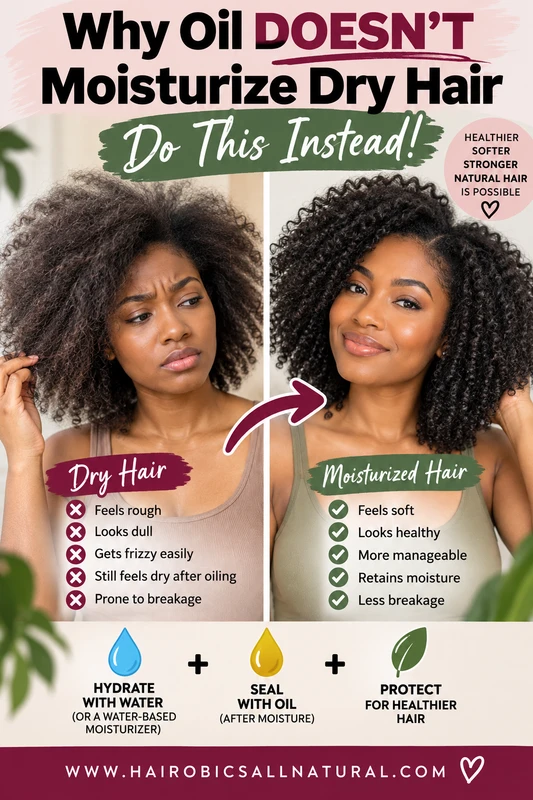
If your natural hair feels dry, your first instinct may be to reach for a bottle of oil. Coconut oil, castor oil, jojoba oil, olive oil, avocado oil, and other natural oils are staples in many Black hair care routines. They can make hair look shinier, feel smoother, and help reduce friction.
But there is one important thing oil cannot do by itself:
Oil does not moisturize dry hair.
That may sound surprising, especially if you have spent years hearing that certain oils are "moisturizing oils." The truth is more nuanced. Oils can be extremely useful for natural hair, but they generally work best as sealers, lubricants, conditioners, or protective ingredients rather than as the primary source of hydration.
If you continuously apply oil to hair that is already dehydrated, you may end up with shiny hair that still feels dry underneath.
Understanding the difference between moisture and oil can completely change the way you care for dry natural hair.
In this guide, we'll explain why oil doesn't moisturize dry hair, what your hair actually needs, when you should use oil, how to layer products correctly, and how to build a moisture routine that keeps natural hair softer and more manageable.
What Does It Mean to Moisturize Hair?
Before discussing oil, it helps to understand what "moisturized hair" actually means.
When people describe their hair as moisturized, they are usually talking about hair that feels:
- Soft
- Flexible
- Supple
- Easier to detangle
- Less brittle
- Less rough
- More manageable
Water plays a central role in hair hydration.
Think about what happens when you step into the shower. Dry natural hair often becomes softer and more flexible once it gets wet.
You didn't add oil.
You added water.
That is an important clue.
Water can temporarily increase the water content of the hair fiber. A good moisturizing routine therefore focuses on introducing hydration and then helping the hair retain it for as long as practical.
Oil can participate in that second part.
But oil itself is not water.
Why Oil Doesn't Moisturize Dry Hair
The simplest explanation is that oil and water are fundamentally different substances.
Most plant oils are hydrophobic, meaning they do not mix readily with water.
When you apply oil to dry hair, the oil primarily coats and lubricates the hair rather than supplying it with water.
That coating may immediately make your hair:
- Shinier
- Smoother
- Less frizzy
- Easier to manipulate
Those changes can make it seem like the hair has been moisturized.
But shine and lubrication are not the same thing as hydration.
Imagine having extremely dry hands and covering them with oil without first introducing any water or a water-containing moisturizer. Your hands may feel slicker, but that doesn't necessarily address the underlying lack of hydration.
Hair can behave similarly.
This is why someone can apply oil every day and still wonder:
"Why is my hair always dry?"
The missing component may be water.
Oil Can Help Keep Hair Moisturized
Saying oil doesn't moisturize hair does not mean oil is useless.
Far from it.
The distinction is that oil generally works better at helping you retain moisture than at supplying the moisture itself.
After applying a water-based moisturizer, leave-in conditioner, or moisturizing spray, an oil can help coat the hair and slow moisture loss.
Think of it like this:
Water = hydration
Water-based product = moisture delivery
Oil = helps seal, lubricate, and protect
This is why product layering can work so well for dry natural hair.
Instead of:
Dry Hair → Oil
try:
Dry Hair → Water-Based Moisture → Oil
That small change can make a noticeable difference.
Why Hair Can Feel Soft Immediately After Applying Oil
This is where the confusion often begins.
You put oil on dry hair.
Five minutes later, your hair feels softer.
So naturally, you think:
"The oil moisturized my hair."
Not necessarily.
Oil can reduce friction between hair strands and coat rough areas of the cuticle. That can create a smoother feel.
The hair may therefore feel softer even though you haven't added significant water.
The difference becomes more obvious later.
If the hair was extremely dehydrated before applying the oil, it may begin feeling dry, stiff, or rough again relatively quickly.
You may respond by adding more oil.
Eventually you can enter a cycle:
Dry hair → oil → temporary softness → dry feeling → more oil → buildup → still dry.
At that point, adding even more oil usually isn't the solution.
Your hair may need cleansing and a better hydration routine.
The Difference Between Dry Hair and Hair That Needs Oil
These two conditions can feel similar.
Hair that needs moisture may feel:
- Brittle
- Straw-like
- Rough
- Stiff
- Difficult to detangle
- Easily tangled
- Less flexible
Hair that could benefit from a small amount of oil may instead feel:
- Frizzy
- Dull
- Rough on the surface
- Difficult to separate
- Prone to friction
- In need of additional sealing
There can obviously be overlap.
The important point is that you don't want to automatically respond to every hair problem by applying more oil.
Sometimes your hair needs hydration.
Sometimes it needs conditioning.
Sometimes it needs cleansing.
Sometimes it needs lubrication.
And sometimes it simply needs to be left alone.
Why Natural Hair Can Become Dry So Quickly
Natural hair—particularly tightly curled and coily textures—can be prone to dryness.
One reason involves the shape of the strand.
Scalp sebum can travel more easily down relatively straight hair than down strands containing numerous bends, twists, and coils. As a result, the ends of curly and coily hair may receive less natural scalp oil.
Your ends are also the oldest part of your hair.
They have experienced years of:
- Washing
- Styling
- Detangling
- Weather exposure
- Friction
- Heat
- Protective styling
- Manipulation
This makes maintaining hydration and minimizing unnecessary damage particularly important for retaining length.
Dryness does not necessarily mean something is "wrong" with your natural hair.
Natural hair simply benefits from a routine designed around its characteristics.
Water Should Be the Foundation of Your Moisture Routine
If your hair is constantly dry, look at the first ingredients in your moisturizing products.
For a product intended primarily to provide moisture, water (aqua) will commonly appear near the beginning of the ingredient list.
Water-based leave-ins and moisturizing sprays can deliver hydration while conditioning ingredients help improve softness and manageability.
You can then follow with an oil or oil-containing product if your hair benefits from additional sealing.
For example:
Step 1: Hydrate
Apply a water-based moisturizer or leave-in.
Step 2: Distribute
Work the product through your hair in sections so that you aren't moisturizing only the outer layer.
Step 3: Seal
Apply a small amount of oil or another sealing product.
Step 4: Protect
Style your hair in a way that reduces excessive manipulation and moisture loss.
The exact products and frequency will depend on your hair.
Why Putting Oil on Bone-Dry Hair Can Be Disappointing
Picture a dry sponge.
If you cover that dry sponge with oil, you haven't actually given it water.
Hair isn't literally a sponge, but the comparison helps illustrate the problem.
Applying oil directly to severely dehydrated hair can coat the strands without addressing the hydration your hair is missing.
This is especially noticeable with heavier oils.
You might end up with hair that feels:
greasy and dry at the same time.
If you've experienced this, you're not imagining it.
The surface of the strand can be oily while the hair still feels rough or dehydrated.
When that happens, repeatedly adding more oil can make the situation worse.
Can You Use Oil on Wet Hair?
Yes.
In fact, many people with natural hair find that applying oil to damp or moisturized hair works better than applying it to completely dry hair.
After washing your hair, water is already present.
You can apply your leave-in conditioner and then use a small amount of oil to help seal in that moisture.
You don't necessarily want dripping-wet hair.
Damp hair often works well.
Try experimenting with:
Clean damp hair → leave-in → oil
and compare the results with:
Dry hair → oil
Your hair's response will tell you which technique works better for you.
What About the LOC Method?
The LOC method is a popular natural hair product-layering technique.
LOC stands for:
L – Liquid
O – Oil
C – Cream
The idea is to layer a liquid or water-based product, oil, and cream to improve moisture retention.
For example:
- Apply a water-based leave-in.
- Apply a small amount of oil.
- Apply a moisturizing or styling cream.
Some people love this method.
Others find it too heavy.
That's why there is also the LCO method.
What Is the LCO Method?
LCO stands for:
L – Liquid
C – Cream
O – Oil
Here, you apply your products in this order:
- Liquid or leave-in
- Cream
- Oil
The oil is applied last as the final sealing layer.
For some people—especially those whose hair dries quickly—the LCO method may feel more effective.
But neither method is universally "better."
The best order is the one that keeps your hair soft without leaving excessive residue.
Low-Porosity Hair and Oil
Hair porosity describes how your hair takes in and retains water and hair products.
Low-porosity hair often resists water and can be especially vulnerable to product buildup.
If you have low-porosity hair, covering it with heavy oils repeatedly may leave it:
- Greasy
- Coated
- Limp
- Dull
- Difficult to moisturize
This is one reason someone might say:
"I moisturize my hair every day, but it's still dry."
If "moisturizing" actually means applying oil every day, the hair may simply be accumulating layers of product.
Low-porosity hair may do better with lighter products and less oil.
Potential lighter oil options include:
- Jojoba oil
- Grapeseed oil
- Argan oil
- Sweet almond oil
You don't necessarily need to eliminate heavier oils.
You simply need to pay attention to how your hair responds.
High-Porosity Hair and Oil
High-porosity hair tends to absorb water readily but may also lose it relatively quickly.
This can occur naturally or result partly from chemical treatments, heat, weathering, and mechanical damage.
High-porosity hair may benefit from richer conditioning and sealing products.
Some people with high-porosity hair enjoy oils such as:
- Avocado oil
- Olive oil
- Castor oil
- Coconut oil
But remember:
Even high-porosity hair needs water first.
Applying a heavy oil to dehydrated high-porosity hair isn't a substitute for hydration.
A more effective sequence is often:
Hydrate → condition → seal → protect
Why Your Hair May Still Feel Dry After Moisturizing
Suppose you're already using water-based products and your hair still feels dry.
There are several possibilities.
1. You're Not Using Enough Product
Thick, dense natural hair often needs to be moisturized in sections.
If you apply a little moisturizer to the outside of your afro or twists, the inner strands may remain untouched.
Divide your hair into manageable sections.
Apply the product from roots toward ends, paying particular attention to dry areas.
2. You're Using Too Much Oil
More oil isn't always better.
Heavy oil application can leave a coating that makes it difficult to tell what your hair actually needs.
If your hair feels greasy but dry, consider reducing the amount of oil you use.
3. You Have Product Buildup
Layering:
Oil + butter + cream + gel + moisturizer + more oil
week after week can eventually leave substantial residue.
At some point, your hair may need a thorough wash rather than another layer of product.
Use an appropriate shampoo and clarify periodically when buildup warrants it.
Then follow with conditioning and moisture.
4. Your Shampoo Is Too Harsh for Your Routine
Cleansing is essential, but your shampoo should fit your scalp, hair, styling habits, and product use.
If your hair feels extremely stripped after every wash, look at your overall routine.
You may need to adjust:
- Shampoo frequency
- Shampoo choice
- Water temperature
- Conditioning
- Styling habits
The goal isn't to avoid shampoo.
A clean scalp and clean hair provide a much better foundation for your routine.
Conditioner Is Important for Dry Hair
Water alone is useful, but conditioning can make a major difference.
Conditioners typically contain ingredients designed to improve:
- Slip
- Softness
- Detangling
- Manageability
- Surface smoothness
This is especially helpful for tightly textured hair because detangling without sufficient slip can increase breakage.
After shampooing:
- Apply conditioner.
- Work in sections.
- Detangle carefully.
- Rinse according to the product instructions.
- Follow with your leave-in or moisturizer.
If your hair tends to be extremely dry, you may also benefit from periodic deep conditioning.
Don't Confuse Shine With Moisture
One of the biggest mistakes in natural hair care is using shine to determine whether hair is healthy or moisturized.
Oil reflects light.
That means oil can make hair look glossy.
But shiny hair can still be dry.
Likewise, healthy tightly coiled hair isn't always naturally glossy.
Your texture affects how light reflects from the strands.
Instead of judging moisture by shine alone, pay attention to:
- Softness
- Flexibility
- Manageability
- Breakage
- Tangling
- How your hair feels several hours after moisturizing
Those observations are usually more useful than shine alone.
Can Coconut Oil Moisturize Hair?
Coconut oil is one of the most researched oils used in hair care.
It has unique interactions with hair compared with many other oils and can penetrate into the hair fiber to some degree.
But that still doesn't turn coconut oil into water.
Coconut oil can be useful in a hair-care routine, including helping reduce certain types of protein loss and damage under some conditions.
However, if your hair is dehydrated, coconut oil alone isn't the same thing as adding water.
Some people also find coconut oil makes their hair feel hard or stiff.
If that happens to you, you don't have to use it.
Natural doesn't automatically mean ideal for every head of hair.
Does Castor Oil Moisturize Hair?
Castor oil is thick and highly popular in Black hair care.
It is often used on:
- Scalp
- Edges
- Ends
- Protective styles
- Locs
Because of its thickness, castor oil can be a useful sealing or lubricating product for some hair types.
But again, it doesn't replace water.
If you apply castor oil to extremely dry hair, you may simply end up with heavy, oily, dry-feeling hair.
Try applying a water-based moisturizer first.
Then use a small amount of castor oil where additional sealing is needed.
Does Jojoba Oil Moisturize Hair?
Jojoba is technically a liquid wax rather than a conventional triglyceride oil, and its properties make it popular in skin and hair products.
It can help lubricate and soften the feel of hair.
But jojoba oil should still not be treated as a substitute for water-based hydration.
It can be an excellent component of a moisture routine.
It just shouldn't necessarily be the entire routine.
Should You Oil Your Scalp?
This depends on your scalp and preferences.
Some people enjoy using small amounts of scalp oil.
Others do better without it.
Your scalp naturally produces sebum, so you don't automatically need to coat your scalp with oil every day.
If you do use scalp oil, avoid assuming that more is better.
Too much oil combined with sweat, dead skin, and styling products can create buildup.
Also remember that persistent scalp symptoms such as severe itching, redness, sores, significant flaking, or unexplained hair loss may need evaluation by a dermatologist or healthcare professional rather than simply adding more oil.
How Often Should You Moisturize Natural Hair?
There isn't one universal schedule.
Some people may need to refresh their hair every couple of days.
Others may be comfortable for most of a week after a thorough wash-day routine.
Instead of following a rigid calendar, monitor your hair.
Ask:
Does it still feel soft?
Are my ends beginning to feel rough?
Is my hair becoming difficult to manipulate?
Does it feel brittle?
If your hair still feels good, you don't necessarily need another layer of products.
If it's beginning to feel dry, a moisture refresh may help.
A Simple Moisture Routine for Dry Natural Hair
If you're struggling with persistent dryness, simplifying your routine can help you figure out what works.
Wash Day
Start with clean hair.
Use shampoo to remove excess oil, dirt, sweat, and product buildup.
Concentrate on cleansing the scalp while allowing the lather and water to cleanse the length of the hair.
Condition
Apply conditioner generously enough to provide slip.
Separate your hair into sections.
Detangle gently from the ends upward.
Apply a Leave-In
After rinsing your conditioner, apply a water-based leave-in treatment while your hair is still damp.
Work section by section.
Don't forget your ends.
Seal If Needed
Apply a small amount of oil, pomade, butter, or another sealing product if your hair benefits from it.
You don't need to saturate the hair.
A light coating may be enough.
Style
Choose a low-manipulation style such as:
- Two-strand twists
- Braids
- Bantu knots
- Flat twists
- Bun
- Afro
- Wash-and-go
The best style is one that works with your hair and lifestyle without creating unnecessary tension.
Pay Extra Attention to Your Ends
Your ends are the oldest part of your hair.
If you're trying to retain length, protecting them is important.
When moisturizing:
- Work your water-based product through the hair.
- Make sure the ends receive moisture.
- Add a small amount of sealing product if needed.
- Avoid excessive pulling and manipulation.
Length retention isn't only about how quickly hair grows from your scalp.
It's also about keeping the hair you've already grown.
Why Daily Oiling Can Backfire
It is easy to fall into the habit of oiling every morning and night because your hair feels dry.
But if the underlying problem is lack of water, daily oiling may create more buildup without solving the problem.
You may notice:
- Heavy strands
- Greasy roots
- Dull hair
- Product flakes
- Increased wash-day difficulty
- Hair that still feels dry
Instead of automatically adding more oil, ask yourself:
When was the last time I actually hydrated my hair?
That question can completely change your routine.
Should You Spray Water on Your Hair Every Day?
Not necessarily.
Some people benefit from light moisture refreshes.
Others find that daily wetting causes too much manipulation, shrinkage, frizz, or styling disruption.
A better approach is to respond to your hair.
If it still feels soft and manageable, leave it alone.
If it feels dry, lightly refresh it with a water-based product and reseal only if necessary.
You don't need to restart your entire wash-day routine every morning.
The Problem With Using Too Many Hair Products
Dryness can make you want to buy everything.
Before long, your routine includes:
Shampoo.
Conditioner.
Deep conditioner.
Leave-in.
Cream.
Butter.
Oil.
Pomade.
Serum.
Gel.
Scalp oil.
Growth oil.
You may not need all of them at once.
A simple routine often makes it easier to determine which products are actually helping.
Start with the basics:
Cleanse → Condition → Moisturize → Seal if needed → Style
Then adjust according to your hair.
Moisture and Protein Are Different
Another common source of confusion is protein.
Protein treatments and moisturizing treatments are not interchangeable.
Protein-containing products may help temporarily reinforce or improve the feel of damaged hair, depending on their formulation.
But too much protein for your particular hair and routine may leave hair feeling stiff.
If your hair feels unusually hard or brittle after repeated strengthening treatments, look at the products you're using.
You may need to rebalance your routine rather than continuing to add oils.
Protective Styles Still Need Hair Care
Braids, twists, wigs, and loc styles can reduce daily manipulation, but they don't eliminate your hair's needs.
Hair underneath a protective style can still become dry.
Use an appropriate lightweight moisturizing product when necessary.
Avoid pouring heavy oil over your scalp and braids every day in an attempt to moisturize them.
A water-based moisturizing spray may provide hydration more effectively.
You can follow with a small amount of oil if needed.
How to Moisturize Locs Without Making Them Greasy
Locs can easily accumulate residue from heavy creams, butters, waxes, and oils.
If your locs feel dry, you don't necessarily need more heavy oil.
Try a lightweight water-based moisturizing spray.
Then use a small amount of oil if necessary.
The goal is:
Hydrated locs—not saturated locs.
Keeping your routine relatively lightweight can also make cleansing easier.
What Ingredients Should You Look for in a Moisturizer?
When shopping for a product designed to moisturize dry natural hair, look at the entire formulation rather than focusing on one trendy ingredient.
Water-based moisturizing products may contain ingredients such as:
- Water
- Aloe-based ingredients
- Glycerin
- Panthenol
- Conditioning agents
- Botanical extracts
- Fatty alcohols
- Oils
- Emollients
Remember that ingredients work as a formula.
One ingredient alone doesn't determine whether a product will work for your hair.
Humectants vs Oils
Humectants are ingredients that interact with water and are often used in moisturizing formulations.
Common examples include:
- Glycerin
- Propylene glycol
- Honey
- Panthenol
Oils, on the other hand, primarily provide emollience, lubrication, and/or occlusive effects depending on the oil and formulation.
That is why a good moisturizer often contains multiple types of ingredients.
A properly formulated product may combine:
Water + humectants + conditioning ingredients + emollients
rather than relying entirely on oil.
Signs Your Hair May Need More Moisture
Your hair may be asking for hydration if it:
- Feels rough
- Feels brittle
- Snaps easily during manipulation
- Becomes difficult to detangle
- Feels unusually stiff
- Loses softness quickly
- Feels dry even though it looks oily
However, breakage and hair loss can have many causes.
Persistent or severe changes should not automatically be blamed on dryness.
Signs You May Be Using Too Much Oil
You may want to reduce oil use if:
- Hair constantly feels greasy
- Products sit on the hair
- Your scalp develops heavy buildup
- Hair feels weighed down
- Hair looks dull despite being oily
- Your hands are covered in oil whenever you touch your hair
- You keep adding oil but dryness doesn't improve
In this situation, the answer usually isn't another layer of oil.
You may need to cleanse your hair and restart with hydration.
Does Oil Make Hair Grow Faster?
Hair oils are frequently marketed as hair-growth products.
It is important to keep expectations realistic.
Hair growth occurs from follicles within the scalp, and many factors influence growth and retention.
These include:
- Genetics
- Age
- Nutrition
- Hormonal factors
- Health conditions
- Hair-care practices
- Breakage
Oil can be useful for reducing friction and supporting a hair-care routine, but simply coating your hair with oil does not guarantee faster growth.
One of the most practical things you can do is focus on length retention.
If your hair grows but continually breaks at the ends, it can appear as though your hair isn't growing.
Keeping hair properly conditioned, minimizing breakage, and handling it gently can help you retain more of the length you grow.
The Best Way to Use Oil for Dry Natural Hair
Oil works best when you give it the right job.
Don't expect oil to do everything.
Try this approach:
1. Start with clean hair.
Remove excessive buildup so water and conditioning products can interact effectively with your strands.
2. Add hydration.
Use water and/or a water-based leave-in.
3. Condition.
Use products that improve softness and manageability.
4. Apply oil strategically.
Use enough to lubricate or help seal the hair without making it excessively greasy.
5. Protect your hair.
Reduce unnecessary manipulation and friction.
6. Repeat when your hair actually needs it.
Don't add oil automatically just because it's morning.
A Better Way to Think About Natural Hair Oils
Instead of asking:
"Which oil will moisturize my hair?"
try asking:
"Which moisturizer hydrates my hair, and which oil helps me maintain the results?"
That question puts oil into a more useful role.
For example:
Your leave-in provides water and conditioning ingredients.
Your oil adds lubrication and helps slow moisture loss.
Your styling product provides hold.
Your satin bonnet reduces nighttime friction.
Each part of the routine has a purpose.
No single product has to do everything.
Frequently Asked Questions
Can I use only oil on my natural hair?
You can use oil whenever you like, but oil alone may not provide enough hydration if your hair is dry. A water-based moisturizer or leave-in conditioner is generally a better foundation for a moisture-focused routine.
Should I put water or oil on my hair first?
If your goal is hydration, water or a water-based moisturizing product generally comes first. Oil can then be used as a sealing or lubricating step.
Why does my hair feel dry even after I oil it?
The hair may be dehydrated underneath the oil, or you may have product buildup. Try cleansing when necessary and applying a water-based moisturizing product before oil.
Can too much oil dry out hair?
Oil itself isn't necessarily "drying" your hair, but excessive oil use can contribute to buildup and may leave you repeatedly coating dehydrated strands rather than supplying the hydration they need.
Is hair grease a moisturizer?
Hair grease is generally better understood as a sealing, lubricating, or protective product rather than a primary source of water-based hydration.
Can I put oil on dry hair?
Yes. Oil can be useful on dry hair for shine, lubrication, frizz control, or reducing friction. But if your hair is dehydrated, apply a water-based moisturizer first.
What's better for dry natural hair: oil or leave-in conditioner?
They perform different jobs. A water-based leave-in can provide hydration and conditioning, while oil can help lubricate and seal. Many people benefit from using both strategically.
How can I tell if my hair needs moisture?
Hair that needs moisture may feel rough, stiff, brittle, tangled, or difficult to manipulate. If adding oil only makes it greasy without improving those issues, focus on water-based hydration and conditioning.
Final Thoughts: Oil Is Helpful, but Water Is the Foundation
Natural oils absolutely have a place in a healthy natural hair routine.
They can add shine, reduce friction, improve manageability, lubricate strands, protect vulnerable ends, and help slow moisture loss.
But there is an important distinction:
Oil is not the same thing as moisture.
If your natural hair is chronically dry, repeatedly covering it with oil may leave you frustrated.
Start with hydration.
Use a water-based moisturizer or leave-in treatment.
Then use oil strategically to help maintain softness and reduce moisture loss.
Remember this simple formula:
Hydrate first. Seal second. Protect third.
Once you understand the difference between adding moisture and sealing moisture, caring for dry natural hair becomes much easier.
Your hair doesn't necessarily need more oil.
Sometimes, it simply needs more water—and a routine designed to help it hold onto that hydration.
SEO Title
Why Oil Doesn't Moisturize Dry Hair: What to Use Instead
Meta Description
Does your hair still feel dry after applying oil? Learn why oil doesn't moisturize dry natural hair, how water hydrates hair, and the right way to use oils to seal in moisture.
Suggested URL Slug
why-oil-doesnt-moisturize-dry-hair
Primary Keyword
why oil doesn't moisturize dry hair
Secondary Keywords
does oil moisturize hair, oil for dry natural hair, how to moisturize dry hair, natural hair moisture, how to keep natural hair moisturized, water vs oil for hair, how to seal moisture in natural hair, why is my hair dry after oiling, best way to moisturize natural hair, dry Black hair care
Suggested Internal Links
Link this article to related Hairobics All Natural blog posts covering Why Is My Natural Hair So Dry?, How to Keep Natural Hair Moisturized, How Often Should You Oil Your Scalp?, Best Oils for Low-Porosity Hair, Best Oils for High-Porosity Hair, Should You Put Oil on Wet or Dry Hair?, and Scalp Oil vs Hair Oil.
Product Integration for Hairobics All Natural
For readers building a moisture-focused routine, introduce Raaw Roots Moisturizing Spray as the hydration step and use Scalp Rejuvenator Oil as a complementary oil step where appropriate. This reinforces the central lesson of the article: hydrate first, then use oil strategically rather than relying on oil alone.
Visit www.hairobicsallnatural.com to explore Hairobics All Natural hair-care products for natural hair.