Wash day is an essential part of maintaining healthy natural hair, but it can quickly become overwhelming when you're dealing with thick curls, tightly coiled strands, shrinkage, tangles, or hair that takes hours to detangle.
One simple technique can make the entire process more manageable: dividing your natural hair into sections before washing it.
But how many sections should you actually use on wash day?
Should you divide your hair into four sections, six sections, eight sections, or even more?
Does 4C hair require smaller sections than other natural hair textures? And can using the wrong number of sections contribute to tangling and unnecessary breakage?
The answer depends on your hair's length, density, texture, condition, and how easily it tangles.
For most people with natural hair, four to eight sections are an excellent starting point. However, some people can comfortably wash their hair in two large sections, while others benefit from ten or more smaller sections.
The goal isn't to create a specific number of perfectly even parts. It's to make your hair easier to cleanse, condition, detangle, and moisturize without unnecessary pulling or manipulation.
In this complete guide, we'll explain how many sections to use for different natural hair types, why sectioning matters, how to divide your hair properly, and how to build a wash-day routine that supports healthier-looking hair and better length retention.
Why Should You Section Natural Hair Before Washing?
Sectioning means dividing your hair into smaller, manageable portions before shampooing, conditioning, detangling, or styling.
Instead of working with your entire head of hair at once, you focus on one area at a time.
This approach can be especially helpful for people with tightly coiled, thick, long, or easily tangled natural hair.
Here are some of the biggest benefits.
1. Sectioning Helps Reduce Tangling
Natural curls and coils naturally wrap around one another.
During washing, loose strands can become intertwined, especially when hair is rubbed together or piled on top of the head.
Working in sections helps keep different areas separated.
This can reduce the amount of untangling required after shampooing.
2. Sectioning Makes Detangling Easier
Detangling a large amount of hair at once can be frustrating.
When you divide your hair into smaller portions, you can identify knots more easily and work through them without pulling on surrounding strands.
Smaller sections also make it easier to remove shed hairs before they become trapped in neighboring curls.
If tangling is one of your biggest challenges, read our guide on how to detangle matted natural hair without causing breakage.
3. Sectioning Improves Shampoo Distribution
When your hair is extremely dense, shampoo may reach the outer strands without adequately reaching the scalp underneath.
Dividing the hair creates easier access to the roots.
You can gently cleanse each area rather than repeatedly rubbing the entire head.
4. Sectioning Helps Distribute Conditioner
Conditioner is particularly important for maintaining softness and manageability.
Working in sections helps you apply conditioner throughout the lengths and ends instead of concentrating most of the product on the surface.
This can be particularly useful for high-density hair.
5. Sectioning May Reduce Unnecessary Breakage
Hair breakage can happen when strands experience excessive pulling, friction, or rough detangling.
Sectioning doesn't automatically prevent breakage, but it can make gentle handling easier.
You can concentrate on one manageable portion instead of repeatedly pulling through large tangled areas.
6. Sectioning Keeps Wash Day Organized
A complicated wash-day routine becomes easier when you follow a consistent pattern.
You know which sections have already been washed, conditioned, and detangled.
This prevents unnecessary repetition and helps you avoid missing areas.
How Many Sections Should You Use on Wash Day?
The ideal number of wash-day sections depends on how much hair you have and how easily you can manage each portion.
Here is a practical starting guide.
| Hair Type or Condition | Suggested Sections |
|---|---|
| Short, low-density natural hair | 2–4 |
| Medium-length natural hair | 4–6 |
| Thick, high-density natural hair | 6–8 |
| Long natural hair | 6–10 |
| Tightly coiled 4C hair | 4–8 |
| Very tangled natural hair | 8–12 |
| Fine, easily managed natural hair | 2–4 |
These numbers are suggestions rather than strict rules.
Someone with short, extremely dense hair may need more sections than someone with long, low-density hair.
Similarly, a person with 4C hair may find four sections perfectly manageable, while another person with the same curl pattern prefers eight.
The best number of sections is the smallest number that allows you to work gently, thoroughly, and comfortably.
Is Four Sections Enough for Natural Hair?
Four sections are one of the most popular starting points for natural hair wash day.
This method is simple, practical, and easy to maintain.
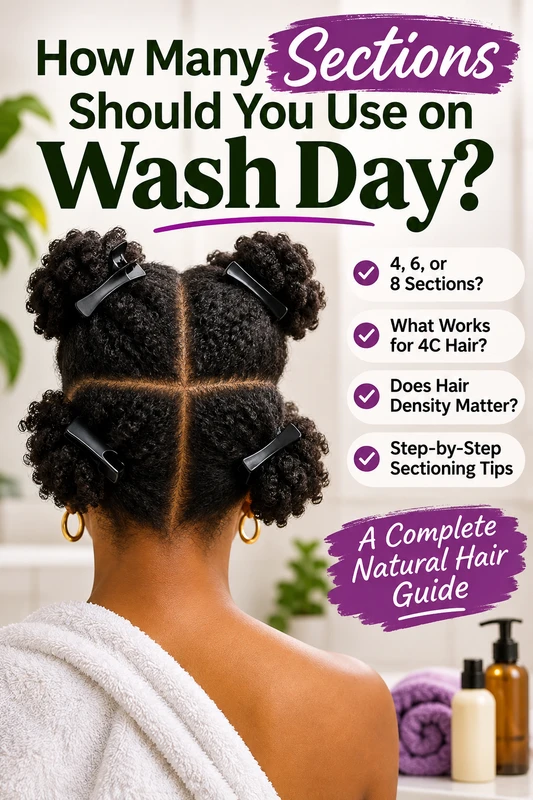
To create four sections, divide your hair down the middle from your forehead to your nape.
Then create another part from ear to ear.
You will have four main areas:
-
Front left
-
Front right
-
Back left
-
Back right
Secure each section with a loose twist, braid, or snag-free hair clip.
Four sections can work particularly well for people with medium-length natural hair, moderate density, or hair that doesn't tangle excessively.
Benefits of Washing in Four Sections
Four sections are relatively quick to create.
You don't need to spend a long time making precise parts.
You can easily reach the scalp, apply products, and keep your hair organized.
Four sections also make it easier to transition directly from shampooing to conditioning.
When Four Sections May Not Be Enough
Four sections may feel too large if your hair is extremely dense, very long, or difficult to detangle.
If you're struggling to reach the roots, distribute conditioner, or work through knots, divide each large section into two smaller sections.
This gives you eight sections without requiring a completely different routine.
Should You Use Six Sections on Wash Day?
Six sections can be an excellent compromise between four large sections and eight smaller ones.
This approach is particularly helpful when your hair is moderately thick or when the back of your head tangles more easily than the front.
For example, you might create:
-
Two front sections
-
Two middle sections
-
Two back sections
Alternatively, create three sections on each side of your head.
Six sections allow you to manage smaller portions without spending excessive time creating parts.
This arrangement may also help when your crown and nape require extra attention.
Remember that your sections don't need to be perfectly symmetrical.
It's completely acceptable to create smaller sections wherever your hair is most difficult to manage.
Is Eight Sections Better for Thick Natural Hair?
For many people with high-density natural hair, eight sections provide greater control during wash day.
Thick natural hair can be challenging because the number of strands makes it harder to reach the scalp and distribute products evenly.
Eight sections divide that workload into smaller portions.
Benefits of Eight Sections
Working in eight sections can make it easier to:
-
Saturate the hair thoroughly.
-
Reach the scalp underneath dense strands.
-
Apply conditioner evenly.
-
Identify tangles before they become larger knots.
-
Remove shed hairs.
-
Keep detangled sections separated.
-
Apply post-wash products more consistently.
Eight sections can be particularly useful for longer natural hair that experiences significant shrinkage.
However, eight sections aren't automatically better than four.
If your hair is easy to manage in four sections, creating eight may add unnecessary time.
For more advice on managing fuller hair, explore our high-density natural hair guide.
How Many Sections Should You Use for 4C Hair?
One of the most common natural hair questions is how many sections are best for washing 4C hair.
Four to eight sections are a practical starting point for many people with 4C natural hair.
However, curl pattern alone doesn't determine the ideal number.
4C hair is known for tightly coiled strands and significant shrinkage, but it can also be fine, coarse, low-density, or high-density.
Someone with short, low-density 4C hair may need only four sections.
Someone with long, high-density 4C hair may find eight or more sections easier.
Why Sectioning Can Be Helpful for 4C Hair
Tightly coiled strands can wrap around neighboring hairs, particularly during washing and detangling.
Sectioning helps keep those strands organized.
It also allows you to focus on smaller areas without repeatedly pulling through the same hair.
A Simple 4C Wash-Day Method
Start by dividing your hair into four large sections.
Check whether each section is easy to handle.
If a section feels too thick or tangled, divide it into two.
Continue until you can comfortably reach your scalp and detangle the hair.
You may end up with six, eight, or ten sections.
The exact number matters less than how manageable each section feels.
Use conditioner with adequate slip, detangle gently from the ends upward, and secure completed sections.
Avoid pulling tightly at the roots or forcing a comb through stubborn knots.
How Many Sections Should You Use for Long Natural Hair?
Long natural hair often benefits from additional sectioning because longer strands have more opportunities to wrap around one another.
For shoulder-length natural hair, four to six sections may be sufficient.
For hair extending well beyond the shoulders, six to ten sections may be more comfortable.
The amount of sectioning you need will also depend on density and how easily your hair tangles.
Why Long Hair May Need Smaller Sections
Longer strands can become intertwined during shampooing.
If you allow the entire head of hair to move freely, you may spend additional time separating tangles afterward.
Keeping long hair in loose twists or braids during parts of your wash-day routine can help maintain organization.
After detangling each portion, secure it again before moving to another area.
This prevents previously detangled strands from becoming tangled with unwashed hair.
How Many Sections Should You Use for Fine Natural Hair?
Fine natural hair has strands with a relatively small diameter.
Fine hair isn't necessarily thin or low-density.
You can have fine strands and still have a very full head of hair.
For fine, low-density natural hair, two to four sections may be sufficient.
For fine, high-density hair, you may prefer four to eight sections.
Avoid Excessive Manipulation
Fine strands can be vulnerable to mechanical damage from rough handling.
Creating too many sections may mean repeatedly parting, twisting, clipping, and manipulating the hair.
Use enough sections to keep your routine organized without adding unnecessary handling.
Choose gentle accessories and avoid securing wet hair too tightly.
Does Hair Density Matter More Than Curl Pattern?
Hair density plays a major role in determining how many sections you need.
Density refers to the number of hair strands growing within a given area of your scalp.
High-density hair contains more strands packed into that area.
Low-density hair contains fewer strands.
This is different from strand thickness, which describes the diameter of individual hairs.
Low-Density Hair
People with low-density hair may find larger sections easier to manage.
Two to four sections can provide adequate organization without creating numerous tiny portions.
Medium-Density Hair
Four to six sections may be a comfortable starting point.
Adjust based on your hair's length, texture, and tendency to tangle.
High-Density Hair
Six to eight sections may help you reach the scalp and distribute products more thoroughly.
For very dense hair, additional smaller sections may be useful during detangling.
If you're unsure how density affects your routine, read how to care for high-density natural hair.
How to Section Natural Hair Before Washing: Step-by-Step
Creating effective wash-day sections doesn't require professional styling skills.
The most important things are gentle handling and manageable portions.
Step 1: Gather Your Tools
Before starting, prepare your wash-day essentials.
You may need:
-
Wide-tooth comb
-
Detangling brush
-
Hair clips
-
Satin scrunchies
-
Spray bottle
-
Shampoo
-
Rinse-out conditioner
-
Leave-in treatment
-
Microfiber towel
Having everything ready prevents unnecessary interruptions.
Step 2: Check Your Hair for Tangles
Before creating sections, gently examine your hair.
If your strands are tangled, avoid forcing a comb through dry knots.
Depending on your hair's needs, you may find it helpful to lightly dampen the hair and use a suitable detangling product.
Work slowly and separate larger tangles with your fingers.
Step 3: Create Your Main Sections
Start with four sections.
Use your fingers or the end of a suitable comb to create comfortable parts.
Your parts don't need to be perfectly straight.
Avoid scratching your scalp or pulling tightly while separating the hair.
Step 4: Evaluate Each Section
Hold one section in your hand.
Ask yourself:
Can I comfortably reach my scalp?
Can I distribute shampoo and conditioner throughout this section?
Can I detangle without excessive pulling?
If the answer is no, make the section smaller.
Step 5: Secure Each Section
Use a loose twist, braid, or clip.
Avoid tight rubber bands that can snag or damage strands.
The purpose is to keep your hair organized, not to create tension.
Step 6: Begin Washing
Work through your sections in a consistent order.
For example, start at the back left and move around your head.
After completing a section, secure it again if needed.
This helps keep the remaining hair out of the way.
Should You Shampoo Natural Hair While It's Twisted?
Some people prefer washing their hair while it remains in large twists or braids.
Others prefer releasing one section at a time.
Both approaches can work, depending on hair density, buildup, and how thoroughly the hair can be cleansed.
Washing in Twists
Washing in loose twists may help keep longer or tightly coiled hair organized.
However, shampoo and water must still reach the scalp and interior strands.
Very tight twists or braids may make thorough cleansing and rinsing difficult.
If your hair has significant buildup, you may need to loosen or release sections to clean properly.
Washing Loose Sections
Another approach is to release one section, cleanse the scalp and hair, rinse thoroughly, and secure the section again.
This can make it easier to access dense areas.
Choose whichever method allows you to cleanse thoroughly without creating excessive tangling.
Should You Keep the Same Sections While Conditioning?
Keeping your hair organized during conditioning can make the process easier.
After shampooing, apply your rinse-out conditioner throughout each section.
Focus especially on the lengths and ends, which experience more weathering over time.
Use your fingers to distribute the conditioner.
If you need to detangle, make sure your hair has adequate slip.
Begin near the ends and gradually work toward the roots.
Once a section is detangled, secure it before moving to the next.
Can You Use Smaller Sections for Detangling?
Absolutely.
You don't have to use the same number of sections for every wash-day step.
For example, you might shampoo in four sections and detangle in eight.
This can save time during cleansing while allowing more precise handling during detangling.
You can also use larger sections when applying conditioner and smaller ones around areas that knot easily.
The key is flexibility.
How to Reduce Breakage While Washing in Sections
Sectioning is useful, but technique matters just as much.
Even small sections can experience damage when handled roughly.
Avoid Aggressive Shampooing
Don't pile your hair on top of your head and rub the strands together.
Instead, gently massage your scalp with your fingertips.
Allow the shampoo and water to move through your hair as you rinse.
Don't Detangle Without Enough Slip
If your hair feels rough or difficult to separate, add an appropriate conditioner or detangling product.
Avoid forcing tools through resistant knots.
Start at the Ends
Detangling from the roots downward can push knots together.
Begin near the ends, remove tangles gradually, and work upward.
Avoid Tight Twists
Your sections should be secure but comfortable.
Tight twisting and pulling can create unnecessary tension, especially around fragile edges.
Stop Repeatedly Combing the Same Section
Once your hair is adequately detangled, secure it and move on.
Repeated combing may increase friction without providing additional benefits.
For more information, read our complete guide on how to stop natural hair from breaking.
Should You Use Different Section Sizes Around Your Hairline and Crown?
Yes. Different areas of your head may need different amounts of attention.
Your crown may be denser or more prone to tangling.
Your nape may experience friction from clothing.
Your hairline may contain shorter, finer, or more fragile strands.
Rather than dividing your entire head into identical sections, adjust the size based on each area's needs.
For example, you might use larger sections along the sides and smaller sections at the crown.
Around fragile edges, handle the hair gently and avoid excessive pulling.
Smaller sections should make handling easier, not create additional tension.
How Sectioning Can Help With Length Retention
Hair growth and length retention are related, but they aren't the same thing.
Hair growth happens at the follicle.
Length retention describes how much of that growth remains visible as the hair gets longer.
If your hair grows but frequently breaks near the ends, you may struggle to notice an increase in length.
Sectioning doesn't directly increase the biological rate of hair growth.
However, it may help reduce some of the mechanical stress associated with washing and detangling.
When you handle smaller portions gently, you may be less likely to pull through large tangles or repeatedly manipulate the same strands.
Over time, a consistent low-breakage routine can support better length retention.
The goal is to preserve the hair you already have while maintaining a clean, comfortable scalp.
Best Hairobics Products to Include in Your Wash-Day Routine
A successful wash-day routine combines gentle cleansing, effective conditioning, manageable sectioning, and appropriate after-wash care.
At Hairobics All Natural, we offer botanical-based hair and scalp products that can complement your natural hair routine.
Here are three options to consider.
1. Hairobics Leave-In Treatment
After shampooing and rinsing out your conditioner, it's time to care for your hair and scalp.
Hairobics Leave-In Treatment contains a botanical blend featuring ingredients such as aloe vera, jojoba oil, avocado oil, rosemary oil, and other plant-derived ingredients.
The formula is designed for hair and scalp care and can be incorporated into your post-wash routine.
Apply according to the product directions, testing a small area first as recommended.
Working in manageable sections can help you apply products consistently without repeatedly handling the same hair.
Shop Hairobics Leave-In Treatment
2. Hairobics Hair & Scalp Booster
After washing, some people prefer additional oil-based conditioning for dry-feeling hair and scalp areas.
Hairobics Hair & Scalp Booster contains a blend of ingredients including coconut oil, jojoba oil, olive oil, wheat germ oil, vitamin E oil, peppermint oil, and rosemary oil.
The formula can complement your regular scalp-care routine.
Apply a suitable amount according to directions and avoid excessive layering that may contribute to buildup.
Remember that oil-based products do not replace water or proper conditioning.
Shop Hairobics Hair & Scalp Booster
3. Hairobics Scalp Rejuvenator Oil
A clean, comfortable scalp is an important part of natural hair maintenance.
Hairobics Scalp Rejuvenator Oil contains botanical oils including rosemary, tea tree, peppermint, lavender, and other plant-derived ingredients.
This scalp oil can be incorporated into a scalp-conditioning routine when used as directed.
Apply a small amount and massage gently without scratching or pulling on fragile strands.
Patch-test before broader application, and discontinue use if irritation occurs.
Shop Hairobics Scalp Rejuvenator Oil
Products can support softness, conditioning, and scalp comfort, but they cannot replace gentle handling or permanently repair broken strands.
How to Make Sectioning Part of a Faster Wash-Day Routine
Some people avoid sectioning because they believe it makes wash day longer.
Creating sections does take a few extra minutes, but it may save time later by reducing tangling and repeated detangling.
The key is to avoid making the process unnecessarily complicated.
Before Washing
Gather your products and accessories.
Check your hair for major tangles.
Create four manageable sections.
Divide larger sections further only when necessary.
During Shampooing
Thoroughly wet your hair.
Cleanse your scalp using gentle fingertip movements.
Work through the sections in a consistent order.
Rinse thoroughly.
During Conditioning
Apply conditioner evenly.
Detangle gently where needed.
Secure completed sections.
After Washing
Apply your leave-in or scalp-care products according to their directions.
Choose a comfortable, low-manipulation hairstyle.
Avoid repeatedly detangling hair that is already manageable.
If you're trying to spend less time washing and styling, explore our guide on how to reduce wash day time.
Common Wash-Day Sectioning Mistakes
Even a helpful technique can become frustrating when it's used incorrectly.
Here are several mistakes to avoid.
Mistake 1: Creating Too Many Tiny Sections
You don't need twenty sections just because someone online uses that method.
Extremely small sections may increase the time spent parting, clipping, and manipulating your hair.
Start with fewer sections and add more only when needed.
Mistake 2: Making Sections Too Large
If you can't comfortably reach your scalp or detangle the hair, your sections may be too large.
Divide them into smaller portions.
Mistake 3: Using Tight Hair Ties
Tight accessories can create tension and snag fragile strands.
Choose gentle clips, loose twists, or soft scrunchies.
Mistake 4: Letting Detangled Sections Mix Together
After detangling, leaving all your hair loose may allow strands to become intertwined again.
Secure completed sections when necessary.
Mistake 5: Ignoring the Crown and Nape
Some areas may require smaller sections or more careful handling.
Adjust your routine rather than forcing every section to be identical.
Mistake 6: Applying Too Much Product
More conditioner, leave-in treatment, or oil doesn't automatically mean better results.
Use appropriate amounts and distribute products thoroughly.
Mistake 7: Rushing Through Detangling
Working in smaller sections won't help if you aggressively pull through knots.
Take your time and use enough slip.
How Often Should You Wash Natural Hair in Sections?
You can use sectioning whenever you wash your hair.
However, the frequency of washing should depend on your scalp and lifestyle.
For many people, washing approximately every seven to fourteen days can be a reasonable starting point.
Others need more frequent cleansing because of exercise, sweat, oiliness, or product buildup.
The important thing is to maintain scalp cleanliness without unnecessarily overcomplicating your routine.
If you regularly use styling creams, gels, oils, or pomades, pay attention to buildup.
Don't assume that adding more moisture products will solve every problem.
Sometimes your scalp and hair simply need cleansing.
For help choosing a schedule, read how often should you wash natural hair.
How to Know Whether You're Using the Right Number of Sections
Your hair will often tell you whether your sectioning method is working.
Consider these questions after your next wash day.
Did you reach your scalp easily?
Was shampoo distributed thoroughly?
Could you apply conditioner evenly?
Were tangles manageable?
Did detangling feel gentle rather than forceful?
Did you avoid repeatedly combing the same areas?
Was your routine reasonably efficient?
If the answer to most of these questions is yes, your current number of sections may be appropriate.
If not, experiment with slightly smaller or larger sections.
You don't need to change everything at once.
Try adjusting just one part of your routine and observe the difference.
Frequently Asked Questions About Wash-Day Sections
Is four sections enough for 4C hair?
Yes. Four sections can be enough for 4C hair, especially when it is shorter or less dense. If your hair is thick, long, or prone to tangling, six to eight sections may be easier to manage.
Is it better to wash natural hair in four or eight sections?
Neither option is universally better. Four sections may be faster for manageable hair, while eight can provide greater control for dense or easily tangled hair.
Can I wash my natural hair without sectioning it?
Yes. Sectioning is optional. However, people with long, dense, or tightly coiled hair may find that washing without sections creates additional tangling.
Should I detangle before or after shampooing?
It depends on your hair. Some people benefit from gently removing major tangles before shampooing. Others prefer detangling after applying a rinse-out conditioner with adequate slip.
Do smaller sections prevent hair breakage?
Smaller sections can make gentle detangling easier, but they don't guarantee that breakage will stop. Technique, conditioning, existing damage, and the amount of tension applied also matter.
How many sections should I use for short natural hair?
Two to four sections may be sufficient for short natural hair. Very dense short hair may benefit from additional sections.
How many sections should I use for thick 4C hair?
Four to eight sections are a practical starting point. Some people with extremely dense hair may prefer ten or more, particularly during detangling.
Should I keep my hair twisted while shampooing?
You can wash in loose twists if your scalp and strands can be thoroughly cleansed and rinsed. Otherwise, release one section at a time and secure it again afterward.
Can I use different numbers of sections for shampooing and detangling?
Yes. You might shampoo in four sections, detangle in eight, and apply leave-in products in six. Adjust the number to suit each step.
Does sectioning help natural hair grow faster?
Sectioning doesn't directly stimulate faster hair growth. However, it can support gentler handling and may help reduce avoidable breakage, allowing you to retain more of the length you grow.
What is the easiest way to section natural hair?
Start with a center part and an ear-to-ear part to create four sections. Secure each portion loosely. Divide any section that feels too large.
Should you section your hair every wash day?
If sectioning makes your hair easier to manage, it can be a useful part of every wash day. If your hair is short or easy to cleanse without sections, it may not be necessary.
Final Thoughts: How Many Sections Are Best for Natural Hair Wash Day?
So, how many sections should you use on wash day?
For most people with natural hair, four to eight sections are a practical starting point.
Four sections may work beautifully for medium-length or easily managed hair.
Six sections may provide a comfortable balance between speed and control.
Eight or more sections may be especially helpful for long, high-density, tightly coiled, or easily tangled hair.
The most important thing is to choose a section size that allows you to cleanse your scalp thoroughly, distribute conditioner evenly, and detangle without excessive pulling.
You don't need perfectly straight parts or an elaborate routine.
You need a method that works for your hair.
Start with four sections, make adjustments when necessary, and pay attention to how your hair responds.
Combine gentle sectioning with appropriate cleansing, conditioning, moisturizing, and low-manipulation styling.
Over time, these habits can help you maintain softer, more manageable hair while reducing unnecessary mechanical stress.
For additional guidance on keeping your routine simple, read our complete guide to building a simple natural hair routine.
Healthy natural hair care doesn't have to be complicated. Sometimes the simplest change—like dividing your hair into manageable sections—can make wash day easier.
Discover botanical-based hair and scalp products designed to complement your natural hair routine at Hairobics All Natural.