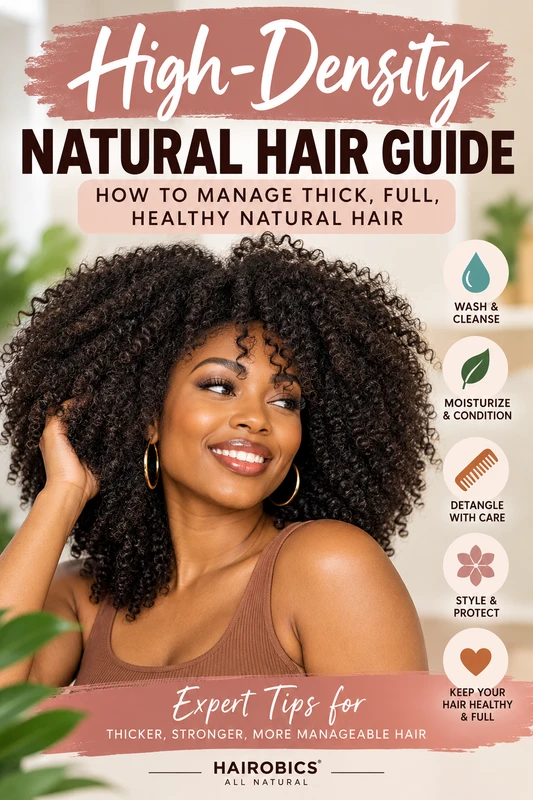
High-density natural hair is known for its beautiful volume, fullness, and versatility. Whether you have thick 4C coils, springy 4A curls, defined 3C ringlets, or a combination of textures, having a high density of hair can give you incredible styling possibilities.
However, maintaining high-density natural hair can also present unique challenges.
You might spend hours washing and detangling your hair, struggle to distribute moisturizing products evenly, or notice that your roots remain damp long after the rest of your hair feels dry.
Sometimes, your hair may look extremely healthy on the outside while the strands underneath are tangled, dry, or experiencing breakage.
The good news is that caring for high-density natural hair doesn't have to be complicated.
The secret is understanding your hair's unique characteristics and developing a routine that keeps every section properly cleansed, conditioned, moisturized, and protected.
In this complete high-density natural hair guide, you'll discover how to identify dense hair, choose appropriate products, manage volume, prevent tangles, maintain moisture, and create a routine that supports healthy hair and length retention.
What Is High-Density Natural Hair?
High-density natural hair refers to hair with a relatively large number of individual strands growing across the scalp.
Hair density is generally described using three categories:
-
Low-density hair: Fewer strands distributed across the scalp.
-
Medium-density hair: A moderate number of strands.
-
High-density hair: A large number of strands growing relatively close together.
People with high-density natural hair often have full-looking afros, thick ponytails, voluminous twist-outs, and hairstyles that naturally appear substantial.
However, hair density is not the same as individual strand thickness.
Someone with high-density hair can have fine, medium, or coarse strands.
For example, you might have thousands of fine strands that create a full appearance. Another person might have fewer strands that are individually much thicker.
Both hair types can appear thick, but their styling and product needs may differ considerably.
Understanding this distinction helps you avoid choosing products based entirely on how much hair you appear to have.
For additional information about density and overall natural hair characteristics, explore our Complete Natural Hair Care Guide.
How to Tell If You Have High-Density Natural Hair
Identifying your hair density is an important first step toward developing an effective natural hair routine.
Although professional measurements provide a more precise assessment, several observations can help you estimate your density at home.
1. Your Scalp Is Difficult to See
One common characteristic of high-density natural hair is that the scalp may be difficult to see when the hair is loose.
If you need to create a defined part to see your scalp clearly, you may have relatively high hair density.
However, curl pattern, hair length, styling, and lighting can influence scalp visibility.
2. Your Ponytail or Puff Looks Full
High-density hair often creates thick ponytails and voluminous puffs.
Even when your hair is relatively short, gathering the strands together may produce substantial fullness.
3. Your Hair Requires Multiple Sections
If washing or detangling your hair without dividing it into smaller sections feels overwhelming, density may be contributing to the challenge.
Many people with high-density natural hair find that four to eight sections make wash day more manageable.
4. Your Hair Takes Longer to Dry
A large number of closely packed strands can limit airflow through the interior of your hair.
Consequently, the outside may dry before the roots and underneath sections.
Porosity, product application, hair length, and environmental conditions also influence drying time.
5. Your Hairstyles Have Natural Volume
High-density natural hair often produces full-looking twists, braids, afros, and wash-and-go styles without requiring additional hair.
Remember that these characteristics are clues rather than a definitive diagnosis of density.
High-Density Hair vs. Thick Hair: Understanding the Difference
One of the biggest misconceptions about natural hair is that having thick-looking hair automatically means your individual strands are coarse.
In reality, hair density and strand thickness describe different characteristics.
Hair density refers to the number of strands growing within an area of the scalp.
Strand thickness refers to the diameter of an individual hair strand.
This distinction creates several possible combinations.
High-Density Fine Hair
You have many strands, but each strand has a relatively small diameter.
Your hair may appear extremely full while still being susceptible to damage from excessive tension or rough handling.
Lightweight conditioners, moisturizing sprays, and flexible styling products may work well.
High-Density Medium Hair
You have numerous strands with medium-sized individual hair fibers.
This combination may offer considerable styling flexibility, although product selection should still account for porosity and condition.
High-Density Coarse Hair
You have many strands, and the individual strands are relatively thick.
Some people with this combination prefer richer conditioning products, particularly when their hair is dry.
However, coarse hair doesn't automatically require heavy oils or butters.
The important lesson is to evaluate density, strand thickness, porosity, and hair condition together.
Why High-Density Natural Hair Can Be Difficult to Manage
High-density hair offers impressive volume, but the large number of strands can make routine maintenance more time-consuming.
One major challenge is reaching every part of the hair.
When you apply conditioner to a large section, the product may primarily coat the outside.
The interior strands can receive less coverage.
Similarly, shampoo may not reach the scalp effectively if the hair isn't separated during cleansing.
Another common challenge is tangling.
Closely packed curls and coils can wrap around neighboring strands, particularly when hair is allowed to shrink freely after detangling.
Dense hair can also require additional drying time.
Understanding these challenges makes it easier to build a routine around efficiency instead of spending unnecessary hours fighting tangles.
1. Divide High-Density Natural Hair Into Manageable Sections
Sectioning is one of the most useful techniques for managing dense natural hair.
Rather than washing, moisturizing, and styling your entire head simultaneously, divide your hair into smaller, organized sections.
Start with four sections.
If your hair is extremely dense or long, increase the number to six, eight, or more.
Secure each section with a loose twist, braid, or hair clip.
Sectioning offers several advantages:
-
Makes the scalp easier to reach.
-
Improves conditioner distribution.
-
Reduces unnecessary tangling.
-
Helps prevent missed areas.
-
Makes detangling more manageable.
-
Keeps completed sections organized.
-
Reduces repeated manipulation.
For example, when washing your hair, release one section, cleanse it, apply conditioner, and detangle as needed.
Once finished, loosely twist the section again before moving to the next.
This simple technique can make a noticeable difference in the amount of time and effort required during wash day.
2. Choose the Right Shampoo for Dense Natural Hair
Healthy-looking natural hair starts with consistent cleansing.
Because high-density hair contains numerous strands, reaching the scalp may require additional attention.
Choose a shampoo appropriate for your scalp condition and styling habits.
If you regularly use creams, gels, oils, and heavy styling products, you may need occasional clarifying to remove accumulated residue.
If your scalp is comfortable and your hair tends to feel dry, a gentle cleansing shampoo may be appropriate for regular wash days.
When shampooing, focus on the scalp rather than aggressively rubbing the entire length of your hair.
Use the pads of your fingertips to massage gently around the crown, nape, hairline, and other areas.
Avoid scratching your scalp with your nails.
Rinse thoroughly, ensuring that shampoo is removed from the roots and interior sections.
Remember that a clean scalp is important for normal scalp health, but shampoo alone cannot increase your genetically determined hair density.
3. Make Sure Water Reaches Every Section
One frequently overlooked challenge with high-density natural hair is uneven water distribution.
Your hair may look completely wet while some interior sections remain only partially saturated.
Before applying shampoo or conditioner, allow water to penetrate each section thoroughly.
Separate the strands with your fingers and gently squeeze water through the hair.
Pay particular attention to the crown and underneath layers.
Adequate saturation helps cleansing products spread more effectively and prepares your hair for conditioning.
If your hair has low porosity, it may take additional time to become thoroughly wet.
Warm water can make washing more comfortable, but excessively hot water may leave your hair and scalp feeling dry.
4. Condition High-Density Natural Hair Thoroughly
Conditioner plays an important role in reducing friction, improving manageability, and helping hair feel softer.
With dense natural hair, application technique matters as much as the amount used.
Instead of applying a large quantity to the surface, distribute conditioner through smaller sections.
Start with the mid-lengths and ends, where older strands often need additional attention.
Use your fingers to spread the product evenly.
Choose a conditioner that provides enough slip to make detangling easier.
For particularly dry or damaged hair, an appropriate deep-conditioning treatment may provide additional softness and manageability.
Follow the manufacturer's recommended processing time rather than assuming that leaving conditioner on for several hours will automatically produce better results.
5. Detangle High-Density Hair Without Excessive Breakage
Detangling is often one of the most challenging parts of maintaining thick natural hair.
When numerous strands grow closely together, shed hairs can become trapped among neighboring curls.
This can create knots and tangles, especially after several days of wearing loose hairstyles.
The goal is to remove tangles while minimizing unnecessary mechanical damage.
Start With Small Sections
Divide your hair into manageable sections.
If a section feels too large to detangle comfortably, divide it again.
Apply a Product With Good Slip
Conditioner or a suitable detangling product can reduce friction between strands.
For many people, detangling damp or wet hair with adequate slip is easier than combing completely dry curls.
However, wet hair can also be vulnerable to excessive stretching, so gentle handling remains essential.
Begin at the Ends
Start detangling near the ends and gradually move toward the roots.
Avoid forcing a comb through resistant knots.
Use Your Fingers First
Finger detangling allows you to identify knots before applying force with a tool.
Carefully separate tangled strands whenever possible.
Choose Appropriate Tools
Wide-tooth combs and detangling brushes designed for textured hair can be useful.
The best tool is one that works comfortably without excessive pulling.
Retwist Completed Sections
After detangling, loosely twist or braid each section to prevent the strands from tangling again.
Patience is especially important when caring for high-density 4C hair.
6. How to Moisturize High-Density Natural Hair
One of the biggest mistakes people make with high-density natural hair is applying moisturizer only to the visible surface.
Because the hair is so full, the outer layers may feel soft while the interior remains dry.
Effective moisturizing requires even distribution.
Begin by dividing your hair into sections.
Apply a water-based leave-in conditioner or moisturizer to each section.
Work the product gently through the hair, paying attention to the mid-lengths and ends.
If needed, follow with a small amount of cream or oil to improve softness, lubrication, and manageability.
Remember that oils are not substitutes for water-based conditioning products.
Adding oil repeatedly to dry hair can create a greasy coating without addressing the underlying need for conditioning.
The goal is to maintain soft, flexible, manageable strands rather than applying as much product as possible.
For a more detailed explanation, visit our Complete Natural Hair Care Guide.
7. Avoid Using Too Much Product
High-density natural hair may require more total product than lower-density hair because there are more strands to cover.
However, that doesn't mean you should automatically use extremely heavy products.
Applying too many layers of leave-in conditioner, cream, butter, gel, and oil can lead to buildup.
Signs of excessive product application may include:
-
Hair feels unusually heavy.
-
Strands appear dull or coated.
-
Products leave visible flakes.
-
Hair feels sticky.
-
Curls lose movement.
-
Hair becomes difficult to rinse clean.
Start with a moderate amount of product and distribute it thoroughly.
Add more only when necessary.
If your hair repeatedly feels weighed down, consider simplifying your routine or switching to lighter formulations.
8. Understand How Porosity Affects Dense Hair
Hair density and porosity are separate characteristics.
Density describes how many strands grow on your scalp.
Porosity describes how hair interacts with water and other substances.
Understanding both characteristics can help you choose a more effective routine.
High-Density, Low-Porosity Hair
This combination can be challenging when trying to saturate your hair quickly.
Take additional time to wet each section thoroughly.
Avoid automatically layering multiple heavy products.
Lightweight conditioning products may provide enough softness without excessive buildup.
High-Density, High-Porosity Hair
High-porosity hair may absorb water relatively quickly but can also lose moisture more readily.
Consistent conditioning and careful handling may be particularly helpful.
Some people prefer richer leave-ins or creams, depending on strand thickness and damage.
High-Density, Mixed-Porosity Hair
Different sections of your hair may respond differently to products.
For example, your ends may be more porous because they have experienced more wear than your roots.
Instead of forcing every section into the same routine, adjust product amounts according to how your hair behaves.
Porosity tests performed at home are not always reliable, so observe your hair's response to washing, conditioning, and styling over time.
9. Best Hairstyles for High-Density Natural Hair
One major advantage of dense natural hair is its versatility.
High-density hair can create impressive volume and definition across numerous hairstyles.
However, the best hairstyles should also be comfortable and minimize unnecessary tension.
Two-Strand Twists
Two-strand twists help keep dense hair organized while reducing daily manipulation.
They can also be worn for several days before creating a twist-out.
Chunky Braids
Large braids are often easier to install and remove than numerous tiny braids.
They can be particularly convenient for people who want a simple maintenance routine.
Twist-Outs
Twist-outs create defined curls with natural fullness.
Allow your twists to dry thoroughly before separating them.
Braid-Outs
Braid-outs can provide a stretched appearance and help reduce some shrinkage.
Natural Afros
High-density natural hair is especially well suited for full, voluminous afros.
Regular conditioning and gentle shaping help maintain a soft appearance.
Wash-and-Go Styles
Wash-and-go hairstyles can showcase natural curl definition.
However, they may require careful product distribution and sufficient drying time.
Low-Tension Buns
Loose buns can keep your ends tucked away while minimizing daily styling.
Avoid pulling the hairline excessively tight.
10. Protect Your Hairline From Excessive Tension
High-density natural hair may look strong because of its fullness.
However, individual strands and follicles can still be damaged by excessive pulling.
Tight ponytails, heavy extensions, restrictive braids, and uncomfortable protective styles may place unnecessary tension on the hairline.
Repeated tension can contribute to traction alopecia, a form of hair loss associated with pulling on the follicles.
Warning signs include scalp tenderness, bumps, broken hairs, and thinning around the edges.
A hairstyle should not cause persistent pain.
Choose comfortable styles and avoid repeatedly pulling the same areas tightly.
If you notice progressive thinning, scalp inflammation, or persistent discomfort, consult a dermatologist.
11. How to Reduce Shrinkage Without Damaging Your Hair
Shrinkage is a normal characteristic of curly and coily hair.
When natural hair dries, curls and coils contract toward their natural shape.
High-density hair can appear particularly compact because numerous strands shrink together.
Although shrinkage isn't a sign of unhealthy hair, some people prefer stretched styles for easier maintenance.
Heat-free stretching methods include:
-
Two-strand twists.
-
Braids.
-
Banding.
-
African threading.
-
Bantu knots.
These techniques can help elongate the appearance of your curls without requiring direct heat.
If you use a blow-dryer, apply an appropriate heat protectant and use controlled heat.
Avoid repeatedly exposing your strands to excessive temperatures.
The goal is to make your hair easier to manage without sacrificing its natural curl pattern.
12. Dry High-Density Natural Hair Completely
Dense natural hair may take considerable time to dry.
The outer sections can feel dry while the roots remain damp.
This can affect the appearance of twist-outs, braid-outs, and other set styles.
Before unraveling twists or braids, check the roots and interior sections.
If the hair is still damp, allow additional drying time.
A hooded dryer or diffuser used at an appropriate temperature may help shorten the process.
Avoid sleeping with tightly wrapped, persistently wet hair.
Adequate drying helps maintain your hairstyle and reduces prolonged dampness against the scalp.
13. Protect Your Hair While Sleeping
Nighttime protection can help reduce friction and tangling.
Dense natural hair may become compressed or tangled when rubbing against bedding throughout the night.
Consider using a satin or silk bonnet, scarf, or pillowcase.
Choose a bonnet large enough to accommodate your hair comfortably.
If your hair is especially long or full, loosely sectioning it before bed may help prevent tangles.
You can also gather your hair into a loose pineapple or several large twists.
Avoid securing your hair so tightly that it pulls on your edges.
The best nighttime routine is one you can maintain consistently.
14. Focus on Length Retention, Not Just Hair Growth
Many people with high-density natural hair want to grow their hair longer.
However, growing hair and retaining length are not exactly the same thing.
Hair grows from follicles within the scalp.
Length retention depends on preserving the strands as they grow.
If your hair grows but the ends repeatedly break, you may notice little visible increase in length.
High-density hair can make breakage harder to identify because the overall hairstyle may still look extremely full.
Pay attention to the condition of your ends.
Signs that your hair may need additional care include frequent snapping, persistent knots, rough ends, and increasing difficulty detangling.
Gentle handling, regular conditioning, low-tension hairstyles, and appropriate trimming can help reduce preventable damage.
For additional guidance, read How to Protect the Oldest Part of Your Hair on the Hairobics All Natural blog.
15. How to Manage High-Density 4C Natural Hair
High-density 4C hair combines a large number of strands with tightly coiled curl patterns.
This combination can create impressive volume, but it may also require patience during detangling and styling.
Because tightly coiled strands can wrap around neighboring hairs, maintaining organized sections is especially helpful.
Start wash day with several loose twists or braids.
Cleanse and condition each section thoroughly.
Use a conditioner with good slip and gently detangle from the ends upward.
After detangling, keep each section organized until you're ready to style.
You may also find stretched hairstyles easier to maintain between wash days.
Remember that 4C hair does not automatically require the heaviest products available.
Choose products based on your actual strand thickness, porosity, condition, and styling preferences.
16. How Often Should You Wash High-Density Natural Hair?
There is no single washing schedule that works for everyone.
Your ideal frequency depends on scalp oil production, sweating, product use, hairstyle, and personal comfort.
Some people prefer washing weekly.
Others find that washing every one to two weeks works well.
If you exercise frequently, use substantial amounts of styling products, or experience buildup, you may need more frequent cleansing.
Pay attention to signs that your scalp needs attention, including accumulated residue, unpleasant odor, or persistent discomfort.
If you have ongoing itching, flaking, or inflammation, seek professional guidance rather than relying exclusively on oils or home treatments.
The goal is to maintain a clean, comfortable scalp without making your routine unnecessarily complicated.
17. Create a Weekly High-Density Natural Hair Routine
Consistency is more important than using a large collection of products.
A simple weekly routine can help you maintain healthy-looking, manageable hair.
Wash Day
Divide your hair into sections.
Saturate each section thoroughly with water.
Cleanse your scalp using an appropriate shampoo.
Apply conditioner evenly throughout the hair.
Detangle gently, working from the ends toward the roots.
Rinse thoroughly and apply a suitable leave-in conditioner.
Finish with a comfortable, low-manipulation hairstyle.
Between Wash Days
Check your hair for dryness, tangling, and product buildup.
Refresh individual sections with a small amount of water-based moisturizer when necessary.
Avoid repeatedly layering products if your hair already feels soft.
Keep your hair organized in twists, braids, or another manageable style.
Nighttime
Protect your hair with satin or silk.
Avoid excessive tension around the hairline.
Monthly Maintenance
Evaluate the condition of your ends.
Check whether your products are creating buildup.
Assess whether your current hairstyles are comfortable.
Trim damaged ends when needed rather than following an arbitrary trimming schedule.
This routine provides a foundation that you can adjust according to your lifestyle.
18. Common Mistakes to Avoid With High-Density Natural Hair
Even naturally full hair can experience damage when maintenance habits create unnecessary stress.
Applying Products Only to the Surface
Always separate dense hair so that conditioning products reach the interior strands.
Using Excessively Heavy Products
High density doesn't automatically mean your hair needs heavy butters and oils.
Detangling Large Sections
Smaller sections usually provide greater control and reduce the temptation to pull through knots.
Ignoring the Scalp
Dense hair can make the scalp difficult to access, but consistent cleansing remains important.
Wearing Tight Hairstyles
Avoid styles that cause persistent pulling, pain, or hairline irritation.
Restyling Too Frequently
Constant brushing, combing, and manipulation can contribute to mechanical damage.
Ignoring Your Ends
The oldest strands often need careful handling because they have experienced more wear.
Following Someone Else's Routine Exactly
Two people with high-density hair may have completely different porosity, strand thickness, and styling needs.
Build your routine around your own hair.
19. Best Products for High-Density Natural Hair
Choosing appropriate products can make dense hair easier to manage.
However, you don't need dozens of products to maintain healthy-looking natural hair.
A practical routine usually includes a cleansing shampoo, rinse-out conditioner, moisturizing leave-in product, and styling product when needed.
Some people also incorporate lightweight oils or creams.
The key is selecting formulas that complement your hair's characteristics.
Moisturizing Products
A water-based leave-in conditioner can help improve softness and manageability.
Apply it in sections so that the product reaches more than just the outer layers.
Conditioning Treatments
Conditioners with good slip can make detangling more comfortable and reduce friction.
Scalp Care Products
Choose scalp products according to your scalp's actual needs.
Avoid assuming that applying more oil will automatically improve hair growth.
Styling Products
Use gels, creams, mousses, or other stylers based on the hairstyle you want to achieve.
For dense, fine-stranded hair, lightweight products may be especially useful.
For dense, coarse-stranded hair, richer formulations may provide a preferred finish.
Hairobics All Natural Hair Care
At Hairobics All Natural, we believe that maintaining beautiful natural hair starts with consistent care, gentle handling, and choosing products that fit your routine.
If you wear braids or other protective styles, explore our Raaw Roots Moisturizer Spray as a convenient option for your hair-care routine.
Always follow product directions and evaluate how your own hair responds.
No single product can guarantee faster growth or permanently increase natural hair density.
20. When High-Density Hair Starts Looking Thinner
High-density natural hair can change in appearance over time.
Some changes are related to haircuts, styling, shrinkage, or breakage.
However, a noticeable reduction in overall fullness can sometimes indicate increased shedding or hair loss.
Possible contributing factors include hormonal changes, nutritional deficiencies, certain medications, scalp conditions, stress-related shedding, and hereditary hair loss.
If you notice widening parts, unusual shedding, bald patches, or persistent thinning, consult a dermatologist.
Early evaluation can help identify the underlying cause.
Avoid assuming that all changes in density can be corrected with oils, scalp massages, or cosmetic products.
Frequently Asked Questions About High-Density Natural Hair
Is high-density natural hair healthy?
High density describes how many strands grow on your scalp, not the health of those strands.
You can have high-density hair that is healthy, damaged, dry, or experiencing breakage.
Does high-density hair grow faster?
Not necessarily.
Hair density does not determine how quickly individual strands grow.
Growth rates vary according to genetics, age, health, and other factors.
Is high-density hair the same as 4C hair?
No.
Density and curl pattern describe different characteristics.
You can have high-density hair with 3C, 4A, 4B, 4C, or other curl patterns.
Why does my high-density hair tangle so easily?
Numerous closely packed strands, shed hairs, shrinkage, friction, and insufficient detangling can contribute to tangles.
Working in sections and maintaining low-manipulation hairstyles may help.
How do I make high-density hair easier to manage?
Start by sectioning your hair during washing, conditioning, and detangling.
Use appropriate moisturizing products, avoid unnecessary manipulation, and choose comfortable hairstyles.
Should high-density hair be moisturized every day?
Not necessarily.
Moisturize according to how your hair feels and responds.
Applying products every day may create buildup if your hair doesn't need additional conditioning.
Can high-density hair be fine?
Yes.
You can have a large number of fine strands that create a full appearance.
How many sections should I use when washing thick natural hair?
Four to eight sections is a practical starting point.
Use more sections if your hair is particularly dense, long, or prone to tangling.
What is the best protective hairstyle for high-density hair?
Loose two-strand twists, braids, and low-tension tucked styles can be useful.
The best choice depends on comfort, maintenance needs, and how much tension the hairstyle creates.
Can high-density natural hair grow waist-length?
Yes, some people with high-density natural hair can achieve waist-length hair.
However, maximum attainable length varies, and maintaining length depends on factors including genetics, growth cycles, and breakage prevention.
Final Thoughts: Embrace Your High-Density Natural Hair
High-density natural hair offers incredible fullness, versatility, and styling possibilities.
Whether you prefer a voluminous afro, defined twist-out, elegant braids, or a simple protective hairstyle, understanding your density can make everyday maintenance easier.
The most important habits are consistent cleansing, thorough conditioning, gentle detangling, appropriate moisturizing, and protecting your strands from unnecessary damage.
Remember that having more hair doesn't automatically mean you need heavier products or a complicated routine.
Focus on distributing products evenly, keeping your hair organized, and paying attention to your scalp and ends.
Most importantly, embrace the natural characteristics that make your hair unique.
With patience, consistency, and the right maintenance techniques, high-density natural hair can remain soft, manageable, beautifully full, and healthy-looking.
Discover more natural hair care tips and explore our products at Hairobics All Natural.