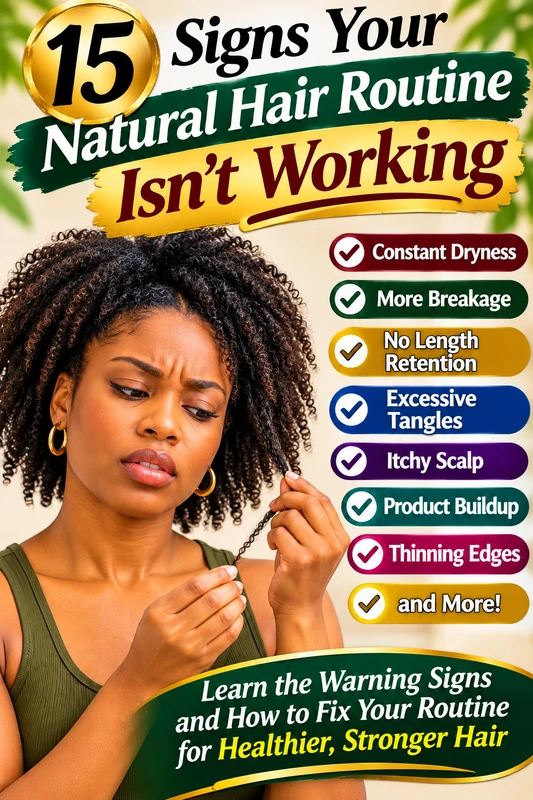
Have you been following the same natural hair routine for months but still struggling with dryness, breakage, tangling, thinning edges, or poor length retention?
Perhaps you've purchased numerous hair care products, watched countless natural hair tutorials, and experimented with different protective hairstyles, yet your hair doesn't seem to be improving.
One of the biggest challenges in maintaining natural hair is recognizing when a routine is no longer meeting your hair's needs.
A routine that worked beautifully six months ago may not be as effective today. Changes in weather, age, lifestyle, hair length, styling habits, and product choices can influence how your hair responds to your regimen.
Whether you have 3C curls, 4A coils, 4B natural hair, or tightly textured 4C hair, understanding the warning signs of an ineffective hair routine can help you make better decisions.
Healthy natural hair doesn't require dozens of expensive products. However, it does require appropriate cleansing, conditioning, gentle handling, and consistent maintenance.
In this comprehensive guide, we'll explore 15 signs your hair routine isn't working, common natural hair care mistakes, and practical ways to develop a more effective routine that supports healthier-looking, stronger, and more manageable hair.
1. Your Natural Hair Is Constantly Dry
Persistent dryness is one of the most common signs your natural hair routine needs improvement.
While curly and coily hair naturally tends to feel drier than straighter hair textures, your strands shouldn't consistently feel brittle, stiff, or difficult to manage.
You may spend considerable time moisturizing your hair only to discover that it feels dry again several hours later.
This may indicate that your current moisturizing routine isn't providing adequate conditioning or that your hair is experiencing excessive moisture loss.
Common signs of excessive hair dryness include:
-
Rough-feeling strands
-
Brittle ends
-
Increased tangling
-
Difficulty styling
-
Hair that snaps easily
-
Reduced flexibility
-
Persistent dryness after conditioning
-
Hair that feels stiff despite applying products
Many people make the mistake of applying more oil whenever their hair feels dry.
However, oils do not directly provide water-based hydration. They are generally more useful for conditioning, lubrication, and helping reduce moisture loss.
Start with properly cleansed hair and a suitable water-based conditioning product.
The Hairobics All Natural Leave-In Treatment contains water, botanical ingredients, and conditioning oils that can complement a consistent natural hair maintenance routine.
Follow the product directions, patch-test before wider use, and adjust application according to your hair and scalp's needs.
2. You're Experiencing More Hair Breakage
Hair breakage is another important indicator that your routine may need adjustment.
Although occasional breakage can happen during normal grooming, regularly finding numerous short pieces of hair on your clothing, pillowcase, bathroom counter, or comb deserves attention.
Breakage occurs when individual hair strands snap rather than naturally shedding from the scalp.
Over time, excessive breakage can make your hair appear thinner, uneven, and shorter.
Common causes of natural hair breakage include:
-
Aggressive detangling
-
Excessive heat styling
-
Insufficient conditioning
-
Tight protective hairstyles
-
Frequent manipulation
-
Damaged ends
-
Chemical processing
-
Friction from bedding and clothing
If your hair frequently breaks during ordinary styling, examine how you're handling it.
Are you combing your hair when it's extremely dry? Are you pulling through stubborn knots? Are you repeatedly brushing fragile areas?
Small changes in your technique can make a significant difference.
Use gentle detangling methods, apply a conditioner that provides adequate slip, and work through manageable sections.
For more detailed guidance, read our article on why your hair breaks when detangling.
3. Your Hair Isn't Retaining Length
Have you noticed that your natural hair seems to remain the same length year after year?
Many women with natural hair assume their hair has stopped growing when the actual problem may be poor length retention.
Hair growth occurs at the follicle, while length retention depends on preserving the strands you've already grown.
If your ends continuously break, your hair may appear to stay the same length despite new growth occurring at the scalp.
Signs of poor length retention include:
-
Remaining at shoulder length for several years
-
Frequently noticing broken ends
-
Experiencing uneven hair lengths
-
Having increasingly thin ends
-
Seeing new growth without noticeable overall length changes
To improve length retention, focus on reducing unnecessary damage rather than constantly searching for a faster hair growth product.
Protect your ends, minimize excessive heat, avoid tight hairstyles, and maintain a consistent conditioning routine.
Take photographs every two or three months under similar lighting and styling conditions.
Comparing your hair when it is stretched to a similar degree can help you distinguish genuine length changes from normal natural hair shrinkage.
If your hair is progressively thinning or you are concerned about changes in its growth, consult a dermatologist.
4. Your Hair Tangles Immediately After Detangling
Natural curls and coils commonly intertwine because of their shape.
However, if your hair becomes severely tangled shortly after you've carefully detangled it, something in your routine may need adjustment.
Excessive tangling can make wash day exhausting and increase the risk of unnecessary breakage.
Several factors can contribute to recurring tangles, including damaged ends, product residue, inadequate conditioning, and excessive friction.
You may also experience more tangling as your hair becomes longer because additional length creates more opportunities for strands to wrap around one another.
Instead of repeatedly combing your hair throughout the day, consider keeping your strands organized with loose twists, braids, or other low-tension hairstyles.
During wash day, detangle one section at a time. Once a section is detangled, loosely twist it to prevent it from mixing with neighboring sections.
Avoid immediately allowing all your hair to shrink together if doing so causes significant knotting.
Our complete guide on how to detangle natural hair without breakage provides additional techniques for making the process more manageable.
5. Your Products No Longer Seem to Work
Have you ever purchased a hair product that initially delivered excellent results but gradually seemed less effective?
This doesn't necessarily mean your hair has become immune to the product.
Your hair's condition or your application habits may have changed.
For example, a lightweight moisturizer that worked well during summer may provide insufficient conditioning during colder weather.
A rich styling cream that worked beautifully on damaged hair may feel excessively heavy as healthier hair grows in.
Other potential explanations include:
-
Changes in hair length
-
Product buildup
-
Seasonal weather changes
-
Changes in hair porosity
-
Different styling techniques
-
Applying too much or too little product
-
Changes in your cleansing schedule
Before replacing every product in your bathroom, determine whether your existing products are being used appropriately.
You may simply need to adjust the quantity, frequency, or order of application.
Changing one element at a time makes it easier to identify what actually improves your hair.
6. Your Scalp Is Frequently Itchy or Uncomfortable
A healthy hair routine should also consider the condition of your scalp.
If your scalp regularly feels itchy, irritated, unusually tight, or uncomfortable, investigate the underlying cause.
Persistent scalp discomfort should not be considered a normal part of natural hair maintenance.
Possible contributing factors include product sensitivity, accumulated residue, tight hairstyles, inadequate cleansing, dandruff, and certain dermatological conditions.
Avoid assuming that every itchy scalp simply needs more oil.
Applying additional products to an already irritated scalp can sometimes make the problem worse.
Make sure your cleansing routine removes sweat, residue, and accumulated styling products.
For occasional dry-feeling scalp areas without active irritation, the Hairobics All Natural Hair & Scalp Booster provides an oil-based botanical conditioning option containing ingredients such as coconut oil, jojoba oil, rosemary oil, aloe vera, and vitamin E oil.
Apply sparingly according to the product directions and avoid excessive buildup.
A cooling or tingling sensation does not indicate hair growth. Stop using any product that causes burning, redness, or irritation.
Persistent itching, scaling, sores, tenderness, or unexplained hair loss should be evaluated by a dermatologist.
7. Your Hair Feels Greasy but Still Dry
One of the most confusing natural hair problems is having hair that feels oily and dry simultaneously.
This often happens when someone repeatedly applies oils, butters, creams, and pomades without addressing the underlying conditioning needs of the hair.
The strands may appear shiny on the outside while continuing to feel stiff, rough, or difficult to style.
Adding more oil is not always the solution.
Heavy product accumulation may make hair feel coated and interfere with your ability to evaluate its actual condition.
Consider simplifying your moisturizing routine.
Begin with clean hair, use an appropriate rinse-out conditioner, and follow with a suitable leave-in product.
If your hair benefits from additional oil-based conditioning, apply a small amount rather than repeatedly coating the entire length.
Remember that the goal is manageable, conditioned hair—not hair that constantly feels saturated with products.
Fine natural hair may require particularly lightweight applications, while thicker strands may tolerate richer formulations.
8. Your Wash Day Is Becoming Increasingly Difficult
Wash day shouldn't leave you feeling exhausted, frustrated, or afraid of how much hair you'll lose.
If your washing routine has become increasingly complicated, evaluate whether every step is genuinely necessary.
Some natural hair routines involve pre-shampoo treatments, multiple shampoos, several conditioners, protein treatments, moisturizing treatments, numerous styling products, and hours of detangling.
Although some of these steps may be beneficial, not everyone needs them during every wash.
Warning signs of an ineffective wash-day routine include:
-
Excessive breakage during shampooing
-
Severe tangling after rinsing
-
Hair becoming matted between washes
-
Persistent residue after shampooing
-
An uncomfortable scalp
-
Increasingly lengthy detangling sessions
Consider washing your natural hair in manageable sections.
Use your fingertips to cleanse your scalp without aggressively scratching or rubbing your strands together.
Follow with an appropriate conditioner and gently remove tangles before styling.
Your washing frequency should reflect your scalp condition, activity level, hairstyle, and product usage.
Read our guide on how often you should wash natural hair to help establish a schedule that works for your lifestyle.
9. Your Ends Are Becoming Thin, Rough, or Split
The ends of your natural hair are generally the oldest parts of your strands.
They have experienced repeated washing, drying, styling, environmental exposure, and everyday friction.
As a result, they often require additional attention.
If your ends are becoming increasingly rough or noticeably thinner than the rest of your hair, your current routine may not be protecting them adequately.
Signs your ends need attention include:
-
Visible split ends
-
Tiny white dots along hair strands
-
Frequent snagging
-
Transparent-looking tips
-
Repeated single-strand knots
-
Ends that break during gentle handling
-
Difficulty separating curls
Although conditioners and oils can temporarily improve the appearance and feel of damaged ends, they cannot permanently repair split hair strands.
A professional trim may be appropriate when damage becomes significant.
Between trims, maintain properly conditioned ends, reduce unnecessary heat exposure, and minimize friction from rough fabrics.
If single-strand knots are becoming a frequent problem, discover additional techniques in our guide on how to reduce fairy knots in natural hair without losing length.
10. Your Natural Curl Pattern Is Changing Unexpectedly
Natural hair patterns can evolve throughout your lifetime.
Hormonal changes, aging, medication, health conditions, chemical treatments, and heat exposure may influence how your hair looks and behaves.
However, if certain sections suddenly become noticeably straighter, weaker, or less responsive after repeated styling, investigate whether your routine is contributing to damage.
Heat damage can cause some strands to lose their usual curl pattern.
Repeated chemical processing can also alter the structure of the hair shaft.
If you suspect styling-related damage, reduce high-temperature tools and give your hair a period of gentler maintenance.
Experiment with heat-free hairstyles such as twist-outs, braid-outs, roller sets, and loose updos.
Keep in mind that healthy natural hair doesn't need to have perfectly defined curls.
Many people naturally have multiple curl patterns across their scalp.
A lack of definition alone does not mean your hair is unhealthy. Pay greater attention to changes accompanied by breakage, weakness, or unusual texture differences.
11. Your Edges Are Becoming Thinner
Thinning edges are an important warning sign that should never be ignored.
The hair around your temples and frontal hairline can be especially vulnerable to repeated tension.
Popular hairstyles may look beautiful but cause unnecessary stress when installed too tightly or worn too frequently.
Potential sources of tension include tight ponytails, heavy extensions, tightly installed braids, wig adhesives, repeated edge brushing, and restrictive headbands.
If your hairline becomes increasingly sparse, stop hairstyles that pull on the affected area.
Pain, bumps, or persistent tightness after installing a hairstyle are signs that excessive tension may be present.
An effective protective hairstyle should protect your natural hair rather than place excessive stress on your follicles.
Avoid aggressively brushing your edges into place every morning. Instead, consider softer styles that allow the hairline to remain relaxed.
Persistent thinning may be caused by traction alopecia or another form of hair loss. Early evaluation by a dermatologist is important because certain types of hair loss can become permanent.
12. You're Experiencing Excessive Product Buildup
If your hair looks dull, feels sticky, or develops a persistent coating, your routine may be creating excessive buildup.
This can happen when styling products accumulate faster than your cleansing routine removes them.
Common products that may contribute to residue include hair gels, edge controls, heavy creams, oils, butters, pomades, and styling sprays.
Buildup doesn't necessarily mean these products are bad.
It may simply mean you're applying them too frequently or using more than your hair needs.
Signs of excessive buildup include:
-
Waxy or sticky strands
-
Hair that feels heavy
-
Visible flakes after layering products
-
Reduced volume
-
Difficulty rinsing away residue
-
Products that appear to sit on the surface
Consider using a clarifying shampoo occasionally if your regular cleanser isn't removing accumulated residue.
Follow with appropriate conditioning to restore manageability.
Avoid aggressive cleansing methods that leave your hair feeling excessively stripped.
A simpler routine may also help you identify which products are contributing to buildup.
13. Your Hair Breaks Despite Wearing Protective Styles
Protective hairstyles are popular because they can reduce daily manipulation and help keep natural hair organized.
However, a hairstyle isn't automatically protective simply because your ends are tucked away.
Braids, twists, wigs, cornrows, and other styles can contribute to damage when installed too tightly, maintained improperly, or worn beyond what your hair and scalp can comfortably tolerate.
If you consistently experience significant breakage after removing protective styles, examine your installation and maintenance habits.
Avoid excessively heavy extensions and ensure your natural hair is properly detangled before installation.
Continue appropriate scalp cleansing during the time you're wearing the hairstyle.
When removing braids or twists, use patience and carefully separate accumulated shed hairs before they become tangled.
Consider alternating protective hairstyles with simpler, low-tension natural styles.
For additional guidance, read our article on 15 signs your hair needs a styling break.
14. You're Constantly Buying New Hair Products
Do you have a bathroom cabinet filled with half-used shampoos, conditioners, oils, moisturizing creams, and hair treatments?
Constantly switching products can make it difficult to determine what your natural hair actually needs.
A temporarily unsuccessful hairstyle does not necessarily mean your entire hair routine has failed.
Likewise, one positive experience with a new product doesn't guarantee long-term improvement.
Healthy natural hair care requires consistency and observation.
Instead of purchasing a new collection of products every month, establish a manageable foundation.
Your routine may only require a suitable shampoo, rinse-out conditioner, leave-in product, and an optional styling or conditioning product.
Evaluate each product individually.
Does it improve softness? Does it make styling easier? Does it cause unwanted residue? Does your scalp tolerate it?
Focus on how the product performs rather than how popular it is on social media.
Our guide to the top 10 mistakes people make with natural hair explains additional habits that may interfere with your progress.
15. Your Hair Is Becoming Harder to Manage Over Time
One of the clearest indications that your routine needs improvement is an overall decline in manageability.
Perhaps your hair previously responded well to styling, but now every session requires more products, more time, and greater effort.
You might experience multiple problems simultaneously, including dryness, tangling, rough ends, buildup, and breakage.
Rather than trying to solve every issue with a separate product, consider reviewing your entire routine.
Ask yourself:
-
Am I cleansing my scalp appropriately?
-
Am I conditioning my hair consistently?
-
Am I detangling gently?
-
Am I protecting my ends?
-
Am I using excessive heat?
-
Am I wearing hairstyles that are too tight?
-
Am I applying too many products?
-
Has my hair changed recently?
Identifying the underlying issue can be more effective than repeatedly addressing individual symptoms.
For a deeper understanding of hair condition, explore our article on 15 signs of unhealthy natural hair.
How to Reset Your Natural Hair Routine in 30 Days
If you've identified several warning signs, a structured routine reset can help you evaluate what your hair needs.
Week 1: Evaluate and simplify
Examine your scalp, hair texture, ends, and current products.
Wash and condition your hair thoroughly. If significant residue is present, consider a suitable clarifying shampoo followed by conditioner.
Remove unnecessary products from your routine.
Take photographs of your hairline, crown, and overall hair length for future comparison.
Week 2: Focus on conditioning
Maintain consistent conditioning without unnecessarily layering products.
Pay particular attention to dry ends and sections that frequently tangle.
Refresh your hair only when needed.
Observe how long your hair remains manageable between washing and styling sessions.
Week 3: Reduce manipulation
Choose hairstyles that do not require extensive daily maintenance.
Avoid tight ponytails, frequent brushing, unnecessary heat styling, and repeated restyling.
Protect your hair at night using a comfortable satin bonnet, scarf, or pillowcase.
Week 4: Review your progress
Consider whether your hair feels softer, detangles more easily, experiences less breakage, or requires fewer products.
Keep the habits that appear beneficial and adjust those that aren't helping.
Thirty days may be enough to notice improvements in manageability, but meaningful changes in length retention and hair density generally require more time.
Frequently Asked Questions About Natural Hair Routines
How do I know if my hair routine is working?
An effective natural hair routine generally helps your hair remain manageable, appropriately conditioned, and less prone to unnecessary breakage. Your scalp should also remain comfortable.
How long should I give a new hair routine?
Allow approximately four to eight weeks to evaluate ordinary maintenance changes, provided the products are well tolerated. Assess length retention over several months. Stop immediately if a product causes irritation.
Should I moisturize natural hair every day?
Not necessarily. Some people benefit from frequent refreshing, while others experience buildup when applying products daily. Moisturize according to your hair's actual needs.
Does excessive shedding mean my hair routine is failing?
Not always. Shedding can be influenced by stress, hormones, illness, nutritional deficiencies, and other factors unrelated to hair care. Consult a healthcare professional if shedding becomes sudden, excessive, or persistent.
Can using too many hair products damage natural hair?
Using numerous products may contribute to residue, scalp irritation, unnecessary manipulation, and styling difficulties. A simpler routine may be easier to maintain.
Is frizz a sign of unhealthy natural hair?
No. Frizz is a normal characteristic of many curly and coily hair textures. It becomes more concerning when accompanied by significant breakage, roughness, or unexpected changes in manageability.
Should I completely change my natural hair routine?
Not necessarily. Sometimes adjusting your washing frequency, moisturizing technique, or styling habits is sufficient. Change one variable at a time whenever possible.
Can a poor hair routine prevent length retention?
Yes. Excessive heat, repeated tension, aggressive grooming, and inadequate conditioning can contribute to breakage, making it more difficult to retain the hair you grow.
Final Thoughts: Listen to What Your Natural Hair Is Telling You
Your natural hair doesn't need a complicated routine to look and feel its best.
It needs appropriate care that reflects its individual texture, condition, and changing requirements.
Recognizing the signs your hair routine isn't working can help you avoid unnecessary product purchases, reduce preventable damage, improve manageability, and establish healthier long-term habits.
Focus on consistent cleansing, suitable conditioning, gentle detangling, comfortable hairstyles, and protecting fragile ends.
Be patient with your progress and avoid comparing your natural hair journey to someone else's.
At Hairobics All Natural, we believe that caring for natural hair starts with understanding its unique needs. Whether you wear curls, coils, braids, twists, locs, or short natural hairstyles, building a consistent and manageable routine is an important part of maintaining healthier-looking hair.
Give your hair the attention it deserves and discover botanical hair and scalp conditioning products designed to complement your natural hair journey.
Shop natural hair care products at HairobicsAllNatural.com.
Healthy-looking natural hair begins with better habits, gentle care, and consistency.