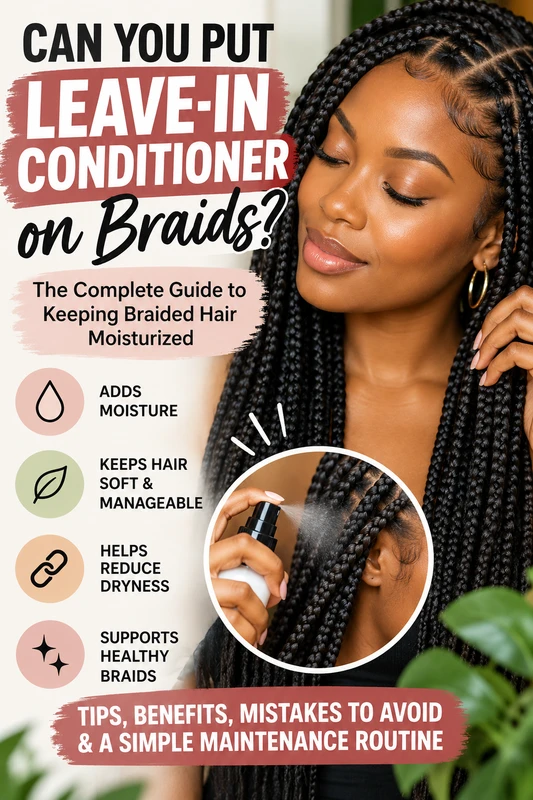
Braids are one of the most popular protective hairstyles for Black women—and for good reason. Box braids, knotless braids, cornrows, feed-in braids, stitch braids, and other braided styles can reduce daily manipulation, protect your natural hair, and make your morning routine much easier.
But protective styling doesn't mean you can completely forget about the hair underneath your braids.
Your natural hair still needs moisture.
That leads to an important question:
Can you put leave-in conditioner on braids?
Yes. You can use leave-in conditioner on braids, and a lightweight leave-in can be an excellent addition to your braid-maintenance routine. The key is choosing the right product, applying an appropriate amount, and avoiding excessive buildup.
When used properly, leave-in conditioner can help keep the natural hair inside your braids feeling softer, more manageable, and less prone to excessive dryness.
However, more isn't always better.
Applying thick creams or repeatedly saturating your braids with conditioner can leave residue, attract dirt, and contribute to buildup.
In this complete guide, we'll explain exactly how to use leave-in conditioner on braids, how often to use it, what mistakes to avoid, and how to build a simple moisture routine that helps keep your natural hair healthy throughout your protective style.
Can You Put Leave-In Conditioner on Braids?
Yes, you can put leave-in conditioner on braids.
In fact, leave-in conditioner can be particularly helpful for people with naturally dry, curly, coily, or kinky hair.
Although your natural hair is tucked inside the braided style, it hasn't stopped needing care.
Your strands are still exposed to moisture loss caused by things like:
- Dry indoor air
- Hot weather
- Cold weather
- Sun exposure
- Friction
- Sweat
- Washing
- Long periods between moisturizing sessions
A lightweight leave-in conditioner can help replenish moisture and improve softness without requiring you to take down your braids.
The important word here is lightweight.
Braids usually don't need to be covered in thick conditioner every day.
Your goal is to moisturize the natural hair—not coat the entire hairstyle with layers of product.
For a more complete moisture routine, read our guide on how to keep natural hair moisturized in braids.
Why Natural Hair Can Become Dry in Braids
One of the biggest misconceptions about protective hairstyles is that hair automatically stays moisturized because it's tucked away.
That's not necessarily true.
Braids reduce manipulation, but they don't eliminate moisture loss.
Your natural hair may remain braided for several weeks. During that time, your strands can gradually become dry if you're not giving them moisture.
This is particularly important for tightly curled and coily textures.
Natural oils produced by your scalp may have difficulty traveling down highly textured strands. When those strands are braided and combined with extension hair, keeping them adequately moisturized can become even more challenging.
This is why someone can take down beautiful-looking braids and discover that the natural hair underneath feels extremely dry.
The hairstyle looked protected.
The hair wasn't necessarily moisturized.
Understanding the difference between protection and moisture is essential.
What Does Leave-In Conditioner Actually Do?
Leave-in conditioner is different from the traditional conditioner you rinse out in the shower.
A rinse-out conditioner is generally applied after shampooing and then rinsed away.
A leave-in conditioner is designed to remain on the hair.
Depending on its formulation, a leave-in treatment may help:
- Improve softness
- Reduce dryness
- Improve manageability
- Reduce friction
- Make detangling easier
- Add sheen
- Help condition dry strands
That can make leave-in conditioner particularly useful during protective styling.
The natural hair inside your braids still needs conditioning.
You simply need to deliver it without creating excessive residue.
What Type of Leave-In Conditioner Is Best for Braids?
For most braided hairstyles, lightweight products are preferable to extremely heavy creams and butters.
Look for products that distribute easily without leaving a thick coating.
Spray leave-ins can be particularly convenient because they allow you to target the portions of your braids containing your natural hair.
This makes application easier and helps prevent overuse.
If you're using a cream leave-in, use a small amount and dilute or distribute it carefully if appropriate according to the product's instructions.
Your hair shouldn't feel:
- Sticky
- Greasy
- Waxy
- Heavy
- Gummy
- Coated
Those can be signs you're applying too much product or layering too many products together.
Try Hairobics Leave-In Hair & Scalp Treatment
For people looking for a leave-in option as part of their natural-hair routine, Hairobics All Natural Leave-In Hair & Scalp Treatment can be incorporated into your hair-care regimen.
It is designed to help condition dry hair and add sheen while providing a convenient spray application.
When using a leave-in with braids, the goal isn't to completely soak your hairstyle.
Apply an appropriate amount to the areas where your natural hair needs conditioning and allow the hair to dry.
Shop Hairobics All Natural Leave-In Hair & Scalp Treatment:
https://www.hairobicsallnatural.com/leave-in-hair-scalp-treatment/
A leave-in can be especially useful when your natural hair begins feeling dry between wash days.
How to Apply Leave-In Conditioner to Braids
Applying leave-in conditioner correctly can make a major difference.
You don't want to spray product randomly until your entire hairstyle is dripping.
Instead, be strategic.
Step 1: Separate Your Braids
Divide your braids into several large sections.
This makes it easier to reach the natural hair throughout your head rather than only moisturizing the outermost braids.
For box braids or knotless braids, four to six large sections usually make application easier.
Step 2: Focus on Your Natural Hair
Remember what you're trying to moisturize.
If your natural hair ends several inches down each braid, you don't necessarily need to saturate the synthetic extension hair all the way to your waist.
Concentrate primarily on the sections containing your real hair.
Lightly distribute the leave-in.
You want the hair damp enough to receive moisture—not soaking wet.
Step 3: Gently Squeeze the Braids
After applying your leave-in, gently squeeze the braided sections.
This can help distribute the product through the braid and toward your natural hair.
Don't aggressively rub your braids.
Excessive rubbing can contribute to frizz.
Step 4: Pay Attention to Your Ends
Your ends are the oldest portion of your hair.
They deserve extra attention.
If you can identify where your natural hair ends inside the braid, make sure that area receives adequate moisture.
Keeping your ends protected and conditioned can be important for length retention.
Step 5: Let Your Braids Dry
Don't immediately cover damp braids with a bonnet and go to sleep.
Give your hair time to dry.
Constantly trapping excessive moisture inside thick braids isn't ideal.
Whenever you wash or significantly wet your protective style, make sure the braids dry thoroughly.
You can also read our complete guide on how to dry braids after washing.
How Often Should You Put Leave-In Conditioner on Braids?
There isn't one schedule that works perfectly for everyone.
Your ideal frequency depends on:
- Your hair texture
- Hair porosity
- Climate
- Activity level
- How dry your hair becomes
- The leave-in you're using
- How frequently you wash your braids
- How much product you're applying
Instead of automatically applying leave-in conditioner every day, pay attention to your hair.
If your natural hair still feels soft and moisturized, you may not need another application.
If it feels noticeably dry or rough, additional moisture may be appropriate.
For many people, applying a lightweight moisturizing product a few times throughout the week can be enough.
The key is consistency without excessive product layering.
Should You Put Leave-In Conditioner on Your Scalp?
This depends on the product.
Some leave-in treatments are formulated for both hair and scalp, while others are primarily intended for the hair.
Always follow the directions for the specific product you're using.
More importantly, don't assume that a dry scalp automatically needs conditioner.
Dryness, dandruff, product buildup, irritation, and other scalp concerns can look similar but have different causes.
Your scalp should remain clean and comfortable while you're wearing braids.
If you're constantly adding product to an itchy scalp without cleansing it, you may simply be layering additional residue over buildup.
Leave-In Conditioner vs Braid Spray
Are braid spray and leave-in conditioner the same thing?
Not necessarily.
A braid spray may be specifically formulated for protective hairstyles, while a leave-in conditioner may be designed for broader hair-care use.
However, their purposes can overlap.
Both may help provide lightweight moisture depending on the formulation.
For braided styles, convenience matters.
A spray product allows you to reach your natural hair without having to manipulate every braid.
That's one reason Hairobics also offers Raaw Roots Antiseptic Moisturizer Spray, which is designed for natural hair, locs, twisties, and braids.
Shop Hairobics Raaw Roots Moisturizer Spray:
https://www.hairobicsallnatural.com/locs-braids-moisturizer-spray/
If you're deciding what type of product fits your routine, our guide to the best spray for braids explains what to look for.
Should You Use Leave-In Conditioner and Oil on Braids?
You can use both, but don't confuse oil with moisture.
This is important.
Oil alone doesn't necessarily provide the hydration dry hair is asking for.
If your hair feels dry, repeatedly adding oil may simply leave you with oily hair that still feels dry underneath.
A better approach can be:
Hydrate → Condition → Seal when necessary.
For example:
- Apply a lightweight water-based moisturizing product.
- Add leave-in conditioner if your hair needs additional conditioning.
- Use a small amount of appropriate oil if it works well for your hair.
You don't necessarily need all three products during every moisturizing session.
The simpler your routine, the easier it is to avoid buildup.
Don't Overload Your Braids With Products
One of the easiest mistakes to make is assuming more products equal healthier hair.
Imagine this routine:
Monday: leave-in conditioner.
Tuesday: braid spray.
Wednesday: scalp oil.
Thursday: more leave-in.
Friday: grease.
Saturday: edge control.
Sunday: another layer of oil.
Then repeat.
Within a couple of weeks, your hair and scalp may have accumulated several layers of product.
Combine that with sweat, dead skin cells, environmental debris, styling products, and natural scalp oils, and buildup can become noticeable.
Your braids may start feeling:
- Sticky
- Heavy
- Dirty
- Stiff
- Greasy
- Coated
You may also notice visible residue around the roots.
Moisturizing your braids should not mean continuously adding products without cleansing.
You Still Need to Wash Your Braids
Leave-in conditioner doesn't replace shampoo.
Neither does braid spray.
Neither does oil.
Your scalp still produces sebum and sheds skin cells while you're wearing braids. Sweat and styling products can also accumulate.
Your scalp therefore needs regular cleansing.
How often you wash depends on your scalp, lifestyle, activity level, hairstyle, and product use.
Someone who exercises heavily several days a week may need a different cleansing routine from someone who rarely sweats.
When washing, concentrate on cleaning the scalp gently rather than aggressively scrubbing your braids.
Read our full tutorial on how to wash braids without ruining them.
Can You Put Leave-In Conditioner on Knotless Braids?
Absolutely.
Knotless braids can be maintained with a lightweight leave-in just like traditional box braids.
Separate the braids into sections and lightly apply the product along the portions containing your natural hair.
Because knotless braids begin with your natural hair rather than a knot of extension hair at the root, you have relatively direct access to your natural strands near the scalp.
Avoid constantly manipulating the roots.
The purpose of a protective style is to reduce manipulation—not create a new daily styling routine.
Can You Put Leave-In Conditioner on Box Braids?
Yes.
Box braids are particularly easy to moisturize because each braid is separated into an individual section.
Lightly spray the portions containing your natural hair.
Gently squeeze the braid to distribute the product.
Pay attention to your edges and ends.
Don't saturate the entire length of extension hair unless the product or hairstyle specifically requires it.
Can You Put Leave-In Conditioner on Cornrows?
Yes, but application should be even lighter.
Because cornrows lie close to the scalp, it's easy to apply too much product directly onto the scalp rather than the hair.
Use a light hand.
Apply product strategically along the braided sections and avoid leaving heavy residue between the parts.
Can You Put Leave-In Conditioner on Feed-In Braids?
Yes.
The same principles apply:
Lightweight product + small amount + targeted application.
Feed-in braids often expose a significant amount of scalp, so maintaining scalp cleanliness is especially important.
Don't cover every visible part with layers of conditioner or oil.
What About Leave-In Conditioner on Boho Braids?
Bohemian braids require slightly different care because loose curly hair is incorporated throughout the style.
Those loose sections can tangle, dry out, or become frizzy.
A lightweight leave-in may help with softness, but avoid overworking the curls.
Too much manipulation can make boho braids look older faster.
Apply your product gently and separate curls only when necessary.
Can Leave-In Conditioner Make Braids Frizzy?
Potentially.
Applying too much liquid or repeatedly manipulating the braids while they're damp may contribute to frizz.
That's why you should mist rather than soak.
Avoid aggressively rubbing your hands up and down your braids after applying product.
Instead, gently squeeze or smooth them.
Also remember that some frizz is completely normal.
Your natural hair grows, sheds, moves, and reacts to humidity.
Braids aren't supposed to remain salon-perfect forever.
If appearance is your primary concern, see our guide on how to keep braids looking fresh.
What If Your Braids Still Feel Dry After Leave-In Conditioner?
Don't immediately apply twice as much product.
First determine what's actually happening.
Ask yourself:
When did I last wash my hair?
If your braids are heavily coated with old products, adding more leave-in may not solve the problem.
Am I using a lightweight product?
A very heavy cream may coat the braid without distributing well.
Am I applying the product to my natural hair?
Spraying only the synthetic extension hair won't necessarily address dryness in your real hair.
Am I using too much oil?
Hair can feel coated yet still lack hydration.
Have my braids been installed too long?
Eventually, every protective style needs to come down.
If your hair is heavily matted at the roots and covered in weeks of buildup, another layer of conditioner isn't the solution.
Protect Your Braids at Night
Your nighttime routine matters almost as much as your moisturizing routine.
Friction between your hair and bedding can contribute to:
- Frizz
- Dryness
- Roughness
- Messy roots
- Reduced longevity of your style
Cover your braids with a satin or silk bonnet or scarf when possible.
For very long braids, avoid twisting them into an extremely tight bun every night.
Gather them comfortably and minimize unnecessary tension around your hairline.
For longer protective styles, see how to sleep with long braids.
Leave-In Conditioner Won't Fix Braids That Are Too Tight
This is extremely important.
If your braids are painfully tight, spraying conditioner on your scalp doesn't solve the underlying problem.
Warning signs may include:
- Persistent pain
- Headaches
- Bumps
- Significant scalp tenderness
- Visible pulling
- Excessive tension around the hairline
Braids should not require days of pain before they become comfortable.
Continuous tension can contribute to breakage and potentially traction-related hair loss.
If your style feels excessively tight, read how to tell if braids are too tight.
Moisture supports hair care.
It doesn't remove mechanical tension.
A Simple Weekly Moisture Routine for Braids
Your routine doesn't need ten different products.
In fact, simpler is often better.
During the Week
Check your natural hair for dryness.
If needed, lightly mist the portions of the braids containing your natural hair with a moisturizing spray or appropriate leave-in.
Gently distribute the product.
Don't soak the braids.
As Needed
Apply a small amount of oil if your hair or scalp responds well to it.
Avoid pouring oil over your scalp.
Wash Day
Clean your scalp and braids as appropriate for your hair, activity level, and product use.
Rinse thoroughly.
Make sure the braids dry completely.
At Night
Protect the hairstyle with satin or silk and avoid excessive tension.
That's it.
A protective-style routine doesn't have to be complicated to be effective.
Does Using Leave-In Conditioner Help Hair Grow in Braids?
Leave-in conditioner doesn't directly make hair grow faster.
Hair growth occurs from the follicles.
However, keeping your strands adequately conditioned can support length retention by helping reduce excessive dryness and breakage.
That's an important distinction.
Imagine your hair grows six inches during a year but four inches break off.
You only retain about two inches.
Now imagine your hair grows the same six inches but you dramatically reduce breakage.
You retain more of your growth.
That's one reason people often associate protective styles with hair growth.
Braids don't magically accelerate the biological growth rate.
Instead, a well-maintained protective style may help you keep more of the hair you're already growing.
Our article do braids help hair grow? explains the difference between hair growth and length retention in greater detail.
What Happens When You Don't Moisturize Hair in Braids?
Going several weeks without moisturizing can leave some hair types feeling extremely dry when the braids are removed.
Dry hair may become:
- Brittle
- Rough
- Difficult to detangle
- More vulnerable to breakage
- More prone to knotting
The takedown process can make things worse.
Someone may remove their braids after several weeks, immediately grab a comb, and attempt to pull through dry shed hair.
That can cause unnecessary breakage.
Maintaining moisture while your braids are installed makes the entire protective-style cycle easier.
That includes installation, maintenance, and takedown.
Don't Leave Braids in Forever
Moisturizing your braids doesn't mean you can keep the same protective style indefinitely.
Eventually, your braids need to be removed.
As your natural hair grows, the roots become looser.
Shed hairs accumulate.
Product builds up.
New growth can begin tangling around the base of the braid.
At some point, keeping the hairstyle installed longer stops being beneficial.
When it's time for removal, take your braids down patiently.
Don't rush.
Afterward, carefully detangle accumulated shed hair before shampooing.
Common Mistakes When Using Leave-In Conditioner on Braids
Mistake #1: Completely Saturating the Braids
Your braids don't need to be dripping every time you moisturize.
Light application is usually enough.
Mistake #2: Applying Leave-In Every Day Automatically
Moisturize based on your hair's needs rather than following an arbitrary rule.
Mistake #3: Using Extremely Heavy Products
Thick creams can be difficult to distribute through braids and may contribute to residue.
Mistake #4: Never Washing Your Hair
Adding moisturizer over several weeks of accumulated product isn't the same as maintaining clean, moisturized hair.
Mistake #5: Applying Product Only to Extensions
Focus on the areas containing your real hair.
Mistake #6: Going to Bed With Soaking-Wet Braids
Allow your hairstyle to dry thoroughly.
Mistake #7: Using Leave-In to Treat Every Scalp Problem
Persistent itching, irritation, sores, or unusual scalp symptoms shouldn't automatically be treated by applying more conditioner.
Frequently Asked Questions
Can I spray leave-in conditioner on my braids every day?
You can use a leave-in according to your hair's needs and the product directions, but daily application isn't automatically necessary. If your hair remains adequately moisturized, applying more product may simply create buildup.
Should I moisturize braids every day?
Not necessarily. Monitor your hair and adjust your routine according to dryness, climate, activity level, and hair characteristics.
Can leave-in conditioner cause buildup in braids?
Yes. Excessive application—particularly when combined with oils, creams, gels, edge control, and other styling products—can contribute to buildup.
Can I use leave-in conditioner on synthetic braiding hair?
You generally want to concentrate on conditioning your natural hair rather than saturating synthetic extension hair unnecessarily.
Should I put leave-in conditioner on my scalp?
Only if the particular product is intended for scalp use. Follow its directions.
Is leave-in conditioner good for knotless braids?
It can be. Lightweight leave-in conditioner can help maintain softness and moisture in the natural hair contained inside knotless braids.
Is leave-in conditioner good for box braids?
Yes. Use it lightly and focus primarily on the portions of each braid containing your natural hair.
Can I use leave-in conditioner after washing braids?
Yes, provided the product is appropriate for your hair. Apply a reasonable amount and make sure your braids dry thoroughly afterward.
Can leave-in conditioner help dry braids?
A lightweight leave-in can help condition dry natural hair inside the braids. If heavy buildup is present, however, cleansing may be necessary before adding more products.
Final Thoughts: Should You Put Leave-In Conditioner on Braids?
Yes—you can put leave-in conditioner on braids.
For many people with natural hair, a lightweight leave-in can be a useful part of a healthy protective-style routine.
The secret is moderation.
You don't need to drench your braids every day.
You don't need five moisturizers.
And you don't need to cover your scalp with layers of products.
Instead, focus on a simple routine:
Cleanse when needed. Moisturize your natural hair. Avoid excessive buildup. Protect your braids at night. Minimize tension.
Your natural hair is still there underneath your protective style, and it still deserves attention.
Braids work best when they protect healthy hair—not when they're used as an excuse to ignore it for weeks.
By giving your hair appropriate moisture throughout the life of your braids, you'll be in a much better position to take them down to softer, more manageable hair while preserving the length you've worked hard to retain.
For your braid-care routine, explore the Hairobics All Natural Leave-In Hair & Scalp Treatment and Raaw Roots Moisturizer Spray for Locs, Twisties, Braids & Natural Hair to help keep your protective-style routine simple and consistent.