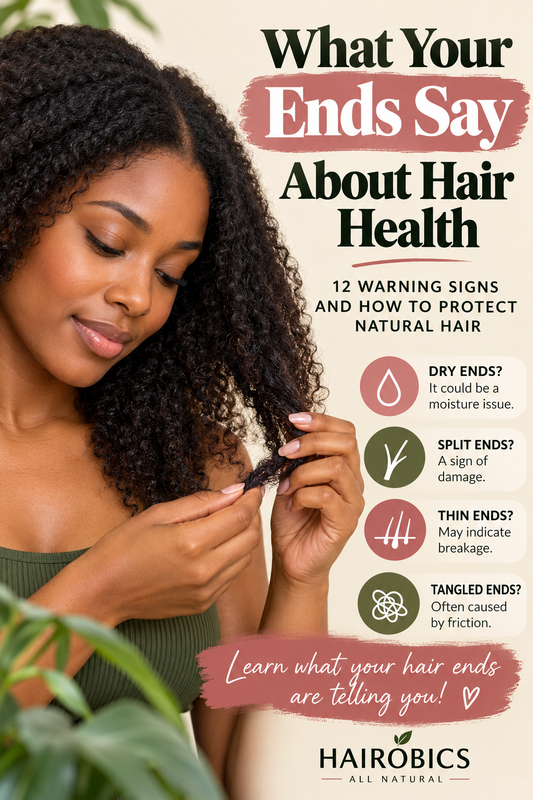
Your hair ends can reveal a surprising amount about the condition of your natural hair. Whether your ends feel soft, rough, thin, tangled, brittle, or constantly dry, their appearance and texture can provide valuable clues about how well your hair is holding up to everyday styling and environmental exposure.
Many people focus on their scalp when trying to grow longer, healthier hair. While scalp care is important, paying attention to the ends is equally essential for maintaining length.
Your ends are the oldest and often most vulnerable part of your hair. They have experienced months or years of washing, conditioning, detangling, brushing, styling, heat exposure, and friction.
Over time, these experiences can affect the strength and appearance of your strands.
This is especially important for people with natural, curly, coily, kinky, and 4C hair because textured strands can be particularly vulnerable to dryness, tangling, and mechanical damage.
But what exactly are your hair ends trying to tell you?
Are dry ends always damaged? Do thin ends mean your hair is breaking? Can healthy hair have split ends? And how can you tell whether your ends need moisture, better protection, or a trim?
In this comprehensive guide, we'll explore 12 important signs your hair ends may reveal about your hair health, what causes these changes, and how to build a routine that supports stronger, healthier-looking natural hair.
Why Your Hair Ends Matter More Than You Think
Hair grows from follicles beneath your scalp. As new hair grows, the older sections move farther away from the roots.
That means the last few inches of your hair have generally experienced more wear than the sections closest to your scalp.
Think about everything your ends encounter during a typical week.
They may rub against your clothing, become tangled during sleep, stretch during styling, and experience repeated manipulation when you detangle or create hairstyles.
Over time, this repeated friction can wear down the protective outer layer of the hair shaft, known as the cuticle.
The cuticle consists of overlapping cells that help protect the inner structure of your hair.
When this protective surface becomes weathered, your hair may feel rougher, tangle more easily, and become more susceptible to breakage.
This is why someone can have healthy-looking roots but damaged ends.
Understanding the condition of your ends can help you make better decisions about conditioning, styling, trimming, and protecting your hair.
1. Soft, Smooth Ends May Indicate Well-Conditioned Hair
One encouraging sign is when your hair ends feel relatively soft and smooth.
Healthy-looking ends generally respond well to conditioning and can be handled without excessive snagging.
You may notice that your ends:
-
Feel flexible during gentle styling
-
Separate without excessive resistance
-
Have relatively little visible splitting
-
Respond well to conditioner
-
Do not break excessively during detangling
-
Maintain their natural curl or coil pattern
However, softness alone does not guarantee that your hair is completely free of damage.
Conditioners and styling products can temporarily improve the feel of damaged strands by coating the hair surface and reducing friction.
The goal is to look at several signs together rather than relying on texture alone.
If your ends feel soft, remain manageable, and show little breakage, your current routine may be working well.
Continue protecting them with regular conditioning, gentle detangling, and low-manipulation styling.
2. Dry Ends May Signal a Moisture or Conditioning Problem
Dry ends are one of the most common concerns among people with natural hair.
You may notice that your roots feel soft while the final few inches feel rough, stiff, or difficult to manage.
This happens partly because your scalp produces natural oils called sebum.
Sebum helps lubricate the scalp and nearby hair. However, with curly and coily textures, these oils may not travel easily along the entire strand.
Your ends also experience more cumulative wear, which can affect how they respond to water and conditioning products.
Dryness can be associated with:
-
Inadequate conditioning
-
Frequent heat styling
-
Harsh cleansing
-
Product buildup
-
Weathered cuticles
-
Excessive friction
-
Chemical processing
-
Environmental exposure
The solution isn't always applying more oil.
Oil can improve lubrication and help reduce friction, but it does not replace water-based conditioning.
Start by applying a suitable conditioner after shampooing and consider using a water-based leave-in product on the lengths and ends.
If your ends feel particularly dry compared with your roots, read our guide on why your ends are drier than your roots.
3. Split Ends Are a Sign of Structural Hair Damage
Split ends are among the clearest visible signs that the hair shaft has experienced damage.
A split end develops when the tip of a strand separates into two or more sections.
You may notice:
-
Y-shaped splits
-
Multiple branches at the tip
-
Frayed-looking ends
-
Rough sections that catch on other strands
-
Small splits extending upward along the hair shaft
Split ends can develop from repeated friction, brushing, excessive heat, chemical processing, and everyday weathering.
Once the hair shaft physically splits, conditioner cannot permanently fuse it back together.
Some products can temporarily smooth the appearance of split ends, but they cannot restore the original structure of the damaged strand.
Trimming the affected portion is the most reliable way to remove an existing split.
If you notice numerous splits, consider reviewing your styling routine rather than simply cutting your hair and continuing the same habits.
Reducing friction, using conditioner, and handling your ends gently can help prevent additional damage.
4. Thin, Wispy Ends May Indicate Breakage or Uneven Length Retention
Have you ever noticed that your hair looks thick near the roots but becomes noticeably thinner toward the bottom?
This appearance is sometimes called see-through ends.
A gradual decrease in fullness can be normal, especially with layered haircuts or naturally uneven growth patterns.
However, excessive thinning toward the ends may suggest that some strands are breaking before they reach the same length as others.
Common contributing factors include repeated detangling, tight hairstyles, heat damage, and inadequate protection.
How to Recognize Thin Ends
Look at your hair in natural lighting.
If the upper sections appear dense while the bottom looks unusually sparse, examine the condition of the individual strands.
Ask yourself:
-
Are the ends breaking during detangling?
-
Do you frequently find short broken hairs?
-
Are certain sections noticeably shorter?
-
Have you been using tight hairstyles?
-
Does your hair repeatedly snag near the tips?
The answers can help you identify possible sources of damage.
Sometimes a small trim can create a fuller appearance by removing excessively uneven or weathered tips.
However, trimming does not change the number of hairs growing from your scalp.
For more information, explore our article on why your hair ends are always thin.
5. Rough, Straw-Like Ends May Signal Excessive Weathering
Hair ends that feel like straw can be frustrating, especially when the rest of your hair feels relatively soft.
You may apply conditioner, moisturizing creams, or oils and still notice a rough texture.
Straw-like ends can develop for several reasons.
The hair may be poorly conditioned, coated with styling-product buildup, or damaged from heat and chemical processing.
In some cases, the outer cuticle has experienced enough wear that the ends no longer feel smooth even after conditioning.
What Should You Do?
First, examine your routine.
If you frequently layer heavy oils and creams, buildup may be contributing to the problem.
Use an appropriate shampoo to remove accumulated products, followed by a moisturizing conditioner.
If your ends become softer afterward, product buildup or inadequate conditioning may have been part of the issue.
If they remain extremely rough, visibly split, and prone to breakage, a trim may be necessary.
Avoid repeatedly applying more oil without identifying why the ends feel rough.
For a more detailed explanation, read why your ends feel like straw and how to make them softer.
6. Constantly Tangled Ends May Indicate Increased Friction
Natural hair tangles because strands curl, bend, and sometimes wrap around neighboring hairs.
Some tangling is completely normal, particularly with tightly coiled textures.
However, when your ends suddenly become much more difficult to detangle, they may be experiencing excessive friction or surface damage.
Weathered hair surfaces can catch against one another more easily.
This may cause:
-
Frequent knots
-
Increased snagging
-
More difficult detangling
-
Breakage during styling
-
Frizz concentrated near the ends
The condition can become a cycle.
Rough ends tangle more easily. Aggressive detangling then causes additional wear, making future tangles more likely.
How to Reduce Tangling
Work in manageable sections and apply a conditioner or detangler that provides enough slip.
For tightly curled hair, detangling while damp and conditioned is often easier than combing dry strands.
Begin at the ends and gradually work toward the roots.
Use your fingers or a wide-tooth comb, depending on what works best for your texture.
Avoid pulling through stubborn knots.
If you encounter a difficult tangle, separate it patiently rather than forcing a comb through it.
7. Single-Strand Knots May Reveal Repeated Curling and Friction
Single-strand knots, sometimes called fairy knots, are particularly common in tightly curled natural hair.
They form when an individual strand loops around itself and creates a small knot.
You may feel tiny bumps when sliding your fingers along a strand.
These knots are not necessarily evidence that your hair is unhealthy.
They can develop simply because of the natural shape and movement of curly or coily hair.
However, excessive knots can increase snagging and make detangling more difficult.
Ways to Minimize Single-Strand Knots
Consider wearing low-tension styles that keep your ends organized.
Loose twists, braids, or stretched styles may reduce opportunities for individual strands to wrap around themselves.
Regular conditioning and gentle handling can also help reduce friction.
Avoid repeatedly picking at knots with your fingernails.
If a knot cannot be safely removed, carefully trimming the affected section with appropriate hair-cutting scissors may prevent additional snagging.
Remember that the goal is not necessarily to eliminate every knot.
Instead, focus on reducing the number of knots that cause breakage or make your hair difficult to manage.
8. Ends That Break Easily May Indicate Hair Fragility
Hair breakage is different from normal shedding.
A naturally shed hair generally comes out from the root, sometimes with a small club-shaped bulb at one end.
Broken hair can appear as shorter pieces that have snapped somewhere along the strand.
If you repeatedly find small fragments of hair on your clothing, bathroom counter, or comb, examine your styling habits and the condition of your ends.
Frequent breakage may be associated with:
-
Excessive heat
-
Chemical processing
-
Repeated brushing or combing
-
Tight protective styles
-
Rough towel drying
-
Inadequate conditioning
-
Excessive manipulation
-
Existing structural damage
Hair can feel soft and still break.
This is because softness and mechanical strength are not the same thing.
A conditioning product may improve the feel of a strand without fully restoring damaged internal structures.
If you're experiencing this problem, our guide on why natural hair feels soft but still breaks explains the difference.
9. Uneven Ends May Reveal Different Growth and Breakage Patterns
Not every strand on your head grows at exactly the same rate or remains in the same growth phase.
Hair also naturally varies in length because individual follicles cycle through periods of growth and rest.
For this reason, perfectly even ends are not required for healthy hair.
However, dramatic differences between sections can sometimes indicate localized breakage.
For example, the hair at the nape may experience more friction from collars and clothing.
The hair around your temples may be affected by repeated tension from tight hairstyles.
One side of your hair may receive more manipulation than the other.
When examining uneven ends, consider where the shorter sections appear.
If the pattern corresponds with your styling habits, changing those habits may help prevent further damage.
Avoid assuming that every uneven section must be cut to the shortest length.
A professional stylist can help determine whether a reshaping trim is appropriate.
10. Ends That Dry Quickly May Suggest Differences in Hair Porosity
Hair porosity describes how readily hair takes in and releases water.
Porosity is influenced by the structure and condition of the hair shaft.
Your roots and ends may behave differently because they have experienced different amounts of wear.
For example, older ends may have more cuticle damage than newer hair near the scalp.
You might notice that your ends become wet quickly but feel dry again sooner than expected.
However, drying speed alone cannot accurately diagnose hair porosity.
Hair density, product buildup, airflow, temperature, and styling methods also affect drying time.
How to Care for Weathered Ends
Instead of relying on a single home porosity test, pay attention to how your hair responds to products.
Does a lightweight conditioner improve softness?
Does a heavy cream leave the ends coated?
Does your hair become difficult to manage after heat styling?
Use these observations to adjust your routine.
For many people, gentle cleansing, regular conditioning, and reduced mechanical damage are more useful than constantly switching products based on an assumed porosity category.
11. Frizzy Ends May Indicate Cuticle Wear or Styling Differences
Frizz is not automatically a sign of unhealthy hair.
Curly and coily hair naturally contains strands that do not always follow the same pattern.
Humidity, shrinkage, and differences in curl definition can create frizz even when hair is in good condition.
However, excessive frizz concentrated at the very ends may suggest increased weathering.
When the hair surface becomes rough, neighboring strands may not align as smoothly.
This can create a fuzzy or uneven appearance.
How to Manage Frizzy Ends
Use conditioner to improve slip and manageability.
Apply styling products evenly without excessive manipulation.
Allow your hair to dry with minimal disturbance when creating defined styles.
If using heat, apply an appropriate heat protectant and avoid unnecessarily high temperatures.
Remember that healthy natural hair does not have to be completely frizz-free.
The goal is comfortable, manageable hair with minimal unnecessary breakage—not forcing every strand into perfect uniformity.
12. Ends That Never Seem to Get Longer May Signal Poor Length Retention
One of the most frustrating experiences is feeling as though your natural hair never grows past a certain length.
You may notice new growth near your scalp while the overall length appears unchanged.
This can happen when hair grows but the ends break at a similar rate.
Hair growth and length retention are two different processes.
Hair growth occurs at the follicle.
Length retention describes how much of that growth remains attached over time.
For example, if your hair grows several inches but repeatedly loses length through breakage, the visible result may be minimal.
This is why protecting your ends matters so much.
You cannot force damaged ends to become new hair, but you can reduce the habits that cause additional damage.
A consistent routine that includes conditioning, gentle detangling, appropriate trims, and low-tension styling can help preserve more of the length you grow.
How to Examine Your Hair Ends at Home
You don't need complicated equipment to perform a basic visual check of your ends.
Choose a well-lit area and work with clean, detangled hair.
Step 1: Separate Your Hair Into Sections
Divide your hair into four to six manageable sections.
This allows you to examine different areas rather than judging your entire head from one small section.
Step 2: Inspect the Final Few Inches
Look closely at the tips.
Check for visible splits, fraying, unusual thinning, or knots.
Pay attention to whether the ends appear significantly different from the middle sections.
Step 3: Feel the Texture
Gently run your fingers along a small section.
Notice whether the ends feel smooth, rough, stiff, or unusually fragile.
Avoid repeatedly pulling or stretching individual strands to test their strength.
Step 4: Observe Detangling
Apply conditioner and gently detangle.
Notice whether your ends separate easily or repeatedly catch.
If you find many broken pieces, consider whether your technique or products need adjustment.
Step 5: Compare Over Time
Take occasional photographs in similar lighting.
This can help you notice changes in fullness, length, and the appearance of your ends.
A single inspection cannot diagnose every problem, but repeated observations can help you recognize patterns.
How to Build a Hair-Care Routine That Protects Your Ends
The most effective routine is one you can maintain consistently.
You don't need a complicated collection of products or a different treatment every day.
Instead, focus on reducing unnecessary damage while keeping your strands clean, conditioned, and manageable.
Step 1: Cleanse Your Hair Gently
Wash your hair according to your scalp condition, styling habits, and product buildup.
Concentrate shampoo primarily on the scalp.
Allow the cleanser to move through the lengths during rinsing rather than aggressively rubbing the ends together.
If your hair feels coated or unusually heavy, review how much product you're applying between wash days.
Step 2: Condition After Shampooing
Conditioner is an essential part of protecting your hair.
It helps reduce friction, improve manageability, and make detangling easier.
Apply conditioner throughout your hair, paying additional attention to the oldest and driest sections.
Allow it to remain on your hair according to the product instructions.
Step 3: Use a Leave-In Treatment When Needed
A leave-in conditioner can provide additional softness and slip between wash days.
Apply it to clean, damp hair, focusing on the lengths and ends.
Use enough product to distribute it evenly without leaving your hair excessively coated.
Hairobics All Natural offers a Leave-In Treatment as part of its natural hair-care collection.
A leave-in product can be a useful addition when your ends need extra conditioning, especially before detangling or creating a low-manipulation hairstyle.
Step 4: Use Oils Strategically
Oils can help lubricate the hair and reduce friction.
However, applying oil to extremely dry hair without adequate conditioning may not solve the underlying problem.
If your hair benefits from oil, use a small amount after applying a suitable water-based conditioning product.
Avoid assuming that heavier products automatically provide better protection.
The right amount depends on your hair's density, texture, condition, and product preferences.
Step 5: Protect Your Ends at Night
Nighttime friction can contribute to tangling and wear.
Consider using a satin or silk bonnet, scarf, or pillowcase.
Keep your hair in a comfortable, low-tension style that minimizes unnecessary movement.
Loose twists or braids may help keep longer natural hair organized while sleeping.
Avoid tight bands or styles that pull against your scalp.
Step 6: Choose Protective Styles Carefully
Protective hairstyles can reduce daily manipulation when installed and maintained appropriately.
However, they are not automatically protective.
Braids, twists, wigs, and extensions can contribute to breakage when they create excessive tension or friction.
Choose styles that do not pull painfully on your roots.
Continue caring for your scalp and exposed hair while wearing the style.
Remove styles carefully rather than rushing through takedown.
For additional preparation tips, read our guide to preparing natural hair for braids.
Step 7: Trim When Necessary
Trimming helps remove split and severely damaged ends.
However, there is no universal trimming schedule that works for everyone.
Some people need more frequent maintenance because of heat styling, chemical processing, or existing damage.
Others can go longer between trims while maintaining healthy-looking ends.
Examine your hair regularly and adjust based on visible splitting, tangling, and breakage.
Remember that trimming does not make hair grow faster from the scalp.
Its primary benefit is removing damaged portions that may continue to snag or break.
Common Mistakes That Make Hair Ends Worse
Even people who follow a consistent hair-care routine can unintentionally contribute to damage.
One common mistake is applying excessive oil without adequately conditioning the hair.
Another is detangling too aggressively, especially when knots are concentrated near the ends.
Repeated heat styling can also weaken the hair shaft, particularly when high temperatures are used without suitable protection.
Tight hairstyles may create additional stress on fragile sections.
Other mistakes include ignoring visible split ends, roughly rubbing hair with towels, using worn-out styling tools, and repeatedly manipulating hair that is already tangled.
The solution is not necessarily purchasing more products.
Often, changing how you handle your hair makes a meaningful difference.
If dryness is your biggest concern, our guide on why natural hair becomes dry and how to build a moisture routine provides additional guidance.
Can Damaged Hair Ends Become Healthy Again?
This depends on what you mean by healthy.
Hair outside the scalp is made of nonliving, keratinized cells.
Once a strand experiences significant structural damage, it cannot biologically regenerate the way living skin can.
However, appropriate hair-care products can improve its appearance, softness, lubrication, and manageability.
Conditioners may temporarily smooth the surface of damaged strands and reduce friction.
Certain specialized treatments may also improve some mechanical properties of damaged hair, depending on their formulation and the type of damage.
But severely split or frayed ends cannot be permanently restored to their original condition.
When damage is extensive, removing the affected portions and preventing new damage is usually the most practical approach.
The good news is that healthier handling habits can make a substantial difference in how your new growth is maintained over time.
How Hairobics All Natural Can Support Your Hair-Care Routine
Maintaining healthy-looking natural hair requires attention to both the scalp and the lengths of your strands.
At Hairobics All Natural, we believe that a consistent, manageable routine is an important part of caring for textured hair.
Our Hair & Scalp Booster is formulated with a blend of botanical oils and other ingredients designed to complement your hair and scalp care routine.
When caring for your ends, combine suitable conditioning products with gentle styling and regular assessment of damaged areas.
Remember that scalp products cannot repair existing split ends, and no oil can replace trimming when the hair shaft has physically separated.
The goal is to create a balanced routine that supports comfortable scalp care while helping you preserve the hair you already have.
Frequently Asked Questions About Hair Ends
What do healthy hair ends look like?
Healthy-looking ends generally have minimal visible splitting, respond well to conditioning, and remain relatively manageable during gentle detangling. They do not have to look perfectly even or completely frizz-free.
Do dry ends mean your hair is unhealthy?
Not necessarily. Dry ends can result from insufficient conditioning, environmental exposure, or normal weathering. Persistent splitting and breakage are stronger indicators of structural damage.
How can I tell if my ends need trimming?
Look for visible splits, severe fraying, repeated snagging, and ends that continue breaking despite gentle handling. A stylist can help determine how much damaged hair should be removed.
Can hair oil fix split ends?
No. Oil can improve lubrication and temporarily make hair feel smoother, but it cannot permanently reconnect a split hair shaft.
Why are my ends thinner than my roots?
The ends may appear thinner because of normal differences in strand length, layered cuts, or accumulated breakage. Significant changes in fullness may warrant closer examination.
Why do my ends keep tangling after conditioning?
Possible causes include cuticle wear, single-strand knots, trapped shed hair, and insufficient detangling slip. Severe damage may also make strands more likely to catch against one another.
Does cutting hair ends make hair grow faster?
No. Hair grows from follicles in the scalp. Trimming removes damaged ends and may help reduce additional snagging, but it does not directly increase follicle growth.
How often should I moisturize my ends?
There is no universal schedule. Some hair types benefit from refreshing between wash days, while others remain manageable with less frequent applications. Pay attention to how your hair responds.
Can protective styles damage your ends?
Yes. Protective styles can cause damage if they are too tight, too heavy, left in too long, or removed aggressively. Proper installation, maintenance, and takedown matter.
Why do my ends feel rough even after deep conditioning?
Possible causes include product buildup, heat damage, chemical damage, weathered cuticles, or severe splitting. Conditioning may improve manageability without reversing structural damage.
Should I cut off all my damaged ends at once?
Not always. The amount to remove depends on the extent of damage and your hair goals. A professional stylist can help you decide whether a gradual trimming plan or a larger cut is appropriate.
Can healthy hair have single-strand knots?
Yes. Single-strand knots can form naturally in tightly curled hair because individual strands bend and loop around themselves. Occasional knots do not automatically indicate poor hair health.
Final Thoughts: Your Hair Ends Tell an Important Story
Your hair ends can provide valuable clues about the condition of your natural hair.
Soft, manageable ends may indicate that your conditioning and styling routine is working well.
Dry, rough, tangled, or brittle ends may suggest that your hair needs additional conditioning, gentler handling, or better protection from friction.
Visible split ends and repeated breakage are stronger signs that structural damage has occurred.
The most important lesson is that healthy hair growth and length retention work together.
Your scalp produces new growth, but your daily habits help determine how much of that length you maintain.
Pay attention to your ends, condition regularly, minimize unnecessary manipulation, and trim damaged sections when needed.
You don't need perfect curls or completely frizz-free hair to have healthy natural hair.
You need a routine that respects your texture, protects your strands, and helps you maintain the length you've worked hard to grow.
Ready to give your natural hair a little extra care? Explore the Hairobics All Natural hair-care collection and build a simple routine that supports your scalp, conditions your strands, and helps protect your beautiful natural hair from unnecessary breakage.