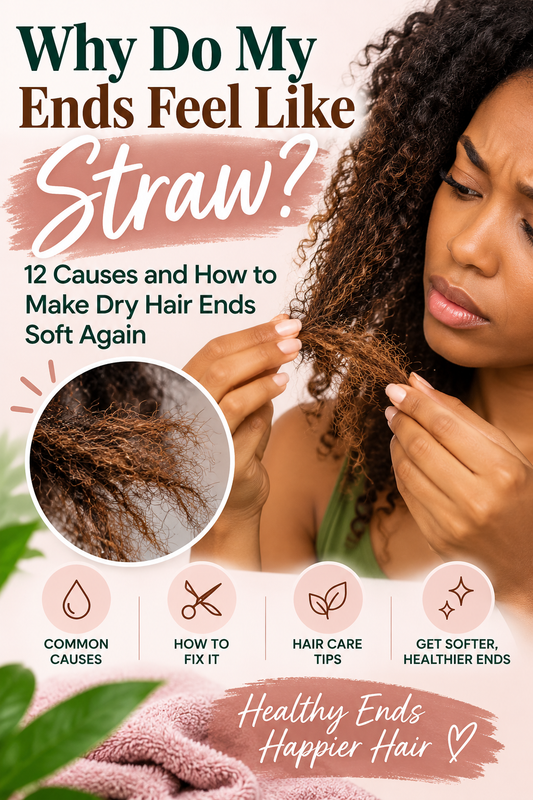
Have you ever touched the ends of your natural hair and wondered why they feel like straw? Maybe your roots feel soft and moisturized, but the last few inches of your hair feel rough, crunchy, stiff, or extremely dry. You might even notice that your ends tangle easily, break when you comb them, or refuse to stay soft no matter how much moisturizer you apply.
If you're constantly asking yourself, "Why do my ends feel like straw?", you're not alone.
Straw-like hair ends are a common concern for people with natural, curly, coily, kinky, and textured hair. Although this problem can affect every hair type, tightly curled hair can be particularly vulnerable to dryness because natural scalp oils don't always travel easily down the hair shaft.
The good news is that straw-like ends don't always mean your hair is permanently damaged. Sometimes your hair simply needs better conditioning, a more effective moisturizing routine, or protection from everyday friction.
However, extremely rough ends can also be a warning sign of split ends, excessive heat damage, chemical processing, or significant cuticle wear.
Understanding the difference is important.
In this comprehensive guide, we'll explain the 12 most common reasons your ends feel like straw, how to identify the underlying problem, and what you can do to make your natural hair feel softer, smoother, and easier to manage.
What Does It Mean When Your Hair Ends Feel Like Straw?
When people describe their hair ends as feeling like straw, they're usually referring to hair that has lost its smooth, flexible texture.
Instead of feeling soft and manageable, the ends may feel:
-
Extremely dry or rough
-
Hard or crunchy
-
Brittle and fragile
-
Stiff when bending
-
Difficult to detangle
-
Frizzy or uneven
-
Coarse to the touch
-
Easily tangled
-
Prone to snapping
-
Unresponsive to moisturizing products
These symptoms can develop gradually or appear after a particular styling treatment.
Your hair's outer protective layer, called the cuticle, plays an important role in how smooth your strands feel.
When the cuticle becomes weathered or damaged, the surface of the hair may become rougher. Increased friction between strands can lead to more tangling and breakage.
Hair can also feel rough when it lacks sufficient conditioning or has accumulated styling-product residue.
The important thing to understand is that straw-like hair is a symptom, not a single diagnosis.
Let's explore what may be causing it.
1. Your Hair Ends Are Extremely Dry
One of the most common reasons hair ends feel like straw is insufficient moisture and conditioning.
Your hair ends are the oldest part of your strands. They've experienced more washing, styling, detangling, environmental exposure, and daily wear than the hair growing near your scalp.
Your scalp produces natural oils called sebum, which help lubricate the scalp and nearby hair.
However, these oils may have difficulty traveling down tightly curled or coily strands.
As a result, your roots may feel relatively soft while your ends become increasingly dry.
How to Fix Extremely Dry Ends
Start by improving how you moisturize your hair.
-
Lightly dampen your hair with water.
-
Apply a water-based leave-in conditioner.
-
Work the product through your hair in sections.
-
Concentrate on the final two or three inches.
-
Add a small amount of oil or cream if your hair benefits from additional lubrication.
-
Protect your ends from friction between wash days.
Remember that moisturizing your scalp and moisturizing your ends are two different tasks.
Your scalp may not need additional oil, even when your ends need extra conditioning.
For a deeper explanation, read our guide on why your ends are drier than your roots.
2. Your Ends Have Experienced Too Much Heat
Flat irons, curling irons, blow dryers, and hot combs can all contribute to straw-like ends when used excessively or at damaging temperatures.
Heat can affect the hair's cuticle and internal structure.
Over time, repeated high-temperature styling may cause your ends to become rough, weak, and less flexible.
Because the ends are older, they've often experienced more heat exposure than the newer hair near your roots.
Signs of Heat-Damaged Ends
You might notice:
-
Ends that no longer curl normally
-
Straight pieces mixed into your natural curls
-
Hair that feels rough after washing
-
Frequent snapping during styling
-
Excessive tangling
-
Ends that remain stiff after conditioning
What You Should Do
Reduce heat styling while you evaluate your hair's condition.
When using heated tools, apply a suitable heat protectant and use the lowest effective temperature.
Avoid making repeated flat-iron passes over the same section.
Consider heat-free styles such as twists, braids, or roller sets.
Conditioning products may improve the appearance and manageability of heat-damaged hair, but severe structural damage cannot always be reversed.
If your ends have permanently lost their curl pattern or continue breaking, trimming the damaged portions may be necessary.
3. You Have Split Ends
Split ends are another major reason hair feels like straw.
A split end develops when the hair shaft begins separating, usually near the tip.
Instead of having a relatively smooth end, the strand becomes frayed.
These damaged tips can catch on neighboring hairs, creating additional tangling and friction.
How to Recognize Split Ends
Look closely at your ends in good lighting.
Common signs include:
-
Y-shaped splits
-
Tiny branches at the tips
-
White dots along damaged strands
-
Frayed or feathered ends
-
Frequent single-strand knots
-
Hair that breaks during detangling
Not every rough end is split, but visible splitting is a strong indication of physical damage.
Can You Repair Split Ends Without Cutting?
Unfortunately, no hair oil, conditioner, or moisturizer can permanently reconnect a split hair shaft.
Some products can temporarily smooth the appearance of damaged ends, making them easier to manage.
However, trimming is the reliable way to remove split ends.
You don't necessarily need a major haircut.
A small, targeted trim may be enough when the damage is limited.
The goal is to remove damaged portions before they contribute to additional tangling and breakage.
4. Your Hair Has Too Much Product Buildup
Sometimes hair feels like straw even though you're applying plenty of moisturizer.
This can happen when styling products accumulate on your strands.
Heavy oils, butters, gels, creams, and other products may leave residue that makes your hair feel coated or stiff.
You might assume your hair needs more moisture and continue adding products.
Unfortunately, additional layers may make the problem worse.
Signs of Product Buildup
-
Hair feels greasy but still rough.
-
Your ends look dull.
-
Moisturizers seem to sit on the surface.
-
Hair feels waxy or sticky.
-
Your strands become stiff after styling.
-
Conditioning products seem less effective.
How to Remove Buildup
Use a shampoo appropriate for your hair type and product usage.
If you've been applying heavy products frequently, occasional clarifying may help remove stubborn residue.
Follow shampooing with a suitable conditioner.
Avoid aggressively scrubbing the ends or repeatedly twisting them together while washing.
Once your hair is clean, apply a moderate amount of leave-in conditioner and evaluate how your ends respond.
Sometimes removing accumulated products is more helpful than purchasing another moisturizer.
5. Your Ends May Have Higher Porosity
Hair porosity describes how your strands interact with water.
Different areas of the same strand may behave differently.
For example, your roots may have relatively intact cuticles, while your ends have experienced years of weathering.
This can cause the ends to behave as though they have higher porosity.
Signs of Weathered, Porous Ends
Your ends may:
-
Become wet quickly
-
Feel dry shortly after moisturizing
-
Tangle more frequently
-
Appear frizzier than the roots
-
Feel rough after air-drying
-
Require more conditioning attention
These observations aren't definitive proof of high porosity, but they can help you understand how your hair behaves.
How to Care for Porous Ends
Focus on consistent conditioning and minimizing additional damage.
Use a suitable leave-in conditioner after washing.
Reduce excessive heat, chemical processing, and rough detangling.
Some damaged hair may benefit from appropriately formulated strengthening treatments, depending on the type of damage.
Avoid assuming every dry strand needs protein.
You can learn more in our complete guide to determining natural hair porosity.
6. You're Using Oil Instead of Proper Moisturization
One common mistake in natural hair care is treating oil as a complete replacement for water-based moisturizing products.
Oils can help lubricate hair, reduce friction, improve shine, and sometimes slow water loss.
However, applying oil alone to rough, poorly conditioned ends may not restore the softness you're looking for.
You might end up with hair that feels greasy and straw-like at the same time.
A Better Moisturizing Approach
Start with clean or lightly dampened hair.
Apply a water-based leave-in conditioner and distribute it evenly.
If needed, follow with a small amount of oil, butter, or cream.
This gives you an opportunity to improve both hydration and lubrication.
Not every hair type needs several product layers.
Fine hair may respond best to a lightweight leave-in, while thicker or coarser hair may prefer additional conditioning.
Pay attention to how your hair feels rather than following a complicated routine automatically.
7. You're Not Conditioning Your Ends Properly
Many people apply conditioner primarily to the top of their hair.
Unfortunately, the oldest and most weathered sections may receive the least attention.
If your ends aren't adequately conditioned during wash day, they may become difficult to detangle and feel rough after drying.
How to Condition Your Ends Correctly
Divide your hair into manageable sections.
Apply conditioner throughout the lengths, concentrating on the ends.
Use enough product to provide good coverage and slip.
Gently detangle with your fingers or a suitable wide-tooth comb, starting at the ends and gradually working upward.
Follow the manufacturer's instructions for how long to leave the conditioner on.
Rinse thoroughly unless the product is specifically designed to remain in the hair.
When your ends need extra attention, consider a deep-conditioning treatment suited to your hair's condition.
The goal isn't to use the greatest number of products.
It's to ensure your ends receive effective conditioning consistently.
8. Your Hair Is Experiencing Too Much Friction
Your ends come into contact with clothing, pillowcases, scarves, and other surfaces throughout the day.
Repeated friction can gradually wear down the hair cuticle.
This may contribute to tangling, roughness, and breakage.
Shoulder-length hair can be particularly vulnerable when the ends constantly rub against clothing.
Common Sources of Friction
-
Rough pillowcases
-
Wool sweaters
-
Jacket collars
-
Cotton scarves
-
Backpack straps
-
Frequent brushing
-
Tight hair accessories
-
Constant manipulation
How to Protect Your Ends
Try wearing your hair in loose twists, braids, or tucked styles when appropriate.
Use a satin or silk bonnet, scarf, or pillowcase at night to help reduce friction.
Avoid hairstyles that create excessive pulling or tension.
When wearing your hair loose, pay attention to whether the ends repeatedly rub against your clothing.
Small adjustments can reduce unnecessary wear over time.
9. You're Detangling Too Aggressively
Detangling can become especially challenging when your ends already feel dry and rough.
Strands may catch on one another, creating knots that are difficult to separate.
If you pull through these tangles aggressively, you may damage the hair further.
A Gentler Detangling Method
-
Divide your hair into sections.
-
Apply a conditioner or detangling product with adequate slip.
-
Hold the section above the area you're detangling.
-
Begin separating knots near the ends.
-
Work gradually toward the roots.
-
Avoid pulling through stubborn tangles.
-
Keep each completed section separated.
For tightly coiled hair, detangling while the strands are damp and coated with conditioner often helps reduce friction.
However, soaking-wet hair can also be vulnerable to stretching and breakage, so use gentle movements.
If your ends repeatedly knot together even after conditioning, inspect them for splitting or significant wear.
10. Chemical Treatments Have Weakened Your Ends
Bleaching, permanent coloring, relaxing, and certain chemical straightening treatments can change the hair's structure.
When these processes are performed too frequently or overlap previously treated hair, they may increase the risk of damage.
The ends are especially vulnerable because they've often experienced several treatments over time.
Signs of Chemically Damaged Ends
-
Unusual roughness
-
Increased breakage
-
Reduced elasticity
-
Excessive tangling
-
Changes in curl pattern
-
Hair that feels weak or fragile
If you suspect chemical damage, avoid additional processing until you've assessed the condition of your hair.
Use gentle cleansing and conditioning products.
A professionally recommended bond-building or strengthening treatment may help improve certain types of damaged hair, although no treatment can completely reverse every form of chemical damage.
Severely damaged ends may need trimming.
11. Your Ends Are Exposed to Harsh Environmental Conditions
Environmental conditions can influence how your hair feels.
Dry air, wind, intense sunlight, and frequent swimming may contribute to roughness or additional wear.
Chlorinated pool water and saltwater can also affect how manageable your hair feels, particularly when combined with repeated washing or inadequate conditioning.
How to Protect Your Hair
Before swimming, wet your hair with clean water and consider a suitable protective hair product.
After swimming, rinse thoroughly and cleanse when needed.
Follow with conditioner.
During windy or dry weather, consider low-manipulation styles that keep your ends from becoming tangled.
Protect your hair from unnecessary sun exposure when spending extended periods outdoors.
You don't have to avoid outdoor activities to maintain healthy-looking natural hair.
You simply need a routine that accounts for the conditions your hair experiences.
12. Your Ends Have Become Severely Weathered
Sometimes straw-like ends result from years of accumulated wear rather than one specific mistake.
Even without frequent heat styling or chemical processing, hair experiences natural weathering.
Washing, combing, styling, friction, and environmental exposure gradually affect the oldest portions.
Eventually, some ends may become too damaged to respond well to ordinary conditioning.
How to Tell if Your Ends Are Severely Weathered
Ask yourself:
-
Do my ends remain rough immediately after conditioning?
-
Do they constantly form knots?
-
Are there visible splits or white dots?
-
Do the ends break with gentle handling?
-
Are they significantly thinner than the rest of my hair?
If several of these symptoms are present, your ends may need more than additional moisturizer.
Consider a small trim to remove damaged sections while preserving as much healthy length as possible.
Remember that trimming doesn't make hair grow faster from the scalp.
It removes damaged portions that may otherwise contribute to continued breakage.
How to Make Straw-Like Hair Ends Soft Again
Now that you understand the possible causes, it's time to build a routine that improves softness and manageability.
The best approach combines cleansing, conditioning, targeted moisturizing, and protection.
Step 1: Start With a Gentle Wash
Choose a shampoo that removes dirt and product residue without leaving your hair excessively rough.
Concentrate on cleansing the scalp while gently washing the lengths as needed.
Avoid aggressively rubbing the ends together.
If you have substantial buildup, use an appropriate clarifying shampoo occasionally rather than repeatedly applying more oil.
Step 2: Give Your Ends Extra Conditioner
Apply conditioner in sections.
Concentrate on the driest and most tangled areas.
Allow the product to work for the recommended time.
Detangle carefully while the hair has enough slip.
A well-formulated conditioner can help reduce friction, improve manageability, and temporarily smooth the surface of weathered strands.
Step 3: Deep Condition When Necessary
Deep conditioning may be helpful when your ends feel especially rough or difficult to manage.
Choose a product designed for your hair's condition.
Some people benefit from deep conditioning weekly, while others need it less frequently.
Use your hair's response to determine the appropriate schedule.
Deep conditioning can improve softness, but it cannot permanently repair split ends.
Step 4: Apply a Leave-In Treatment to Damp Hair
After rinsing your conditioner, gently remove excess water.
While your hair is still damp, apply a leave-in conditioner through the lengths.
Spend extra time distributing it over the final few inches.
A suitable leave-in product can help improve slip, softness, and everyday manageability.
For your natural hair routine, consider the Hairobics All Natural Leave-In Treatment, designed to complement a regular moisturizing and conditioning routine.
Step 5: Add a Small Amount of Sealing Product if Needed
If your ends benefit from additional lubrication, apply a small amount of oil or cream after your leave-in.
Avoid saturating your hair with heavy products.
Your ends should feel conditioned and manageable, not excessively greasy.
Step 6: Choose a Low-Manipulation Hairstyle
Loose two-strand twists, braids, flat twists, and tucked hairstyles can help reduce unnecessary handling.
Choose styles that don't pull tightly on your roots or edges.
A protective style is only helpful when it reduces damage rather than creating additional tension.
Step 7: Protect Your Ends at Night
Use a satin or silk bonnet, scarf, or pillowcase.
If your hair is long, loosely section or gather it to reduce nighttime tangling.
Avoid tight accessories that pull on your strands while sleeping.
Step 8: Trim Ends That Are Actually Damaged
Inspect your ends periodically.
If you notice splitting, severe fraying, or persistent breakage, consider trimming the affected portions.
There is no universal rule requiring everyone to trim every six or eight weeks.
Your trimming schedule should reflect your hair's condition, styling habits, and length-retention goals.
Why Do My Ends Feel Like Straw After Washing?
If your ends feel like straw immediately after shampooing, several factors may be responsible.
Your shampoo may be removing more surface oils and conditioning residue than your hair comfortably tolerates.
You may also be washing without adequately conditioning the lengths afterward.
Alternatively, existing cuticle damage may become more noticeable once styling products have been removed.
Try using an appropriate conditioner after every shampoo.
Focus on the ends and avoid unnecessary friction.
If your hair feels soft after conditioning but rough again when dry, evaluate your leave-in routine and styling methods.
Why Do My Ends Feel Like Straw After Deep Conditioning?
Deep conditioning doesn't guarantee that damaged ends will become permanently smooth.
If your ends remain rough after treatment, possible explanations include:
-
Significant cuticle wear
-
Split ends
-
Inadequate product distribution
-
Residual buildup
-
An unsuitable conditioning formula
-
Excessive heat or chemical damage
Avoid automatically applying another heavy treatment.
Instead, examine your ends and evaluate your overall routine.
Sometimes a lightweight leave-in works better than repeated applications of thick masks.
Other times, damaged portions need to be trimmed.
Why Do My Ends Feel Like Straw but My Roots Are Soft?
Your roots and ends are different ages.
The hair near your scalp is newer and generally experiences less accumulated wear.
Your ends have been exposed to more washing, detangling, friction, and styling.
Natural scalp oils also have more difficulty reaching the ends of curly and coily hair.
As a result, it's possible to have soft, healthy-feeling roots and rough, straw-like ends.
You may need to condition your ends more carefully rather than applying additional oil to your scalp.
Can Straw-Like Ends Cause Hair Breakage?
Yes. Hair that feels rough, brittle, or severely weathered may be more vulnerable to breakage.
However, dryness alone doesn't prove that a strand is structurally damaged.
Breakage can occur when weakened strands experience excessive tension, friction, or manipulation.
If your ends constantly snap during detangling, your hair may struggle to retain length.
This is why caring for the ends is important for anyone trying to grow longer natural hair.
Your hair may continue growing normally at the scalp, but frequent breakage can make that growth difficult to notice.
Best Hairstyles for Protecting Straw-Like Ends
Choosing the right hairstyle can help reduce daily manipulation while you're improving your conditioning routine.
Two-Strand Twists
Two-strand twists keep sections of hair organized and can reduce tangling.
Apply a suitable moisturizer before styling and avoid twisting too tightly.
Loose Braids
Loose braids can help protect the lengths from constant manipulation.
Avoid excessive tension and keep the hair appropriately conditioned.
Flat Twists
Flat twists can provide a low-manipulation styling option without requiring frequent combing.
Low-Tension Buns
A comfortable bun can help keep your ends from rubbing against clothing.
Avoid securing it too tightly or placing repeated pressure on the same sections.
Tucked Protective Styles
Tucking your ends away can help reduce environmental exposure and friction.
However, don't keep damaged hair hidden indefinitely without inspecting or caring for it.
The best protective hairstyle is one that allows you to maintain your hair comfortably without creating additional damage.
A Simple Weekly Routine for Softer Natural Hair Ends
Consistency is often more helpful than using a large collection of products.
Wash Day
-
Cleanse your scalp and hair.
-
Apply conditioner throughout the lengths.
-
Detangle gently.
-
Deep condition when needed.
-
Apply a leave-in treatment to damp hair.
-
Style with minimal tension.
Midweek
Check your ends for dryness or tangling.
If necessary, lightly dampen them and apply a small amount of leave-in conditioner.
Avoid piling heavy products onto hair that already feels coated.
Every Night
Protect your hair with a satin or silk bonnet, scarf, or pillowcase.
Keep your ends from becoming excessively tangled.
Periodically
Inspect your hair for split ends, thinning, and breakage.
Trim damaged portions when necessary.
Evaluate whether your routine is keeping your hair soft and manageable.
Frequently Asked Questions About Straw-Like Hair Ends
Can straw-like hair become soft again?
Yes, if the roughness is primarily related to inadequate conditioning, buildup, or manageable dryness, an improved routine may restore softness. Severely damaged hair may feel temporarily smoother with products, but structural damage cannot always be reversed.
Should I cut my ends if they feel like straw?
Not automatically. First determine whether the ends are dry or physically damaged. If they have visible splits, severe fraying, or persistent breakage, trimming may be appropriate.
Is coconut oil good for straw-like ends?
Coconut oil can help reduce certain forms of hair damage and improve lubrication for some people. However, it doesn't replace conditioner, and not everyone likes how their hair feels after using it.
How often should I moisturize my ends?
There is no universal schedule. Some people need a light refresh every few days, while others maintain softness longer. Apply products according to how your hair responds rather than following a rigid daily schedule.
Can too much protein make my ends feel stiff?
Some protein-containing treatments can leave certain hair types feeling stiff or coated, especially when used excessively or without adequate conditioning. However, straw-like ends aren't necessarily caused by protein.
Why are my ends crunchy after applying oil?
Your hair may have insufficient conditioning, product buildup, or existing damage. Adding more oil may increase greasiness without improving softness. Try cleansing appropriately and applying a water-based leave-in before using oil.
Do straw-like ends mean my hair isn't growing?
No. Your hair may still be growing normally at the scalp. However, frequent breakage at the ends can interfere with length retention.
Can low-porosity hair have straw-like ends?
Yes. Low-porosity hair can feel rough when it isn't adequately conditioned or when products accumulate. Different sections of the same strand may also behave differently because of weathering.
Does deep conditioning repair damaged ends?
Deep conditioning can improve softness, manageability, and the temporary appearance of damaged hair. It cannot permanently reconnect split ends or completely reverse severe structural damage.
How long does it take to soften dry hair ends?
Hair that mainly needs better conditioning may feel softer after one wash and conditioning session. Maintaining that improvement requires consistency. Severely damaged ends may not recover their original texture and may need trimming.
Final Thoughts: Why Do My Ends Feel Like Straw?
If your ends feel like straw, the problem may involve dryness, inadequate conditioning, product buildup, friction, heat damage, split ends, or accumulated wear.
The most important step is identifying what your hair actually needs.
Not every rough strand requires more oil.
Not every dry end needs protein.
And not every straw-like end needs to be cut immediately.
Start with gentle cleansing, effective conditioning, targeted moisturizing, and low-manipulation styling.
Pay particular attention to the oldest portions of your hair, since these sections experience the greatest accumulated wear.
When your ends are severely split or damaged, trimming can help prevent continued tangling and breakage.
Support Your Natural Hair Care Routine With Hairobics All Natural
At Hairobics All Natural, we believe that caring for natural hair should be simple, consistent, and focused on maintaining healthy-looking strands.
Whether you're managing dry ends, rough textures, or hair that's difficult to detangle, building a routine around gentle cleansing, proper conditioning, and moisture maintenance can make a meaningful difference.
Explore the Hairobics All Natural Leave-In Treatment as part of your regular conditioning routine, and remember that protecting your ends is an important part of maintaining beautiful, manageable natural hair.
Soft, healthy-looking ends begin with consistent care—not simply adding more products.