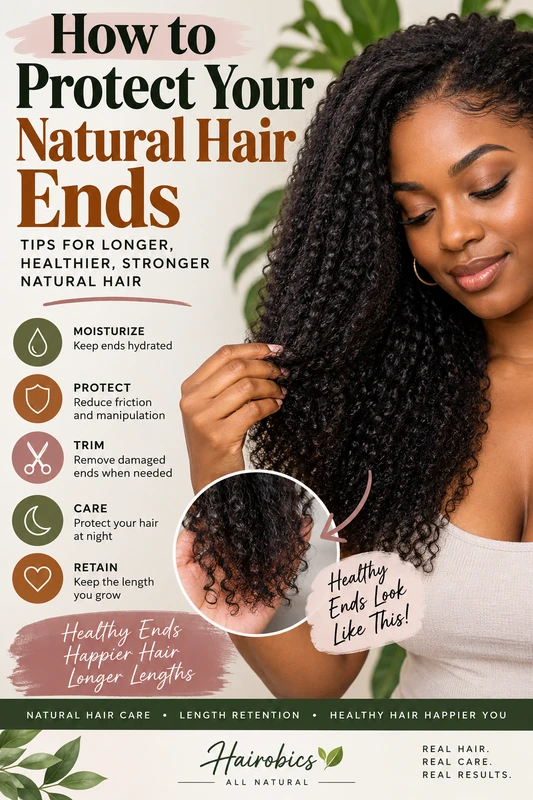
Growing natural hair is only part of the journey. If your goal is longer, fuller-looking hair, protecting your ends is just as important as encouraging healthy growth at the scalp.
Your ends are the oldest part of your hair. They have been through months—or even years—of washing, detangling, styling, moisturizing, weather changes, friction, and manipulation. Because of this, they are often the first part of natural hair to become dry, tangled, split, or broken.
You may feel like your hair "isn't growing" when the real problem is that your ends are breaking at nearly the same rate that new hair is growing from your scalp.
Learning how to protect your natural hair ends can help you retain more of the length you already grow. The goal isn't to make your ends indestructible. It's to reduce unnecessary damage, keep them properly conditioned, and recognize when damaged ends actually need to be trimmed.
In this guide, we'll cover why natural hair ends become damaged, how to moisturize and protect them, which hairstyles can help with length retention, nighttime protection, trimming, detangling, and common mistakes that can make your ends more vulnerable.
Why Are the Ends of Natural Hair So Fragile?
Your hair ends are usually the oldest section of each strand.
Think about a strand of hair that has been growing for several years. The section closest to your scalp is relatively new. The very end of that same strand has experienced hundreds of days of manipulation and environmental exposure.
Over time, the protective outer layer of the hair fiber can become worn.
Natural hair can be especially susceptible to mechanical damage because curls, coils, and bends create points along the strand where friction and stress can occur. Natural hair also relies on thoughtful conditioning because scalp oils do not necessarily travel easily down tightly curled strands.
This doesn't mean natural hair is unhealthy or inherently weak. It means your hair-care routine should account for the structure of your hair and the age of your ends.
Signs Your Natural Hair Ends May Need More Protection
Pay attention to what happens during detangling and styling.
Common signs of stressed or damaged ends include:
- Ends that constantly feel rough
- Frequent single-strand knots
- Excessive tangling near the bottom of the hair
- Split ends
- Ends that look noticeably thinner than the rest of your hair
- Small broken pieces of hair during styling
- Ends that feel dry shortly after moisturizing
- Hair that seems to stay at the same length despite visible new growth
- Ends that catch on your fingers or comb
- Uneven or see-through-looking ends
One of these signs doesn't automatically mean your hair is severely damaged. But repeated problems can indicate that your ends need more attention—or that it may be time for a trim.
1. Keep Your Ends Properly Moisturized
One of the most important parts of protecting natural hair ends is maintaining adequate moisture and conditioning.
Dry hair is generally less flexible. When hair becomes difficult to bend and manipulate, everyday styling can contribute to breakage.
Your ends often need special attention because they're older than your roots.
When applying your moisturizer or leave-in product, don't automatically stop once you've covered the main body of your hair.
Gently work some product down toward the ends.
How to Moisturize Natural Hair Ends
After washing your hair:
- Apply a leave-in conditioner or moisturizing treatment while your hair is still slightly damp.
- Divide your hair into manageable sections.
- Work the product through each section.
- Pay special attention to the final few inches.
- Gently smooth your ends between your fingers.
- Follow with your preferred styling method.
Your hair shouldn't necessarily feel coated or greasy. The objective is manageable, conditioned hair that doesn't feel brittle.
If your ends become dry long before the rest of your hair, you may need to refresh them between wash days.
A light mist of water or a moisturizing spray followed by an appropriate hair product may be enough.
Avoid continuously layering heavy products onto dry hair without cleansing it. Product buildup can eventually make your hair more difficult to manage.
2. Seal Your Ends When Appropriate
Many people with natural hair like to follow a water-based moisturizer with an oil, butter, cream, or pomade.
This is commonly called sealing.
The idea is not that oil magically hydrates dry hair. Water provides hydration. Oils and other products may help lubricate the hair and reduce moisture loss depending on their formulation and your individual hair.
After applying your leave-in or moisturizer, smooth a small amount of your preferred sealing product over your ends.
You don't need to saturate them.
Too much oil or butter can leave the hair greasy and contribute to buildup.
Experiment with the amount that leaves your ends soft and manageable.
3. Stop Rough Detangling
You can have an excellent moisturizing routine and still experience breakage if you're too aggressive when detangling.
Tangles often become concentrated toward the ends.
If you begin combing at the roots and force the comb downward, you push multiple tangles together.
That can create a larger knot near your ends.
Instead, work gradually.
Hold a section of hair and begin detangling near the ends. Once that area is free of major tangles, move slightly higher.
Continue working upward until you can gently move through the entire section.
Finger Detangling vs. Combs
Neither method is automatically best for everyone.
Finger detangling allows you to feel individual knots and may help you avoid ripping through them.
A wide-tooth comb or quality detangling brush can be faster and may remove shed hairs more thoroughly.
The most important factor is how you use the tool.
Avoid:
- Ripping through knots
- Detangling extremely dry hair
- Using damaged combs with sharp seams
- Repeatedly brushing the same section
- Pulling aggressively when you encounter resistance
If you reach a knot, stop and work on the knot rather than pulling harder.
Patience can save your ends.
4. Keep Your Ends Tucked Away
Protective styling can be useful for natural hair because it reduces how frequently the ends are exposed to manipulation and friction.
Styles that keep your ends tucked away may include:
- Two-strand twists
- Flat twists
- Buns
- Braided updos
- Cornrows
- Box braids
- Knotless braids
- Mini twists
- Wigs worn with proper hair preparation underneath
However, a hairstyle isn't automatically protective simply because it's called a "protective style."
A style that causes excessive tension, dryness, matting, or neglect can become counterproductive.
The best protective style is one that allows your hair and scalp to remain reasonably clean and conditioned while minimizing unnecessary manipulation.
5. Don't Make Your Protective Styles Too Tight
Tighter does not mean more protective.
Braids, cornrows, buns, ponytails, and other styles should not create persistent pain or excessive pulling.
Your edges and nape can be especially vulnerable.
If a style feels painfully tight immediately after installation, don't assume that suffering through the first few days is simply part of the process.
Your natural hair should be handled gently.
Also be careful when constantly pulling your ends into the same bun.
A bun can protect your ends, but repeatedly placing a hair tie in exactly the same area can create friction and mechanical stress.
Change the position of your styles periodically.
6. Protect Your Hair at Night
Your nighttime routine can have a major impact on length retention.
If your hair rubs against an absorbent or rough surface for several hours every night, that friction can contribute to tangling and breakage.
A satin or silk bonnet, scarf, or pillowcase can help reduce friction compared with rougher bedding materials.
You don't necessarily need all three.
Choose whichever option you can use consistently.
Simple Natural Hair Night Routine
Before bed:
- Check whether your ends feel excessively dry.
- Add a small amount of moisture if necessary.
- Put long hair into several loose twists, braids, or another low-manipulation arrangement.
- Cover your hair with a satin or silk bonnet or scarf.
- Sleep on a satin or silk pillowcase if desired.
Avoid making your nighttime style excessively tight.
The objective is to reduce tangling and friction while you sleep.
7. Be Careful With Heat
Heat isn't automatically forbidden for natural hair.
Many people successfully use blow-dryers, hooded dryers, flat irons, and other heated tools.
Problems are more likely to occur when hair is repeatedly exposed to excessive heat or poor technique.
Your ends deserve extra caution because they're already the oldest part of your strands.
If you use heat:
- Use an appropriate heat protectant.
- Avoid unnecessary repeated passes.
- Use the lowest effective temperature for your desired result.
- Don't repeatedly flat iron already-straightened sections.
- Avoid holding concentrated heat on your ends.
- Give your hair breaks between high-heat styles.
If you notice that your ends become extremely rough, brittle, split, or difficult to curl after heat styling, reassess your technique and frequency.
8. Trim Damaged Ends When Necessary
Some people become so focused on retaining length that they avoid trimming altogether.
But holding onto badly damaged ends doesn't necessarily help you achieve healthy-looking long hair.
Split or severely weathered ends cannot truly be permanently repaired by a cosmetic product.
Conditioners and styling products may temporarily improve how damaged ends look and feel, but they don't fuse severely split hair back into permanently healthy hair.
When ends are significantly damaged, trimming is the most reliable solution.
How Often Should Natural Hair Be Trimmed?
There isn't one universal trimming schedule.
Some people need trims more frequently because of heat styling, manipulation, environmental exposure, or their preferred hairstyles.
Others can go longer between trims.
Instead of trimming solely according to a calendar, watch the condition of your hair.
Possible signs it's time for a trim include:
- Numerous visible split ends
- Excessive knots
- Persistent roughness at the ends
- Thin, uneven ends
- Ends that constantly tangle together
- Breakage that continues despite improving your routine
A professional stylist experienced with natural hair can help determine how much actually needs to be removed.
9. Don't Confuse Length Retention With Hair Growth
This distinction is extremely important.
Hair grows from follicles in your scalp.
Putting a product directly on your ends cannot make the hair follicle produce hair faster.
However, protecting your ends can help you retain more of the hair you've already grown.
Imagine your hair grows a certain amount over several months, but the bottom repeatedly breaks.
You may see new growth near your scalp while your overall length barely changes.
This can create the impression that your hair has stopped growing.
Improving length retention means reducing unnecessary breakage so more of that growth remains attached.
10. Reduce Daily Manipulation
Natural hair doesn't necessarily need to be completely restyled every morning.
Constant manipulation adds up.
Think about everything your ends might experience during one week:
Combing.
Brushing.
Twisting.
Untwisting.
Braiding.
Unbraiding.
Ponytails.
Buns.
Edge styling.
Heat.
Clips.
Hair ties.
Clothing friction.
None of these things automatically destroys your hair, but repeated mechanical stress can eventually contribute to damage.
Try creating styles that can last several days without requiring complete daily manipulation.
A twist-out, braid-out, bun, puff, wash-and-go, mini twists, or other style may work depending on your hair and preferences.
11. Watch Your Hair Accessories
Sometimes the problem isn't your moisturizer.
It's your accessories.
Certain elastic bands, clips, barrettes, and hair ties can snag natural hair.
Inspect your accessories regularly.
If you notice rough seams, exposed metal, cracks, or areas where hair can become trapped, replace them.
Choose smooth accessories whenever possible.
And don't pull your ponytail or bun unnecessarily tight.
A "snatched" hairstyle isn't worth repeatedly damaging your strands.
12. Protect Your Ends From Clothing
This is an overlooked source of friction.
When natural hair reaches shoulder length, the ends may constantly rub against:
- Cotton shirts
- Sweaters
- Hoodies
- Wool coats
- Scarves
- Jacket collars
If you're trying to grow your hair past shoulder length, pay attention to how often your ends rub against your clothing.
You don't have to wear your hair up every day.
But alternating between loose styles and styles that keep your ends off your shoulders may help reduce unnecessary friction.
This can become particularly useful during colder months when you're wearing heavier fabrics.
13. Don't Let Your Hair Stay Tangled
There's a difference between low manipulation and neglect.
Leaving natural hair alone for weeks while it becomes increasingly tangled isn't necessarily protective.
Shed hairs naturally accumulate.
Those shed strands can wrap around neighboring hairs and contribute to knots and matting.
How often you need to thoroughly detangle depends on your hair, hairstyle, density, length, and wash routine.
The goal is to find a balance:
Don't manipulate your hair constantly, but don't allow severe tangles to accumulate either.
14. Wash Your Hair Regularly
Healthy-looking ends aren't created by moisturizer alone.
Your hair also needs cleansing.
Products, sweat, environmental debris, oils, and styling residue accumulate over time.
Eventually, excessive buildup may make it difficult for your hair to behave the way it normally does.
A consistent wash routine gives you the opportunity to:
- Cleanse your scalp
- Remove buildup
- Condition your hair
- Detangle shed strands
- Examine your ends
- Reset your style
There's no single perfect wash schedule for every person.
Some people wash weekly. Others prefer a different schedule based on their scalp, lifestyle, hairstyle, and product use.
What matters is not allowing your hair and scalp to remain excessively dirty simply because you're trying not to manipulate your hair.
15. Condition After Shampooing
Conditioning is especially important when you're trying to maintain manageable natural hair.
A good conditioner can improve slip, making the strands easier to separate during detangling.
Less resistance during detangling can mean less unnecessary pulling on your ends.
Apply conditioner throughout your hair, including the ends.
Allow it to remain on your hair according to the product directions.
Then detangle carefully if the product and your routine allow for it.
Don't assume that using more conditioner always means better results. Follow the directions and pay attention to how your hair responds.
16. Deep Condition When Your Hair Needs It
Some natural hair routines include periodic deep conditioning.
This can be useful when your hair feels especially dry or difficult to manage.
However, deep conditioning shouldn't become a substitute for proper everyday hair care.
You cannot repeatedly damage your hair with excessive heat, rough detangling, and tight styles and expect one deep conditioner to undo everything.
Think of deep conditioning as one part of your routine—not a rescue treatment for every type of damage.
17. Be Gentle When Removing Braids
Protective-style takedown is one of the easiest times to damage your ends.
Imagine wearing braids for several weeks.
Your hair has accumulated shed strands, product, and tangles. When you remove the braids, you may be tempted to grab a comb and immediately pull through everything.
Don't rush.
Take your time.
Carefully unravel each braid.
Use your fingers to separate shed hair and obvious tangles before aggressively combing.
If necessary, apply a product that provides slip.
Work in sections.
This is particularly important near your ends, where knots may have developed.
A protective style isn't truly protective if you lose excessive hair during the takedown process.
18. Don't Leave Braids In Forever
Braids can be convenient, but they shouldn't become an excuse to ignore your natural hair indefinitely.
As your hair grows, the style becomes looser at the roots. Shed hairs accumulate, and tangles can form.
Leaving a style in too long can make takedown more challenging.
There's no universal number of weeks that works for every person and every braided style.
Pay attention to your scalp, new growth, buildup, tangling, and the condition of your hair.
Remove the style before your hair becomes severely matted.
19. Protect Your Ends Under Wigs
Wigs can provide a break from daily styling, but your natural hair still needs care underneath.
Before wearing a wig, your hair should be arranged in a comfortable, low-tension style.
Don't neglect your hair simply because you can't see it.
Depending on how you're wearing the wig, you'll still need an appropriate routine for cleansing and conditioning your natural hair.
Also watch for friction around the hairline and nape.
Wig caps, combs, clips, adhesives, and tight braids can potentially cause problems if used improperly.
20. Give Your Ends Extra Attention During Winter
Cold weather can change the way your hair behaves.
Indoor heating, lower humidity, hats, scarves, sweaters, and coats can all influence your natural hair routine.
If your ends feel drier during winter, you may need to adjust your routine.
That could mean:
- Moisturizing slightly more often
- Using a richer conditioner
- Wearing protective styles more frequently
- Protecting hair from rough scarves and coats
- Using satin-lined hats
- Keeping ends tucked away on especially dry days
Don't automatically use more and more product.
Adjust based on what your hair actually needs.
21. Be Careful With DIY Treatments
Natural hair communities are filled with home remedies.
Some are relatively harmless, while others can irritate the scalp or leave the hair difficult to manage.
You don't need a complicated kitchen recipe to protect your ends.
A consistent routine involving cleansing, conditioning, gentle detangling, moisturizing, and low-manipulation styling can accomplish a lot.
More ingredients don't necessarily equal healthier hair.
Consistency usually matters more than complexity.
22. Don't Obsess Over Every Single-Strand Knot
Single-strand knots—sometimes called fairy knots—are common in tightly curled hair.
A strand can curl around itself and form a tiny knot.
You may not be able to eliminate them completely.
The goal is to reduce excessive knotting.
You may find it helpful to:
- Keep hair properly conditioned
- Detangle regularly
- Stretch your hair occasionally
- Keep ends protected
- Trim damaged ends
- Avoid letting your hair become severely tangled
If you find an individual knot that cannot be gently removed, cutting that single strand with proper hair shears may be better than aggressively ripping through it.
23. Stretch Your Hair Carefully
Some people find that gently stretching natural hair helps reduce tangling because the strands aren't constantly wrapping around each other.
Stretching methods include:
- Braids
- Twists
- Banding
- African threading
- Low-heat blow-drying
You don't have to stretch natural hair to keep it healthy.
But if stretched styles make your hair easier to manage, they can be incorporated into your routine.
Just avoid turning stretching into another source of tension or heat damage.
24. Use Hair Shears for Trimming
If you trim your own hair, use scissors designed for cutting hair.
Don't grab the same scissors you use for opening packages or cutting paper.
Dull scissors can create a poor cut and potentially contribute to additional fraying.
Keep your hair shears clean and reserve them for hair.
If you're uncomfortable trimming your own natural hair, visit a professional.
25. Pay Attention to Your Ends During Wash Day
Wash day is one of the best opportunities to assess the condition of your ends.
When your hair is wet and conditioned, examine several sections.
Ask yourself:
Do my ends feel smooth?
Are they constantly catching on each other?
Do I see many splits?
Are my ends significantly thinner than the rest of my hair?
Am I finding a lot of small broken pieces?
Does my hair detangle easily until I reach the bottom?
You don't have to inspect every strand under a magnifying glass.
You're looking for patterns.
The earlier you recognize a problem, the easier it may be to adjust your routine.
26. Don't Try to Save Every Inch
Length goals can sometimes make people afraid of scissors.
But healthy-looking length is more important than simply having the longest possible strands.
If the bottom several inches of your hair are severely damaged, transparent, split, and constantly tangling, keeping them may actually make styling more frustrating.
Sometimes removing damaged ends makes the entire head of hair look fuller.
A trim doesn't erase your progress.
It can be part of maintaining it.
27. Create a Simple Length-Retention Routine
Protecting natural hair ends doesn't require 15 products and hours of work every day.
A straightforward routine may be more sustainable.
Example Weekly Natural Hair Routine
Wash Day
Cleanse your scalp and hair using an appropriate shampoo.
Follow with conditioner.
Detangle carefully in sections.
Apply a leave-in or moisturizing treatment.
Style your hair with minimal tension.
Give your ends additional attention.
During the Week
Avoid unnecessary manipulation.
Refresh moisture when needed instead of automatically applying products every day.
Keep your ends from constantly rubbing against rough clothing.
At Night
Put your hair into a comfortable arrangement.
Use a satin or silk bonnet, scarf, or pillowcase.
Periodically
Check for split, thin, excessively tangled, or damaged ends and trim when necessary.
That's enough to build a strong foundation.
Best Hairstyles for Protecting Natural Hair Ends
Styles that reduce manipulation and keep your ends tucked away can be particularly helpful when length retention is your goal.
Some options include:
Two-Strand Twists
Two-strand twists can be worn for multiple days and make it easy to moisturize individual sections.
They also work across many natural hair lengths.
Low Bun
A loose low bun can keep your ends off your clothing.
Avoid repeatedly pulling the hair extremely tight.
Braided Bun
Braiding your hair before creating a bun can provide additional control and help keep the ends tucked away.
Mini Twists
Mini twists can reduce the need for daily detangling and styling.
However, be careful during removal because small twists can tangle if rushed.
Cornrows
Properly installed cornrows can provide low-manipulation styling.
Avoid excessive tension around the edges and nape.
Box or Knotless Braids
Braids can reduce daily styling, but your natural hair still needs appropriate care while they're installed.
Takedown should be slow and gentle.
How to Protect Natural Hair Ends While Wearing Your Hair Out
You don't have to wear protective styles constantly.
Natural hair should be enjoyed.
Afros, twist-outs, braid-outs, wash-and-gos, stretched styles, and other loose hairstyles can all be part of a healthy routine.
The key is balancing appearance with manipulation.
When wearing your hair out:
Avoid constantly touching it.
Detangle only when necessary.
Protect it at night.
Keep the ends conditioned.
Pay attention to clothing friction.
Avoid repeatedly restyling throughout the day.
If your ends begin tangling excessively after several days, reset the style instead of continuously pulling the tangles apart.
How to Protect Natural Hair Ends While Growing Long Hair
If you're trying to grow longer natural hair, think in terms of months and years rather than days.
You cannot control every aspect of hair growth, and dramatic overnight growth promises should be viewed skeptically.
What you can control is how you treat the hair that's already on your head.
Focus on:
Healthy scalp care + consistent cleansing + conditioning + gentle handling + reduced breakage + patience.
Take progress photos every few months rather than checking your length every day.
Small improvements in retention can become noticeable over time.
Common Mistakes That Can Damage Natural Hair Ends
Sometimes improving your routine means stopping certain habits rather than buying something new.
Common mistakes include:
- Detangling aggressively
- Ignoring split ends
- Using excessive heat
- Wearing extremely tight hairstyles
- Allowing hair to become severely tangled
- Leaving protective styles in too long
- Neglecting your hair underneath wigs
- Constantly restyling
- Sleeping without reducing friction
- Pulling through knots
- Using damaged hair accessories
- Letting ends constantly rub against clothing
- Overloading hair with product
- Treating oil as a replacement for water-based moisture
- Trying to repair severely split ends instead of trimming them
Changing just two or three damaging habits can make your routine significantly more effective.
Frequently Asked Questions About Protecting Natural Hair Ends
How Do I Stop My Natural Hair Ends From Breaking?
Start by identifying the source of the breakage.
Improve conditioning, detangle gently, reduce unnecessary manipulation, protect your hair while sleeping, limit damaging heat practices, avoid overly tight styles, and trim severely damaged ends.
If breakage is sudden, severe, unexplained, or accompanied by scalp symptoms or unusual hair loss, consider speaking with a dermatologist or other qualified healthcare professional.
Should I Oil My Ends Every Day?
Not necessarily.
More oil isn't automatically better.
If your ends feel dry, first consider whether they need moisture or conditioning. Oil can be used as part of your routine, but coating dry hair repeatedly with oil may not address the underlying problem.
Pay attention to how your individual hair responds.
Does Protective Styling Make Hair Grow Faster?
Protective styles don't directly make your follicles produce hair faster.
Their potential benefit is length retention.
By reducing daily manipulation and protecting the ends, a good protective style may help you retain more of your existing hair.
Should I Keep My Ends Tucked Away All the Time?
No.
You can wear your natural hair out.
Protective styling is a tool, not a requirement.
The objective is to create a healthy balance between enjoying your hairstyles and limiting unnecessary damage.
Can Split Ends Be Repaired?
Products may temporarily smooth the appearance and feel of damaged ends, but severely split hair cannot be permanently restored to its original condition.
Trimming is the reliable way to remove a split end.
Why Are My Ends Dry but My Roots Feel Moisturized?
Your ends are older and have experienced more wear.
Natural scalp oils may also have difficulty traveling down curly or coily strands.
When moisturizing, intentionally work your product through the entire length of the hair instead of concentrating only near the roots.
Why Do My Ends Keep Knotting?
Tightly curled strands can naturally wrap around themselves and neighboring hairs.
Dryness, shed hair, friction, infrequent detangling, and damaged ends can make the problem worse.
Regular conditioning, gentle detangling, stretched styles, and timely trimming may help.
Is It Better to Wear Natural Hair Up or Down for Growth?
Neither automatically causes faster hair growth.
However, wearing your hair up in a comfortable low-tension style can reduce friction between your ends and clothing.
If you always wear the same tight updo, though, you may create stress in other areas.
Variety and gentle handling matter.
The Secret to Longer Natural Hair Is Often Retention
When people begin a natural hair growth journey, much of their attention goes directly to the scalp.
They look for oils, shampoos, supplements, treatments, and routines promising faster growth.
Scalp health certainly matters.
But there's another side of the equation:
You have to keep the hair you grow.
If your hair grows at the roots but continually breaks at the ends, achieving your length goals becomes much more difficult.
That's why learning how to protect your natural hair ends should be a major part of your natural hair routine.
Keep your hair adequately conditioned.
Be patient while detangling.
Protect your hair at night.
Reduce unnecessary manipulation.
Use protective styles strategically.
Limit damaging heat practices.
Pay attention to friction.
And trim ends that are truly damaged.
You don't need a perfect routine.
You need one that you can follow consistently.
Over several months, those small habits can make a meaningful difference in how much length you're able to retain.
Final Thoughts
Your ends tell the story of everything your natural hair has experienced.
They've survived wash days, hairstyles, weather, sleeping, detangling, shrinkage, protective styles, and everyday life.
Treat them accordingly.
Instead of focusing exclusively on making your hair grow faster, shift some of your attention toward preserving the length you already have.
Protecting natural hair ends comes down to a few fundamentals: moisture and conditioning, gentle handling, low manipulation, protection from friction, smart styling, and trimming when necessary.
Build those habits into your routine and you'll give your natural hair a better opportunity to remain strong, manageable, and beautiful as it gets longer.