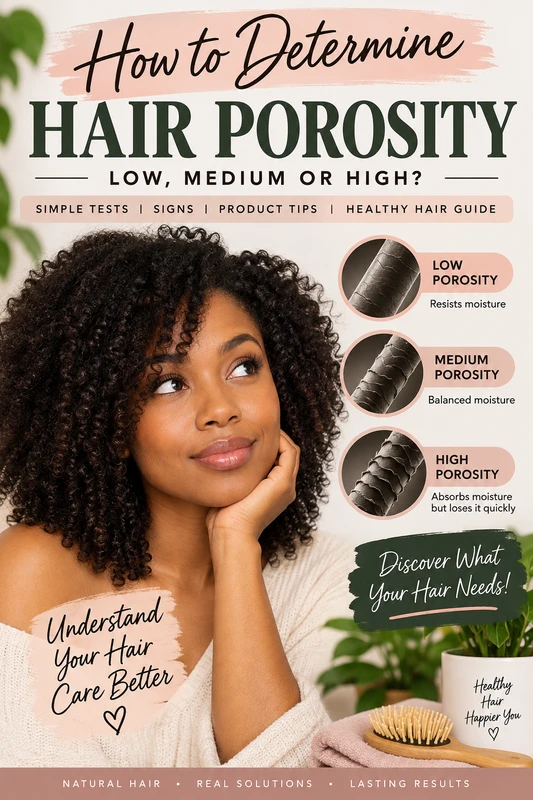
Understanding your hair porosity can completely change the way you care for your natural hair. You may already know your curl pattern, hair density, and strand thickness, but porosity tells you something different: how your hair interacts with water and hair products.
Have you ever applied moisturizer only to find that your hair feels dry again a few hours later? Maybe water seems to sit on top of your strands instead of soaking in. Or perhaps your hair absorbs products quickly but loses moisture almost as fast.
These experiences may be connected to your hair's porosity.
Knowing whether you have low-, medium-, or high-porosity hair can help you choose better products, develop a more effective wash-day routine, and understand why certain techniques work beautifully for someone else's natural hair but not yours.
The good news is that determining your hair porosity doesn't have to be complicated.
In this complete guide, we'll explain how to determine hair porosity, what the different porosity levels mean, which tests are useful, which popular tests aren't always reliable, and how to care for your hair once you understand its moisture behavior.
What Is Hair Porosity?
Hair porosity refers to your hair's ability to take in and retain water and moisture.
The outermost portion of each hair strand is called the cuticle. The cuticle consists of overlapping cells that help protect the inner structures of the hair fiber.
How your hair behaves around water is influenced partly by the condition and structure of this outer layer.
In simple terms, you can think of the cuticle as a protective barrier.
If your hair doesn't wet easily and products tend to remain on its surface, you may notice characteristics commonly associated with low-porosity hair.
If your hair wets relatively easily and generally maintains moisture well, it may behave more like medium- or normal-porosity hair.
If your hair absorbs water quickly but also seems to become dry quickly, it may display characteristics associated with high-porosity hair.
Porosity isn't necessarily the same across every strand on your head. Some people have mixed porosity, meaning different areas of their hair behave differently.
This is especially important for people with natural hair because factors such as heat styling, chemical processing, coloring, friction, weathering, and everyday manipulation can affect different sections of the hair differently.
The Three Main Hair Porosity Levels
Hair porosity is commonly divided into three categories:
- Low porosity
- Medium or normal porosity
- High porosity
Understanding the characteristics of each can help you determine where your hair most closely fits.
What Is Low-Porosity Hair?
Low-porosity hair is generally resistant to becoming fully saturated with water.
You may stand under the shower and notice that water initially beads on the surface of your hair. When applying creams, butters, and oils, you may also feel as though products are coating your strands rather than disappearing into your hair.
Common Signs of Low-Porosity Hair
You may have low-porosity hair if:
- Water tends to bead on your hair initially.
- Your hair takes a while to become completely wet.
- Thick products easily leave buildup.
- Products sometimes seem to sit on your strands.
- Your hair may take a long time to air-dry.
- Lightweight products often work better than very heavy formulas.
- Your hair can feel coated even though it still needs hydration.
- Clarifying your hair occasionally makes a noticeable difference in how products perform.
One of the biggest mistakes people make with low-porosity hair is assuming that it doesn't need moisture.
It absolutely does.
The challenge is usually getting water and conditioning ingredients distributed effectively without overwhelming the hair with unnecessary layers of heavy products.
What Is Medium-Porosity Hair?
Medium-porosity hair—sometimes called normal porosity—generally accepts and retains moisture relatively well.
Water penetrates the hair without excessive resistance, and the hair doesn't necessarily lose that moisture extremely quickly.
People with medium porosity often have more flexibility when choosing products and routines.
Common Signs of Medium-Porosity Hair
Your hair may fall into this category if:
- It becomes wet without much difficulty.
- It doesn't dry unusually quickly or unusually slowly.
- Moisturizers generally leave it feeling hydrated.
- Products absorb reasonably well.
- You don't experience excessive product buildup from moderate product use.
- Your hair remains moisturized for a reasonable amount of time.
- Your strands respond well to a variety of conditioning treatments.
Having medium porosity doesn't mean your hair requires no maintenance.
Natural hair still needs a consistent routine involving cleansing, conditioning, hydration, gentle handling, and protection from excessive damage.
What Is High-Porosity Hair?
High-porosity hair tends to become wet quickly but may also lose moisture relatively quickly.
Some naturally high-porosity hair behaves this way because of its inherent characteristics. In other cases, increased porosity may be associated with accumulated damage from chemical treatments, repeated coloring, excessive heat, UV exposure, mechanical wear, or other forms of weathering.
Common Signs of High-Porosity Hair
You may have high-porosity hair if:
- Your hair becomes wet very quickly.
- It can dry relatively quickly after washing.
- It frequently feels dry despite moisturizing.
- It absorbs products rapidly.
- Your hair becomes frizzy easily in humid conditions.
- Your strands feel rough or uneven.
- Your hair tangles frequently.
- Your ends seem especially dry.
- You experience considerable breakage.
- Previously colored or chemically treated sections behave differently from newer growth.
High porosity doesn't automatically mean unhealthy hair.
Some people's hair naturally behaves as though it is more porous. However, a noticeable difference between your roots and older lengths may indicate that damage and normal weathering have changed the condition of the older hair.
How to Determine Hair Porosity
There is no perfect DIY porosity test that can give everyone a definitive answer.
Instead of depending on one experiment, the most practical approach is to observe several characteristics of clean hair over time.
Pay attention to:
- How quickly your hair becomes saturated
- Whether water beads on the surface
- How products spread through your strands
- How easily buildup occurs
- How quickly your hair dries
- How long your hair stays moisturized
- Whether different sections behave differently
Together, these observations can give you a much better understanding of your hair than relying on a single test.
Let's examine some of the most popular methods.
1. The Water Saturation Test
One of the easiest ways to begin evaluating your porosity is simply to observe your hair in the shower.
Start with hair that doesn't have a heavy coating of oil, butter, gel, silicone, or styling product.
Turn on the shower and allow water to flow over your hair.
Don't immediately manipulate it.
Watch what happens.
Possible Low-Porosity Behavior
With lower-porosity hair, you may initially notice water droplets sitting on the surface.
You may have to work the water through your hair with your hands before your strands feel completely saturated.
Possible Medium-Porosity Behavior
Medium-porosity hair generally becomes saturated without excessive difficulty.
Water doesn't appear to remain on the surface for an unusually long period, but your hair doesn't necessarily become soaked instantly either.
Possible High-Porosity Behavior
More porous hair may become wet extremely quickly.
As soon as water touches the strands, they may appear to absorb it readily.
However, remember that products already on your hair can dramatically affect this observation.
That is why you should evaluate porosity when your hair is reasonably clean.
2. The Spray Bottle Test
Another simple option is the spray bottle test.
Start with clean, dry hair without heavy styling products.
Separate a small section.
Spray a fine mist of water onto the hair and watch how the droplets behave.
If the water beads noticeably on the surface before gradually spreading or soaking in, the hair may display lower-porosity characteristics.
If the water seems to spread and absorb at a moderate rate, the section may behave more like medium-porosity hair.
If the hair quickly appears to absorb the water, it may have higher-porosity characteristics.
Don't make your entire decision based on this one observation.
The amount of product residue on the hair, strand thickness, how much water you spray, and environmental conditions can all affect what you see.
Use the spray test as one clue rather than a final diagnosis.
3. Pay Attention to Your Drying Time
Drying time can provide another clue about your hair.
After washing your hair, notice how long it takes to air-dry without using a hooded dryer or blow dryer.
Hair That Takes a Long Time to Dry
If your hair stays wet for many hours, you may suspect low porosity.
However, don't automatically assume this is the case.
Very dense hair can take a long time to dry simply because you have a lot of hair. Thick sections, protective styles, humidity, product use, and strand thickness can also influence drying time.
Hair That Dries Quickly
Hair that becomes saturated quickly and then loses water relatively quickly may display high-porosity characteristics.
Again, density matters.
A person with fine, low-density hair may dry faster than someone with extremely dense hair regardless of porosity.
For that reason, drying time should always be considered alongside other observations.
4. Observe How Your Hair Responds to Products
Your everyday product experience can tell you a great deal.
Think about what happens when you apply your favorite leave-in conditioner, moisturizer, cream, or styling product.
Does it spread easily?
Does it seem to disappear into your hair?
Does it sit visibly on your strands?
Does your hair feel soft initially but become dry shortly afterward?
These patterns can help you understand your porosity.
Product Behavior on Low-Porosity Hair
With low-porosity hair, you might notice:
- White product sitting on your strands
- Heavy creams taking a long time to disappear
- Oils leaving the hair greasy
- Frequent buildup
- Hair feeling weighed down
- Better results from smaller amounts of product
- Better results when products are applied to damp or wet hair
If you're constantly adding more product because your hair "won't absorb it," adding even more may make the problem worse.
You could simply be creating additional buildup.
Product Behavior on High-Porosity Hair
High-porosity hair may seem to drink up products.
You apply moisturizer and your hair immediately feels softer.
The problem is that the softness may not last as long as you expect.
You might find yourself thinking:
"I just moisturized my hair yesterday. Why is it already dry again?"
That pattern can be a clue that your hair is having difficulty retaining hydration.
5. Examine Different Areas of Your Hair
One of the most overlooked aspects of determining hair porosity is checking multiple sections of your head.
Don't examine one strand and assume every strand behaves identically.
Test:
- Your crown
- Your front hairline
- Your sides
- Your nape
- Your ends
- Your roots
- Any previously colored areas
You may discover that your roots behave differently from your ends.
For example, your newer growth may resist water initially while your ends become saturated almost instantly.
That would suggest that your hair doesn't fit neatly into one category.
You may have mixed-porosity hair.
What Is Mixed-Porosity Hair?
Mixed porosity simply means different portions of your hair demonstrate different moisture behaviors.
This is extremely important for people with longer natural hair.
Consider a strand that has been growing for several years.
The hair near your scalp is relatively new.
The ends may have experienced years of:
- Washing
- Detangling
- Styling
- Sun exposure
- Friction
- Manipulation
- Heat
- Protective styles
- Clothing rubbing against the hair
It's therefore reasonable for the older ends to behave differently from the newer hair near your scalp.
Someone may have lower-porosity characteristics at the roots while the ends display higher-porosity characteristics.
You don't necessarily need to force your entire head into one category.
Instead, adjust your routine where necessary.
Is the Hair Float Test Accurate?
One of the most famous DIY porosity tests is the hair float test.
The instructions usually look something like this:
Take a strand of hair and place it in a glass of water.
If it floats, it's low porosity.
If it remains in the middle, it's medium porosity.
If it sinks, it's high porosity.
It sounds simple.
Unfortunately, the interpretation isn't always that simple.
A strand's behavior in a glass of water can be influenced by several factors, including surface oils, styling-product residue, surface tension, whether the strand is completely clean, and how the test is performed.
A single floating strand therefore shouldn't be treated as definitive proof of your porosity.
If you've already performed the float test, you don't need to throw away the result entirely.
Just compare it with other observations.
If your strand floats and your clean hair takes time to become saturated and water beads on the surface and products frequently create buildup, you have several observations pointing in the same direction.
That's much more useful than relying on the floating strand alone.
Can You Determine Porosity by Touching Your Hair?
You've probably heard another common test:
Run your fingers up a strand of hair from the ends toward the root.
If it feels smooth, supposedly it's low porosity.
If it feels rough, supposedly it's high porosity.
Again, this can provide information about the surface condition of the strand, but it shouldn't be considered a definitive porosity test.
Natural texture itself can influence how a strand feels.
Damage, split ends, product buildup, knots, and irregularities can also make the hair feel rough.
Use touch as another observation rather than your only method.
Why Clean Hair Matters When Testing Porosity
Imagine applying a heavy butter and several oils to your hair and then spraying water over it.
The water may bead on the surface.
Does that automatically mean your hair has low porosity?
No.
The products themselves may be affecting how water interacts with your strands.
This is why evaluating freshly cleansed hair generally provides more useful information.
If you regularly use:
- Heavy butters
- Pomades
- Gels
- Edge controls
- Oils
- Silicone-containing styling products
- Multiple styling layers
you may need an appropriate cleansing routine to remove accumulated residue.
Sometimes people think they have extremely low-porosity hair when they're actually dealing partly with product buildup.
Hair Porosity vs Hair Type
Hair porosity and curl pattern are not the same thing.
You can have:
- Type 3 hair with low porosity
- Type 3 hair with high porosity
- Type 4 hair with low porosity
- Type 4 hair with medium porosity
- Type 4 hair with high porosity
Your curl pattern describes the general shape of your strands.
Porosity describes how your hair behaves when interacting with water and products.
This distinction matters because two women with similar-looking curls may need completely different routines.
One woman's hair may become weighed down easily by thick creams.
Another woman's seemingly similar hair may feel dry unless she uses richer conditioning products.
Their hair may look similar but behave differently.
Hair Porosity vs Hair Density
Density refers to how much hair you have on your scalp.
Someone with high-density hair has many strands growing relatively close together.
Someone with lower-density hair has fewer strands.
Density can make porosity harder to judge.
For example, high-density hair may take a long time to dry simply because there's so much hair packed together.
That doesn't automatically mean it's low porosity.
This is why drying time alone isn't enough to determine porosity.
Hair Porosity vs Strand Thickness
Strand thickness refers to the diameter of individual strands.
Hair may be described as fine, medium, or coarse.
Fine hair can become weighed down easily by heavy products even if its porosity isn't particularly low.
Coarse hair may require a different amount of product.
Understanding porosity + density + strand thickness gives you a much better picture of what your natural hair actually needs.
What Causes High-Porosity Hair?
Some people naturally have hair that behaves as though it is relatively porous.
But hair can also become more porous as it experiences damage and weathering.
Potential contributors include:
Excessive Heat Styling
Frequently using very high temperatures can damage the hair's structure over time.
This may include excessive use of:
- Flat irons
- Curling irons
- Hot combs
- Blow dryers
Occasional heat styling isn't automatically disastrous, but repeated high-temperature styling without appropriate precautions can increase damage.
Chemical Processing
Chemical treatments can alter the structure of the hair.
Examples include:
- Relaxers
- Permanent hair color
- Bleaching
- Certain straightening processes
Previously processed hair may therefore behave differently from new growth.
Excessive Manipulation
Hair doesn't need chemicals to become damaged.
Years of aggressive combing, brushing, detangling, and styling can gradually wear down the outer surface.
The ends are particularly vulnerable because they're the oldest part of your hair.
Environmental Exposure
Hair is exposed to the environment every day.
Sunlight, wind, water, friction, and repeated wetting and drying can contribute to normal weathering of the strand over time.
Can Hair Porosity Change?
Yes, the way your hair behaves can change.
Your hair may not remain exactly the same throughout its entire length or throughout your life.
For example, new growth may behave differently from hair that has been bleached or repeatedly heat styled.
That's why it's useful to reevaluate your hair periodically rather than deciding:
"I'm low porosity, so I'll always be low porosity."
Your routine should be based on what your hair is doing now.
How to Care for Low-Porosity Natural Hair
If your observations suggest low porosity, your primary goal is usually to hydrate your hair effectively without creating excessive buildup.
Start With Water
Water is the foundation of hydration.
Don't depend entirely on oils and heavy butters to solve dryness.
A good wash-day routine allows your hair to become thoroughly saturated before conditioning and styling.
Use Lightweight Products When Appropriate
Very thick formulas aren't automatically better.
If your hair becomes coated easily, try lighter leave-ins and moisturizers.
Use enough product to achieve softness and manageability without drowning the strands.
Apply Products to Damp Hair
Many people with low-porosity hair find that products spread more effectively when their hair is damp.
Work in sections to make sure everything is distributed evenly.
Be Careful With Product Layering
Applying:
leave-in + cream + butter + oil + gel
may simply be too much for some hair.
More product doesn't necessarily equal more moisture.
Start with a simple routine and add products only when they serve a clear purpose.
Clarify When Needed
If your hair feels:
- Coated
- Dull
- Sticky
- Heavy
- Difficult to wet
despite using moisturizing products, buildup may be part of the problem.
An appropriate clarifying shampoo can help remove accumulated residue.
How often you need one depends on your styling routine and the products you use.
How to Care for Medium-Porosity Hair
Medium-porosity hair is often relatively straightforward to maintain.
Focus on consistency rather than trying to fix something that isn't broken.
A basic routine may include:
- Regular cleansing
- Conditioning
- Leave-in conditioner when needed
- Moisturizing styling products
- Gentle detangling
- Protection at night
- Periodic trims
- Limited unnecessary heat
Pay attention to changes.
If your hair suddenly becomes much rougher, drier, or more difficult to manage after repeated heat styling or chemical processing, reevaluate its condition.
How to Care for High-Porosity Natural Hair
With high-porosity hair, the challenge is often retaining moisture and minimizing further damage.
Condition Regularly
A good rinse-out conditioner can improve softness, lubrication, and manageability after shampooing.
Pay particular attention to older, more weathered areas.
Consider Richer Moisturizers
Some high-porosity hair responds well to richer creams than low-porosity hair does.
However, product choice should still depend on your strand thickness and density.
Fine high-porosity hair may not tolerate extremely heavy products.
Reduce Unnecessary Heat
If your increased porosity is associated with heat damage, repeatedly applying high temperatures isn't going to help.
Consider reducing:
- Temperature
- Frequency
- Number of passes with a flat iron
Handle Wet Hair Gently
Hair can be vulnerable during manipulation.
Detangle carefully using adequate water and conditioner or another product that provides enough slip.
Start at the ends and gradually work upward.
Protect Your Ends
Your ends are the oldest portion of your hair.
Give them special attention.
Keep them conditioned, minimize unnecessary friction, and trim severely split or damaged ends when needed.
Does Oil Change Your Hair Porosity?
Oil can influence how your hair feels and how quickly water is lost, but applying oil doesn't permanently convert low-porosity hair into high-porosity hair or vice versa.
This distinction is important.
Oils can be useful within a natural hair routine, but they aren't replacements for water.
If your hair feels dry, repeatedly applying oil to already-dry hair may leave it oily and dry.
Hydration and lubrication are not exactly the same thing.
Should Low-Porosity Hair Avoid Oils?
No.
Low-porosity hair doesn't automatically need to avoid oil.
The key is finding the right amount and type of product for your individual hair.
If a small amount of oil leaves your hair soft, shiny, and manageable, there is no reason to eliminate it just because an online porosity chart says you should.
If your hair becomes greasy, limp, coated, or difficult to wash, reduce the amount or frequency.
Your hair's response matters more than rigid internet rules.
Does High-Porosity Hair Need Heavy Oils?
Not necessarily.
Some high-porosity hair responds well to richer products, but porosity isn't the only factor that determines what you should use.
Someone with fine, high-porosity strands may still find heavy oils and butters overwhelming.
Instead of selecting products based on porosity alone, consider:
porosity + strand thickness + density + hairstyle + climate + personal preference.
That creates a much more useful routine.
How Often Should You Test Your Hair Porosity?
You don't need to test your porosity every week.
Once you understand your hair's general behavior, simply continue observing it during your normal routine.
Reevaluate when something significant changes.
For example:
- You bleach your hair.
- You color your hair.
- You start regularly heat styling.
- You experience significant breakage.
- Your products suddenly stop working.
- Your ends behave very differently from your roots.
- You transition from relaxed to natural hair.
- You cut away damaged hair.
The goal isn't to constantly label your hair.
The goal is to understand it well enough to care for it effectively.
Common Hair Porosity Mistakes
Porosity information can be useful, but it can also become unnecessarily complicated.
Here are some mistakes to avoid.
Mistake #1: Trusting One Test
Don't decide your entire routine based on one strand floating in a glass.
Look for patterns.
Mistake #2: Testing Dirty Hair
Heavy product residue can alter how water behaves on the hair.
Evaluate relatively clean hair whenever possible.
Mistake #3: Confusing Dry Hair With High Porosity
Dryness alone doesn't prove high porosity.
Low-porosity hair can also feel dry when it isn't being hydrated effectively or when buildup interferes with the routine.
Mistake #4: Confusing Slow Drying With Low Porosity
Density, styling method, climate, product use, and strand thickness can influence drying time.
Mistake #5: Buying an Entire New Product Collection
You don't necessarily need to throw away everything you own after determining your porosity.
First adjust:
- How much product you use
- When you apply it
- How often you clarify
- How wet your hair is during application
- How you layer products
Sometimes technique matters as much as the product itself.
Mistake #6: Treating Porosity as Permanent
The condition of your hair can change, particularly as it experiences chemical processing, heat, environmental exposure, and mechanical wear.
Mistake #7: Ignoring Your Ends
Your roots and ends can behave very differently.
Don't assume the porosity characteristics you notice at the roots apply equally to three-year-old ends.
A Simple At-Home Hair Porosity Routine
If you're still unsure about your hair, try this simple process.
Step 1: Cleanse Your Hair
Wash away enough buildup that you can observe the hair itself rather than several layers of styling product.
Step 2: Observe How Quickly It Gets Wet
Does water bead?
Does your hair require manipulation to become completely saturated?
Or does it become soaked almost immediately?
Step 3: Condition Normally
Notice how your hair responds to conditioner.
Does the conditioner spread easily?
Does your hair soften quickly?
Step 4: Apply Your Normal Moisturizer
After washing, apply a reasonable amount of your usual moisturizing product.
Observe whether it absorbs easily or leaves a visible coating.
Step 5: Observe Drying Time
Take density into consideration.
Don't automatically classify slow-drying hair as low porosity.
Step 6: Check Moisture Retention
The next day, feel your hair.
Then check it again over the next several days.
Does your hair remain soft?
Or does it become dry again very quickly?
Step 7: Repeat Your Observations
Perform these observations across several wash days.
You'll eventually notice consistent patterns.
Those patterns are more useful than a one-time experiment.
Quick Hair Porosity Comparison
Low-Porosity Hair
Water absorption: Often slower initially
Product absorption: May appear slow
Buildup: Often noticeable with heavy product use
Drying: Can be slow, although density matters
Moisture challenge: Getting hair thoroughly hydrated without excessive buildup
Medium-Porosity Hair
Water absorption: Moderate
Product absorption: Generally balanced
Buildup: Depends largely on product use
Drying: Moderate
Moisture challenge: Maintaining a consistent routine and minimizing damage
High-Porosity Hair
Water absorption: Often fast
Product absorption: Often fast
Drying: May be faster
Moisture challenge: Maintaining softness and limiting rapid moisture loss
Remember: these are general tendencies, not strict rules.
How Porosity Can Help You Build a Better Natural Hair Routine
Learning your porosity isn't about placing your hair into a box.
It's about answering practical questions.
Why does my hair take forever to get wet?
Why does my moisturizer sit on top of my strands?
Why does my hair feel dry one day after wash day?
Why are my ends much drier than my roots?
Why does my friend's favorite product make my hair greasy?
Porosity can help explain some of these differences.
Once you understand how your hair interacts with water and products, you can stop blindly following routines designed for someone else's hair.
Instead, you can build a routine around what your hair actually does.
Frequently Asked Questions About Hair Porosity
What is the easiest way to determine hair porosity?
One of the easiest approaches is observing clean hair when you wet it. Notice whether water beads on the surface, gradually saturates the hair, or appears to absorb very quickly.
Combine this observation with product absorption, drying time, moisture retention, and the condition of your strands.
Using several clues is more useful than relying on one test.
How do I know if I have low-porosity hair?
Common signs include water initially beading on your hair, products sitting on the surface, frequent buildup from heavy formulas, and difficulty getting your hair thoroughly saturated.
However, product buildup can imitate some of these behaviors, so evaluate clean hair whenever possible.
How do I know if I have high-porosity hair?
High-porosity hair often becomes wet quickly but may also lose moisture relatively quickly.
You may also notice persistent dryness, roughness, tangling, frizz, or significant differences between newer growth and older, processed hair.
Is the water glass test reliable for hair porosity?
The float test can be affected by factors such as product residue, oils, surface tension, and testing technique.
For that reason, don't rely on it as your only porosity test.
Observing how your clean hair behaves during actual washing and styling can provide more practical information.
Can you have low- and high-porosity hair at the same time?
Yes.
Different areas of your hair can behave differently.
Your newer growth might show lower-porosity characteristics while older, colored, heat-styled, or weathered ends behave as though they are more porous.
This is commonly referred to as mixed porosity.
Does low-porosity hair mean healthy hair?
Not automatically.
Porosity alone isn't a complete measurement of hair health.
Low-porosity hair can still experience:
- Breakage
- Split ends
- Excessive dryness
- Knots
- Scalp problems
- Heat damage
- Mechanical damage
Likewise, high porosity doesn't automatically mean that every strand is unhealthy.
Can damaged hair become high porosity?
Damage to the hair fiber can increase its porosity.
Repeated chemical processing, bleaching, excessive heat, and mechanical wear can alter the outer structure of the hair and affect the way it interacts with water.
Can your hair porosity change over time?
Yes.
Different parts of a strand can have different levels of weathering or damage.
Your hair's behavior may also change after coloring, bleaching, chemical processing, repeated heat exposure, or growing out damaged sections.
Is 4C hair automatically low porosity?
No.
4C is a curl-pattern classification, not a porosity level.
4C hair can demonstrate low-, medium-, or high-porosity characteristics.
This is one of the most important distinctions to understand when creating a natural hair routine.
Which porosity is best?
There isn't a "best" porosity.
Each type has different characteristics.
Rather than trying to change your natural hair to fit a particular label, focus on understanding its behavior and creating a routine that keeps it clean, conditioned, moisturized, manageable, and protected from unnecessary damage.
Final Thoughts: How to Determine Your Hair Porosity
Learning how to determine hair porosity can make caring for natural hair much easier.
Instead of relying entirely on the popular glass-of-water test, pay attention to how your hair behaves in real life.
Observe:
- How easily clean hair becomes wet
- Whether water beads on the surface
- How quickly products spread and absorb
- Whether heavy products create buildup
- How quickly your hair dries
- How long it remains moisturized
- Whether your roots and ends behave differently
If water tends to remain on the surface and your hair is easily weighed down by products, you may have characteristics associated with low-porosity hair.
If your hair absorbs and retains moisture relatively easily, it may behave more like medium-porosity hair.
If your hair becomes wet quickly but frequently becomes dry again soon afterward, you may notice characteristics associated with high-porosity hair.
Most importantly, don't become obsessed with the label.
Hair porosity is useful because it helps you understand your hair—not because it gives you another set of complicated rules to follow.
Your hair's actual response should always guide your routine.
Pay attention to it.
If your hair stays soft, moisturized, manageable, and relatively free from excessive breakage, your routine is probably moving in the right direction.
And as your hair grows and changes, continue adjusting your routine accordingly.
The better you understand how your natural hair responds to water, conditioners, moisturizers, oils, styling products, and everyday manipulation, the easier it becomes to give your strands exactly what they need.