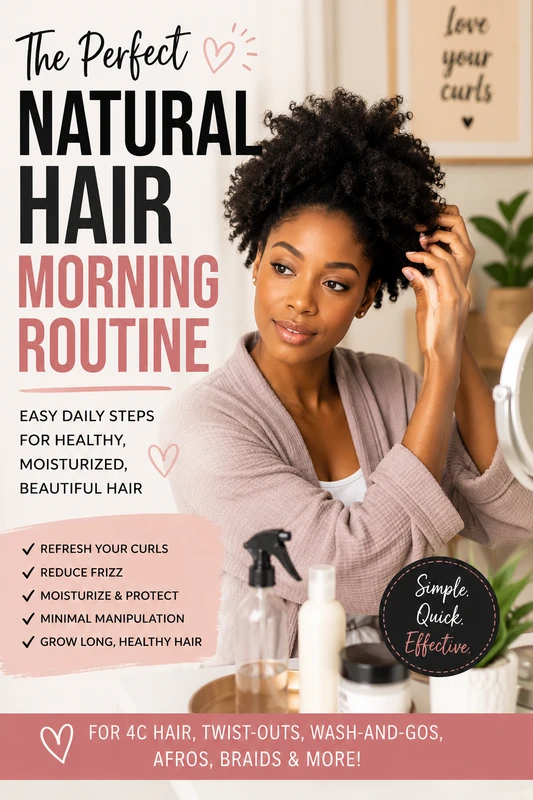
A good natural hair morning routine can make the difference between starting your day with soft, manageable hair and spending the morning fighting dryness, frizz, tangles, flattened curls, and an uncooperative hairstyle.
For many people with natural hair, nighttime protection is only half of the equation. Even when you sleep with a satin bonnet, scarf, or pillowcase, your hair may need a little attention when you wake up.
Your curls might be compressed on one side. Your twist-out may have lost some definition. Your afro might need reshaping. Your ends may feel slightly dry. Or your wash-and-go may simply need a quick refresh.
The good news is that your morning hair routine doesn't have to take an hour.
In fact, one of the best things you can do for natural hair is develop a simple morning routine that gives your hair what it needs without constantly manipulating it.
The goal isn't to completely restyle your hair every morning.
Instead, a good routine should help you:
- Restore moisture when needed
- Revive your curls
- Reduce frizz
- Protect your ends
- Maintain your hairstyle
- Minimize unnecessary manipulation
- Keep your scalp comfortable
- Prevent excessive breakage
- Make styling easier
- Get out the door faster
Whether you have loose curls, coils, 4C hair, twists, braids, an afro, or a stretched natural hairstyle, this guide will show you how to build a natural hair morning routine that works for you.
Why Your Natural Hair Morning Routine Matters
Natural hair often needs a different approach from straight hair because the structure of curly and coily strands makes it more difficult for natural scalp oils to travel from the roots to the ends.
The tighter your curls and coils are, the more bends and curves those oils have to navigate.
As a result, the ends of natural hair can become dry more easily.
Your ends are also the oldest portion of your hair.
That makes them especially important when you're trying to retain length.
A consistent morning routine gives you an opportunity to check your hair before beginning your day.
But this doesn't mean applying several products every morning.
One of the biggest mistakes people make with natural hair is assuming that more products automatically mean healthier hair.
Sometimes your hair needs moisture.
Other mornings it needs absolutely nothing.
Learning to recognize the difference is an important part of maintaining healthy natural hair.
The Ideal Natural Hair Morning Routine
A simple routine can usually be divided into seven steps:
- Remove your nighttime protection carefully.
- Assess your hair before adding products.
- Separate and fluff your hairstyle gently.
- Add moisture only if needed.
- Seal or protect dry ends when necessary.
- Refresh your hairstyle with minimal manipulation.
- Protect your hair from the day's environment.
You may not need every step every morning.
Think of this routine as a framework rather than a rigid set of rules.
Step 1: Carefully Remove Your Bonnet or Scarf
Your morning routine actually begins with something extremely simple: taking off your nighttime hair protection.
If you sleep with a satin or silk bonnet, don't yank it off quickly.
Hair can occasionally become caught around elastic bands, seams, clips, pins, or ties.
Remove your bonnet or scarf gently and check whether any strands have become trapped.
If you pineapple your hair at night, carefully remove the scrunchie or hair tie.
Avoid pulling it aggressively through your curls.
Instead, loosen the accessory and allow your hair to fall naturally.
Give your curls a few minutes to settle before deciding that your hairstyle needs to be completely redone.
Compressed curls often begin expanding on their own once they are released.
Step 2: Look at Your Hair Before Touching It
This may be one of the most underrated natural hair tips.
Don't immediately start manipulating your hair.
First, look at it.
Ask yourself:
Does my hair actually feel dry?
Are my ends dry?
Is my hairstyle still defined?
Is one section flattened?
Does my scalp feel comfortable?
Do I actually need more product?
Sometimes your hair looks perfectly fine.
If that's the case, leave it alone.
Natural hair doesn't necessarily need to be moisturized every single morning.
Overapplying creams, oils, gels, and leave-ins can eventually create buildup and make your hair feel coated or heavy.
Your morning routine should respond to the condition of your hair rather than follow an automatic product schedule.
Step 3: Fluff Your Natural Hair Gently
After sleeping, natural hair may become compressed.
This is particularly common with:
- Afros
- Wash-and-gos
- Twist-outs
- Braid-outs
- Curly styles
- Stretched natural hair
Instead of combing through your entire hairstyle, focus on the roots.
Place your fingers near the roots and gently lift the hair.
You can also use an afro pick at the roots if appropriate for your hairstyle.
Avoid pulling the pick all the way through the ends unless you're intentionally creating a picked-out afro.
For a twist-out or braid-out, separating too aggressively can destroy definition and create unnecessary frizz.
Start with the sections that actually need attention.
Sometimes lifting three or four flattened areas is all that's necessary.
Step 4: Refresh Moisture Only When Necessary
If your natural hair feels dry in the morning, you may want to refresh it with a small amount of moisture.
This doesn't mean soaking your entire head.
A light mist can often be enough.
Depending on your hair, you might use:
- Water
- A water-based moisturizing spray
- A lightweight leave-in conditioner
- A moisturizing hair mist
Concentrate on areas that feel dry instead of automatically saturating everything.
For example, if your ends are dry but the rest of your hair feels moisturized, focus on your ends.
This targeted approach can help reduce product buildup.
Should You Spray Natural Hair With Water Every Morning?
Not necessarily.
Some people love refreshing their curls with water every morning.
Others find that frequent wetting causes excessive shrinkage, tangling, or disruption of stretched hairstyles.
Your hair's response matters more than following a universal rule.
If a light water mist keeps your hair soft and manageable, it can be useful.
If water causes your hairstyle to shrink dramatically or tangle, consider using less water or refreshing only specific sections.
Step 5: Pay Special Attention to Your Ends
When trying to grow longer natural hair, retaining the length you already have is extremely important.
That makes your ends a priority.
Your ends have been exposed to:
- Washing
- Styling
- Detangling
- Weather
- Clothing
- Friction
- Manipulation
for longer than newer growth near your scalp.
After moisturizing, you may apply a small amount of cream, butter, or oil to your ends if your hair responds well to it.
You don't need to coat them heavily.
The goal is simply to keep them flexible and reduce excessive dryness.
If your ends repeatedly feel rough even after moisturizing, they may need additional attention during wash day.
Persistent roughness can also sometimes indicate that a trim is needed.
Step 6: Refresh Your Hairstyle Without Starting Over
One of the best habits you can develop is learning how to refresh natural hair without completely restyling it.
Constant restyling creates more manipulation.
And excessive manipulation can contribute to unnecessary breakage.
Here's how to refresh several popular natural hairstyles.
Morning Routine for a Twist-Out
A twist-out can often last several days when properly maintained.
In the morning:
- Remove your bonnet or scarf.
- Allow your hair to fall naturally.
- Gently separate any sections that became compressed.
- Fluff the roots using your fingertips.
- Apply a tiny amount of moisturizer to dry sections if necessary.
- Shape your hair.
- Avoid repeatedly separating curls that are already defined.
The more you separate your twist-out, the bigger and less defined it usually becomes.
That isn't necessarily bad.
Many people actually prefer their twist-out on the second or third day because it becomes fuller.
Morning Routine for a Braid-Out
A braid-out can be treated similarly to a twist-out.
Avoid aggressively combing through your waves or curls.
Instead, lift the roots and reposition flattened sections.
If one section has completely lost definition, you can lightly dampen that specific section, apply a tiny amount of styling product, braid it again, and allow it to set.
There's usually no reason to redo your entire head because one section became frizzy.
Morning Routine for a Wash-and-Go
Wash-and-gos can become flattened overnight, particularly around the back and sides.
When you wake up:
- Remove your nighttime protection.
- Shake your curls gently.
- Fluff the roots.
- Mist flattened sections if necessary.
- Scrunch curls back into position.
- Allow damp areas to dry before excessive manipulation.
Avoid automatically soaking your entire wash-and-go every morning.
Refreshing only the sections that need help can make the style easier to maintain.
4C Natural Hair Morning Routine
4C hair can experience significant shrinkage and may be more vulnerable to tangling when repeatedly manipulated.
A simple 4C hair morning routine might include:
- Remove your satin bonnet or scarf.
- Undo large nighttime twists, braids, or bands.
- Separate your hair carefully with your fingers.
- Check the ends for dryness.
- Apply a small amount of moisturizer if necessary.
- Fluff the roots.
- Shape your hairstyle using your hands.
- Avoid unnecessary combing.
If you keep your 4C hair stretched overnight, excessive water in the morning may cause it to shrink.
In that situation, a light moisturizing spray or small amount of leave-in may work better than heavily wetting the hair.
Morning Routine for an Afro
If you wear an afro, sleeping can flatten certain sections.
In the morning, begin by using your fingers to loosen and lift the hair.
Then use an afro pick near the roots if necessary.
Work gradually around your head.
Don't aggressively rake the pick through tangled ends.
If your hair needs detangling, save thorough detangling for an appropriate detangling session instead of forcing through knots while styling your morning afro.
Once you've achieved the shape you want, stop manipulating it.
Morning Routine for Natural Hair in Twists
Twists can make mornings incredibly simple.
After removing your bonnet:
- Check for frizz.
- Smooth any loose sections.
- Moisturize dry twists if needed.
- Pay attention to your ends.
- Style the twists into a bun, ponytail, half-up style, or leave them down.
Avoid constantly re-twisting hair that doesn't need it.
The beauty of twists is that they can reduce daily manipulation.
Morning Routine for Braided Natural Hair
If your natural hair is braided, you generally don't need to manipulate the individual strands each morning.
Instead, focus on maintaining the style and scalp.
After removing your scarf or bonnet:
- Check the braids.
- Smooth loose areas gently.
- Moisturize the hair when needed.
- Keep your scalp comfortable.
- Avoid pulling the braids into extremely tight hairstyles.
Your edges deserve special attention.
Repeatedly pulling braids tightly into buns or ponytails can place unnecessary tension around the hairline.
How to Refresh Natural Hair in the Morning Without Frizz
Frizz isn't automatically a sign of unhealthy hair.
Curly and coily hair naturally develops some frizz as hairstyles age.
However, if you want to preserve definition, minimize unnecessary touching.
The more you separate, pull, comb, and fluff your curls, the more likely they are to lose definition.
Try these techniques:
Use Your Fingertips
Your hands often provide better control than a brush or comb when refreshing defined curls.
Work on Problem Areas Only
If only the left side is flattened, refresh the left side.
Don't disturb the rest of your hair.
Use Small Amounts of Product
Adding too much product can weigh down curls and create buildup.
Let Water Do Some of the Work
For certain curl patterns, a small mist of water can help curls spring back.
Don't Fight Every Bit of Frizz
Trying to make day-four hair look exactly like freshly styled day-one hair can lead to excessive manipulation.
Allow your hairstyle to evolve.
Should You Moisturize Natural Hair Every Morning?
This depends on your hair.
Some people need moisture frequently, while others can go several days without reapplying moisturizer.
Factors that influence how frequently your hair may need moisture include:
- Hair porosity
- Curl pattern
- Weather
- Hairstyle
- Products used
- Wash routine
- Hair density
- Indoor heating or air conditioning
Instead of moisturizing according to the calendar, pay attention to how your hair feels.
If your hair still feels soft and flexible, adding more moisturizer may not provide much benefit.
If it feels rough, brittle, or unusually dry, a refresh may help.
Water vs Leave-In Conditioner in the Morning
Water and leave-in conditioner serve different purposes.
Water provides moisture directly.
A leave-in conditioner generally combines water with conditioning ingredients designed to improve softness, manageability, and lubrication.
You don't necessarily need both every morning.
For a quick refresh, water may be enough.
If your hair needs additional softness or manageability, a water-based leave-in or moisturizing spray may be more useful.
Experiment to determine which approach leaves your hair feeling best throughout the day.
Should You Oil Natural Hair Every Morning?
Usually, there is no reason to automatically apply oil every morning.
Oil doesn't replace water.
Applying oil repeatedly to dry hair without addressing moisture may simply leave the hair feeling greasy while it remains dry underneath.
If you use oils, consider using a small amount strategically.
For example, you might use oil after moisturizing your ends.
You can also use oils during scalp massage if they fit comfortably into your routine.
But more oil isn't necessarily better.
The 5-Minute Natural Hair Morning Routine
Busy morning?
Your routine doesn't have to be complicated.
Minute 1: Remove Your Nighttime Protection
Take off your bonnet, scarf, or scrunchie carefully.
Minute 2: Assess Your Hair
Look for flattened, dry, or frizzy areas.
Minute 3: Refresh
Mist only the sections that need moisture.
Minute 4: Fluff
Lift the roots and reshape the hairstyle.
Minute 5: Finish
Smooth your edges if desired, protect your ends, and make final adjustments.
That's it.
A healthy natural hair routine doesn't need fifteen different products.
Natural Hair Morning Routine for Hair Growth
No morning routine can magically make hair grow several inches overnight.
However, a low-manipulation routine can support length retention by reducing unnecessary breakage.
If growing longer natural hair is your goal, focus your morning routine on protecting the hair you already have.
Prioritize:
- Gentle handling
- Moisturized ends
- Low manipulation
- Minimal tension
- Scalp cleanliness
- Protective nighttime habits
- Regular conditioning
- Careful detangling
Hair growth and length retention are not exactly the same thing.
Your scalp may be producing new growth while breakage at your ends prevents you from seeing much increase in overall length.
Protecting your ends is therefore extremely important.
Natural Hair Morning Routine for Dry Hair
If your natural hair frequently feels dry when you wake up, examine both your nighttime and wash-day routines.
Morning dryness may indicate that your hair needs more than another layer of oil.
Try:
- Lightly misting your hair with water or a moisturizing spray.
- Applying a small amount of leave-in where needed.
- Paying attention to the ends.
- Avoiding excessive manipulation.
- Protecting your hair from dry weather.
Also consider whether your nighttime routine is contributing to moisture loss.
Cotton pillowcases can create more friction than satin or silk surfaces.
Sleeping with a satin bonnet or scarf can help reduce friction and preserve your hairstyle.
Natural Hair Morning Routine in Winter
Cold outdoor temperatures combined with dry indoor heating can leave natural hair feeling especially dry.
During winter, you may need to increase your focus on moisture.
Consider:
- Using a richer moisturizer when needed.
- Keeping your ends protected.
- Wearing low-manipulation styles.
- Protecting your hair underneath winter hats.
- Using satin-lined hats when possible.
- Avoiding going outdoors with soaking wet hair.
If your winter hat is lined with rough material, consider placing a satin or silk barrier between the material and your hair.
Natural Hair Morning Routine in Summer
Summer brings a different set of challenges.
Heat, humidity, swimming, sweating, and sun exposure can affect natural hairstyles.
Your summer morning routine might focus more on:
- Lightweight moisture
- Frizz management
- Scalp freshness
- Protective styling
- UV/environmental protection
- Avoiding heavy product buildup
If you exercise in the morning, allow your scalp to dry before covering it for long periods.
Heavy products combined with sweat may also contribute to buildup.
What Products Do You Need for a Natural Hair Morning Routine?
You probably need fewer products than you think.
A simple routine may include:
Water or Moisturizing Mist
Useful for refreshing dry or flattened sections.
Leave-In Conditioner
Useful when your hair needs extra softness or manageability.
Lightweight Oil
Optional for sealing or adding lubrication to the ends.
Styling Product
Useful when specific sections need definition restored.
Edge Product
Optional if you prefer sleek edges.
Satin Scarf or Bonnet
Technically a nighttime product, but one of the biggest contributors to easier mornings.
You don't need to use every product every day.
Common Natural Hair Morning Routine Mistakes
Even a good routine can become counterproductive if you overdo it.
Here are some common mistakes to avoid.
1. Completely Restyling Your Hair Every Morning
Constant manipulation can place unnecessary stress on your strands.
Preserve yesterday's style whenever possible.
2. Applying Too Much Product
If yesterday's moisturizer is still in your hair, adding another heavy layer may cause buildup.
3. Combing Dry Hair Aggressively
Aggressive detangling can cause breakage.
Save major detangling sessions for when your hair is properly lubricated and you're able to work carefully.
4. Ignoring Your Ends
Your ends are the oldest and often most vulnerable part of your hair.
Give them attention.
5. Pulling Your Edges Too Tight
Sleek doesn't have to mean painfully tight.
Avoid repeatedly placing excessive tension on your hairline.
6. Using Heavy Oil to Fix Dryness
Oil and water aren't interchangeable.
If your hair lacks moisture, simply coating it with more oil may not solve the underlying problem.
7. Touching Your Hair All Day
Morning styling should ideally end when you leave the mirror.
Constantly pulling, separating, and playing with your hair creates more manipulation.
How to Make Your Natural Hair Routine Faster
If your morning routine takes too long, the solution may actually begin the night before.
Try preparing your hair before bed.
Depending on your hairstyle, you can:
- Pineapple curls.
- Put hair into large twists.
- Braid stretched hair.
- Band sections.
- Protect ends.
- Use a satin bonnet.
- Sleep on a satin pillowcase.
Preserving your hairstyle overnight dramatically reduces the amount of work required in the morning.
Think of your morning and nighttime routines as partners.
A good nighttime routine creates an easier morning routine.
How to Know Whether Your Morning Routine Is Working
After following your routine consistently, your hair should generally feel manageable rather than progressively harder to style.
Signs your routine may be working include:
- Hair feels soft and flexible.
- Your hairstyle lasts longer.
- You experience less unnecessary manipulation.
- Your ends don't constantly feel rough.
- Your hair isn't excessively coated with product.
- Your curls remain relatively easy to refresh.
- You spend less time restyling every morning.
If your hair feels increasingly sticky, greasy, dull, or coated, you may be using too much product.
If it consistently feels dry, reassess your wash-day conditioning and moisturizing routine rather than simply adding more oil every morning.
Sample Weekly Natural Hair Morning Schedule
Your exact schedule will depend on your hair, but here's an example.
Monday
Remove bonnet, fluff roots, shape hairstyle.
No additional product if the hair is already moisturized.
Tuesday
Fluff and lightly refresh dry ends.
Wednesday
Mist flattened sections and reshape curls.
Thursday
Minimal manipulation. Refresh only where necessary.
Friday
Use a small amount of moisturizer if the hair feels dry.
Saturday
Wear a low-manipulation style or prepare for wash day.
Sunday
Wash, condition, detangle, moisturize, style, and prepare your hair for the upcoming week.
Again, this isn't a rule.
It's simply an example of how you can avoid automatically layering products onto your hair every day.
Frequently Asked Questions About Natural Hair Morning Routines
What Should I Do to My Natural Hair Every Morning?
Start by assessing your hair.
Remove your nighttime protection, allow the hair to settle, fluff or reshape it, and add moisture only where needed.
You don't have to completely restyle your hair every day.
Should I Wet My 4C Hair Every Morning?
Not necessarily.
Some people with 4C hair benefit from light daily moisture, while others find that frequent wetting creates excessive shrinkage or tangling.
Use the frequency that keeps your hair soft and manageable without causing unwanted problems.
How Do I Refresh My Natural Hair Without Washing It?
Use your fingers to reshape the hair, lightly mist flattened or dry sections, and apply a small amount of styling product only where needed.
Focus on refreshing rather than completely resetting the hairstyle.
Should I Comb My Natural Hair Every Morning?
Usually not.
Many natural hairstyles can be maintained without daily combing.
Finger styling and gentle root fluffing are often enough.
Why Is My Natural Hair Flat When I Wake Up?
Your hair may become compressed while sleeping.
Using a pineapple, large twists, braids, bands, or another nighttime preservation method can reduce flattening.
A satin bonnet or pillowcase can also help preserve the style.
How Do I Keep My Natural Hair Moisturized All Day?
Start with a solid wash-day routine and use a suitable moisturizer.
Protect your hair from excessive friction and pay attention to environmental conditions.
Remember that repeatedly adding oil doesn't necessarily provide hydration.
Can I Use Leave-In Conditioner Every Morning?
You can use leave-in conditioner as needed, but daily application isn't automatically necessary.
If your hair already feels moisturized, additional leave-in may simply create buildup.
How Do I Refresh 4C Hair Without Shrinkage?
Use as little water as necessary.
Focus on individual dry or flattened areas rather than saturating your entire head.
If maintaining stretched hair is important, a lightweight moisturizing spray may be easier to control than heavily wetting the hair.
How Long Should a Natural Hair Morning Routine Take?
For an established hairstyle, approximately five to fifteen minutes may be enough.
More complicated styling will naturally take longer.
The goal is to avoid completely restyling your hair when it isn't necessary.
Build a Morning Routine Around Your Hair
There is no single natural hair morning routine that works perfectly for everyone.
Someone with a wash-and-go may need a different routine from someone wearing a stretched afro.
Someone with 4C hair in twists may need something completely different from someone wearing loose curls.
The most important skill is learning to recognize what your hair needs.
Some mornings that may mean moisture.
Other mornings it may mean reshaping one flattened section.
And sometimes the healthiest thing you can do is simply remove your bonnet, fluff your hair, and leave it alone.
Keep your routine simple.
Protect your ends.
Avoid unnecessary manipulation.
Use products intentionally rather than automatically.
Pay attention to how your hair responds.
Over time, you'll develop a morning routine that makes your natural hair easier to manage while helping you maintain softness, definition, and length.
The best natural hair routine isn't necessarily the one with the most steps.
It's the one you can consistently follow while keeping your hair healthy.