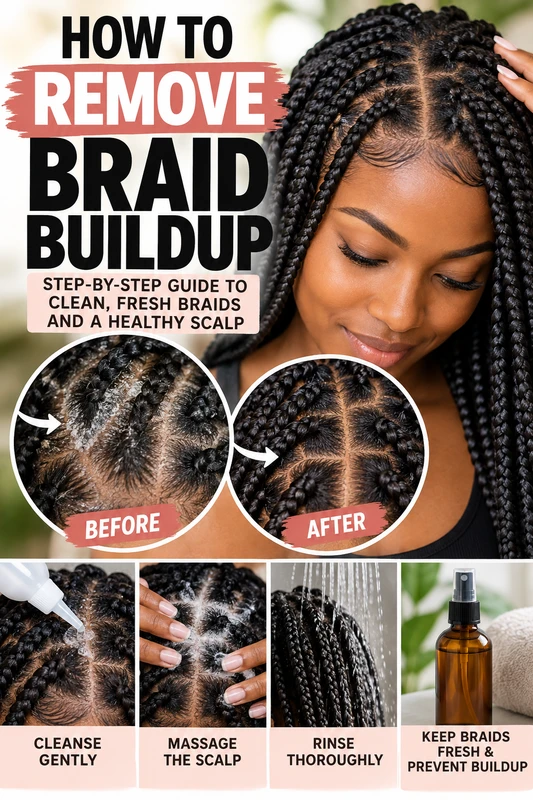
Braids are one of the most convenient protective styles for natural hair, but after a few weeks, you may notice something frustrating happening around your roots: buildup.
That white, gray, sticky, or flaky residue around your braids can make a beautiful style look old long before you are ready to take it down. Buildup can also leave your scalp feeling itchy, greasy, coated, or uncomfortable.
The good news is that braid buildup does not automatically mean you have to remove your style.
With gentle cleansing, thorough rinsing, and better product habits, you can often remove much of the residue while keeping your braids looking fresh.
In this complete guide, we'll explain how to remove braid buildup, what causes buildup around braids, how to clean your scalp without creating excessive frizz, what to do about stubborn buildup at the roots, and how to prevent the problem from coming back.
What Is Braid Buildup?
Braid buildup is the accumulation of products, natural oils, sweat, dead skin cells, lint, dirt, and other residue around your scalp, roots, and braided hair.
It commonly appears around the base of individual braids because that is where products are frequently applied and where shed hair can remain trapped.
Buildup may look:
- White
- Gray
- Yellowish
- Flaky
- Sticky
- Waxy
- Greasy
- Crusty
You may notice it along your parts, around your hairline, behind your ears, at your crown, or directly around the base of individual braids.
A small amount of accumulation can happen naturally as you wear a protective style. However, heavy buildup is often a sign that your scalp needs cleansing or that too many products are being layered onto the hair.
What Causes Buildup in Braids?
Understanding the cause is the first step toward preventing the problem.
1. Too Much Styling Product
Gel, edge control, mousse, pomade, braid gel, holding products, and creams can gradually accumulate around the roots.
You might apply only a small amount at a time, but repeatedly adding products without cleansing your scalp allows layers of residue to form.
This is particularly common around the hairline because many people reapply edge control every few days.
2. Heavy Oils and Butters
Applying oil to your scalp isn't necessarily a problem. The issue is applying large amounts of heavy products repeatedly.
Thick oils and butters can combine with sweat, dirt, lint, and dead skin.
Instead of continuing to coat your scalp whenever it feels dry, consider whether your hair actually needs moisture rather than additional oil.
3. Sweat
If you exercise regularly, work outdoors, or live in a warm climate, sweat can accumulate between your braids.
When sweat mixes with hair products and natural scalp oils, residue can develop faster.
Active braid wearers may therefore need to cleanse their scalp more frequently.
4. Dead Skin Cells
Your scalp naturally sheds skin cells.
Braids don't stop this process.
Because your hair is sectioned and relatively stationary, flakes and dead skin can sometimes become trapped around the roots.
5. Natural Scalp Oil
Your scalp produces sebum naturally.
Sebum can combine with styling products and environmental debris, contributing to greasy or waxy buildup.
6. Lint
Lint from towels, clothing, blankets, pillows, hats, and scarves can become caught around braided roots.
Once lint becomes mixed with product residue, it can be difficult to remove without carefully cleaning or taking down the style.
Sleeping in a satin or silk scarf or bonnet can help reduce friction and exposure to lint.
Is Braid Buildup Normal?
Some accumulation during a long-term protective style is common.
Your scalp continues producing oil, sweating, and shedding skin while your hair is braided.
However, extremely heavy buildup shouldn't simply be ignored.
If your scalp feels dirty or coated, cleansing it may be better than repeatedly covering the problem with more oils, sprays, or styling products.
Our guide on how to keep your scalp healthy under braids explains additional ways to maintain your scalp throughout a protective style.
How to Remove Braid Buildup Without Taking Your Braids Out
If you want to keep your style installed, start with the gentlest cleaning method possible.
The goal is to loosen residue without aggressively rubbing your roots.
Step 1: Examine the Buildup
Before washing, look closely at your scalp.
Ask yourself:
Is the residue mostly along the parts?
Is it concentrated around the base of each braid?
Does it look oily or dry?
Is your scalp also itchy?
Is there a noticeable odor?
Knowing what you're dealing with can help you decide whether you need a light scalp cleanse or a complete braid wash.
If buildup covers much of your scalp, washing your braids is usually more practical than trying to spot-clean dozens of individual sections.
Step 2: Loosen Surface Residue Carefully
If there are visible loose flakes, gently separate what can be removed without pulling your natural hair.
Don't aggressively scratch your scalp with your fingernails.
Scratching can irritate the skin, especially when the scalp is already sensitive.
Use the pads of your fingertips to gently massage areas where residue has accumulated.
The goal isn't to scrape your scalp clean.
Step 3: Dilute Your Shampoo
One of the easiest ways to cleanse braids is with diluted shampoo.
Place a small amount of shampoo into an applicator bottle and add water. The thinner consistency allows you to direct cleanser between your braids instead of dumping concentrated shampoo over the entire style.
Apply the mixture along your parts and around the roots.
If you want a complete washing routine, read our Braids Washing Guide: How to Wash Braids Without Ruining Them.
Step 4: Massage the Scalp Gently
Once you've applied shampoo, massage your scalp using your fingertips.
Focus on areas where buildup is visible.
Use small, controlled motions.
Avoid vigorously moving the braids back and forth because excessive friction can create unnecessary frizz and place additional stress on your roots.
Spend a little more time on areas where residue tends to accumulate:
- Hairline
- Crown
- Nape
- Behind the ears
- Parts
- Base of individual braids
Let the cleanser do most of the work.
Step 5: Let the Shampoo Loosen the Buildup
You don't need to scrub continuously.
Give the shampoo and water a chance to soften product residue.
For stubborn areas, gently massage again rather than scratching or picking.
This is particularly important when you have significant new growth because shed hairs may already be tangled around your roots.
Aggressive picking can turn a cleansing problem into a detangling problem.
Step 6: Rinse Thoroughly
Rinsing is one of the most important steps in removing braid buildup.
Allow lukewarm water to flow from your scalp downward through your braids.
Continue rinsing until the shampoo has been completely removed.
Pay particular attention to your roots.
Ironically, poorly rinsed shampoo can create new residue that looks similar to the buildup you were trying to remove.
Step 7: Repeat Only If Necessary
If your scalp was heavily coated, one gentle shampoo may not remove everything.
A second light cleanse may be necessary.
However, avoid repeatedly shampooing your scalp simply because you can still see a few particles around your roots.
Some stubborn residue may be tangled with shed hair and may be easier to remove when you eventually take the braids down.
Step 8: Remove Excess Water
After rinsing, gently squeeze your braids from top to bottom.
Don't wring them.
Use a microfiber towel or soft T-shirt to absorb excess water.
Avoid rubbing a rough towel across your scalp because friction can make the style frizzier.
For additional tips, see our guide on how to wash your braids without frizz.
Step 9: Dry Your Braids Completely
This step shouldn't be skipped.
Braids—especially long or thick box braids—can hold a surprising amount of water.
Allow plenty of drying time.
You can air-dry in a well-ventilated area or use an appropriate hooded dryer or blow dryer on a low or cool setting.
Pay special attention to your roots.
Avoid going to sleep with soaking-wet braids.
How to Moisturize After Removing Buildup
Once you've cleansed your scalp, you don't want to immediately cover it with layers of heavy products again.
Think lightweight.
A moisturizing spray can make it easier to refresh your natural hair without heavily coating the scalp.
Hairobics Raaw Roots Antiseptic Moisturizer Spray is designed for locs, twisties, braids, and natural hair and can be incorporated into a lightweight braid-care routine.
Shop Hairobics Raaw Roots Moisturizer Spray
Apply moisture where needed instead of saturating your entire scalp every day.
For a more complete moisture routine, read How to Keep Natural Hair Moisturized in Braids.
How to Remove Hard Buildup Around Braid Roots
Sometimes buildup becomes hardened around the base of a braid.
This can happen when styling gel, oil, sweat, lint, and shed hair become compacted together.
Resist the temptation to scrape it away aggressively.
First soften the area with water and cleanser.
Massage carefully.
Rinse.
If the buildup remains firmly attached to your natural hair, it may be better to wait until the braid is removed.
Once the extension is taken down, you can separate the residue from the shed hair much more safely.
Trying to force hardened buildup out while the braid is still installed can unnecessarily pull or break your natural hair.
Removing Buildup After Taking Braids Down
The takedown process deserves even more patience.
After several weeks in braids, your roots may contain a combination of:
- Shed hair
- Styling gel
- Oil
- Flakes
- Lint
- Dirt
- New growth
This combination can sometimes look like a small knot around the root.
Don't immediately shampoo your loose hair without assessing the tangles.
Separate the Braids Carefully
Take down one braid at a time.
Start from the bottom and work upward.
Once you reach your natural hair, gently separate the section with your fingers.
Don't Panic About Shed Hair
Hair naturally sheds.
When your hair is loose, many shed strands fall away throughout the day. When your hair is braided, those strands can remain trapped in the style.
Therefore, seeing shed hair during braid takedown does not automatically mean your braids caused severe hair loss.
The important thing is to remove those shed strands carefully before they create additional tangles.
Our guide on how to detangle after long-term braids without breakage explains the process in greater detail.
Break Apart Buildup With Your Fingers
If you find a hard patch near the root, don't immediately run a fine-tooth comb through it.
Use your fingers to gently separate the hair.
Work slowly.
You can add a product with slip if needed to make the section easier to manipulate.
Once the buildup and shed hair begin separating, you can continue detangling from the ends toward the roots.
Detangle Before Aggressive Shampooing
One of the biggest mistakes after removing braids is jumping directly into the shower with severely tangled hair.
Water can cause loose shed hairs and existing tangles to tighten together.
Remove major tangles and shed hairs first.
Then divide your hair into manageable sections before washing.
Should You Use a Clarifying Shampoo for Braid Buildup?
A clarifying shampoo can be useful when significant product residue remains on the hair or scalp.
Clarifying shampoos are designed to provide deeper cleansing than many everyday moisturizing shampoos.
However, you don't necessarily need an aggressive cleanser every time you wear braids.
Choose the level of cleansing based on the amount of buildup present.
If your hair feels unusually coated even after washing, clarifying may be appropriate.
After clarifying loose natural hair, follow with moisture because a strong cleansing session can leave some hair feeling dry.
Can You Use Apple Cider Vinegar to Remove Braid Buildup?
You'll often see apple cider vinegar recommended online for braid cleansing.
Although diluted acidic rinses are sometimes used in hair-care routines, they aren't automatically necessary for removing ordinary braid buildup.
A properly formulated shampoo and thorough rinse may be all you need.
If you use DIY scalp treatments, avoid applying highly concentrated acids, essential oils, or other potentially irritating ingredients directly to your scalp.
More isn't necessarily better.
If your scalp is irritated, inflamed, painful, or has open areas, stop experimenting with DIY mixtures and consider seeking advice from a dermatologist or another qualified healthcare professional.
How to Prevent Braid Buildup
Removing buildup is helpful.
Preventing excessive buildup is even better.
Use Less Product
Start by reducing the number of products you're layering onto your scalp.
You probably don't need oil, grease, moisturizer, edge control, gel, mousse, and several scalp treatments applied simultaneously.
Keep your routine simple.
Choose Lightweight Moisture
Braided hair still needs moisture, but moisturizing doesn't mean covering your scalp with thick grease every day.
A lightweight moisturizing spray can be easier to distribute through braided hair.
Don't Apply Oil Just Because Your Scalp Itches
Itching doesn't always mean your scalp needs oil.
Your scalp could be reacting to sweat, product buildup, flakes, tension, or irritation.
Adding another layer of oil may temporarily make the scalp feel different while making buildup worse over time.
If itching is your biggest problem, see our guide on how to get rid of itchy scalp under braids.
Clean Your Scalp When It Needs It
You don't have to wait until your braids are covered in visible residue.
Watch for signs such as:
- Greasy roots
- Visible buildup
- Flaking
- Sweat accumulation
- Scalp odor
- Persistent itching
- Hair that feels coated
A gentle cleansing routine can prevent minor accumulation from becoming hard, stubborn buildup.
Be Careful With Edge Control
Edge control is one of the biggest areas where people repeatedly layer product.
Instead of adding a fresh layer every morning, remove old residue periodically.
You can also embrace slightly softer edges as your style gets older rather than continuously adding more product to make the hairline look freshly braided.
Protect Your Hair at Night
Wear a satin or silk scarf or bonnet.
This helps protect the braids from friction while reducing contact with lint-producing fabrics.
Make sure your scarf or bonnet is washed regularly too.
Putting a clean scalp inside a dirty bonnet every night defeats part of your maintenance routine.
What If Your Braids Are Itchy and Have Buildup?
Itching plus visible residue often indicates that your scalp needs attention.
Start by cleansing rather than automatically adding more oil.
However, persistent scalp problems deserve attention.
If you have severe itching, sores, bleeding, significant redness, swelling, unusual discharge, painful bumps, or symptoms that continue after cleansing, consider speaking with a healthcare professional or dermatologist.
Don't repeatedly scratch an irritated scalp.
Can Buildup Cause Hair Breakage?
Buildup itself isn't necessarily going to make your hair suddenly break off, but the behaviors surrounding heavy buildup can contribute to problems.
For example, aggressively scratching your scalp, picking hardened residue from your roots, allowing the hair to become severely tangled, or roughly combing through matted sections during takedown can lead to unnecessary breakage.
The safest strategy is prevention plus gentle removal.
If protecting your length is a priority, read our complete guide on how to prevent breakage after braids.
When Should You Take Your Braids Out Instead?
Sometimes cleaning isn't the best solution.
If your braids have substantial new growth, severe matting around the roots, persistent odor, excessive buildup that won't rinse away, or your natural hair is becoming tangled together, it may be time to remove the style.
Keeping braids installed longer isn't always better.
Protective styling should make caring for your natural hair easier—not create a situation where removing the style becomes increasingly difficult.
Also pay attention to tension.
If your scalp is painful, your hairline appears stressed, or individual braids are pulling excessively, buildup isn't the only issue you should address.
Read How to Tell if Braids Are Too Tight for signs that your protective style may be placing too much tension on your hair.
Simple Braid Buildup Prevention Routine
Keeping braids clean doesn't require an enormous routine.
During the week: Monitor your scalp and apply lightweight moisture when your hair actually needs it.
After sweating: Allow your scalp and braids to dry instead of immediately covering damp hair with a bonnet, hat, or heavy oil.
When buildup appears: Cleanse your scalp gently rather than piling additional products on top.
At night: Protect your style with clean satin or silk.
On wash day: Concentrate cleanser on your scalp, massage gently, rinse thoroughly, and dry your roots completely.
This simple approach can dramatically reduce the layers of product that eventually create stubborn residue.
Frequently Asked Questions About Braid Buildup
Why do I have white stuff at the roots of my braids?
White residue can be caused by dried styling products, shampoo residue, flakes, dead skin, lint, or a combination of these materials.
If you're repeatedly applying gels, creams, oils, or edge control, product buildup is especially likely.
Can I wash buildup out of braids?
Yes. Many forms of buildup can be reduced with gentle shampooing and thorough rinsing while the braids are still installed.
Hardened residue tangled with shed hair may be easier to remove during takedown.
How do I remove buildup without ruining my braids?
Concentrate diluted shampoo on the scalp, gently massage with your fingertips, minimize rubbing, rinse thoroughly, gently squeeze out excess water, and allow the braids to dry completely.
Why does buildup return so quickly?
Your routine may involve too much product.
Look at how often you're using oils, creams, edge control, gels, dry shampoo, and other styling products.
Sweating heavily without cleansing can also accelerate buildup.
Should I pick buildup from my braids?
Avoid aggressive picking.
When buildup is attached to tangled natural hair and shed strands, pulling it away forcefully can contribute to breakage.
Soften and cleanse the residue first.
How often should I clean my braids?
There isn't one schedule that works for everyone.
Your activity level, scalp oiliness, climate, product use, braid type, and amount of sweating all matter.
Instead of waiting for severe buildup, cleanse when your scalp begins showing clear signs that it needs it.
Final Thoughts: Keep Your Braids Clean Without Overdoing Your Routine
Learning how to remove braid buildup comes down to balancing cleanliness with gentle handling.
You don't need to scrub your scalp aggressively or use a complicated mixture of products.
Start by loosening visible residue gently. Apply diluted shampoo directly to the scalp, massage with your fingertips, rinse extremely well, and allow your braids to dry completely.
More importantly, look at what caused the buildup.
If you're constantly layering oil, edge control, creams, gels, and sprays onto your braids, even the best cleansing routine will struggle to keep up.
Keep your braid-care routine simple.
Cleanse when necessary. Moisturize lightly. Minimize heavy product layering. Protect your braids at night. And handle your roots gently.
For lightweight moisture between washes, try Hairobics Raaw Roots Antiseptic Moisturizer Spray, formulated for locs, twisties, braids, and natural hair.
A clean scalp and a simple maintenance routine can help your protective style stay fresher while making eventual braid takedown much easier.