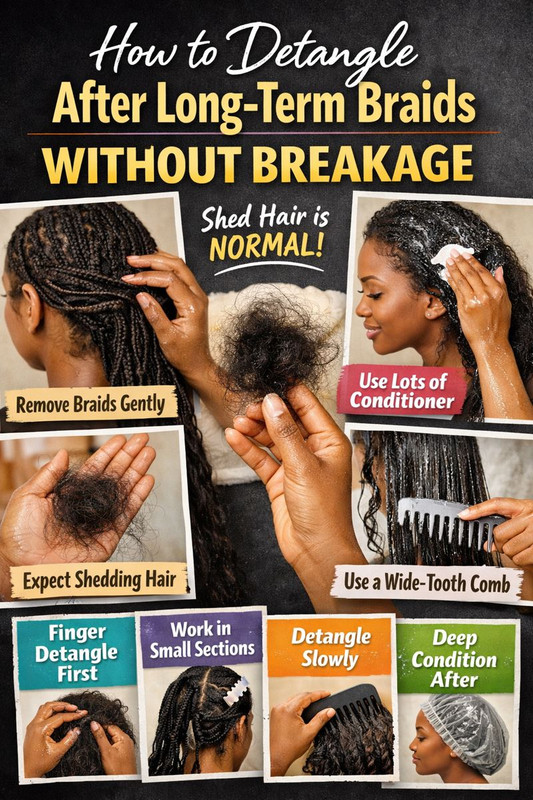
Taking down long-term braids can feel terrifying. You’ve protected your hair for weeks—or even months—only to watch strands pile up in your hands during detangling. The truth is, most breakage after braids doesn’t happen because braids are “bad”—it happens because of how the hair is handled afterward.
If you’ve ever experienced excessive shedding, snapping ends, or matted roots after braid removal, this guide is for you. Below, we’ll break down exactly how to detangle after long-term braids without breakage, step by step, with science-backed reasoning and practical techniques that protect your length.
Why Hair Is More Fragile After Long-Term Braids
Before touching a comb, it’s important to understand what’s happening to your hair after weeks in braids.
1. Shed Hair Has Been Trapped for Weeks
On average, people shed 50–100 hairs per day. When hair is braided, those shed strands don’t fall away—they stay wrapped around neighboring hairs. After 6–8 weeks, that’s thousands of shed strands waiting to be released.
When detangling is rushed, those shed hairs act like Velcro, tightening knots and causing breakage.
2. Hair Is Drier Than You Think
Braids limit moisture distribution. Even if you oiled your scalp regularly, your actual hair strands may be dry, brittle, and less elastic—especially near the line of demarcation where new growth meets older hair.
Dry hair + tension = snapping.
3. The Root Area Is Weaker
New growth is softer and more fragile than older hair. Aggressive combing at the roots can cause breakage before you ever reach the ends.
The Biggest Detangling Mistake People Make
Detangling immediately after braid removal—dry.
This is the fastest way to lose length.
Dry hair has little elasticity. When knots are forced apart without lubrication or slip, the hair doesn’t “untangle”—it breaks.
Step-by-Step: How to Detangle After Long-Term Braids Without Breakage
Step 1: Cut the Braids Carefully (If Needed)
If your braids include extensions, cut below your natural hair line, not at the braid base.
Pro tip: Stretch a braid fully and cut lower than you think you need. Cutting too high is irreversible.
Step 2: Finger-Detangle Each Braid Section First
Before reaching for water or conditioner:
-
Gently unravel the braid
-
Use your fingers only
-
Pull shed hair out slowly from root to tip
This step removes most trapped hair before it tangles further.
Why this matters: Fingers can feel resistance. Combs can’t.
Step 3: Saturate Hair With Slip — Not Just Water
Water alone increases friction.
Instead, apply:
-
A slippery conditioner
-
A detangling cream
-
Or a conditioner + oil mix
Hair should feel slick, not just wet.
Key areas to focus on:
-
Roots
-
The line where new growth meets older hair
-
Ends
Step 4: Work in Small, Controlled Sections
Divide hair into 4–8 sections, depending on thickness.
Secure each section with a clip or loose braid after detangling.
Small sections:
-
Reduce tension
-
Prevent re-tangling
-
Make shed hair easier to remove
Step 5: Finger-Detangle Again (Yes, Again)
This second finger-detangling round:
-
Loosens knots softened by moisture
-
Separates shed hairs
-
Prevents comb snagging
Gently pull strands apart—never force them.
Step 6: Use the Right Tool (And Only One)
Best tools for post-braid detangling:
-
Wide-tooth comb
-
Detangling brush designed for wet hair
Avoid:
-
Fine-tooth combs
-
Hard bristle brushes
Technique matters more than the tool.
Always start at the ends, then slowly work upward.
Step 7: Detangle Under Running Water (Optional but Powerful)
Detangling under running water with conditioner can:
-
Increase slip
-
Help shed hair slide out
-
Reduce friction
Let water flow downward, never flip hair upside down (this causes matting).
What “Normal Shedding” Looks Like After Braids
Seeing a clump of hair doesn’t automatically mean breakage.
Normal:
-
Long strands with bulbs on the end
-
Hair released evenly during detangling
Not normal:
-
Short snapped pieces
-
Hair breaking mid-strand
-
Hair breaking at the root line
If most hair is short and uneven, detangling technique—not braids—is the issue.
Should You Shampoo Before or After Detangling?
Always detangle BEFORE shampooing.
Shampoo causes hair strands to swell and roughen, which:
-
Tightens knots
-
Increases breakage
-
Makes shed hair harder to remove
If hair is heavily product-coated, use:
-
A cleansing conditioner
-
Or diluted shampoo after detangling
The Best Products for Detangling After Long-Term Braids
Look for products with:
-
Slip (conditioners with fatty alcohols)
-
Lightweight oils
-
Humectants for flexibility
Ingredients that help:
-
Aloe vera
-
Marshmallow root
-
Slippery elm
-
Glycerin (in moderation)
-
Lightweight oils (jojoba, grapeseed)
Avoid heavy protein immediately after braid removal unless hair feels mushy or overly elastic.
How Long Detangling Should Take
If braids were in for:
-
4–6 weeks: 45–90 minutes
-
8+ weeks: 1.5–3 hours
Rushing is the enemy of length retention.
Common Detangling Myths (That Cause Breakage)
Myth 1: “All the hair coming out is breakage”
Most of it is shed hair that never had a chance to fall.
Myth 2: “You need to detangle aggressively to get it over with”
Aggression equals snapped ends.
Myth 3: “Braids ruin hair”
Poor takedown routines do—not braids themselves.
What to Do After Detangling to Prevent Future Breakage
1. Deep Condition Immediately
After detangling:
-
Use a moisturizing deep conditioner
-
Focus on elasticity and softness
-
Add heat if hair feels stiff
2. Trim If Necessary
If ends feel:
-
Thin
-
Rough
-
See-through
A light trim prevents future splitting.
3. Give Hair a Break
Avoid:
-
Tight styles
-
Heat
-
Manipulation for at least 7–10 days
Your hair just went through trauma—treat it gently.
How Often Should You Take Breaks Between Braids?
For long-term protective styles:
-
At least 1–2 weeks between installs
-
Focus on moisture, scalp health, and low tension styles
Protective styling only works when paired with recovery time.
Signs You’re Detangling Correctly
✔ Hair feels softer, not thinner
✔ Less breakage each braid cycle
✔ Knots release instead of snap
✔ Ends stay full over time
If your hair looks shorter after every braid takedown, something in your routine needs adjusting.
Final Thoughts: Detangling Is Where Length Is Won or Lost
Protective styles don’t fail people—poor takedown routines do.
When you detangle after long-term braids:
-
Take your time
-
Use slip generously
-
Prioritize fingers over tools
-
Respect how fragile your hair is in that moment
Length retention isn’t about growing hair faster—it’s about not breaking the hair you already grew.
If you master post-braid detangling, you’ll finally stop feeling like braids are “stealing” your hair—and start seeing real length retention over time.