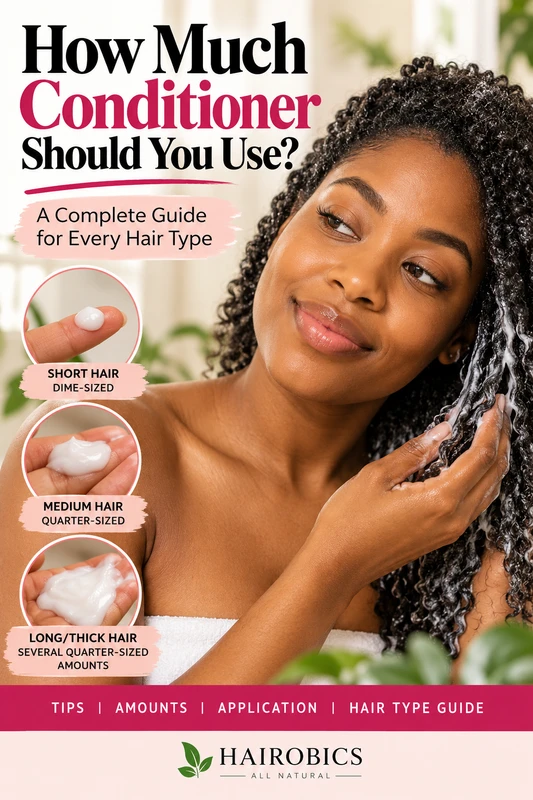
Conditioner is one of the most important products in a healthy hair care routine, but knowing exactly how much to use can be surprisingly confusing. Should you use a dime-sized amount, a quarter-sized amount, or enough to completely coat every strand? Does natural hair require more conditioner than straight hair? And can using too much conditioner actually make your hair feel worse?
The answer depends on several factors, including your hair length, density, texture, porosity, and the type of conditioner you are using.
For Black women with natural hair, understanding the correct amount of conditioner is particularly important. Curly, coily, and kinky hair textures often experience dryness because natural scalp oils have a harder time traveling along curved hair strands. Proper conditioning helps improve softness, manageability, and detangling while reducing friction that contributes to breakage.
However, more conditioner does not automatically mean healthier hair.
Using excessive amounts can waste product, leave behind residue, weigh down your curls, and make your hair feel coated. Using too little may leave sections inadequately conditioned, making detangling more difficult.
In this guide, we will explore exactly how much conditioner you should use, how to adjust the amount for different hair types, and how to develop an effective conditioning routine that keeps your hair soft, manageable, and healthy.
1. Why Is Conditioner Important for Natural Hair?
Before discussing how much conditioner to use, it helps to understand what conditioner actually does.
Shampoo primarily removes dirt, excess oil, sweat, and product buildup from your hair and scalp. Although cleansing is essential, shampooing can temporarily leave your strands feeling rough or difficult to detangle.
Conditioner helps restore manageability after washing.
Most rinse-out conditioners contain ingredients designed to smooth the hair's outer surface, reduce friction, and improve softness. Many also contain conditioning agents that help reduce static and make strands easier to separate.
For natural hair, these benefits are especially valuable.
Benefits of using conditioner
-
Improves softness and manageability.
-
Makes detangling easier.
-
Reduces friction between strands.
-
Helps minimize mechanical breakage.
-
Improves curl definition.
-
Reduces the appearance of frizz.
-
Helps hair feel smoother after shampooing.
-
Supports moisture retention when used as part of a complete routine.
Conditioner does not permanently repair damaged hair or directly stimulate growth from the scalp. However, reducing tangles and breakage can help you retain more of the length your hair naturally grows.
This is particularly important for anyone trying to grow longer natural hair.
2. How Much Conditioner Should You Use Based on Hair Length?
One of the easiest ways to estimate the correct amount of conditioner is by looking at your hair length.
Longer hair generally requires more product because there is more surface area to cover. However, hair density and strand thickness also influence the amount needed.
The following measurements are practical starting points rather than strict rules.
Conditioner amount by hair length

Short hair
Approximately 2–3 mL. Start small and add more if necessary.

Medium-length hair
Approximately 5–8 mL, adjusted for density.

Shoulder-length hair
Approximately 8–15 mL, distributed in sections.

Long or very thick hair
Approximately 15–30 mL, depending on density and product consistency.
These measurements are intended for regular rinse-out conditioner. Deep conditioners, leave-in treatments, and concentrated professional formulas may require different amounts.
The goal is to coat your strands evenly without leaving large amounts of unused conditioner sitting on the hair.
3. How Much Conditioner Should You Use for 4C Hair?
Type 4C hair is known for its tightly coiled texture, shrinkage, and tendency to experience dryness and tangling.
Because of its curl pattern, 4C hair can require careful product distribution to ensure every section receives adequate conditioning.
However, having 4C hair does not automatically mean you need an excessive amount of conditioner.
The correct amount depends heavily on hair density, length, and the formula being used.
For short 4C hair, begin with approximately a quarter-sized amount.
For medium-length 4C hair, try one to two quarter-sized amounts.
For long, thick 4C hair, you may need approximately one to two tablespoons.
The most effective approach is to divide your hair into manageable sections.
Apply a small amount to each section, work it through gently, and add more only where needed.
This technique provides more even coverage than applying a large handful of conditioner directly to the top of your head.
Helpful tip: If your 4C hair feels rough after conditioning, the issue may not be the quantity. Your shampoo, water quality, product formulation, buildup, or existing hair damage may also influence how your strands feel.
4. Does Hair Density Affect How Much Conditioner You Need?
Hair density refers to how many individual hair strands grow within a given area of your scalp.
It is different from hair thickness, which describes the diameter of an individual strand.
Two people can have shoulder-length natural hair but require very different amounts of conditioner because one has considerably more strands than the other.
Low-density hair
Low-density hair generally requires less conditioner.
Start with a small amount and focus on distributing it evenly rather than increasing the quantity.
Using too much rich conditioner may leave fine or low-density hair looking flat.
Medium-density hair
Medium-density hair typically benefits from moderate amounts of conditioner.
Apply the product in sections and adjust based on how easily your hair detangles.
High-density hair
High-density hair often requires more conditioner because there are more strands to cover.
Sectioning becomes especially important.
Instead of using one large amount, distribute smaller portions throughout the hair to prevent some areas from receiving too much while others receive too little.
Remember that density, texture, and porosity are separate characteristics. Understanding all three helps you build a more personalized conditioning routine.
5. How Much Conditioner Should You Use for Low-Porosity Hair?
Low-porosity hair tends to resist rapid water absorption and may become weighed down when too many heavy products are applied.
If you have low-porosity hair, begin with a modest amount of conditioner and increase only when necessary.
For medium-length hair, approximately one quarter-sized amount is a reasonable starting point.
Look for formulas that provide good slip without leaving excessive residue.
You should also make sure your hair is thoroughly wet before applying conditioner. Water helps distribute the formula, allowing a smaller amount to cover more strands.
If you frequently experience buildup, read our guide on how to determine your hair porosity .
6. How Much Conditioner Should You Use for High-Porosity Hair?
High-porosity hair often absorbs water quickly but may also lose moisture relatively quickly.
This is particularly common in hair that has experienced significant heat styling, coloring, chemical processing, or environmental wear.
High-porosity hair may benefit from conditioners containing ingredients that improve surface smoothness and reduce friction.
For medium-length high-porosity hair, begin with one or two quarter-sized amounts.
For longer hair, approximately one tablespoon may provide adequate coverage.
Pay additional attention to your ends, especially if they feel rough or tangle easily.
However, avoid assuming that damaged hair requires unlimited amounts of conditioner. Product formulation, cleansing practices, and gentle handling are equally important.
7. Can You Use Too Much Conditioner?
Yes. Although conditioner is beneficial, excessive amounts can create unwanted results.
Using more than your hair needs may leave behind excess residue, particularly when combined with leave-in conditioners, styling creams, oils, and butters.
Common signs of excessive product use include:
-
Hair feels unusually heavy after washing.
-
Curls appear flat or lack movement.
-
Strands feel coated or waxy.
-
Hair looks greasy shortly after drying.
-
Products accumulate on your strands.
-
Your usual styling products no longer perform as expected.
However, these symptoms do not automatically mean your hair is over-conditioned. Similar problems can result from inadequate rinsing, mineral deposits, or incompatible styling products.
If your hair consistently feels coated, learn more about why products sit on top of your hair .
The solution may be as simple as using less conditioner, choosing a lighter formula, or cleansing more thoroughly.
8. How Do You Know If You're Using Too Little Conditioner?
Using too little conditioner can also make your wash-day routine more difficult.
When your strands are not adequately coated, you may notice increased friction during detangling.
Possible signs include:
-
Hair feels rough immediately after shampooing.
-
Your fingers cannot glide through conditioned sections.
-
Ends remain difficult to separate.
-
Some sections feel softer than others.
-
Detangling requires excessive pulling.
-
Hair lacks the softness normally provided by your conditioner.
Before applying another large handful, add a little water and distribute the existing conditioner more thoroughly.
Sometimes uneven application, rather than insufficient quantity, is the actual problem.
9. How to Apply Conditioner Correctly
The amount of conditioner matters, but your application technique is just as important.
For natural hair, sectioning is one of the most effective ways to improve product distribution.
Step 1: Shampoo thoroughly
Begin with clean hair.
Remove dirt, excess oils, and accumulated styling products so your conditioner can spread evenly.
Step 2: Leave your hair wet
Avoid completely drying your hair before applying rinse-out conditioner.
Hair that is wet allows many conditioning formulas to distribute more easily.
Step 3: Divide your hair into sections
For medium- or high-density natural hair, divide your hair into four to eight sections.
This helps you reach areas that may otherwise be missed.
Step 4: Apply conditioner to the lengths
Begin with a modest amount and smooth it through the mid-lengths and ends.
Unless the product is specifically intended for scalp application, concentrate primarily on your strands.
Step 5: Detangle gently
Use your fingers or a suitable detangling tool.
Begin at the ends and gradually work toward the roots.
Avoid forcing a comb through resistant knots.
Step 6: Follow the recommended processing time
Most regular conditioners are designed to work within a relatively short period.
Follow the manufacturer's instructions rather than assuming leaving the product on longer will automatically produce better results.
Step 7: Rinse thoroughly
Remove the conditioner according to its directions.
Your hair should feel manageable without excessive slippery residue or a heavy coating.
10. How Much Deep Conditioner Should You Use?
Deep conditioners are generally richer treatments designed to provide additional conditioning benefits.
Because their formulas vary considerably, they should not automatically be measured using the same guidelines as regular rinse-out conditioners.
For short natural hair, start with approximately one teaspoon.
For medium-length hair, begin with one to two teaspoons.
For long or high-density hair, approximately one to two tablespoons may be appropriate.
The important thing is achieving even coverage.
Deep conditioning does not require applying such a thick layer that large amounts of product remain unused on the hair.
For more information, explore our guide on how often you should deep condition natural hair .
11. How Much Leave-In Conditioner Should You Use?
Leave-in conditioner differs from regular conditioner because it is formulated to remain on your hair rather than being rinsed away.
Consequently, using excessive amounts may be more noticeable once your hair dries.
Start with the manufacturer's recommended quantity, applying small amounts to damp hair.
For spray formulas, apply a light, even mist and increase gradually if needed.
For cream formulas, begin with a dime-sized amount for short hair or a quarter-sized amount for medium-length hair.
Long, dense natural hair may require additional product distributed across several sections.
The objective is softness and manageability without making your hair sticky or excessively heavy.
Featured Hairobics product: Leave-In Hair & Scalp Treatment

Hairobics All Natural Leave-In Treatment
This botanical treatment contains ingredients including aloe vera, jojoba oil, avocado oil, rosemary, and other botanical extracts.
It can be incorporated into your hair and scalp care routine following the product's application directions.
When using a leave-in alongside other moisturizing products, avoid unnecessarily layering several heavy formulas.
A balanced routine is usually more effective than applying large quantities of everything you own.
12. Should You Use Conditioner Every Time You Wash Your Hair?
For most people, applying conditioner after shampooing is a practical part of maintaining manageable hair.
How frequently you wash depends on your scalp condition, lifestyle, styling routine, and individual needs.
People who exercise frequently or experience significant scalp buildup may need to cleanse more often than those with relatively low product accumulation.
Regardless of your washing schedule, conditioning can help reduce friction after cleansing.
For additional guidance, explore our article on building a complete natural hair routine .
Consistency is more important than using excessive quantities during occasional wash days.
13. Does More Conditioner Make Hair Grow Faster?
No. Conditioner does not directly accelerate the biological growth rate of hair follicles.
Hair growth occurs beneath the scalp and is influenced by genetics, hormones, nutrition, age, and general health.
However, conditioner can support length retention.
By reducing friction and making detangling easier, a suitable conditioner may help limit unnecessary mechanical breakage.
This distinction is especially important for people with tightly coiled natural hair.
Your hair may be growing normally while breakage prevents you from noticing significant length changes.
Instead of using increasingly large amounts of conditioner, focus on maintaining a routine that protects your existing strands.
14. Common Conditioner Mistakes to Avoid
Even an excellent conditioner may produce disappointing results when used incorrectly.
Applying too much at once: Start with smaller amounts and distribute the product before adding more.
Ignoring the ends: Older hair is often more weathered and may need additional conditioning.
Applying conditioner only to the surface: Divide thick natural hair into sections to reach the inner layers.
Using a rinse-out formula as a leave-in: Only leave conditioner in your hair when the manufacturer indicates that it is suitable for that purpose.
Skipping proper cleansing: Repeatedly layering conditioner over accumulated styling products may contribute to a coated feeling.
Assuming every hair type needs the same amount: Fine, coarse, short, long, low-density, and high-density hair have different requirements.
Using conditioner instead of water: Conditioning ingredients can improve hair feel and manageability, but water remains essential for hair hydration.
Avoiding these mistakes can help you get more consistent results without wasting product.
15. How to Make Your Conditioner Last Longer Without Sacrificing Results
If you have long, thick natural hair, you may notice that you go through conditioner much faster than someone with shorter or finer hair.
Fortunately, there are several ways to reduce unnecessary product waste.
First, thoroughly saturate your hair with water before conditioning. Applying conditioner to hair that is barely wet may make it harder to distribute the product evenly.
Second, work in sections. This allows you to see exactly where conditioner has been applied and prevents you from repeatedly coating the same areas.
Third, add a small amount of water when your conditioner becomes difficult to spread. You may discover that your hair needs better distribution rather than more product.
Fourth, use a conditioner that provides adequate slip for your hair type. A well-formulated conditioner may allow you to detangle effectively without using excessive quantities.
Finally, evaluate whether your hair needs a richer formula or simply more consistent care.
If you regularly struggle with rough strands, read our guide on how to make natural hair softer .
16. Frequently Asked Questions About Conditioner
Is a quarter-sized amount of conditioner enough?
A quarter-sized amount can be sufficient for medium-length, low-density hair. However, long, thick, or high-density hair may require considerably more.
Begin with a small amount and increase until your strands are evenly coated.
Should conditioner touch your scalp?
Most traditional rinse-out conditioners are primarily intended for the hair lengths and ends. However, certain products are formulated specifically for scalp application.
Always follow the directions on your particular conditioner.
How long should conditioner stay in your hair?
Regular rinse-out conditioners commonly require a few minutes, while deep conditioning treatments may require longer.
Follow the product label rather than assuming that extended processing automatically improves results.
Can too much conditioner cause hair loss?
Using excessive conditioner does not ordinarily cause hair loss directly. However, heavy residue may affect how your hair feels and looks.
Persistent shedding, thinning, or scalp irritation should not automatically be blamed on conditioner. Consider consulting a dermatologist if these symptoms continue.
Should you use more conditioner on dry hair?
Dry hair may benefit from additional conditioning, but increasing the quantity is not always the answer.
Consider whether your hair needs a different formulation, better cleansing, less heat exposure, or improved moisture retention.
Can I skip regular conditioner if I use a leave-in?
Some routines may work with a single suitable conditioning product, but regular and leave-in conditioners serve different purposes.
A rinse-out conditioner provides conditioning during wash day, while a leave-in is designed to remain on the hair afterward.
Your ideal routine depends on your hair's condition and the products being used.
How much conditioner should men use?
Men with short hair can generally begin with a dime-sized amount.
Men with longer curls, waves, or Afros may need additional product based on their length and density.
Hair characteristics matter more than gender when determining conditioner quantity.
Should you use more conditioner during winter?
Cold weather and indoor heating can contribute to dryness for some people.
You may benefit from a richer conditioner or more consistent moisturizing routine, but you do not necessarily need to double the amount you use.
Is it better to use too much conditioner or too little?
Neither extreme is ideal.
The goal is to use enough conditioner to cover your strands evenly, provide adequate slip, and leave your hair manageable without unnecessary residue.
Final Thoughts: How Much Conditioner Should You Really Use?
The ideal amount of conditioner depends on your hair length, density, texture, porosity, and the formula you choose.
For short hair, a dime-sized amount may be sufficient. Medium-length hair often needs approximately a quarter-sized amount, while long or high-density natural hair may require one or two tablespoons.
However, these quantities should be treated as starting points rather than strict measurements.
The most effective approach is to begin with a modest amount, apply it evenly in sections, and add more only where necessary.
Remember that healthy natural hair does not come from using the largest possible amount of conditioner. It comes from choosing suitable products, maintaining consistent cleansing and conditioning habits, minimizing breakage, and understanding what your individual strands need.
For additional help building your moisture routine, explore our guide to caring for mixed-porosity natural hair .
Discover more natural hair care solutions at Hairobics All Natural and build a routine that keeps your hair soft, manageable, and beautiful.