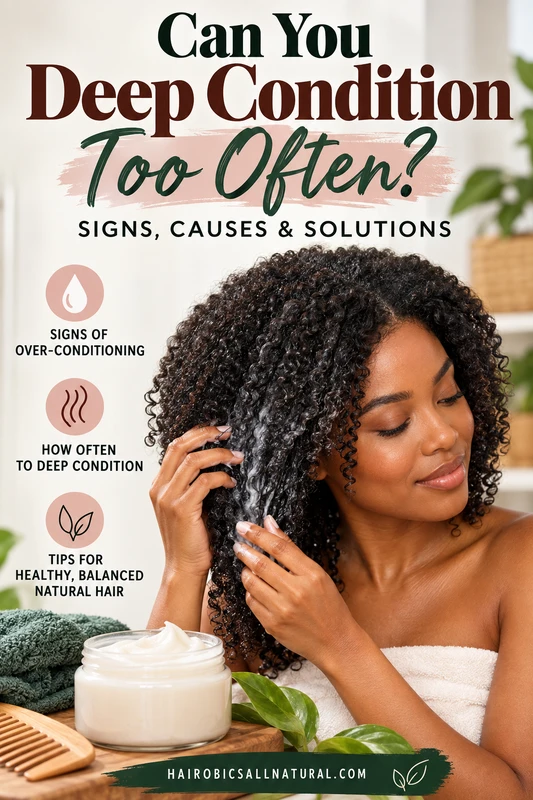
Deep conditioning is one of the most popular steps in a healthy natural hair care routine. Whether you have tightly coiled 4C hair, loose curls, transitioning hair, or chemically treated strands, deep conditioning can help improve softness, manageability, and moisture retention.
But can you deep condition too often?
The short answer is yes. Although deep conditioning provides numerous benefits, using rich conditioning treatments more frequently than your hair needs can sometimes leave your strands feeling limp, overly soft, coated, or difficult to style.
Many people assume that if deep conditioning once a week is beneficial, doing it three or four times a week must produce even better results. Unfortunately, healthy hair care does not always work that way.
Your hair requires a balance of conditioning, cleansing, gentle handling, and appropriate strengthening treatments. Too much of any one step can interfere with how your hair looks and feels.
For Black women with natural hair, understanding this balance is especially important because textured hair can be prone to dryness, tangling, and breakage.
In this comprehensive guide, we will explain what happens when you deep condition too frequently, how to recognize the warning signs, how often different hair types should receive conditioning treatments, and how to create a routine that supports healthy, manageable natural hair.
What Is Deep Conditioning?
Deep conditioning involves applying a concentrated hair treatment designed to improve the condition of your strands.
Unlike everyday rinse-out conditioners, deep conditioners often contain richer combinations of ingredients intended to improve lubrication, softness, detangling, and the appearance of damaged hair.
Common deep-conditioning ingredients include:
-
Shea butter
-
Aloe vera
-
Glycerin
-
Fatty alcohols
-
Coconut oil
-
Avocado oil
-
Panthenol
-
Hydrolyzed proteins
-
Conditioning agents
Some formulas primarily focus on softness and moisture retention, while others contain proteins that temporarily reinforce damaged areas of the hair shaft.
Deep conditioners are typically applied after shampooing and left on for approximately 10–30 minutes, depending on the manufacturer's directions.
The goal is to improve your hair's condition without creating unnecessary buildup or weighing down your natural texture.
Can You Really Deep Condition Too Often?
Yes. Deep conditioning too frequently can become counterproductive, particularly when you repeatedly use heavy formulas without adequately cleansing your hair.
However, there is no universal number of treatments that automatically qualifies as excessive.
Some people benefit from weekly deep conditioning, while others find that conditioning every two weeks is sufficient.
Several factors influence how frequently your hair needs treatment:
-
Hair porosity.
-
Hair density and strand thickness.
-
Chemical processing or heat damage.
-
Your shampooing schedule.
-
The ingredients in your conditioner.
-
Environmental conditions.
-
Your hair's current condition.
For example, someone with bleached, high-porosity hair may benefit from more frequent conditioning than someone with healthy, fine, low-porosity strands.
The important distinction is that deep conditioning should respond to your hair's needs rather than follow an unnecessarily aggressive schedule.
More conditioner does not automatically produce healthier hair.
8 Signs You May Be Deep Conditioning Too Often
Your hair often provides clues when your conditioning routine needs adjusting.
Here are eight signs worth paying attention to.
1. Your Hair Feels Extremely Soft but Lacks Strength
Healthy natural hair should feel reasonably soft while maintaining enough resilience to tolerate everyday manipulation.
If your strands suddenly feel unusually mushy, weak, or difficult to handle, evaluate your conditioning routine.
This can happen when repeated treatments leave excessive conditioning residue on the hair or when already-damaged strands are not receiving the care they need.
However, softness alone does not prove moisture overload. Chemical damage, excessive heat, and mechanical wear can produce similar symptoms.
2. Your Curls Lose Definition
Have your normally springy curls started looking flat or stretched out?
Heavy conditioning formulas can weigh down fine strands, reducing volume and curl definition.
You might notice that your wash-and-go no longer looks as full or that your twist-outs lose their shape faster than usual.
This is particularly noticeable when rich conditioners are combined with heavy leave-ins, creams, butters, and oils.
3. Your Hair Feels Coated
Another common warning sign is hair that feels slippery or coated even after rinsing.
Some conditioning ingredients are designed to remain attached to the hair shaft after washing.
While this can improve manageability, repeated product application without proper cleansing may create noticeable residue.
Your strands might feel:
-
Waxy
-
Heavy
-
Greasy
-
Sticky
-
Difficult to rinse clean
If this happens, consider whether your routine includes too many rich products.
4. Your Hair Breaks Despite Feeling Moisturized
Breakage can occur even when hair feels soft.
If your strands are snapping during detangling, styling, or washing, investigate the underlying cause instead of automatically adding more conditioner.
Possible contributors include previous chemical damage, friction, tight hairstyles, excessive heat, and rough handling.
Conditioners improve manageability but cannot permanently repair every form of structural hair damage.
5. Your Hair Takes Longer to Dry
Hair coated in multiple conditioning and styling products may sometimes take longer to dry.
However, drying time also depends on porosity, density, humidity, styling products, and how much water remains in the hair.
A change in drying time alone is not reliable evidence of over-conditioning.
6. Your Hair Looks Flat and Lifeless
If your natural hair normally has noticeable volume but suddenly appears flat, your products may be too heavy.
Rich masks containing substantial amounts of butter, oil, and conditioning agents can be especially noticeable on fine hair.
Reducing treatment frequency or switching to a lighter formula may help restore movement.
7. Your Hair Tangles More Easily
Conditioning normally improves slip and makes detangling easier.
However, if your strands repeatedly feel coated or difficult to separate, product accumulation may be interfering with your routine.
Persistent tangling can also indicate damaged cuticles, split ends, or insufficient detangling.
8. Your Hairstyles Do Not Last
Twist-outs, braid-outs, roller sets, and wash-and-go styles may lose definition when hair is weighed down by excessive product.
If your hairstyle looks great immediately after styling but becomes flat shortly afterward, review the amount of conditioner and styling cream you are applying.
Sometimes a simpler routine produces better results.
What Is Moisture Overload in Natural Hair?
The phrase moisture overload is frequently used in natural hair communities to describe hair that feels overly soft, limp, or unusually stretchy.
It is important to understand that moisture overload is not a precise medical or scientific diagnosis.
Hair naturally absorbs water, and conditioning ingredients affect its surface properties, flexibility, and manageability.
Problems commonly attributed to moisture overload may actually involve product buildup, pre-existing damage, excessive wet manipulation, or inappropriate conditioning formulas.
One condition that is particularly relevant is hygral fatigue.
Understanding Hygral Fatigue
Hygral fatigue refers to damage associated with repeated swelling and contraction of hair fibers during wetting and drying cycles.
Repeated water exposure can contribute to stress on the hair shaft, particularly when combined with existing damage and rough handling.
However, applying a deep conditioner frequently does not automatically cause hygral fatigue.
The relationship between water exposure, conditioning, and hair damage is more complicated than simply having too much moisture.
The practical takeaway is to avoid unnecessary prolonged soaking, handle wet hair gently, and follow conditioning product instructions.
How Often Should You Deep Condition Natural Hair?
For many people with natural hair, deep conditioning approximately once a week or every other week provides a reasonable starting point.
However, your ideal frequency depends on how your hair responds.
Use the following chart as a general guide rather than a strict rule.
|
Hair Type or Condition |
Suggested Starting Frequency |
|---|---|
|
Healthy natural hair |
Every 1–2 weeks |
|
Dry 4C natural hair |
Once weekly |
|
Low-porosity hair |
Every 1–2 weeks |
|
High-porosity hair |
Once weekly |
|
Fine natural hair |
Every 2 weeks |
|
Color-treated hair |
Once weekly |
|
Heat-damaged hair |
Weekly, depending on product |
|
Hair in protective styles |
After cleansing, as practical |
These recommendations are flexible.
If your hair feels manageable and healthy with deep conditioning twice monthly, there is no need to increase the frequency simply because someone else's routine includes weekly treatments.
Likewise, if your hair is chemically processed and benefits from weekly conditioning, that frequency may be appropriate.
Pay attention to results rather than following trends.
Can You Deep Condition 4C Hair Too Often?
Yes. Even naturally dry 4C hair can become weighed down by excessive conditioning products.
Type 4C hair has tightly coiled strands that may experience increased friction during detangling and styling.
Its curl structure can also make it more challenging for scalp oils to spread evenly along the hair shaft.
Because of these characteristics, regular conditioning is particularly helpful for improving manageability.
However, the goal should be maintaining healthy strands rather than constantly applying heavy masks.
A practical 4C hair routine might include:
-
Shampooing every 7–14 days.
-
Applying a moisturizing deep conditioner after washing.
-
Detangling carefully while the hair has sufficient slip.
-
Using a leave-in conditioner as needed.
-
Applying a small amount of oil or styling cream when appropriate.
-
Protecting the hair overnight with satin or silk.
If your hair begins feeling excessively coated or heavy, reduce the amount of product rather than automatically increasing conditioning frequency.
Consistency matters more than using the richest conditioner available.
Can Low-Porosity Hair Be Over-Conditioned?
Low-porosity hair has a cuticle structure that tends to resist rapid water absorption.
People with low-porosity hair sometimes notice that heavy products sit on their strands instead of distributing easily.
This does not mean low-porosity hair cannot benefit from deep conditioning.
It simply means product selection and application techniques may need adjustment.
Tips for Deep Conditioning Low-Porosity Hair
Choose lightweight formulas that rinse clean and avoid layering several heavy products unnecessarily.
Apply your conditioner to freshly washed, thoroughly wet hair.
If the manufacturer recommends gentle heat, use a warm conditioning cap or steamer according to the instructions.
Avoid leaving your conditioner on overnight unless the product is specifically designed for extended use.
For many people with low-porosity hair, conditioning every one to two weeks is sufficient.
If your strands consistently feel coated afterward, experiment with a lighter formula or less frequent application.
Can High-Porosity Hair Handle More Deep Conditioning?
High-porosity hair often absorbs water quickly and may lose moisture more readily.
This can occur naturally, but it is also associated with chemical processing, environmental wear, and heat damage.
Because high-porosity strands may have compromised cuticles, conditioning treatments can improve softness and reduce friction.
Weekly deep conditioning may be beneficial.
However, high-porosity hair does not necessarily need a heavy moisturizing mask every time it gets wet.
Some damaged strands may also benefit from appropriately formulated protein-containing or bond-building products.
The right approach depends on the underlying condition of the hair and the treatment being used.
Moisture vs. Protein: Understanding the Difference
One of the most misunderstood areas of natural hair care is the relationship between moisture and protein.
Hair is primarily composed of keratin, a structural protein.
Water influences hair flexibility, while conditioning ingredients improve lubrication and manageability.
Protein-containing treatments may temporarily improve certain properties of damaged hair, depending on the type of protein and the formulation.
Neither category should be treated as a universal solution for every hair problem.
Moisturizing Deep Conditioners
These formulas typically focus on softness, slip, and conditioning.
Common ingredients include:
-
Glycerin
-
Aloe vera
-
Panthenol
-
Fatty alcohols
-
Shea butter
-
Conditioning polymers
They can be useful for hair that feels rough, dry, or difficult to detangle.
Protein-Based Treatments
Protein-containing products may include:
-
Hydrolyzed keratin
-
Hydrolyzed wheat protein
-
Hydrolyzed silk protein
-
Hydrolyzed rice protein
-
Hydrolyzed collagen
These ingredients can help improve the feel or temporary strength of certain damaged strands.
However, using a protein treatment does not permanently rebuild hair that has experienced significant structural damage.
Also, hair that feels overly soft does not automatically need protein.
Always consider the overall condition of your strands before introducing stronger treatments.
What Happens If You Deep Condition Every Day?
Daily deep conditioning is generally unnecessary for most natural hair routines.
Deep conditioners are designed to provide a concentrated conditioning treatment, not necessarily to replace everyday leave-in products.
Applying them daily may lead to several issues.
First, repeated application of rich formulas can make hair feel heavy or coated.
Second, daily wetting and detangling can increase manipulation, potentially contributing to mechanical damage.
Third, certain masks are not formulated to remain on the hair or scalp for extended periods.
Finally, daily deep conditioning can become expensive without providing meaningful additional benefits.
If your hair feels dry between wash days, consider refreshing it with an appropriate leave-in conditioner rather than repeating an entire deep-conditioning session.
For natural hair, reducing unnecessary manipulation is often just as important as maintaining softness.
Can You Leave Deep Conditioner in Overnight?
Leaving a deep conditioner on overnight is usually unnecessary unless the manufacturer specifically recommends it.
Many products are designed to deliver their intended conditioning benefits within approximately 10–30 minutes.
Leaving a rinse-out treatment on for several additional hours does not guarantee better results.
In some cases, prolonged contact with certain ingredients may irritate sensitive scalps.
Sleeping with wet hair may also increase friction and leave the scalp damp for extended periods.
Instead, follow the directions on the packaging.
If your hair needs additional overnight care, use a leave-in product specifically formulated for that purpose.
How to Fix Hair That Feels Over-Conditioned
If your hair has started feeling unusually limp, coated, or difficult to style, you may need to adjust your routine.
Fortunately, many product-related issues can improve with a few simple changes.
Step 1: Evaluate Your Current Products
Look at everything you use during wash day.
Are you applying a deep conditioner, leave-in conditioner, moisturizing cream, butter, and multiple oils?
If so, your hair may simply be receiving more product than it needs.
Consider reducing the number of products before eliminating conditioning altogether.
Step 2: Cleanse Your Hair Thoroughly
Use an appropriate shampoo to remove accumulated oils and styling residue.
If you suspect significant buildup, consider using a clarifying shampoo according to its instructions.
Avoid repeatedly clarifying your hair in an attempt to make it feel stronger.
Excessive cleansing can increase dryness and friction.
Step 3: Temporarily Reduce Deep Conditioning
If you normally deep condition three times weekly, try reducing your routine to once every week or two.
Observe how your hair responds.
You do not necessarily need to stop conditioning completely.
A regular rinse-out conditioner may provide enough slip and manageability while you adjust your routine.
Step 4: Choose a Lighter Formula
If heavy masks consistently leave your hair feeling coated, switch to a lightweight conditioner.
This can be especially helpful for fine or low-density natural hair.
Remember that product performance depends on the entire formulation, not simply whether an ingredient such as shea butter appears on the label.
Step 5: Evaluate Whether Your Hair Is Damaged
If your hair continues breaking, stretching unusually, or feeling weak after removing buildup, consider whether previous damage is contributing to the problem.
Bleaching, relaxers, repeated heat exposure, and mechanical stress can compromise hair fibers.
An appropriate strengthening treatment may improve manageability, but severe damage sometimes requires trimming.
Step 6: Simplify Your Styling Routine
Use only the products needed to achieve your desired hairstyle.
A leave-in conditioner followed by a suitable styling product may be enough.
Avoid assuming that every wash day requires multiple layers of oil, butter, cream, and gel.
Step 7: Monitor Your Hair Over Several Wash Days
Changes in hair condition are not always immediate.
Observe how your hair feels after cleansing, conditioning, drying, and styling.
Look for improvements in movement, definition, softness, and detangling.
If excessive shedding, scalp inflammation, or unexplained breakage persists, consult a dermatologist.
How to Deep Condition Natural Hair Correctly
Deep conditioning is most effective when performed consistently and appropriately.
Here is a simple routine.
1. Start With Clean Hair
Shampoo your hair to remove dirt, sweat, oil, and styling residue.
Clean hair allows conditioning products to distribute more evenly.
2. Remove Excess Water
Gently squeeze excess water from your strands.
Your hair should remain damp enough for the conditioner to spread easily.
3. Divide Your Hair Into Sections
For thick or tightly coiled natural hair, working in four to six sections can make application easier.
This also reduces unnecessary tangling.
4. Apply Conditioner Evenly
Distribute the product throughout your strands, paying particular attention to the mid-lengths and ends.
Unless the product is specifically designed for scalp application, avoid unnecessarily coating your scalp with heavy conditioner.
5. Follow the Recommended Processing Time
Most treatments require approximately 10–30 minutes, but follow the directions on your specific product.
Longer processing does not automatically provide greater benefits.
6. Rinse Thoroughly
Remove the product as instructed.
Leaving behind excessive rinse-out conditioner may contribute to residue and poor styling results.
7. Apply Your Leave-In Treatment
After rinsing, apply a lightweight leave-in conditioner to support softness and manageability between wash days.
For natural hair, a leave-in can help reduce friction during styling and detangling.
8. Style and Protect Your Hair
Complete your routine with your preferred styling products.
Use satin or silk accessories at night to reduce friction and help maintain your hairstyle.
How to Maintain Moisture Between Deep-Conditioning Sessions
One reason people deep condition too frequently is that their hair feels dry shortly after wash day.
Instead of repeating an intensive treatment every few days, focus on maintaining your hair between washes.
A balanced routine may include applying a lightweight leave-in conditioner when needed, avoiding excessive heat, protecting your ends, and using gentle detangling techniques.
Protective hairstyles can also help reduce daily manipulation when installed without excessive tension.
Pay attention to your scalp as well.
A healthy hair routine should address both your strands and scalp without relying on unnecessary layers of products.
Incorporating Hairobics All Natural Into Your Routine
Hairobics All Natural Leave-In Treatment
A leave-in treatment can complement your deep-conditioning routine by helping maintain softness and manageability between wash days. Apply according to the product directions, focusing on your hair's individual needs.
Rather than relying on increasingly frequent deep-conditioning sessions, build a simple routine around proper cleansing, conditioning, moisturizing, and protective styling.
Deep Conditioning Mistakes to Avoid
Even a high-quality deep conditioner may produce disappointing results when used incorrectly.
Common mistakes include applying too much product, skipping shampoo, leaving treatments on longer than directed, and using formulas that are unnecessarily heavy for your strands.
Another mistake is assuming that all dry hair needs more conditioning.
Sometimes dryness is associated with buildup, environmental conditions, chemical damage, or insufficient protection between wash days.
Likewise, constantly switching between moisturizing and protein treatments without understanding your hair's needs can make it difficult to identify which products are actually helping.
A consistent routine gives you a better opportunity to evaluate results.
Frequently Asked Questions
Is deep conditioning twice a week too much?
Not necessarily. Some severely damaged or chemically treated hair may benefit from more frequent conditioning. However, twice-weekly deep conditioning is unnecessary for many people with healthy natural hair. Start with weekly treatments and adjust based on your results.
Can too much deep conditioner cause hair loss?
Deep conditioning itself is not an established cause of hair loss. However, scalp irritation, excessive manipulation, and underlying hair or scalp conditions may contribute to shedding or breakage. Persistent hair loss should be evaluated by a dermatologist.
How do I know if my hair needs moisture or protein?
Dry, rough hair may benefit from conditioning, while certain types of damaged hair may respond to appropriately formulated protein treatments. However, touch-based tests cannot reliably diagnose a specific protein or moisture deficiency.
Should I deep condition every wash day?
You can deep condition every wash day if your schedule and hair condition support it. For someone washing weekly, this may be appropriate. If you wash daily, deep conditioning every time is generally unnecessary.
Can deep conditioning make natural hair too soft?
Rich conditioning formulas can leave strands feeling unusually soft, slippery, or weighed down. If this affects your styling results, reduce the amount or frequency of the product and evaluate whether buildup is contributing.
Can you over-condition low-porosity hair?
Yes. Heavy formulas may leave low-porosity strands feeling coated or weighed down. Lightweight products, thorough cleansing, and moderate application can help.
How long should deep conditioner stay in 4C hair?
Follow the manufacturer's instructions. Many products recommend approximately 10–30 minutes. Hair type alone does not mean a conditioner needs to remain on for several hours.
Can you use a leave-in conditioner after deep conditioning?
Yes. A leave-in conditioner can help maintain softness, improve detangling, and support manageability between wash days. Use an appropriate amount to avoid unnecessary buildup.
Does deep conditioning make hair grow faster?
Deep conditioning does not directly increase the biological rate of hair growth. However, improving manageability and reducing breakage can help you retain more of the length your hair naturally grows.
What should I do if my hair feels mushy after deep conditioning?
Start by rinsing thoroughly and reviewing your product routine. If your hair feels coated, cleanse appropriately and reduce heavy product layering. Persistent weakness or unusual stretching may indicate underlying damage that requires additional attention.
Final Thoughts: Finding the Right Deep-Conditioning Balance
So, can you deep condition too often?
Absolutely. While deep conditioning can improve softness, detangling, and manageability, excessive use of rich treatments may leave your hair feeling coated, weighed down, or difficult to style.
The solution is not to eliminate deep conditioning from your routine. Instead, focus on understanding what your hair actually needs.
For many people with natural hair, weekly or biweekly deep conditioning provides a practical starting point.
Pay attention to your hair's porosity, strand thickness, existing damage, and response to different formulas.
Most importantly, remember that healthy natural hair care involves more than applying moisture treatments. Proper cleansing, gentle handling, appropriate conditioning, and reducing unnecessary manipulation all contribute to maintaining healthier strands.
Your goal should not be to deep condition as often as possible. Your goal should be to condition as often as your hair needs.
For more natural hair care tips, moisturizing treatments, and products designed to complement your healthy hair routine, visit Hairobics All Natural