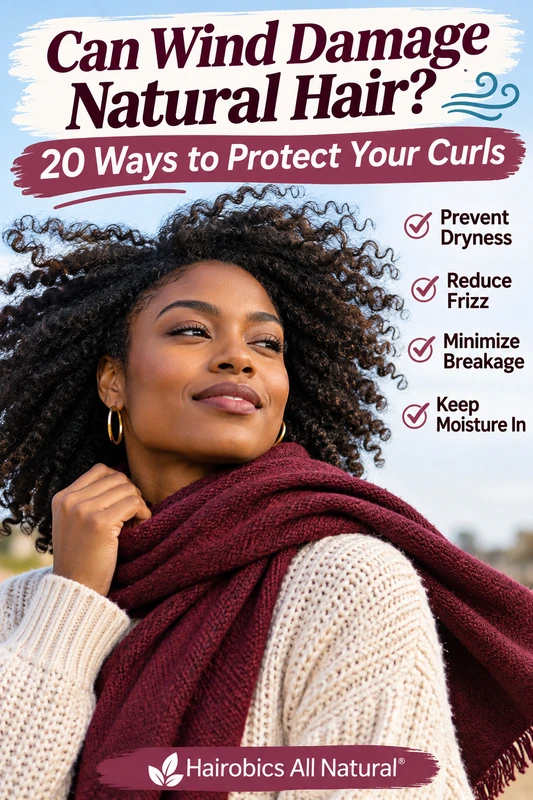
Have you ever spent hours moisturizing and styling your natural hair, only to step outside on a windy day and return home with dry, tangled, frizzy curls?
Wind is an environmental factor that many people overlook when developing a natural hair care routine. While excessive heat, chemical treatments, and tight hairstyles are commonly associated with hair damage, repeated exposure to strong winds can also contribute to dryness, tangling, split ends, and breakage.
For Black women with natural hair, particularly those with tightly curled 4A, 4B, and 4C textures, windy weather can create additional challenges when it comes to retaining moisture and maintaining healthy-looking hair.
Whether you live near the beach, in a dry desert climate, in a windy city, or in a region that experiences cold winter winds, understanding how wind affects your natural hair can help you protect your strands.
Fortunately, you do not have to avoid spending time outdoors to maintain beautiful natural hair. The right moisturizing products, protective hairstyles, and gentle hair care techniques can help minimize environmental damage.
In this comprehensive guide, we will explain how wind damages natural hair, the warning signs of wind-related damage, and 20 effective ways to protect your curls throughout the year.
Can Wind Damage Natural Hair?
Yes, wind can contribute to natural hair damage, particularly when your hair is already dry, fragile, chemically treated, or exposed to strong winds for extended periods.
Wind can cause individual strands to move repeatedly, rub against one another, and become tangled. In dry environments, moving air may also accelerate evaporation from damp hair.
Over time, repeated exposure combined with aggressive detangling and inadequate conditioning can contribute to:
-
Dry and rough-feeling hair
-
Increased frizz
-
Hair breakage
-
Split ends
-
Single-strand knots
-
Excessive tangling
-
Difficulty retaining moisture
-
Reduced curl definition
-
Increased friction between strands
-
Difficulty retaining length
Wind does not necessarily cause permanent damage after a single exposure. However, repeatedly exposing unprotected hair to harsh environmental conditions may increase mechanical wear.
Understanding these risks is the first step toward developing a more effective natural hair care routine.
For a broader understanding of environmental damage, read our guide on How Weather Affects Natural Hair.
Why Is Natural Hair Vulnerable to Wind Damage?
Natural hair has a unique structure that influences how it responds to environmental conditions.
Unlike straight hair, tightly curled and coily hair contains numerous bends and curves along each strand. These curves can create areas that are more vulnerable to mechanical stress.
Natural oils produced by the scalp may also have difficulty distributing evenly throughout tightly coiled hair.
As a result, the middle sections and ends of natural hair may require additional conditioning.
When strong wind causes strands to move in different directions, curls and coils can become intertwined.
Hair that is already dry or damaged may be especially difficult to separate without causing breakage.
Natural hair is not inherently unhealthy or weak. However, understanding its structure helps you choose techniques that preserve its natural beauty while reducing unnecessary damage.
7 Ways Wind Can Damage Natural Hair
1. Wind Can Contribute to Moisture Loss
Strong winds, especially in environments with low humidity, may increase the rate at which water evaporates from damp hair.
This can leave natural hair feeling less soft and more difficult to manage.
People living in dry regions may notice that their hair feels moisturized indoors but becomes rough after spending several hours outside.
Cold winds combined with indoor heating can create similar challenges.
For more information about protecting your curls in low-humidity environments, explore our guide to Natural Hair Care in Dry Climates.
2. Wind Increases Hair Tangling
When natural hair is worn loose, strong winds can cause strands to wrap around one another.
This is especially common with afros, twist-outs, braid-outs, and longer natural hairstyles.
Once strands become intertwined, separating them can require additional manipulation.
Trying to force a brush or comb through wind-related tangles may cause more damage than the original wind exposure.
3. Wind Can Increase Hair Breakage
Hair strands can experience repeated friction when they move against neighboring strands, clothing, hats, or accessories.
If your hair is already weakened by heat styling, coloring, or insufficient conditioning, this friction may contribute to additional breakage.
Broken strands are often shorter than your overall hair length and may appear on your clothing, bathroom counter, or hands after styling.
4. Wind Can Cause Excessive Frizz
Wind can separate naturally grouped curls and disrupt curl definition.
Even a freshly styled twist-out or wash-and-go may become less defined after prolonged exposure to strong winds.
Frizz is not necessarily a sign of unhealthy hair. However, sudden increases in frizz accompanied by roughness and tangling may suggest that your routine needs adjustment.
5. Wind May Contribute to Split Ends
The ends of your hair are the oldest portions of each strand.
They have experienced more washing, detangling, styling, and environmental exposure than newer growth.
Repeated friction and rough handling can gradually weaken these areas.
Once a hair strand develops a split end, conditioning products may temporarily improve its appearance, but trimming is necessary to remove the damaged section.
6. Wind Can Increase Single-Strand Knots
Single-strand knots, sometimes called fairy knots, occur when an individual hair strand loops around itself.
Tightly coiled natural hair can be particularly susceptible to these knots.
Wind-related movement, shrinkage, and friction may increase opportunities for knots to develop.
Keeping your ends conditioned and reducing unnecessary movement can help make them easier to manage.
7. Wind Can Make Your Hair Feel Rough
Repeated environmental exposure can affect how your natural hair feels.
Instead of feeling smooth and flexible, your strands may become rough, stiff, or difficult to separate.
If this happens regularly, examine your conditioning routine, styling habits, and environmental exposure.
Read Why Natural Hair Feels Rough for additional solutions.
20 Effective Ways to Protect Natural Hair From Wind Damage
1. Moisturize Your Natural Hair Before Going Outside
Preparing your hair before exposure to strong winds can improve its manageability.
Begin with a lightweight, water-based conditioning product that works well with your hair texture.
Pay attention to your ends, crown, and other areas that frequently become dry.
Avoid completely saturating your hair immediately before going outdoors in cold or dusty conditions.
A properly conditioned hairstyle may be easier to manage when you return indoors.
2. Use a Quality Leave-In Treatment
A leave-in treatment can help maintain softness and improve the feel of natural hair between wash days.
Look for a formula that provides conditioning without leaving excessive residue.
Hairobics Leave-In Treatment combines water, botanical ingredients, and conditioning oils to help care for dry natural hair.
It can be incorporated into routines for curls, coils, twists, braids, and other natural hairstyles.
Apply according to the product instructions, concentrating on areas that need additional conditioning.
Shop Hairobics Leave-In Treatment
3. Add an Oil-Based Conditioning Product When Needed
Water-based products and oil-based products serve different purposes in natural hair care.
Water-based products provide hydration, while suitable oils can improve lubrication, softness, and moisture retention.
Applying a small amount of an oil-based conditioner after your leave-in treatment may be helpful if your hair frequently feels dry.
Hairobics Hair & Scalp Booster contains a botanical blend featuring coconut oil, jojoba oil, olive oil, rosemary oil, and vitamin E oil.
It can complement a conditioning routine designed to care for dry hair and scalp areas.
Use sparingly according to the directions and avoid unnecessary buildup.
Shop Hairobics Hair & Scalp Booster
4. Wear Protective Hairstyles on Windy Days
Protective hairstyles can reduce the movement of individual hair strands.
Instead of allowing your curls to blow freely in different directions, consider styles that keep sections of hair together.
Popular options include:
-
Two-strand twists
-
Flat twists
-
Loose buns
-
Cornrows
-
Knotless braids
-
French braids
-
Low-tension updos
-
Tucked hairstyles
Choose a style that feels comfortable and does not place excessive tension on your scalp.
A protective hairstyle should never cause headaches, soreness, or pulling around your hairline.
5. Wear a Satin-Lined Hat
Hats provide a physical barrier between your hair and windy conditions.
However, rough hat materials may create additional friction, especially around the edges and nape.
Satin-lined hats can provide a smoother surface against your hair.
Choose a hat that fits comfortably and does not compress your curls excessively.
This is especially useful during winter, outdoor activities, and windy morning commutes.
6. Protect Your Hair With a Silk or Satin Scarf
A silk or satin scarf can help keep natural hair in place during strong winds.
Scarves are particularly useful when traveling, walking outdoors, or riding in a vehicle with the windows open.
They can also help preserve twist-outs and braid-outs.
Secure your scarf comfortably without tying it tightly around your hairline.
Avoid repeatedly adjusting the scarf if doing so creates friction against your edges.
7. Keep Your Hair Stretched
Stretched natural hair may be easier to manage in windy conditions because the coils have fewer opportunities to wrap tightly around one another.
You can stretch your hair without excessive heat by using loose braids, twists, African threading, or gentle banding.
Choose techniques that work comfortably with your hair texture.
Keeping your hair moderately stretched can also help reduce tangling during your next wash day.
8. Tuck Away Your Ends
Your ends deserve additional protection because they have experienced the greatest amount of accumulated wear.
Leaving fragile ends exposed to strong wind may increase friction and tangling.
Consider wearing a hairstyle that keeps your ends loosely tucked away.
Low buns, flat twists, and pinned hairstyles can be helpful when performed without excessive tension.
Avoid repeatedly placing your bun in the same position, as this may create stress in one area.
9. Avoid Excessive Hair Manipulation
Constantly touching, combing, and restyling your hair throughout a windy day can contribute to mechanical damage.
Instead of trying to correct every strand that becomes displaced, allow your hairstyle to maintain some natural movement.
Once you return indoors, gently assess whether your hair requires attention.
Reducing unnecessary manipulation can support your long-term length-retention goals.
Learn more in our guide to What Is Low-Manipulation Hair Care?.
10. Deep Condition Your Hair Regularly
Regular conditioning can improve softness and reduce friction between hair fibers.
If your hair frequently feels rough after windy weather, consider incorporating a suitable deep conditioner into your wash-day routine.
Some people benefit from weekly deep conditioning, while others need it less frequently.
Follow the directions on your chosen product.
Pay particular attention to areas that have experienced previous heat damage, coloring, or frequent tangling.
11. Avoid Brushing Dry, Wind-Tangled Hair
One of the biggest mistakes you can make after spending time outside is immediately brushing tangled natural hair.
Dry tangles may resist the movement of a comb or brush.
Forcing a styling tool through these areas can cause strands to snap.
Instead, divide your hair into manageable sections, apply a suitable conditioning product for slip, and gently separate difficult tangles with your fingers.
Begin near the ends and gradually work toward the roots.
12. Use a Gentle Finger-Detangling Technique
Finger detangling allows you to feel knots and tangled areas before applying additional pressure.
After returning indoors, gently separate strands using your fingertips.
If you encounter resistance, stop and apply more conditioning product where necessary.
Avoid using your fingernails to scrape or pull apart knots.
Finger detangling may take additional time, but it can help you identify fragile areas before using a comb.
13. Protect Your Hair While Driving
Driving with your windows down can expose your hair to continuous, strong air movement.
This may be particularly challenging during long highway drives or when riding in a convertible.
Wear a satin scarf, loosely gather your hair, or keep your windows partially closed.
Try to prevent loose ends from repeatedly whipping against your face, shoulders, or clothing.
These simple changes can help preserve your hairstyle during travel.
14. Adjust Your Routine for Cold Winds
Winter winds can be particularly challenging when combined with low-humidity conditions and indoor heating.
Your natural hair may require additional conditioning during colder months.
Wear a satin-lined hat, protect your ends, and avoid unnecessary heat styling.
Pay attention to changes in softness rather than automatically applying heavy products every day.
Avoid spending extended periods outdoors with soaking-wet hair in freezing temperatures.
15. Protect Your Hair From Hot, Dry Winds
Hot desert winds can create different challenges from cold winter weather.
Low humidity, direct sunlight, dust, and prolonged outdoor exposure may leave hair feeling rough or dry.
Choose a comfortable protective hairstyle and use a breathable head covering when appropriate.
Maintain regular conditioning, and protect exposed scalp areas from excessive sun exposure.
A suitable scalp sunscreen can provide additional protection where hair does not fully cover your scalp.
16. Manage Wind Exposure at the Beach
Beach environments frequently combine wind, sunlight, humidity, and saltwater.
These conditions can contribute to tangling and changes in hair texture.
Before visiting the beach, consider wearing twists, braids, or another comfortable hairstyle.
After swimming in saltwater, rinse your hair with fresh water when possible.
Cleanse and condition appropriately to remove accumulated salt, sand, and styling products.
For more warm-weather hair care advice, read Natural Hair Care in Tropical Weather.
17. Reduce Friction From Clothing
Wind can cause your natural hair to rub repeatedly against jackets, sweaters, scarves, and other clothing.
Wool collars and rough fabrics may be particularly problematic for shoulder-length hair.
Consider wearing your hair up or tucked away when wearing clothing that frequently catches your strands.
A smooth scarf can also provide a barrier between your hair and rough outerwear.
Pay special attention to the nape, where repeated clothing friction may contribute to breakage.
18. Trim Damaged Ends When Necessary
Regularly inspecting your ends can help identify damage before tangling becomes more difficult to manage.
Signs that your ends may need trimming include persistent splitting, excessive knots, uneven ends, and recurring tangles.
There is no universal trimming schedule that works for everyone.
Base your decisions on the condition of your hair rather than automatically trimming according to a calendar.
Removing damaged ends may improve manageability and reduce snagging.
19. Adjust Your Hair Care Routine According to Humidity
Not every windy day produces the same effect on natural hair.
Dry winds may contribute to a dry-feeling texture, while humid winds may increase shrinkage and frizz.
During humid conditions, styling products that provide suitable hold may help maintain curl definition.
During dry conditions, additional conditioning may be more useful.
Explore our complete guide to Natural Hair Care in Humid Climates for more recommendations.
20. Protect Your Natural Hair at Night
After spending the day outdoors, give your hair an opportunity to rest.
Gently address any developing tangles and use additional conditioning only where needed.
Wear a satin or silk bonnet, or sleep on a smooth pillowcase.
Longer natural hair may benefit from being loosely twisted or sectioned before bedtime.
Nighttime protection can help prevent existing tangles from becoming more difficult to manage by morning.
How Wind Affects Different Natural Hair Types
Wind Damage and 3C Natural Hair
Type 3C hair typically features tightly defined curls that can become separated during strong winds.
Common challenges include frizz, reduced definition, and tangling near the ends.
Lightweight conditioning products and gentle hairstyles may help maintain manageability without weighing down the curls.
Wind Damage and 4A Natural Hair
Type 4A hair has tightly coiled strands that may experience significant shrinkage depending on environmental conditions.
Wind can disrupt curl groupings and increase tangling.
Regular conditioning and loosely stretched hairstyles can be helpful during periods of strong wind.
Wind Damage and 4B Natural Hair
Type 4B hair often features bends and coils that can become intertwined during repeated movement.
Protective hairstyles, careful sectioning, and gentle detangling can help minimize unnecessary friction.
Focus on maintaining softness rather than trying to eliminate all natural frizz.
Wind Damage and 4C Natural Hair
Type 4C hair can be particularly vulnerable to tangling because of its tightly coiled structure.
Wind exposure may increase single-strand knots, interlocking strands, and difficulty separating sections.
Consider wearing two-strand twists, flat twists, or another low-manipulation hairstyle during periods of strong wind.
If your strands frequently become intertwined, read Why Does Natural Hair Web Together?.
Can Wind Damage Low-Porosity Natural Hair?
Low-porosity hair can be sensitive to excessive product layering.
Applying large amounts of heavy oils and butters before windy weather does not necessarily improve hydration.
Instead, it may leave your strands coated and difficult to cleanse.
For low-porosity hair, focus on effective cleansing, appropriate lightweight conditioning, and physical protection from strong winds.
Apply products gradually and evaluate how your hair responds.
Can Wind Damage High-Porosity Natural Hair?
High-porosity hair may exchange moisture with the surrounding environment more readily, particularly when the cuticle has been damaged.
People with high-porosity hair may notice changes in softness after exposure to dry or windy conditions.
Consistent conditioning, gentle handling, and suitable oil-based products may help improve lubrication and manageability.
Protective hairstyles can provide additional benefits by reducing repeated friction between strands.
A Simple Wind Protection Routine for Natural Hair
You do not need an expensive or complicated routine to protect your natural hair from windy weather.
Before Going Outside
-
Check your hair for dryness and existing tangles.
-
Apply a suitable leave-in conditioning product if needed.
-
Add a small amount of oil-based conditioner if your hair benefits from it.
-
Choose a comfortable hairstyle that limits excessive movement.
-
Use a satin-lined hat or scarf during particularly windy conditions.
After Returning Indoors
-
Remove your head covering carefully.
-
Inspect your hair for knots and tangled areas.
-
Apply additional conditioning where necessary.
-
Gently separate tangles using your fingers.
-
Avoid unnecessary brushing and restyling.
Before Going to Bed
-
Place your hair in loose twists or another comfortable hairstyle if needed.
-
Protect your ends.
-
Cover your hair with a satin or silk bonnet.
-
Avoid sleeping with severely tangled or soaking-wet hair.
Following these steps consistently can help reduce avoidable environmental and mechanical damage.
Signs Your Natural Hair May Be Experiencing Wind-Related Damage
Pay attention to changes in the appearance and behavior of your natural hair.
Possible warning signs include:
-
Hair that feels rough after spending time outdoors
-
Increased single-strand knots
-
More broken hairs on clothing
-
Persistent tangles near the nape
-
Difficulty maintaining curl definition
-
Ends that frequently catch on neighboring strands
-
Increased split ends
-
Difficulty retaining length
-
Reduced softness and manageability
These symptoms are not exclusive to wind damage. Heat styling, chemical processing, tension, and insufficient conditioning may also contribute.
If your hair continues breaking despite changes in your routine, seek advice from a qualified hair care professional.
Persistent thinning, bald patches, or scalp inflammation should be evaluated by a dermatologist.
Common Wind Protection Mistakes to Avoid
Protecting your natural hair should not create additional problems.
Avoid these common mistakes:
-
Wearing excessively tight protective hairstyles.
-
Applying large amounts of heavy oils to already coated hair.
-
Brushing dry, tangled curls immediately after going outdoors.
-
Wearing rough hats without protective lining.
-
Ignoring persistent split ends.
-
Using excessive heat to restore curl definition.
-
Neglecting regular cleansing because your hair is in a protective style.
The most effective routine balances conditioning, cleanliness, gentle handling, and environmental protection.
Frequently Asked Questions About Wind Damage and Natural Hair
Can wind cause natural hair loss?
Ordinary wind exposure is unlikely to cause hair loss directly from healthy follicles. However, repeated friction and rough detangling may contribute to hair breakage, making your hair appear thinner or shorter over time.
Does wind stop natural hair from growing?
Wind does not normally stop hair follicles from producing hair. However, excessive breakage can prevent you from retaining the length your hair naturally grows.
Is cold wind worse for natural hair than hot wind?
Both can create challenges. Cold winds may occur alongside dry winter conditions, while hot winds may be associated with low humidity and prolonged sun exposure. Your hair's condition and protection routine influence how it responds.
Should I moisturize my hair every time I go outside?
Not necessarily. Apply additional conditioning when your hair needs it. Excessive product application can lead to buildup without providing meaningful additional protection.
Does wearing a bonnet outside protect natural hair from wind?
A properly secured satin bonnet can help reduce hair movement and friction. A satin-lined hat or scarf may also provide practical outdoor protection.
Can wind damage braids and locs?
Wind can contribute to dryness, friction, and frizz around braids and locs. Keeping your hairstyle appropriately conditioned and covering it during strong winds may help maintain its appearance.
Is wind-damaged hair permanently damaged?
Dryness, tangling, and temporary frizz can often be improved through conditioning and gentle care. However, structurally broken or split hair fibers cannot be permanently repaired with cosmetic products.
Should I wash my hair after a windy day?
You do not need to wash your hair after every windy day. Consider cleansing if you have been exposed to substantial dust, sand, saltwater, or other environmental debris.
What is the best hairstyle for windy weather?
Loose twists, flat twists, comfortable braids, and low-tension buns are excellent options. The best hairstyle is one that limits strand movement without causing unnecessary tension.
Can wind damage my edges?
Repeated friction, tight head coverings, and aggressive styling may contribute to breakage around fragile edges. Protect your hairline with smooth fabrics and comfortable hairstyles.
Final Thoughts: Protect Your Natural Hair From Wind Damage
Wind is a natural part of everyday life, but it does not have to prevent you from maintaining beautiful, healthy-looking natural hair.
Understanding how windy conditions contribute to tangling, friction, dryness, and breakage allows you to make better decisions about your hair care routine.
Focus on consistent conditioning, protecting your ends, reducing unnecessary manipulation, and choosing comfortable protective hairstyles.
Incorporating Hairobics All Natural hair care products into your routine can provide additional conditioning support for dry hair and scalp areas.
Remember that maintaining healthy natural hair is not about eliminating every environmental challenge. It is about developing consistent habits that help preserve your strands, improve manageability, and support better length retention.
Whether you have 3C curls, 4A coils, 4B natural hair, or tightly coiled 4C hair, the right approach can help you maintain softer, more manageable hair throughout every season.
Give your natural hair the care, nourishment, and protection it deserves with Hairobics All Natural.
Healthy-looking hair starts with consistent care. Protect your curls today for more manageable hair tomorrow.