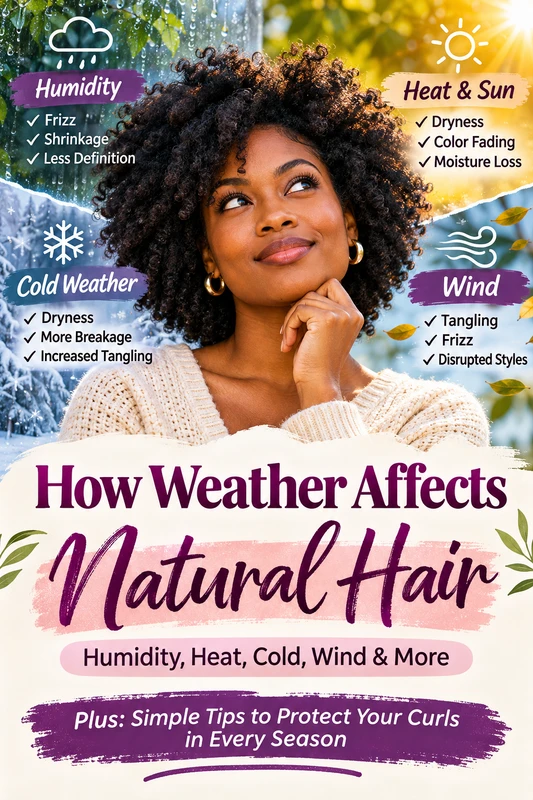
Natural hair can behave completely differently depending on the weather. One day, your curls are soft, defined, moisturized, and manageable. The next day, your hair feels dry, frizzy, tangled, shrunken, or difficult to style.
If you have ever wondered why your natural hair looks beautiful indoors but becomes frizzy the moment you step outside, weather may be one of the biggest reasons.
Humidity, cold temperatures, summer heat, wind, sunlight, and dry air can all influence how natural hair absorbs moisture, maintains hairstyles, and responds to daily manipulation.
For people with 4A, 4B, and 4C natural hair, these changes can be especially noticeable because tightly curled and coiled strands have unique shapes that influence how natural scalp oils travel along the hair.
Understanding how weather affects natural hair is important for maintaining softness, reducing unnecessary breakage, protecting fragile ends, and supporting healthy length retention.
The good news is that you do not need an entirely different collection of hair products for every season.
Instead, you need to understand how your environment affects your strands and make small adjustments to your moisturizing, conditioning, washing, and styling routine.
In this complete guide, we will explain how different weather conditions affect natural hair, why humidity causes frizz and shrinkage, how cold weather contributes to dryness, and what you can do to keep your curls healthier throughout the year.
Why Does Weather Affect Natural Hair?
Natural hair responds to environmental conditions because hair fibers interact with moisture in the surrounding air.
Each hair strand contains keratin proteins and has an outer protective layer called the cuticle.
The cuticle helps regulate how water enters and leaves the hair fiber.
When humidity rises, hair can absorb additional water vapor from the environment. This can temporarily change the hydrogen bonds within the hair, affecting its shape, volume, and appearance.
When the surrounding air becomes extremely dry, hair may lose some of its water content as it adjusts to the environment.
These changes can influence how hair feels and how well a hairstyle holds.
Weather can affect:
-
Hair moisture balance
-
Curl definition
-
Frizz and flyaways
-
Shrinkage
-
Tangling
-
Styling longevity
-
Scalp comfort
-
Hair manageability
-
Breakage risk during handling
-
Overall length retention
However, weather does not automatically cause permanent damage.
The amount of damage depends on factors such as existing hair condition, porosity, exposure, grooming habits, and protective care.
Understanding your hair's characteristics can help you make better seasonal decisions.
For additional guidance, read our article on how to determine hair porosity.
1. How Humidity Affects Natural Hair
Humidity is one of the most noticeable environmental factors affecting curly and coily hair.
Humidity describes the amount of water vapor in the air.
When humidity is high, hair can absorb moisture from the surrounding environment.
This additional water can temporarily change the shape of individual strands, especially when hair has been stretched, straightened, or styled into a particular curl pattern.
Why Humidity Causes Frizz
Frizz develops when individual strands move away from the surrounding hairstyle.
In humid conditions, hair absorbs water vapor, which can disrupt the temporary bonds holding a style in place.
As strands respond differently to moisture, some begin curling, shrinking, or lifting away from the rest of the hair.
The result may include:
-
Increased frizz
-
Less curl definition
-
Greater hair volume
-
More visible shrinkage
-
Reduced hairstyle longevity
-
Difficulty maintaining stretched styles
Humidity does not necessarily mean your hair is unhealthy.
Frizz is often a normal response to environmental moisture.
How to Protect Natural Hair From Humidity
Start with a moisturizing wash-day routine that leaves your hair properly conditioned.
Apply a suitable leave-in treatment while your hair is damp.
If you are creating a defined style, use a styling product designed to provide hold and humidity resistance.
Allow your hair to dry completely before separating twists or manipulating curls.
Consider hairstyles that work with your natural texture instead of fighting against humidity.
Twist-outs, braid-outs, buns, and carefully maintained protective styles may be more practical during humid weather.
If wash-and-go styles are particularly challenging, explore our guide on how humidity affects wash-and-go hairstyles.
2. How Hot Weather Affects Natural Hair
Hot weather can influence natural hair in several ways, especially when high temperatures occur alongside strong sunlight, sweating, or low humidity.
Heat alone does not automatically dry out every hair type.
However, hot, dry conditions can contribute to moisture loss from the hair fiber.
During summer, people also tend to spend more time outdoors, swim more frequently, and wash their hair more often.
These activities can change how hair feels and behaves.
Common Summer Hair Problems
Natural hair may experience:
-
Dry-feeling ends
-
Increased tangling
-
Sweat accumulation on the scalp
-
Frizz from humid conditions
-
Roughness after swimming
-
Color fading from sunlight
-
More frequent washing and styling
One important distinction is that hot weather and humid weather are not the same.
A hot, humid environment can produce frizz and shrinkage, while a hot, dry environment may leave hair feeling rough or dehydrated.
Best Natural Hair Routine for Hot Weather
Begin with a gentle shampoo that removes sweat, excess oils, and accumulated styling products without unnecessarily stripping the hair.
Follow with a rinse-out conditioner.
Use a leave-in treatment suited to your hair's needs, concentrating on areas that become dry quickly.
Choose lightweight styling products if your hair becomes easily weighed down.
Protect your hair from prolonged direct sunlight with a comfortable hat, scarf, or other appropriate covering.
If you swim regularly, rinse your hair after swimming and follow with suitable cleansing and conditioning care.
Avoid allowing chlorine or saltwater residue to remain on your hair unnecessarily.
Recommended Hairobics Product
Hairobics Leave-In Treatment
A leave-in treatment can help make natural hair feel softer and more manageable after washing.
In hot weather, it can be useful as part of a conditioning routine for curls and coils exposed to outdoor conditions.
Apply according to product directions and avoid overloading the hair.
Shop Hairobics Leave-In Treatment
3. How Cold Weather Affects Natural Hair
Cold weather presents different challenges for natural hair.
During winter, outdoor air may be dry, and indoor heating can reduce relative humidity.
Together, these conditions may affect the amount of moisture in the hair fiber.
As a result, some people notice that their natural hair feels rougher, less flexible, or more difficult to detangle.
Cold temperatures themselves do not automatically cause hair breakage.
However, dry-feeling strands combined with frequent manipulation, friction, and existing damage can increase the risk of breakage.
Why Natural Hair Feels Dry in Winter
During colder months, several factors may contribute to dryness:
-
Lower indoor humidity
-
Frequent exposure to heated rooms
-
Friction from winter clothing
-
Inadequate conditioning
-
Repeated styling and detangling
-
Existing damage to the hair cuticle
Scarves, sweaters, coats, and hats can also rub against the ends and nape of natural hair.
Repeated friction may contribute to tangling and mechanical damage.
How to Keep Natural Hair Moisturized in Winter
Use a gentle shampoo and follow with a moisturizing conditioner.
Deep condition when your hair needs additional softness or manageability.
Apply leave-in treatment to damp hair.
If your hair benefits from oil-based conditioning, use a small amount on appropriate areas.
Wear hairstyles that reduce friction between your ends and winter clothing.
Choose smooth-lined hats or place a satin or silk scarf underneath rough winter accessories.
Keep your hair fully dry before spending extended periods outdoors in freezing conditions.
Most importantly, avoid assuming that more oil automatically means more moisture.
Oils can provide conditioning and influence how hair feels, but they do not replace water-based conditioning.
Recommended Hairobics Product
Hairobics Hair & Scalp Booster
Hairobics Hair & Scalp Booster contains a botanical oil blend that includes coconut oil, jojoba oil, olive oil, and vitamin E oil.
It can complement a winter conditioning routine for dry-feeling hair and scalp areas.
Use a small amount as directed, adjusting the quantity to your hair's density and needs.
Shop Hairobics Hair & Scalp Booster
4. How Dry Weather Affects 4C Natural Hair
Dry climates can be particularly challenging for people who already struggle to maintain softness and manageability.
In low-humidity environments, the surrounding air contains less water vapor.
Hair naturally exchanges moisture with its environment, so very dry conditions may contribute to lower water content in the hair fiber.
For tightly coiled hair, this can become noticeable when strands feel rough or difficult to separate.
Signs Your Natural Hair May Need More Conditioning
You may notice:
-
Ends that feel rough
-
Increased tangling
-
Reduced softness
-
More friction during detangling
-
Styles that look dull
-
Difficulty maintaining flexibility
These symptoms are not proof that weather is the only problem.
Product buildup, excessive shampooing, heat damage, and other factors may produce similar results.
How to Protect 4C Hair in Dry Weather
Focus on conditioning rather than constantly applying more oil.
After washing, use a rinse-out conditioner that provides adequate slip.
Apply a suitable leave-in treatment.
Consider wearing twists, braids, or another low-manipulation hairstyle.
Protect your ends at night with a satin bonnet or pillowcase.
Avoid repeatedly combing dry, tightly coiled hair without sufficient slip.
If your ends remain rough despite regular conditioning, inspect them for splits, knots, or accumulated damage.
Consistent gentle handling is essential for maintaining length.
5. How Rainy Weather Affects Natural Hair
Rain can quickly change the appearance of natural hairstyles.
When natural hair becomes wet, temporary hydrogen bonds within the hair fiber are disrupted.
As the hair dries, these bonds reform.
This is why a carefully stretched hairstyle may shrink after exposure to rain.
Rainwater itself is not automatically damaging to natural hair.
However, repeated wetting and drying can increase tangling in some hairstyles, especially when the hair is handled roughly.
Common Rainy-Day Hair Problems
Rainy weather may cause:
-
Unexpected shrinkage
-
Frizzy twist-outs
-
Loss of stretched styles
-
Increased tangling
-
Changes in curl definition
-
Longer drying times
How to Protect Natural Hair From Rain
Carry an umbrella or wear a protective head covering when necessary.
Choose hairstyles that tolerate moisture well.
If your hair becomes wet, gently blot away excess water rather than rubbing vigorously with a towel.
Allow your hair and scalp to dry thoroughly.
If you wear braids or locs, pay particular attention to drying the roots and interior sections.
Avoid tightly covering damp hair for extended periods.
If your hairstyle becomes tangled after getting wet, use conditioner or another product with adequate slip before detangling.
6. How Wind Affects Natural Hair
Wind is another environmental factor that can make natural hair more difficult to manage.
Strong winds move loose strands against one another.
This movement can increase friction and encourage tangling, particularly when hair is worn loose.
Longer natural hair may become tangled around clothing, accessories, or neighboring strands.
Wind can also disturb carefully arranged curls and stretched styles.
How to Prevent Wind-Related Tangling
Wear loose twists, braids, buns, or another low-manipulation hairstyle when strong winds are expected.
Avoid tight hairstyles that place unnecessary tension on the hairline.
Use smooth accessories that do not snag delicate strands.
If your hair becomes tangled, separate it into manageable sections before detangling.
Start at the ends and work gradually toward the roots.
Never force a comb through wind-created knots.
For additional techniques, read our guide on how to reduce breakage while shampooing.
7. How Sun Exposure Affects Natural Hair
Sunlight contains ultraviolet radiation that can affect the hair fiber over time.
Prolonged UV exposure may contribute to changes in hair proteins, pigments, and surface properties.
These effects can be especially noticeable in color-treated hair.
Sun exposure may contribute to:
-
Hair color fading
-
Increased surface roughness
-
Reduced shine
-
Weathering of the hair shaft
-
Greater vulnerability in already damaged strands
Natural hair does not need to be hidden from sunlight constantly.
However, protecting your hair during prolonged outdoor exposure is a sensible preventive measure.
Best Ways to Protect Natural Hair From the Sun
Wear a comfortable hat or scarf when spending extended periods outdoors.
Choose protective hairstyles that keep fragile ends tucked away when practical.
Use conditioning products that help maintain manageability.
Avoid unnecessary additional heat styling when your hair already feels dry or damaged.
Remember that ordinary hair oils are not reliable substitutes for tested UV-protective hair products or physical sun protection.
8. Does Weather Affect Natural Hair Growth?
Weather can affect how natural hair looks, feels, and retains length.
However, hair growth and hair length retention are different processes.
Hair grows from follicles beneath the scalp.
The visible hair shaft is made of keratinized cells.
Environmental conditions mainly affect the exposed hair shaft and can also influence scalp comfort.
For example, dry weather may make already fragile ends more difficult to manage.
If those ends break during styling, your hair may appear to be growing slowly even though the follicles continue producing new hair.
Hair Growth vs. Length Retention
Hair growth refers to new hair produced by follicles.
Length retention refers to keeping the hair that has already grown.
A person can experience normal hair growth while struggling to retain visible length because of repeated breakage.
Seasonal changes in hair growth and shedding have been observed in some research, but they vary between individuals.
There is not enough evidence to conclude that a particular season guarantees faster natural hair growth.
The most practical strategy is to maintain a healthy scalp, protect your strands, and reduce avoidable damage.
For a deeper explanation, read our related article on how weather changes affect natural hair growth.
9. How Hair Porosity Changes Your Response to Weather
Hair porosity influences how readily water moves into and out of the hair fiber.
Although porosity is often described as low, medium, or high, actual hair behavior exists along a spectrum.
Low-Porosity Natural Hair
Low-porosity hair generally has a relatively resistant cuticle surface.
It may take longer to become thoroughly wet and can be prone to product accumulation when too many heavy products are layered.
During humid weather, low-porosity hair can still experience frizz and shrinkage.
During dry weather, it may benefit from well-formulated conditioning products without excessive buildup.
High-Porosity Natural Hair
High-porosity hair often absorbs water readily.
It may also experience faster moisture exchange with the surrounding environment.
Some high-porosity hair has been affected by heat, chemical processing, or mechanical weathering.
During humid weather, it may respond strongly to environmental moisture.
During dry weather, it may feel rough or become difficult to manage.
Conditioning, gentle detangling, and reducing additional damage are especially important.
Does Weather Permanently Change Hair Porosity?
Ordinary changes in humidity do not necessarily cause permanent changes in hair porosity.
However, cumulative damage from UV exposure, excessive heat, chemical treatments, and repeated friction can alter the hair surface over time.
Learn more in our article on whether hair porosity can change.
10. How Weather Affects Protective Hairstyles
Protective hairstyles can reduce daily manipulation, but they do not completely shield natural hair from environmental conditions.
Braids, twists, cornrows, and locs can still be affected by humidity, sweat, rain, and dry air.
Braids in Humid Weather
Humidity can cause natural strands to expand or curl away from the braid pattern.
This may create a fuzzy appearance.
Instead of repeatedly tightening or restyling the braids, focus on gentle maintenance.
Locs in Rainy Weather
Locs can retain water within their structure.
Thorough drying is important after washing, swimming, or heavy rain.
Leaving locs damp for prolonged periods may contribute to odor and other moisture-related problems.
Twists in Dry Weather
Twists can help keep natural hair organized and reduce repeated combing.
However, exposed ends may still feel dry.
Condition your hair appropriately before installing twists and avoid making them excessively tight.
For more information, explore our guide on how humidity affects braided hairstyles.
Recommended Hairobics Product for Braids and Locs
Hairobics Raaw Roots Locs & Braids Moisturizer Spray
This product is designed for braid and loc maintenance and can be incorporated into a regular conditioning routine.
Apply according to directions, avoiding excessive saturation or buildup.
Shop Hairobics Locs & Braids Moisturizer Spray
11. The Best Natural Hair Routine for Every Season
A successful natural hair routine should be flexible.
Your hair may need different levels of conditioning, cleansing, styling hold, or protection depending on the weather.
Spring Natural Hair Routine
Spring often brings changing temperatures and increased humidity in some regions.
Focus on maintaining a consistent wash-day schedule.
Use a leave-in treatment after conditioning.
Choose hairstyles that tolerate changing moisture levels.
Avoid excessive restyling when humidity causes frizz.
Summer Natural Hair Routine
During summer, prioritize scalp cleansing when sweat and product buildup increase.
Use conditioner after shampooing.
Protect your hair from prolonged sunlight.
Rinse after swimming.
Select lightweight products when heavy layering makes your hair feel coated.
Fall Natural Hair Routine
Fall is a useful time to reassess your hair after summer activities.
Inspect your ends for knots and splits.
Adjust your conditioning routine if the air becomes drier.
Reduce unnecessary heat styling.
Choose hairstyles that minimize friction from seasonal clothing.
Winter Natural Hair Routine
Winter often calls for extra attention to dryness and friction.
Condition consistently.
Apply leave-in treatment when appropriate.
Use a small amount of oil-based conditioning if your hair benefits from it.
Protect your ends from rough scarves and sweaters.
Avoid repeated manipulation of hair that already feels brittle.
12. How to Build a Weather-Resistant Natural Hair Routine
A simple routine can help your natural hair remain manageable throughout changing weather conditions.
Step 1: Cleanse Your Scalp
Use a shampoo appropriate for your scalp and hair condition.
Wash as often as needed to remove sweat, oils, and product buildup.
Step 2: Condition Thoroughly
Apply rinse-out conditioner to the hair lengths.
Concentrate on areas prone to tangling.
Detangle gently while the product provides sufficient slip.
Step 3: Apply Leave-In Treatment
After rinsing, apply a suitable leave-in product according to directions.
Focus on distributing the product evenly rather than applying excessive amounts.
Step 4: Add Oil-Based Conditioning if Needed
Some hair types benefit from additional oil-based products.
Use a small quantity and observe how your hair responds.
Avoid assuming that oils alone can hydrate dry hair.
Step 5: Choose a Weather-Appropriate Hairstyle
For humid weather, consider styles that accommodate shrinkage.
For windy conditions, keep loose strands organized.
For dry winter weather, reduce friction and protect exposed ends.
Step 6: Protect Your Hair Overnight
Use a satin or silk bonnet, scarf, or pillowcase.
These accessories can reduce friction and help preserve your hairstyle.
Step 7: Adjust Based on Results
Observe how your hair feels rather than following rigid seasonal rules.
If your hair feels coated, reduce product layering.
If it feels rough, reassess your conditioning routine.
If tangling increases, consider a lower-manipulation hairstyle.
13. Hairobics All Natural Products for Year-Round Hair Care
Maintaining natural hair throughout changing seasons does not require dozens of products.
A consistent routine built around cleansing, conditioning, gentle handling, and suitable styling products is often more practical.
Hairobics All Natural offers several products that can complement your routine.
Hairobics Leave-In Treatment
A convenient option for incorporating leave-in conditioning after wash day.
It can support a routine focused on softness and manageability.
Hairobics Hair & Scalp Booster
An oil-based conditioning product featuring botanical ingredients.
It may be useful for people who prefer additional conditioning on dry-feeling areas.
Hairobics Scalp Rejuvenator
A scalp-conditioning oil that can be incorporated into a regular scalp-care routine.
Apply as directed and avoid using excessive quantities.
If your scalp becomes persistently irritated, seek appropriate medical advice rather than relying on oils alone.
Hairobics Hair Growth Bundle
For customers who want several complementary products, the Hairobics Hair Growth Bundle includes:
-
Hair & Scalp Booster
-
Leave-In Treatment
-
Scalp Rejuvenator
These products can be used as part of a consistent hair and scalp conditioning routine.
They do not replace proper cleansing, protective styling practices, or medical treatment for hair loss.
Shop Hairobics Hair Growth Bundle
14. Common Weather-Related Natural Hair Mistakes
Even with a good routine, certain habits can make seasonal hair problems worse.
Applying Too Much Oil
Heavy oil layering can leave hair coated without addressing the need for appropriate conditioning.
Start with small quantities.
Constantly Restyling Frizzy Hair
Humidity-related frizz is normal.
Repeated combing, brushing, and pulling can create unnecessary friction.
Ignoring the Ends
The ends are the oldest parts of the hair shaft.
They have experienced the most exposure to washing, styling, and environmental conditions.
Give them extra attention during conditioning and detangling.
Wearing Tight Protective Styles
A hairstyle is not truly protective if it causes excessive pulling.
Avoid tight braids, ponytails, and extensions that place strain on the hairline.
Leaving Braids or Locs Damp
After rain or washing, allow protective styles to dry thoroughly.
Using the Same Routine Regardless of Conditions
Your hair may need less product in humid weather and different conditioning strategies in dry weather.
Pay attention to the results rather than following the exact same steps every day.
Frequently Asked Questions About Weather and Natural Hair
Does humidity make natural hair frizzy?
Yes. High humidity can increase water absorption by the hair fiber, temporarily changing strand shape and contributing to frizz, shrinkage, and loss of hairstyle definition.
Does cold weather make natural hair break?
Cold weather does not automatically cause breakage. However, low humidity, friction from clothing, existing hair damage, and rough manipulation can increase breakage risk.
Why does my 4C hair shrink when it rains?
Water changes temporary bonds within the hair fiber. When tightly coiled hair becomes wet, it can return toward its natural curl pattern, making the hair appear shorter.
Is hot weather bad for natural hair?
Not necessarily. Hot weather can be manageable with appropriate conditioning and protection. Prolonged sunlight, swimming, sweat buildup, and dry air may require adjustments to your routine.
Does natural hair grow faster in summer?
Some research suggests seasonal patterns in hair growth or shedding, but individual results vary. Summer does not guarantee faster growth, and protecting existing length remains important.
Should I moisturize natural hair more often in winter?
Some people benefit from adjusting their conditioning routine during winter, particularly when indoor air is dry. However, the correct frequency depends on hair condition, porosity, products, and styling habits.
Can humidity damage natural hair permanently?
Ordinary humidity changes do not automatically cause permanent damage. However, repeated swelling and drying, particularly in already damaged hair, may contribute to wear over time.
What is the best hairstyle for natural hair in humid weather?
Twists, braids, buns, and other low-manipulation styles can be practical choices. The best option depends on your hair's length, density, condition, and styling preferences.
Does wind cause natural hair breakage?
Wind can increase tangling and friction, particularly when hair is worn loose. Breakage is more likely when tangled strands are handled roughly.
Can weather cause a dry, itchy scalp?
Environmental conditions may contribute to scalp discomfort, but persistent itching or flaking can also result from dandruff, dermatitis, or other scalp conditions. Seek professional evaluation when symptoms persist.
Final Thoughts: Protecting Natural Hair in Every Weather Condition
Weather can have a noticeable influence on how natural hair looks, feels, and responds to styling.
Humidity can increase frizz and shrinkage.
Dry air may leave strands feeling rougher.
Cold-weather clothing can create friction.
Wind can increase tangling, while prolonged sunlight may contribute to hair weathering.
However, changing weather does not mean your natural hair has to become unhealthy or unmanageable.
The key is developing a flexible routine that responds to your hair's needs.
Focus on regular cleansing, effective conditioning, gentle detangling, reduced manipulation, and hairstyles suited to your environment.
Pay particular attention to fragile ends and areas that experience repeated friction.
Most importantly, remember that healthy natural hair care is about consistency rather than perfection.
With thoughtful seasonal adjustments, you can maintain softer, more manageable curls and protect the length you have worked hard to grow.
Explore natural hair and scalp conditioning products at Hairobics All Natural and build a routine that works for your hair throughout the year.