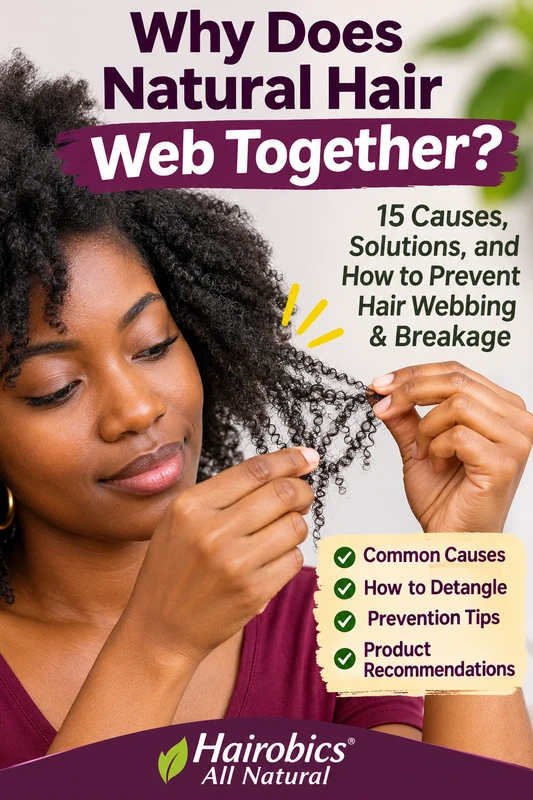
Have you ever tried separating your natural hair, only to discover that your strands seem connected like a spiderweb? You pull one section apart, and several other strands come with it. Even after detangling, your curls seem to cling together, making styling frustrating and increasing the risk of breakage.
This common problem is known as natural hair webbing.
Hair webbing can happen with almost any curly or coily hair texture, but it is especially noticeable in tightly coiled 4A, 4B, and 4C natural hair.
If your hair constantly sticks together, forms tiny interconnected tangles, or becomes difficult to separate after washing, understanding the causes can help you protect your strands.
The good news is that hair webbing does not automatically mean your hair is unhealthy. In many cases, small changes to your moisturizing routine, detangling methods, and styling habits can make a noticeable difference.
In this comprehensive guide from Hairobics All Natural, we explain why natural hair webs together, the most common causes, how to separate webbed strands without unnecessary breakage, and the best ways to prevent the problem from returning.
What Is Natural Hair Webbing?
Natural hair webbing happens when individual strands become intertwined, creating a network of hair that is difficult to separate.
Instead of falling apart into individual curls or sections, the strands catch on one another.
You might notice that:
-
Your hair stretches into thin, web-like connections when separated.
-
Several strands move together when you pull one strand.
-
Your curls stick together after washing.
-
Your ends constantly catch on neighboring strands.
-
Your hair becomes tangled shortly after detangling.
-
You experience more resistance when parting or styling.
-
Your hair feels rough, dry, or difficult to manage.
Webbing is a descriptive hair-care term rather than a medical diagnosis.
It often describes the early stages of tangling, when strands begin catching on one another but have not necessarily formed tight knots or mats.
Understanding the difference between ordinary curl clumping and problematic webbing is important.
Healthy curls naturally group together. This is called curl clumping, and it can help create definition.
Problematic webbing occurs when those groups become difficult to separate because individual strands are caught, twisted, or tangled.
Why Does Natural Hair Web Together?
The main reason natural hair webs together is that curly and coily strands naturally bend, overlap, and wrap around neighboring hairs.
Unlike straight hair, which generally falls in a more uniform direction, tightly coiled hair grows in curved patterns.
These curves increase opportunities for strands to make contact and become intertwined.
When additional factors such as dryness, friction, shed hair, or damaged ends are present, the strands may catch on one another more easily.
Let's examine 15 common causes.
1. Natural Hair Shrinkage
Shrinkage is one of the biggest contributors to hair webbing.
Natural hair can contract significantly as it dries, especially when it has tight curls or coils.
As your hair shrinks, individual strands move closer together.
This creates more opportunities for neighboring curls to wrap around one another.
For example, you may carefully detangle your hair while it is damp, but once it dries and shrinks, you notice that the strands are connected again.
Shrinkage itself is normal and is not evidence of damage.
However, when shrinkage combines with friction, shed hair, or rough ends, tangling can increase.
How to help: Keep freshly detangled hair in loose twists, braids, or another low-tension stretched style while it dries.
You do not need to eliminate shrinkage completely. The goal is to reduce unnecessary tangling while preserving your natural curl pattern.
2. Dry Natural Hair
Dry-feeling hair often experiences increased friction during styling.
When the hair surface is rough, neighboring strands may catch more easily instead of sliding past one another.
This can make hair webbing especially frustrating when separating twists, removing braids, or preparing for wash day.
Signs that your hair may need additional conditioning include roughness, dullness, stiffness, and difficulty detangling.
However, dryness is not always the only cause of webbing.
Hair can feel moisturized and still tangle because of its curl pattern, density, or accumulated shed strands.
How to help: Use a moisturizing conditioner during wash day and maintain an appropriate leave-in conditioning routine between washes.
For additional conditioning support, explore Hairobics Leave-In Treatment.
This botanical-based hair and scalp treatment can complement a routine focused on maintaining manageable natural hair.
3. Shed Hair Trapped Between Your Curls
Natural hair sheds as part of its normal growth cycle.
However, curly and coily hair does not always release shed strands immediately.
Instead, loose hairs may remain trapped within surrounding curls.
As additional strands shed, they can become intertwined with neighboring hairs.
Eventually, these loose strands form connections that resemble a web.
This is especially common when you wear protective styles for extended periods.
After removing braids or twists, you may discover a significant amount of accumulated shed hair.
How to help: Remove shed strands carefully during regular detangling sessions.
Avoid pulling multiple strands apart without first checking whether loose hairs are connecting them.
4. Split Ends and Damaged Hair
Split ends can contribute to natural hair webbing because damaged hair surfaces may catch on surrounding strands.
When the protective outer layer of the hair becomes worn, the strands can feel rougher and become more vulnerable to tangling.
Common contributors to hair damage include excessive heat, chemical processing, rough brushing, and repeated mechanical friction.
You may notice that webbing happens primarily near the ends rather than throughout your entire head.
If your ends constantly knot together, examine them for visible splitting, fraying, or breakage.
How to help: Trim visibly damaged ends when necessary and reduce practices that create unnecessary friction.
Conditioners can temporarily improve manageability, but they cannot permanently restore a split hair shaft.
5. Product Buildup
Using too many styling products can sometimes make hair feel coated, sticky, or difficult to separate.
Heavy gels, waxes, butters, oils, and styling creams may accumulate when they are repeatedly layered without adequate cleansing.
This buildup can interfere with how your hair feels and responds to conditioning products.
Some products may also leave a tacky residue that encourages strands to cling together.
How to help: Cleanse your hair thoroughly with a shampoo appropriate for your hair and product usage.
Use a clarifying shampoo occasionally if buildup is persistent, followed by a suitable conditioner.
Avoid adding more oil or styling cream to hair that already feels heavily coated.
6. Not Detangling Thoroughly
Incomplete detangling is another common reason natural hair webs together.
You might remove the obvious knots while leaving smaller tangles hidden between strands.
These tiny tangles can gradually connect with neighboring curls.
Eventually, the hair becomes difficult to separate even though you recently detangled it.
For a complete approach, read our guide to detangling natural hair without breakage or pain.
How to help: Work in manageable sections, apply a conditioner with adequate slip, and gently separate the strands from the ends upward.
7. High-Density Natural Hair
High-density hair contains a relatively large number of strands on the scalp.
When many curls occupy a small area, they have more opportunities to overlap.
This can make webbing particularly noticeable in thick-looking, tightly coiled hair.
However, density is not the same as individual strand thickness.
You can have fine strands and high-density hair at the same time.
Fine strands may also be more vulnerable to damage when excessive force is used during detangling.
How to help: Divide dense hair into smaller sections and keep completed sections separated.
For some people, six to eight sections may be more manageable than four.
8. Sleeping With Loose Natural Hair
Your nighttime routine can influence how tangled your hair becomes.
When loose curls rub against bedding or against one another, friction may encourage strands to catch and twist together.
Hair can also become compressed during sleep, making existing tangles harder to separate.
This is especially noticeable when sleeping with a loose afro.
How to help: Try loose twists, large braids, or a comfortable pineapple style when appropriate for your hair length.
A satin or silk bonnet, scarf, or pillowcase may help reduce friction.
Avoid tight nighttime hairstyles that pull on your edges or scalp.
9. Washing Natural Hair Without Sections
Shampooing your entire head without controlling the hair can sometimes encourage additional tangling.
This is particularly true if you pile your hair on top of your head or rub the strands together aggressively.
As the hair moves in different directions, curls may wrap around neighboring sections.
The result can be webbing that becomes noticeable during rinsing.
How to help: Wash your hair in sections when needed, focusing shampoo on the scalp and allowing the cleanser to move through the lengths during rinsing.
Avoid circular scrubbing motions that unnecessarily tangle the hair.
10. Excessive Manipulation
Constantly combing, brushing, separating, twisting, and restyling natural hair can increase friction and mechanical stress.
Even when you are trying to keep your hair neat, repeated handling may cause strands to become rougher or break.
This can create more opportunities for webbing.
How to help: Choose hairstyles that allow your hair to remain relatively undisturbed between maintenance sessions.
Low-manipulation styling does not mean neglecting your hair.
It means reducing unnecessary handling while maintaining cleanliness, conditioning, and scalp comfort.
11. Hair Porosity and Surface Damage
Hair porosity describes how readily hair takes in and releases water under particular conditions.
Porosity is influenced by the hair's structure and condition.
Hair with substantial cuticle damage may feel rough and tangle more easily.
However, low-porosity hair can also experience webbing, especially when tightly coiled strands shrink around one another.
Porosity alone does not determine whether hair will tangle.
How to help: Focus on how your hair responds to cleansing and conditioning rather than relying only on a porosity label.
Use products that improve softness and manageability without leaving excessive residue.
12. Wearing Protective Styles Too Long
Braids, twists, and other protective hairstyles can reduce daily manipulation.
However, leaving styles installed too long may allow shed hair to accumulate near the roots.
As new growth appears, neighboring strands can begin wrapping around one another.
When the style is finally removed, the roots may feel webbed or matted.
How to help: Maintain protective styles appropriately and remove them before significant matting develops.
During takedown, carefully separate the hair and remove accumulated shed strands before shampooing.
Never assume that a protective style eliminates the need for hair maintenance.
13. Skipping Regular Conditioning
Shampoo removes dirt, sweat, oils, and product residue.
However, cleansing alone may leave some hair types feeling less manageable.
Conditioning products help improve lubrication and reduce friction during detangling.
When conditioning is consistently skipped, strands may be more difficult to separate.
How to help: Use a suitable rinse-out conditioner after shampooing, especially when your hair feels rough or tangled.
A deep conditioner may be useful when your hair needs additional conditioning.
Choose products based on how your hair responds rather than assuming every wash day requires an intensive treatment.
14. Friction From Clothing and Accessories
Hair webbing does not always occur evenly across your head.
Sometimes the back of your hair becomes tangled more frequently than the front.
This can happen when the hair repeatedly rubs against clothing, scarves, jacket collars, or other surfaces.
The nape is particularly vulnerable because it experiences regular contact with clothing.
How to help: Protect the back of your hair from unnecessary rubbing.
Consider styles that keep fragile ends away from rough fabrics.
Avoid accessories that repeatedly snag or pull individual strands.
15. Delaying Detangling for Too Long
Waiting too long between detangling sessions can allow small tangles to develop into larger networks.
As shed hair accumulates and curls continue to shrink, neighboring strands may become increasingly connected.
The longer severe tangles remain, the more difficult they may become to remove without damage.
However, detangling frequency should depend on your hair type, hairstyle, and individual needs.
Some people benefit from weekly detangling, while others can safely go longer.
How to help: Establish a consistent schedule that prevents significant matting without encouraging excessive manipulation.
For additional prevention strategies, read how to prevent natural hair from retangling.
How to Stop Natural Hair From Webbing Together
Once you understand the causes, the next step is learning how to separate tangled strands safely.
The goal is not to force your hair apart.
Instead, you want to reduce friction, remove trapped shed hair, and prevent unnecessary breakage.
Step 1: Divide Your Hair Into Sections
Begin by separating your hair into manageable sections.
Four sections may work for medium-density hair, while six to eight may be more practical for dense or tightly coiled hair.
Secure each section loosely with a clip or hair tie.
Avoid pulling aggressively through tangled areas just to create a perfect part.
Step 2: Add Water and a Conditioner With Slip
Lightly dampen the section if appropriate for your hair.
Apply a detangling conditioner that provides enough lubrication for strands to move past one another.
For heavily tangled hair, a generous amount of rinse-out conditioner may be more useful than a small amount of oil.
Allow the product time to distribute through the section.
Do not assume that soaking the hair is always the best option. Some hair becomes more fragile or difficult to manage when fully saturated.
Step 3: Start With Finger Detangling
Use your fingers to locate interconnected strands.
Gently loosen the outer edges of each tangle.
Work slowly and avoid pulling against resistance.
If several strands are connected, separate them gradually rather than trying to remove the entire web at once.
Step 4: Remove Trapped Shed Hair
As you loosen the tangles, look for shed strands that are wrapped around neighboring hairs.
Carefully slide these strands away when possible.
Do not yank them out.
A strand that appears loose may still be wrapped around several other hairs.
Step 5: Detangle From Ends to Roots
Once the major webs have loosened, begin working from the ends upward.
Use your fingers or an appropriate detangling tool.
Hold the section above the area being detangled to reduce pulling on the scalp.
If the tool encounters resistance, stop and loosen the tangle manually.
Step 6: Keep Detangled Sections Separated
After detangling a section, place it into a loose twist or braid.
This prevents the hair from immediately mixing with neighboring sections.
Repeat until the entire head is detangled.
Step 7: Finish With Gentle Conditioning and Styling
After cleansing and conditioning, apply your preferred leave-in products according to their directions.
Choose a low-tension hairstyle that reduces unnecessary friction.
If you want to maintain some stretch, consider loose twists, braids, or banding with gentle materials.
For additional help with severe tangles, see how to detangle matted natural hair without causing breakage.
Best Hairobics Products for a Natural Hair Webbing Prevention Routine
Healthy natural hair maintenance requires more than choosing a single product.
Gentle detangling, regular cleansing, appropriate conditioning, and scalp care all contribute to a manageable routine.
Hairobics All Natural offers botanical-based hair and scalp products that can complement these habits.
1. Hairobics Leave-In Treatment
If your hair frequently feels dry or difficult to manage after washing, leave-in conditioning may be a useful addition to your routine.
Hairobics Leave-In Treatment contains a botanical-based blend that includes purified water, aloe vera, jojoba oil, avocado oil, and other ingredients.
It can be incorporated into your regular hair and scalp conditioning routine according to its directions.
For severe webbing, use a dedicated detangling conditioner with sufficient slip before attempting to separate tight knots.
Shop Hairobics Leave-In Treatment
2. Hairobics Hair & Scalp Booster
Hair that feels dry may benefit from appropriate oil-based conditioning as part of a balanced routine.
Hairobics Hair & Scalp Booster contains ingredients including coconut oil, olive oil, jojoba oil, wheat germ oil, aloe vera, and vitamin E oil.
It can complement a routine focused on caring for dry-feeling hair and scalp areas.
Apply sparingly according to directions.
Heavy oil application does not replace water-based conditioning and may contribute to buildup if products are repeatedly layered.
Shop Hairobics Hair & Scalp Booster
3. Hairobics Scalp Rejuvenator
Maintaining a clean, comfortable scalp is another important part of natural hair care.
Hairobics Scalp Rejuvenator is a botanical oil blend containing ingredients such as olive oil, rosemary oil, lavender oil, tea tree oil, and peppermint oil.
It can be incorporated into a scalp-conditioning routine with gentle massage.
Avoid excessive rubbing or scratching, particularly when your hair is already tangled.
Patch-test products as directed and discontinue use if irritation develops.
Shop Hairobics Scalp Rejuvenator
These products can support a conditioning and scalp-care routine, but no oil or leave-in treatment can guarantee that tightly coiled hair will never web or tangle.
How to Prevent 4C Hair From Webbing
4C natural hair can be especially prone to webbing because of its tightly coiled structure and shrinkage.
However, 4C hair is not inherently unhealthy or impossible to manage.
The most effective approach is usually a consistent routine that minimizes unnecessary friction.
Consider these habits:
-
Detangle in manageable sections.
-
Use a conditioner that provides sufficient slip.
-
Remove trapped shed hair carefully.
-
Keep detangled sections separated during wash day.
-
Avoid repeatedly combing dry, resistant tangles.
-
Use low-tension twists or braids when appropriate.
-
Protect your hair from nighttime friction.
-
Cleanse regularly enough to control buildup.
-
Address visibly damaged ends.
-
Avoid hairstyles that place excessive tension on the scalp.
The goal is not to make 4C hair behave like straight hair.
Instead, it is to work with the natural curl pattern while reducing the conditions that lead to tangling.
Why Does Natural Hair Web Together After Washing?
If your natural hair becomes webbed immediately after washing, several factors may be responsible.
First, shampooing can move neighboring strands into contact with one another.
Second, hair may shrink during drying, causing previously separated curls to overlap.
Third, insufficient conditioning may leave the hair feeling rough and difficult to separate.
Finally, rinsing with the hair completely loose may allow sections to mix together.
Try shampooing in sections and following with a conditioner that provides adequate slip.
Detangle carefully when the conditioner is present, if that method works well for your hair.
Then secure each section before moving to the next.
You can also explore our article on whether to detangle natural hair before or after shampooing.
Why Does Natural Hair Web Together When Dry?
Dry hair webbing often becomes noticeable when separating curls, removing twists, or styling an afro.
Possible contributing factors include shrinkage, accumulated shed hair, rough ends, friction, and inadequate conditioning.
However, not every web-like connection indicates dryness.
Some healthy curls naturally interlock because of their shape.
If your hair feels soft and the strands separate easily, you may simply be experiencing ordinary curl clumping.
If your hair resists separation, catches repeatedly, or breaks during styling, consider adjusting your detangling and conditioning routine.
Is Hair Webbing the Same as Fairy Knots?
No. Although both involve tangling, they describe different problems.
Hair webbing involves multiple strands becoming interconnected.
Fairy knots, also called single-strand knots, form when an individual strand loops around itself and creates a knot.
Both problems can occur together.
For example, a strand with a fairy knot may catch on neighboring strands and contribute to a larger tangle.
The prevention methods overlap, including gentle detangling, reducing friction, and caring for damaged ends.
For more information, read how to reduce fairy knots in natural hair.
Can Hair Webbing Cause Breakage?
Hair webbing does not automatically cause breakage.
However, aggressive attempts to separate tangled strands can damage the hair.
When multiple strands are connected, pulling on one strand may place tension on several others.
If the force exceeds what the strands can tolerate, breakage may occur.
This is why patience is essential during detangling.
Avoid forcing combs through resistant sections or repeatedly pulling apart tightly tangled hair.
For more protective techniques, read how to reduce breakage while shampooing.
When Does Hair Webbing Become a Serious Problem?
Occasional webbing is common in curly and coily hair.
However, severe or persistent tangling may require additional attention.
Be particularly careful if you notice large, tightly matted sections, repeated breakage, painful pulling at the scalp, or hair that cannot be separated despite careful conditioning.
If matting is extensive, a stylist experienced with natural hair may be able to help.
Seek medical evaluation if tangling occurs alongside sudden excessive shedding, bald patches, scalp inflammation, or unexplained hair loss.
Hair webbing itself is not a medical condition, but accompanying symptoms may indicate another issue.
Frequently Asked Questions About Natural Hair Webbing
Why does my 4C hair stick together?
4C hair has tightly coiled strands that naturally overlap and shrink. This can make neighboring hairs catch on one another, particularly when shed hair, friction, or damaged ends are present.
Does natural hair webbing mean my hair is damaged?
Not necessarily. Healthy natural hair can web because of its curl pattern. However, persistent roughness, split ends, and excessive breakage may indicate damage.
Can moisturizing stop hair webbing?
Appropriate conditioning may reduce friction and make hair easier to separate, but moisturizing alone cannot completely prevent tangling.
Should I detangle webbed hair when wet or dry?
Many people find damp hair coated with a conditioner that provides slip easier to detangle. However, hair is more vulnerable to stretching and certain forms of damage when wet, so avoid excessive pulling.
The best method depends on your hair's condition and how it responds.
Why does my hair web together immediately after detangling?
Shrinkage, trapped shed hair, incomplete detangling, or mixing freshly detangled sections can cause tangles to return.
Keeping completed sections in loose twists or braids may help.
Can oils prevent natural hair webbing?
Some oils can provide lubrication and reduce friction, but they do not remove knots or replace proper conditioning.
Use oil-based products as part of a balanced routine rather than relying on them as your only detangling solution.
Does webbing prevent natural hair from growing?
Webbing does not directly stop hair from growing at the scalp.
However, repeated breakage during detangling can make it harder to retain length.
Protecting the hair from unnecessary mechanical damage can help preserve the length you grow.
How often should I detangle natural hair to prevent webbing?
There is no universal schedule.
Your ideal frequency depends on your curl pattern, density, hairstyle, shedding, and tendency to tangle.
Detangle often enough to prevent severe knots, but avoid unnecessary daily manipulation.
Final Thoughts: How to Keep Natural Hair From Webbing Together
Natural hair webbing can be frustrating, especially when you spend time detangling only to discover that your strands have become intertwined again.
Fortunately, webbing is often manageable.
The most important steps are understanding your curl pattern, removing trapped shed hair, maintaining appropriate conditioning, reducing friction, and separating tangles gently.
Remember that natural hair does not need to remain perfectly separated at all times to be healthy.
Curls and coils naturally interact with neighboring strands.
The goal is to prevent those interactions from developing into stubborn knots, painful tangles, or excessive breakage.
With a consistent wash-day routine and gentle styling habits, you can make your natural hair easier to manage while protecting your length.
For botanical-based hair and scalp conditioning products, explore Hairobics All Natural and discover options that complement your natural hair care routine.
Healthy natural hair starts with consistent care, gentle handling, and learning what works best for your unique curls.