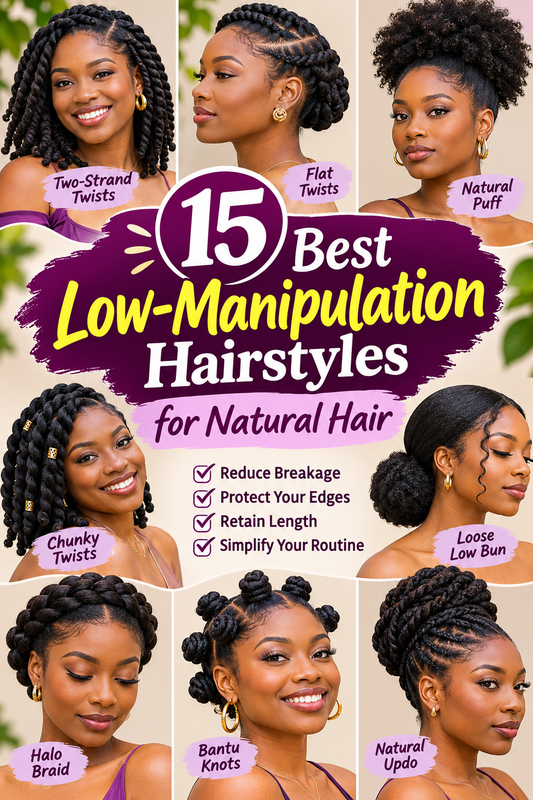
Beautiful, healthy natural hair does not have to require hours of styling every week. In fact, one of the smartest ways to care for curly, coily, and textured hair is to reduce unnecessary handling while keeping your strands moisturized, protected, and comfortable.
That is where low-manipulation hairstyles for natural hair come in.
Whether you have 4A, 4B, 4C, fine, thick, short, or shoulder-length natural hair, choosing hairstyles that require less daily brushing, combing, pulling, and restyling can make a meaningful difference in your hair care routine.
Many women struggle with hair that seems to grow but never gets longer. Their ends become thinner, their edges appear fragile, or their strands break before they reach their desired length.
Although there are several possible reasons for these problems, excessive manipulation can be a contributing factor.
The good news is that you do not have to give up beautiful hairstyles to protect your hair.
From two-strand twists and flat twists to loose buns, braid-outs, and elegant natural updos, there are plenty of styles that allow you to look your best without constantly disturbing your strands.
In this complete guide, we will explore the 15 best low-manipulation hairstyles, how to choose the right style for your hair, common styling mistakes, and practical ways to support healthier-looking natural hair.
What Are Low-Manipulation Hairstyles?
Low-manipulation hairstyles are styles designed to reduce how frequently you handle, comb, brush, separate, stretch, or restyle your hair.
Instead of changing your hairstyle every morning, you create a style that can remain comfortable and attractive for several days or longer with minimal adjustments.
The goal is to reduce unnecessary friction and mechanical stress.
For example, imagine two different natural hair routines.
In the first routine, someone detangles, brushes, parts, and restyles their hair every morning.
In the second routine, someone installs medium-sized twists, moisturizes when necessary, protects their hair at night, and leaves the twists alone for several days.
The second routine generally involves less daily handling.
That difference matters because repeated friction, pulling, and tension can contribute to weakened strands and breakage.
However, low manipulation does not mean ignoring your hair. Your scalp still needs cleansing, your strands still need conditioning, and your hairstyle should never cause discomfort.
For more information, read our Complete Guide to Protective Styles.
Why Low-Manipulation Hairstyles Matter for Natural Hair
Natural hair is incredibly versatile, but curly and coily strands can be vulnerable to mechanical damage.
Every curl and bend creates an area where the strand may experience stress during combing, brushing, or detangling.
When hair is dry, tangled, or repeatedly pulled, breakage becomes more likely.
1. They Help Reduce Breakage
Frequent manipulation increases the opportunities for strands to snag, stretch excessively, or snap.
Low-manipulation hairstyles help limit these situations by keeping hair organized and reducing repeated styling.
2. They Support Length Retention
Hair growth happens inside the follicle, while length retention depends partly on preserving the hair that has already grown.
A hairstyle cannot directly make follicles grow faster.
However, reducing breakage may help you retain more of your existing length.
3. They Can Protect Fragile Ends
The ends of your hair are the oldest portions of the strands.
They have experienced the most washing, brushing, styling, and environmental exposure.
Hairstyles that minimize friction or tuck the ends away can help reduce additional wear.
4. They Save Time
A well-planned low-manipulation routine can reduce the amount of time spent styling your hair each morning.
This is especially useful for busy women, mothers, professionals, and anyone who wants a simpler natural hair routine.
5. They Can Reduce Hairline Stress
When properly installed, loose hairstyles may reduce unnecessary pulling around the edges, temples, and nape.
This is particularly important for women experiencing fragile hairlines.
15 Best Low-Manipulation Hairstyles for Natural Hair
1. Two-Strand Twists
Best for: Type 3 and Type 4 natural hair, beginners, and women focused on length retention.
Two-strand twists are among the most versatile low-manipulation hairstyles for natural hair.
They are created by dividing a section of hair into two pieces and wrapping the pieces around each other.
Unlike styles that require heavy extensions or tight braiding, two-strand twists can be installed using only your natural hair.
Their biggest advantage is simplicity.
Once installed, you can wear them down, arrange them into an updo, or gently pin them away from your face.
They can also make wash day easier by keeping strands separated into manageable sections.
How to protect your hair:
-
Start with clean, conditioned hair.
-
Detangle gently before twisting.
-
Apply a suitable leave-in treatment.
-
Create twists without pulling tightly at the roots.
-
Protect your hair with a satin bonnet at night.
Avoid constantly unraveling and redoing the twists.
For many people, medium-sized twists offer a practical balance between appearance, maintenance, and easy removal.
2. Mini Twists
Best for: Women who want a longer-lasting natural hairstyle without extensions.
Mini twists are smaller versions of traditional two-strand twists.
Because they contain smaller sections of hair, they offer additional styling flexibility.
You can wear them loose, gather them into a ponytail, or create a lightweight updo.
Mini twists can be especially useful for women who prefer natural hairstyles that do not require daily detangling.
However, smaller twists require more time to install and remove.
If your hair tangles easily, extremely tiny twists may create unnecessary difficulty during takedown.
Choose a size that works with your hair density, strand thickness, and available maintenance time.
For some women, slightly larger mini twists are easier to maintain than very small ones.
3. Flat Twists
Best for: Short to medium-length natural hair and women who prefer neat, elegant hairstyles.
Flat twists are created by twisting sections of hair close to the scalp.
They resemble cornrows in appearance but use a twisting technique instead of a traditional three-strand braid.
Flat twists can be arranged into straight rows, curved patterns, side-swept designs, or elegant updos.
One of their biggest advantages is that they can keep hair organized without requiring extensions.
Flat twists are particularly attractive for women with shoulder-length natural hair who want a polished appearance.
Styling tip: Avoid pulling tightly around your temples and edges. Flat twists should feel comfortable from the moment they are installed.
4. Loose Low Buns
Best for: Medium to long natural hair, professional environments, and everyday styling.
A loose low bun is one of the easiest low-manipulation hairstyles to create.
Instead of repeatedly brushing your hair into a tight ponytail, gently gather your strands near the nape of your neck.
Secure the hair with a soft, snag-free accessory and loosely arrange the ends into a bun.
This style can help reduce contact between your ends and your clothing.
However, wearing a bun in exactly the same position every day can create repeated stress.
Alternate the placement occasionally and avoid pulling the hairline tight.
Never force short strands into the bun.
If your hair does not comfortably reach the back, use a different style rather than stretching fragile sections.
5. Loose Cornrows
Best for: Women who want a neat hairstyle that requires minimal daily styling.
Cornrows can be a practical low-manipulation option when installed with appropriate tension.
They keep hair organized and may remain manageable for several days or weeks, depending on the installation and hair needs.
However, cornrows are not automatically protective.
Tight braiding can contribute to breakage, scalp irritation, and traction alopecia.
Choose a stylist who prioritizes comfort rather than extremely tight, perfectly sleek results.
Avoid heavy extensions and excessive tension around the hairline.
If your scalp hurts, develops bumps, or feels persistently sore, the style needs to be loosened or removed.
6. Medium Knotless Braids
Best for: Women who prefer extension hairstyles with reduced daily styling.
Knotless braids are popular because the braiding hair is gradually incorporated instead of beginning with a traditional extension knot.
When installed carefully, they may feel lighter and more flexible than some traditional box braid installations.
However, knotless braids can still damage hair when they are too tight, too heavy, or attached to fragile sections.
Medium-sized, lightweight braids are often easier to manage than excessively long or heavy styles.
Keep the scalp accessible for cleansing and avoid repeatedly pulling the braids into tight ponytails.
If you notice breakage or thinning after removing braids, explore our guide on How to Prevent Breakage After Braids.
7. Chunky Twists
Best for: Thick natural hair, busy schedules, and simple wash-day styling.
Chunky twists are larger two-strand twists that require fewer sections.
They are ideal for women who want to minimize styling time.
Because there are fewer twists, installation and removal can be faster than with mini twists.
Chunky twists also make it easier to apply conditioner and gently separate sections.
For a simple look, create six to twelve loose twists, depending on your hair density.
You can wear them down, pin them into an updo, or cover them with a satin scarf at night.
Make sure each twist is secure without being overly tight.
8. Loose Braided Updos
Best for: Special occasions, work, and women who want their ends tucked away.
A loose braided updo combines the structure of braids with the convenience of an updo.
Instead of allowing your ends to rub against clothing, the braids are gently arranged and secured.
Popular variations include braided crowns, side-swept braids, and low braided buns.
The most important consideration is tension.
An updo should not pull at your scalp throughout the day.
Use lightweight accessories and avoid placing multiple pins directly against fragile sections.
If you feel discomfort when turning your head, adjust the hairstyle.
9. Bantu Knots
Best for: Short to medium-length natural hair and women who enjoy versatile styling.
Bantu knots are created by dividing hair into sections, twisting or wrapping each section, and securing it into a small knot.
They offer a beautiful style that celebrates natural hair texture.
Bantu knots can also create a defined curly appearance when unraveled.
However, they should not be twisted excessively tightly.
Very tight knots can place unnecessary stress on the roots and hairline.
For a gentler approach, create moderately sized sections and secure them without pulling.
Avoid sleeping on uncomfortable, tightly secured knots.
10. The Tucked-and-Pinned Natural Updo
Best for: Shoulder-length natural hair and women who want a polished look without extensions.
A tucked-and-pinned updo is a simple hairstyle that involves gently rolling or folding sections of hair inward and securing them with hairpins.
This style works particularly well on stretched natural hair.
You can create a side part, tuck the back sections inward, and leave a soft twist or small section framing your face.
Because the ends are tucked away, they experience less contact with clothing.
Use smooth hairpins and remove them carefully.
Avoid inserting pins repeatedly into the same fragile area.
11. Twist-Outs With Minimal Restyling
Best for: Women who love wearing their natural curls loose.
A twist-out can be a low-manipulation hairstyle when you avoid repeatedly combing, separating, and restyling it.
The key is preparation.
Start with moisturized hair, create twists, allow them to dry completely, and unravel gently.
Once the twist-out is formed, preserve it rather than recreating it every morning.
At night, loosely section your hair or use a satin bonnet.
In the morning, gently fluff only where necessary.
Because the ends remain exposed, twist-outs may require more attention than tucked hairstyles.
If your ends frequently tangle, consider alternating twist-outs with twists or updos.
12. Braid-Outs
Best for: Women who want stretched, defined natural hairstyles.
Braid-outs are similar to twist-outs but begin with braids.
They can create a textured, stretched appearance while reducing the need for daily heat styling.
For a low-manipulation braid-out, install a manageable number of loose braids and allow your hair to dry thoroughly.
Unravel carefully, starting at the ends.
Avoid excessive separation.
The more frequently you pull apart the finished style, the greater the opportunity for tangling and frizz.
A braid-out is not automatically protective because the ends remain exposed, but it can fit into a gentle styling routine.
13. Loose Halo Braids
Best for: Medium to long natural hair and elegant everyday styling.
A halo braid wraps around the head, creating a crown-like appearance.
It is a beautiful option for women who want their hair away from their shoulders and face.
The braid can be created using natural hair alone.
However, the braid should remain loose enough to avoid pulling around the perimeter.
This is especially important near the temples.
If your hairline is already fragile, avoid adding tension simply to make the braid look smoother.
A soft, slightly textured halo braid can be just as attractive as a tightly polished version.
14. Low-Tension Natural Puffs
Best for: Short and medium-length natural hair.
Natural puffs are popular because they showcase beautiful curls and coils while keeping styling relatively simple.
However, puffs can become damaging when secured with tight elastic bands or repeatedly pulled into the same position.
To create a gentler puff, moisturize your hair and gather it loosely using a soft accessory.
Avoid tightening the band repeatedly.
If you notice tension around your edges, loosen the puff immediately.
Alternate between puffs, twists, and loose styles to reduce repeated stress.
For additional hairline care, read How to Protect Fragile Hair Around the Hairline.
15. Simple Natural Hair Updos
Best for: Women who want an attractive hairstyle with minimal daily maintenance.
Natural hair updos can include loose twists, tucked ends, pinned sections, and soft braided details.
They are especially useful for women who want to protect their ends without installing long-term extensions.
The best updo is one that remains comfortable and does not require constant adjustments.
Try creating a simple updo after wash day and preserving it for several days.
Refresh only the sections that need attention.
Remember that low manipulation is not about achieving a flawless hairstyle every morning.
It is about finding a comfortable balance between appearance, maintenance, and healthy hair habits.
Which Low-Manipulation Hairstyles Are Best for Your Hair Type?
Not every hairstyle works equally well for every person.
Your hair density, strand thickness, length, porosity, and personal preferences all matter.
Best Styles for 4C Natural Hair
Type 4C hair can benefit from styles that reduce repeated detangling and help keep strands organized.
Good options include:
-
Medium two-strand twists
-
Chunky twists
-
Flat twists
-
Loose cornrows
-
Tucked natural updos
Choose styles that allow you to moisturize and cleanse your hair without excessive disturbance.
Best Styles for Fine Natural Hair
Fine strands may be more vulnerable to breakage from heavy extensions or tight accessories.
Lightweight twists, loose buns, and gentle flat twists may be preferable.
Avoid using heavy braiding hair simply to create a fuller appearance.
Best Styles for Short Natural Hair
Short natural hair offers plenty of low-manipulation possibilities.
Consider flat twists, chunky twists, small Bantu knots, and short natural twist styles.
There is no need to force your hair into ponytails or buns before it is long enough.
Best Styles for Shoulder-Length Natural Hair
Shoulder-length hair is versatile enough for medium twists, loose low buns, tucked updos, braid-outs, and flat-twist styles.
Because the ends may rub against collars and clothing, alternating between loose styles and tucked hairstyles can be helpful.
How to Prepare Your Natural Hair Before Styling
Even the best hairstyle may contribute to breakage when installed on tangled, neglected, or excessively dry hair.
Preparation is an important part of a successful low-manipulation routine.
Step 1: Cleanse Your Hair and Scalp
Begin with a shampoo appropriate for your scalp and hair needs.
Focus on removing excess oil, sweat, dirt, and product buildup.
A clean scalp helps maintain comfort while your hair is styled.
Step 2: Condition Thoroughly
Apply a conditioner that provides enough slip for gentle detangling.
Work in sections to minimize unnecessary pulling.
If your hair is particularly dry, a deep-conditioning treatment may help improve softness and manageability.
Step 3: Detangle Gently
Start at the ends and gradually work toward the roots.
Use your fingers, a wide-tooth comb, or a suitable detangling brush.
Do not force tools through stubborn knots.
Step 4: Apply a Leave-In Treatment
A leave-in product can help condition your strands and make styling easier.
For women who want to incorporate botanical ingredients into their routine, Hairobics Leave-In Treatment is formulated with ingredients including aloe vera, jojoba oil, avocado oil, and other botanical extracts.
Use an appropriate amount according to your hair needs and the product directions.
Step 5: Install Your Style Without Excessive Tension
Take your time.
Avoid pulling sections tightly or repeatedly brushing the hairline.
Your hairstyle should feel comfortable immediately.
How to Maintain Low-Manipulation Hairstyles
A low-manipulation hairstyle should simplify your routine, not eliminate hair care.
The goal is to maintain moisture, cleanliness, and scalp comfort without unnecessarily disturbing the hairstyle.
Moisturize According to Your Hair's Needs
Check your hair regularly for signs of dryness.
If your strands feel rough or brittle, apply a suitable moisturizing product without oversaturating them.
Water-based conditioning products can help address dryness, while oils and richer products may help reduce moisture loss.
Avoid applying heavy layers of products every day when they are not needed.
Maintain a Comfortable Scalp
Your scalp should not feel constantly itchy, painful, or irritated.
Cleanse it regularly according to your scalp needs and the type of hairstyle you are wearing.
If you enjoy using an oil-rich conditioning product, Hairobics Hair & Scalp Booster contains ingredients including coconut oil, jojoba oil, olive oil, rosemary oil, and vitamin E oil.
Apply sparingly according to directions and avoid allowing product buildup to accumulate.
Remember that scalp products do not replace regular cleansing or treatment for medical scalp conditions.
Protect Your Hair at Night
Nighttime protection is one of the simplest ways to reduce unnecessary friction.
Consider using a satin bonnet, satin scarf, or smooth pillowcase.
If your hairstyle contains loose sections, arrange them gently before sleeping.
Avoid tight overnight ponytails.
Avoid Constant Restyling
One of the biggest mistakes is installing a low-manipulation hairstyle and then changing it every day.
Repeatedly taking down twists, tightening buns, or rearranging braids defeats the purpose.
Choose a style you genuinely enjoy wearing for several days.
Low Manipulation vs. Protective Styling: What's the Difference?
Although these terms are frequently used together, they are not identical.
A low-manipulation hairstyle reduces the frequency or intensity of handling.
A protective hairstyle generally aims to reduce exposure, friction, or stress on vulnerable portions of the hair, especially the ends.
For example, a twist-out may be low manipulation when preserved for several days, but its ends remain exposed.
A tucked bun may provide additional protection for the ends, but it can become damaging if pulled tightly.
Two-strand twists can provide both benefits when installed gently and maintained properly.
The most effective hairstyle is not necessarily the one that lasts the longest.
It is the one that reduces unnecessary handling without introducing new sources of damage.
Learn more in our article, Protective Styles That Prevent Growth (And the Ones That Actually Help It).
Common Low-Manipulation Hairstyle Mistakes
1. Installing Hairstyles Too Tight
Pain is not a sign that a hairstyle will last longer or look better.
Tight styles can cause irritation, breakage, and traction-related hair loss.
2. Keeping Hairstyles Installed Too Long
Even comfortable hairstyles require maintenance and eventual removal.
Excessive wear can contribute to tangling, matting, buildup, and difficult takedowns.
3. Neglecting Moisture
Hair can become dry while braided, twisted, or tucked away.
Monitor your strands and condition them when needed.
4. Ignoring the Ends
Your ends need attention even when you rarely manipulate your hair.
Check for roughness, tangles, splits, and visible damage.
5. Using Heavy Extensions
Heavy extensions may place unnecessary strain on the roots, especially around fragile areas.
6. Roughly Removing Hairstyles
Rushing through braid or twist removal can cause unnecessary breakage.
Work patiently in sections and use conditioning products when needed.
For a closer look at styling risks, read Why Protective Styles Sometimes Cause More Breakage (And How to Prevent It).
A Simple Weekly Low-Manipulation Hair Routine
You do not need an elaborate routine to maintain healthy-looking natural hair.
Consistency is more important than using numerous products or styling techniques.
Wash Day
Cleanse your scalp, condition your strands, detangle gently, and apply a suitable leave-in treatment.
Install your chosen hairstyle without excessive tension.
During the Week
Leave your hairstyle alone as much as reasonably possible.
Check your hair and scalp for dryness or irritation.
Refresh only when necessary.
Every Night
Protect your hair with a satin bonnet, scarf, or pillowcase.
Avoid sleeping with tight accessories.
When Removing Your Style
Take your time.
Carefully separate sections, remove shed hair, and detangle before restyling.
If your hair feels excessively tangled or fragile, focus on conditioning and gentle handling rather than immediately installing another demanding hairstyle.
Do Low-Manipulation Hairstyles Help Natural Hair Grow?
Low-manipulation hairstyles do not directly increase the biological rate of hair growth.
Hair growth depends on factors including genetics, age, nutrition, hormones, and overall health.
However, these hairstyles may help reduce breakage.
When fewer strands break, you may retain more of the length your hair naturally produces.
This is why length retention is such an important part of a natural hair journey.
Someone may experience normal hair growth but struggle to see progress because their ends repeatedly break.
Reducing mechanical damage can help address that problem.
It is also important to recognize that persistent thinning, patchy hair loss, scalp inflammation, or a receding hairline may require evaluation by a dermatologist.
Hairstyling changes alone cannot treat every cause of hair loss.
Frequently Asked Questions About Low-Manipulation Hairstyles
What is the best low-manipulation hairstyle for natural hair?
Medium-sized two-strand twists are an excellent option for many people because they are versatile, relatively easy to maintain, and can be installed without extensions. However, the best choice depends on your hair's length, density, condition, and styling preferences.
Are low-manipulation hairstyles good for 4C hair?
Yes. Low-manipulation hairstyles can be particularly useful for tightly coiled hair because they reduce the need for repeated detangling and restyling. Flat twists, chunky twists, and medium two-strand twists are popular options.
How long should I keep a low-manipulation hairstyle?
There is no single ideal duration. Loose buns and puffs may need adjustments after a day or two, while twists and braids may last considerably longer. Remove or refresh a style when it becomes uncomfortable, excessively tangled, dirty, or difficult to maintain.
Can I wear low-manipulation hairstyles every day?
Yes, provided your routine includes regular cleansing, conditioning, comfortable styling, and attention to your scalp and ends. Rotate styles when necessary to avoid repeated tension on the same areas.
Are wigs considered low-manipulation hairstyles?
Wigs can reduce daily styling of your natural hair, but they are not automatically protective. Tight wig caps, adhesives, clips, and friction can damage the hairline. Proper fit, regular removal, and care of the hair underneath are essential.
Are mini twists better than box braids?
Neither hairstyle is automatically better. Mini twists made with natural hair generally avoid the added weight of extensions, while box braids may offer different styling options. Installation tension, hair condition, maintenance, and removal techniques matter more than the hairstyle's name.
Can low-manipulation hairstyles prevent split ends?
They may reduce some friction and mechanical damage that contribute to split ends, but they cannot eliminate split ends entirely. Existing split ends cannot be permanently repaired by styling products and may need trimming.
Should I moisturize my hair every day?
Not necessarily. Moisturizing frequency depends on your hair's condition, porosity, environment, and products. Apply moisture when needed rather than following a rigid schedule that causes buildup.
Final Thoughts: Healthy Natural Hair Starts With Gentle Styling
The best low-manipulation hairstyles for natural hair are not necessarily the most complicated, expensive, or fashionable.
They are the hairstyles that allow your hair to remain comfortable, conditioned, and protected from unnecessary handling.
Whether you choose two-strand twists, flat twists, chunky twists, loose buns, braid-outs, or elegant natural updos, the goal remains the same: reduce breakage while maintaining a routine that works for your lifestyle.
Remember that healthy natural hair care involves more than choosing a hairstyle.
Regular cleansing, proper conditioning, gentle detangling, nighttime protection, and avoiding excessive tension are equally important.
At Hairobics All Natural, we believe that caring for natural hair should be simple, consistent, and centered on healthy hair and scalp habits.
Beautiful natural hair does not need constant manipulation. Sometimes, doing less with your hair is exactly what helps you retain more of it.
Explore our 75 Best Protective Hairstyles for Black Women for even more hairstyle inspiration.
Discover natural hair and scalp care products at Hairobics All Natural.