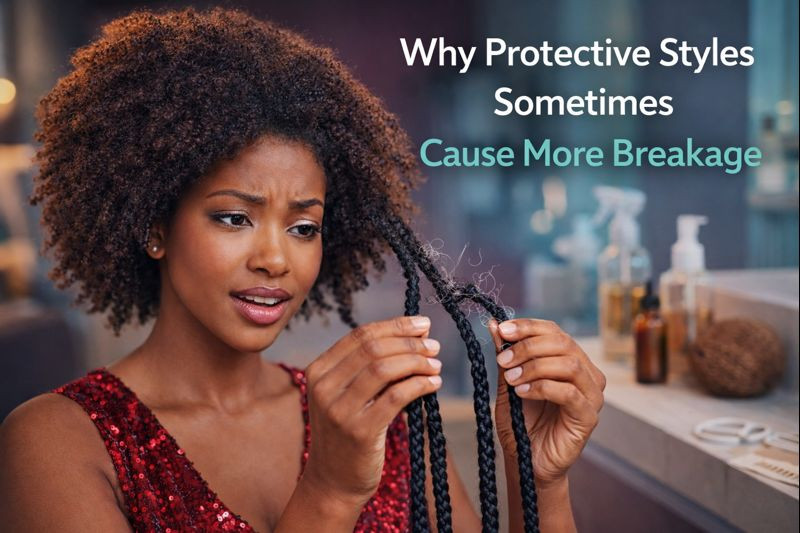
Protective styles are supposed to protect your hair. Braids, twists, locs, wigs, sew-ins, and buns are all marketed as low-maintenance solutions that help retain length and reduce daily manipulation.
So why do so many women experience more breakage, thinning edges, and shedding after protective styles?
If you’ve ever taken down braids only to find short pieces all over the sink, dry ends snapping off, or edges suddenly looking sparse — you’re not alone.
The truth is this:
Protective styles only work when the hair underneath is properly cared for.
When they’re done incorrectly — or maintained poorly — they can quietly destroy your hair from the inside out.
Let’s break down why protective styles sometimes cause more damage than protection, and exactly how to wear them without sacrificing your length.
What Is Breakage vs Shedding? (Quick Clarity)
Before we go deeper, it’s important to know what you’re actually seeing.
Hair Breakage
-
Short, broken strands
-
Snaps easily
-
Often dry, rough, or uneven
-
Usually caused by mechanical stress or lack of moisture
Hair Shedding
-
Full strands with a white bulb
-
Normal hair cycle (50–100 hairs/day)
-
Can increase from stress, hormones, illness, or tight styles
Protective styles mostly cause breakage, not shedding — and that’s an important distinction.
The Big Myth: “Protective Styles Automatically Grow Hair”
This is one of the most damaging hair myths.
Protective styles do not grow hair.
They only preserve length if the hair is already healthy and maintained.
If your hair is:
-
Dry
-
Weak
-
Protein-imbalanced
-
Or your scalp is inflamed
A protective style can actually accelerate damage instead of preventing it.
1. Tension Is the #1 Reason Protective Styles Cause Breakage
Tightness is the silent killer of healthy hair.
What Happens When Styles Are Too Tight
-
Constant pulling weakens hair at the root
-
Blood flow to follicles decreases
-
Hair snaps where tension is highest (edges, nape, crown)
This leads to:
-
Traction alopecia
-
Thinning edges
-
Breakage at the base of braids or twists
If your style hurts, it is already damaging your hair.
Pain is not normal. Ever.
2. Dry Hair Under a “Protective” Style Still Breaks
Hair doesn’t magically stay moisturized just because it’s braided.
In fact, protective styles often hide dryness until it’s too late.
Why Hair Gets Drier in Protective Styles
-
No daily water exposure
-
Oils sit on the scalp instead of the hair shaft
-
Synthetic hair absorbs moisture from your natural hair
-
Heat from the scalp dries strands over time
Dry hair becomes brittle — and brittle hair breaks.
3. Lack of Scalp Care Weakens Hair at the Root
Healthy hair starts at the scalp.
When the scalp is neglected during protective styles:
-
Product buildup suffocates follicles
-
Inflammation weakens strands before they even grow
-
Dandruff and itch lead to scratching (which causes breakage)
A clogged scalp produces weak, fragile hair, no matter how “protective” the style is.
4. Synthetic Hair Can Cause Friction + Moisture Loss
Most braids and twists use synthetic hair — and that matters more than people realize.
Synthetic Hair Can:
-
Strip moisture from natural hair
-
Cause friction where hair bends
-
Create micro-tears along the strand
This friction is especially damaging at:
-
The point where your hair is braided into extensions
-
Ends that rub against clothing
That’s why many people see breakage exactly where the braid starts.
5. Leaving Protective Styles in Too Long Backfires
“Low maintenance” doesn’t mean “no maintenance.”
When styles are left in too long:
-
New growth tangles at the base
-
Shed hair gets trapped
-
Hair mats and knots form
When you finally take the style down, the detangling alone can cause massive breakage.
Protective styles have an expiration date.
6. Rough Takedown Causes Instant Breakage
How you remove a style matters just as much as how it’s installed.
Common takedown mistakes:
-
Cutting too close to the braid
-
Ripping extensions out
-
Detangling dry hair
-
Skipping slip or lubrication
Dry takedowns turn weeks of “protection” into instant damage.
7. Protein–Moisture Imbalance Under Protective Styles
Hair needs both moisture and strength.
Too much protein:
-
Makes hair stiff
-
Causes snapping
Too little protein:
-
Leaves hair weak and mushy
-
Breaks under tension
Protective styles amplify whatever imbalance already exists.
8. Styling Over Existing Damage Makes It Worse
Protective styles don’t fix damage — they hide it.
If your hair already has:
-
Split ends
-
Weak edges
-
Thinning crown
-
Chemical or heat damage
Protective styles can cause those weak areas to break faster.
How to Wear Protective Styles Without Breakage
Here’s how to flip the script and make protective styles actually protect.
1. Prep Your Hair Before Styling (Non-Negotiable)
Before installing any protective style:
-
Cleanse thoroughly
-
Deep condition
-
Trim damaged ends
-
Strengthen weak areas
Healthy hair survives tension better than compromised hair.
2. Moisturize While the Style Is Installed
Yes — you still need moisture.
Focus on:
-
Water-based leave-ins
-
Lightweight oils
-
Regular scalp hydration
Hair breaks when it dries out — covered or not.
3. Keep Your Scalp Clean and Calm
A healthy scalp = stronger hair growth.
Use lightweight scalp treatments that:
-
Reduce inflammation
-
Support circulation
-
Prevent buildup
This keeps new growth strong while your style is in.
4. Reduce Tension at Installation
Protective styles should feel:
-
Secure, not painful
-
Comfortable at the hairline
-
Loose enough to move
If a stylist says “it’ll loosen up,” that’s a red flag.
5. Limit How Long You Wear the Style
General guidelines:
-
Braids/Twists: 4–6 weeks
-
Crochet styles: 3–4 weeks
-
Wigs: Remove nightly or every few days
-
Loc retwists: Avoid over-retwisting
Longer isn’t better when it comes to protection.
6. Be Gentle During Takedown
Always:
-
Detangle in sections
-
Use slip
-
Work slowly
-
Finger-detangle first
This is where most breakage happens — patience pays off.
7. Focus on Strength Between Styles
Your hair needs recovery time.
Between protective styles:
-
Wear low-tension styles
-
Moisturize deeply
-
Rebuild strength
Back-to-back installs with no break is a recipe for thinning.
Why Hair & Scalp Health Matter More Than the Style Itself
Protective styles don’t fail — routines do.
When hair is:
-
Hydrated
-
Nourished
-
Strengthened at the scalp
It can handle styles without breaking.
This is why scalp-focused routines are becoming the new standard in hair growth and length retention.
Final Thoughts: Protection Is a Process, Not a Style
Protective styles are tools — not magic solutions.
They work only when paired with proper moisture, scalp care, low tension, and intentional maintenance.
If your hair keeps breaking after braids, twists, or wigs, the issue isn’t your hair type — it’s what’s happening underneath the style.
Healthy hair doesn’t fear protection.
It thrives with the right approach.