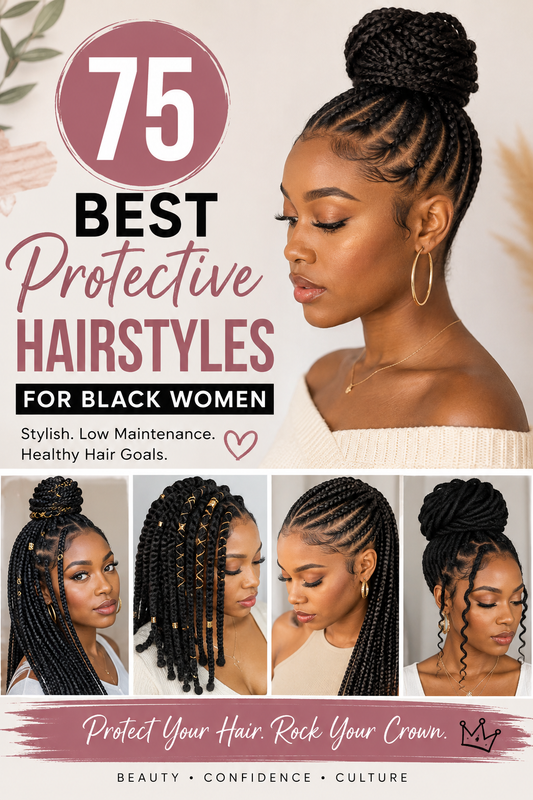
Protective hairstyles have long been an important part of Black hair care. From classic box braids and cornrows to modern passion twists, knotless braids, faux locs, and elegant updos, protective styles can make caring for natural hair easier while offering seemingly endless ways to express your personal style.
But protective styling is about more than simply choosing a beautiful hairstyle.
When installed and maintained properly, a protective hairstyle can help reduce daily manipulation, protect fragile ends, make length retention easier, and give your natural hair a break from frequent combing, brushing, heat styling, and environmental exposure.
The key words are when done properly.
Braids that are excessively tight, extensions that are too heavy, styles worn for too long, or neglecting the hair underneath can work against your hair goals. The best protective hairstyles should look beautiful without causing unnecessary tension or making your natural hair difficult to maintain.
Whether your hair is short, long, thick, fine, transitioning, relaxed, or completely natural, this guide covers 75 of the best protective hairstyles for Black women, along with practical tips for choosing, installing, maintaining, and removing your next style.
What Is a Protective Hairstyle?
A protective hairstyle is generally a style designed to reduce manipulation and help protect vulnerable areas of the hair—especially the ends.
Your ends are the oldest part of your hair. Because they have been exposed to washing, styling, friction, weather, and manipulation longer than your newer growth, they can become particularly vulnerable to dryness and breakage.
Protective styles can help by keeping the hair contained, reducing how frequently it needs to be handled, and—in many styles—keeping the ends tucked away.
Popular protective hairstyles for Black women include:
- Box braids
- Knotless braids
- Cornrows
- Senegalese twists
- Marley twists
- Passion twists
- Faux locs
- Bantu knots
- Flat twists
- Halo braids
- Protective buns
- Crochet hairstyles
Protective styling does not automatically make hair grow faster. Your hair continues following its natural growth cycle. What protective styling can do is help you retain more of the length you grow by reducing some sources of mechanical damage and breakage.
That distinction matters.
If your hair grows but repeatedly breaks at the ends, you may feel as though it never gets longer. A well-planned protective styling routine can support length retention by helping you preserve those older ends.
Benefits of Protective Hairstyles for Black Women
1. Less Daily Manipulation
Constantly combing, detangling, brushing, twisting, stretching, and restyling natural hair can create mechanical stress.
A protective style can dramatically reduce the amount of daily handling your hair receives.
Instead of completely restyling your hair every morning, you may only need to moisturize as needed, protect your style at night, and maintain your scalp.
2. Better Length Retention
Protective styles are frequently associated with hair growth because women may notice more visible length after taking their style down.
Part of this can simply be normal hair growth.
Another important factor is length retention.
If your ends are protected and you're experiencing less breakage, more of the length your scalp produces remains on your head.
3. Convenient Styling
One of the biggest practical benefits of protective hairstyles is convenience.
A well-installed style can significantly simplify your morning routine. Depending on the hairstyle, you may be able to wake up, remove your satin scarf or bonnet, make a few adjustments, and be ready for the day.
4. Versatility
Protective hairstyles can be incredibly versatile.
You can choose:
- Long or short
- Natural-looking or dramatic
- Braided or twisted
- With or without extensions
- Simple or intricate
- Professional or playful
- Lightweight or voluminous
There is a protective hairstyle for almost every preference.
5. Reduced Heat Styling
Protective styles can also reduce your reliance on flat irons, curling irons, blow-dryers, and other heated tools.
Heat isn't automatically harmful when used carefully, but excessive temperatures or repeated heat exposure can damage the hair shaft.
Taking periodic breaks from heat can therefore be useful.
75 Best Protective Hairstyles for Black Women
Now let's explore 75 protective styles you can consider for your next look.
1. Classic Box Braids
Box braids remain one of the most recognizable protective hairstyles for Black women.
The hair is divided into individual sections—traditionally square or box-shaped—and braided from the root toward the ends. Extensions can be incorporated for additional length, thickness, or color.
Box braids are popular because they are versatile. You can wear them down, pull them into a ponytail, create buns, experiment with half-up styles, or accessorize them.
Avoid making the braids excessively tight or heavy, especially around the hairline.
2. Knotless Box Braids
Knotless braids have become a favorite alternative to traditional box braids.
Instead of beginning with a noticeable extension knot at the scalp, extension hair is gradually incorporated into the braid.
The result is a flatter, more natural-looking base.
Knotless braids can also feel lighter and may place less immediate tension at the root when installed properly.
3. Jumbo Box Braids
Want a bold protective style without spending quite as long creating hundreds of individual braids?
Consider jumbo box braids.
Large sections and thicker braids create a dramatic appearance. Because fewer braids are installed, jumbo braids may also take less time than smaller versions.
Keep extension weight in mind. Bigger doesn't necessarily need to mean heavier.
4. Small Box Braids
Small box braids provide a detailed, flowing appearance.
Because there are more individual braids, they can offer tremendous styling flexibility.
However, installation and removal can take considerably longer. Be patient during takedown so you don't accidentally cut or break your natural hair.
5. Medium Box Braids
Medium box braids offer a great middle ground between jumbo and micro-sized braids.
They're large enough to make installation manageable but small enough to provide plenty of movement and styling versatility.
For many women, medium braids are one of the most practical protective hairstyles.
6. Bob Box Braids
You don't need waist-length extensions to enjoy box braids.
Bob box braids typically fall somewhere between the jaw and shoulders, creating a chic protective hairstyle without excessive length.
They're particularly appealing if you prefer lightweight styles.
7. Shoulder-Length Box Braids
Shoulder-length braids offer enough length for movement and styling while remaining manageable.
You get much of the versatility of long box braids without having extensions hanging down your back all day.
8. Waist-Length Box Braids
For maximum drama, waist-length box braids make a statement.
Long braids can look stunning in photos, ponytails, and half-up styles.
Just remember that extremely long extensions can add considerable weight. If your scalp feels uncomfortable or your roots appear strained, the style may be too heavy.
9. Bohemian Box Braids
Bohemian box braids combine traditional braids with loose, curly pieces throughout the hairstyle.
The curls give the braids a softer, more romantic appearance.
Because the loose hair isn't fully braided, it generally requires more maintenance than traditional box braids. Detangling and protecting the loose curls at night can help preserve the look.
10. Goddess Box Braids
Goddess box braids incorporate flowing curls into a braided foundation.
The combination of structured braids and loose curls creates texture and dimension.
This is an excellent choice for women who love braids but want something softer than a completely braided hairstyle.
11. Triangle Box Braids
Change the parting pattern and you can completely transform classic box braids.
Triangle box braids use triangular sections instead of traditional square sections.
It's a subtle detail that makes the hairstyle stand out.
12. Side-Part Box Braids
A defined side part can instantly change the appearance of box braids.
The asymmetrical placement adds shape around the face and works beautifully with medium and long braids.
13. Cornrows
Cornrows are one of the most timeless protective hairstyles in Black hair culture.
Hair is braided close to the scalp in continuous rows. Patterns can range from simple straight-back braids to elaborate geometric designs.
Cornrows can be worn alone or used as the foundation for wigs and crochet styles.
14. Straight-Back Cornrows
Simple straight-back cornrows prove that protective hairstyles don't have to be complicated.
The hair is braided from the front toward the back in clean rows.
They're practical, classic, and easy to wear.
15. Feed-In Cornrows
Feed-in braids gradually incorporate extension hair as the braid progresses.
This technique can create a smoother transition from the natural hair into the extensions.
Feed-in cornrows can be styled in straight lines, curved patterns, ponytails, and countless artistic designs.
16. Ghana Braids
Ghana braids are larger cornrow-style braids that create a striking, sculpted appearance.
They can be arranged in straight-back patterns or more intricate designs.
Because larger braids can become heavy when excessive extension hair is added, comfort should remain a priority.
17. Stitch Braids
Stitch braids are known for their exceptionally clean, defined sections.
Small horizontal lines create the characteristic "stitched" appearance between the cornrows.
They're ideal when you want a sleek, precise hairstyle.
18. Lemonade Braids
Lemonade braids sweep across the scalp toward one side.
This asymmetrical braided look became especially popular in contemporary protective styling and remains a favorite for women who want something more distinctive than straight-back cornrows.
19. Zigzag Cornrows
Instead of traditional straight parts, zigzag cornrows incorporate angular parting patterns.
The design adds visual interest without necessarily requiring additional length or extensions.
20. Curved Cornrows
Curved cornrows follow rounded patterns across the scalp.
This allows a stylist to create flowing designs that frame the head beautifully.
21. Cornrow Ponytail
Cornrows can be directed toward a central point and gathered into a ponytail.
The finished style combines the security of scalp braids with the movement of a long braided ponytail.
Be cautious with very heavy ponytails because concentrated weight can create unnecessary tension.
22. Cornrow Bun
Instead of leaving the ends hanging, gather cornrows into a bun.
This keeps the hairstyle compact and can offer additional protection for the ends.
It's also an elegant option for professional environments and formal occasions.
23. Two Feed-In Braids
Two large feed-in braids are simple, sporty, and stylish.
They can work especially well when you want a protective style that doesn't require hours of installation.
24. Four Feed-In Braids
Four feed-in braids provide more detail than a two-braid style while remaining relatively simple.
Experiment with straight, curved, or creative parts.
25. Fulani Braids
Fulani-inspired braids typically combine cornrows, individual braids, decorative patterns, and sometimes beads.
There are many modern variations.
The result can be elegant, artistic, and highly customizable.
26. Beaded Braids
Beads can transform a basic braided hairstyle.
Wooden, metallic-looking, clear, colorful, and neutral beads can all create different effects.
When adding beads, make sure the accessories aren't so heavy that they pull excessively on your hair.
27. Senegalese Twists
Senegalese twists offer a smooth, rope-like appearance.
They're generally created by wrapping two sections around one another rather than forming a three-strand braid.
The finished style looks sleek and polished.
28. Marley Twists
Marley twists have a fuller, textured appearance that can blend beautifully with natural hair aesthetics.
They're ideal for women who prefer a less silky and more textured protective hairstyle.
29. Havana Twists
Havana twists are typically larger and fuller than many traditional twist styles.
Their chunky texture creates volume without requiring hundreds of individual twists.
30. Passion Twists
Passion twists combine a twisted structure with a loose, bohemian texture.
They have a soft, slightly undone appearance that separates them from sleek Senegalese twists.
Protect them at night to reduce unnecessary frizz and tangling.
31. Spring Twists
Spring twists are known for their lightweight, springy texture.
They can provide plenty of volume without necessarily feeling excessively heavy.
Their shorter versions can be especially convenient.
32. Mini Twists
Mini twists can be created using your own natural hair.
Small sections are divided into two strands and twisted from the roots toward the ends.
Because your natural hair remains accessible, mini twists can make moisturizing easier than styles that heavily incorporate extensions.
33. Chunky Two-Strand Twists
If mini twists require more time than you'd like to spend, try larger two-strand twists.
Chunky twists are faster to install and remove while still reducing daily manipulation.
34. Flat Twists
Flat twists sit against the scalp similarly to cornrows but are created with a twisting technique.
They can be styled straight back, toward a bun, around the perimeter of the head, or in creative patterns.
35. Flat-Twist Updo
Direct flat twists upward or toward the center of the head and secure the remaining hair into an updo.
This can create an elegant protective hairstyle while keeping the ends tucked away.
36. Flat-Twist Crown
Flat twists can wrap around the perimeter of the head to create a crown-like effect.
It's a beautiful option for weddings, work, special occasions, or everyday wear.
37. Faux Locs
Love the appearance of locs but don't want to permanently loc your hair?
Faux locs offer a temporary alternative.
Your natural hair is protected inside or underneath the loc extensions.
Because faux locs can become heavy, choosing appropriate length and extension density is important.
38. Soft Locs
Soft locs offer a softer, more flexible variation of traditional faux locs.
They often have a relaxed appearance and can provide movement from the beginning.
39. Butterfly Locs
Butterfly locs intentionally incorporate loops and irregular texture.
The distressed finish gives them a bohemian appearance.
Shoulder-length butterfly locs are particularly popular because they offer volume without extremely long extensions.
40. Goddess Locs
Goddess locs combine loc extensions with loose curls.
They're ideal for anyone who likes the texture of faux locs but wants additional softness and movement.
41. Short Faux Locs
Faux locs don't need to extend down your back.
Short locs can be stylish, lightweight, and much easier to manage.
A loc bob is an especially attractive option.
42. Crochet Braids
Crochet hairstyles involve attaching extension hair to a braided foundation, often cornrows.
One major advantage is the wide range of textures available.
You can create the appearance of curls, twists, braids, or locs without individually installing every strand from the root.
43. Crochet Curls
Crochet curls provide the look of a voluminous curly hairstyle while your natural hair remains braided underneath.
The curl pattern can range from loose waves to tight coils.
44. Crochet Twists
Pre-twisted extension hair can be crocheted into a cornrow foundation.
This can significantly reduce installation time compared with creating every twist individually.
45. Crochet Locs
Crochet locs offer another way to achieve a temporary loc appearance.
Preformed loc extensions are attached to the braided base.
46. Crochet Box Braids
Pre-braided extensions can also be installed using crochet techniques.
This can provide the visual effect of individual braids while reducing some of the installation time.
47. Bantu Knots
Bantu knots are both beautiful and functional.
Sections of hair are twisted or wrapped into small knots across the head.
The style keeps the hair compact and can also produce a curly or wavy Bantu knot-out after removal.
Avoid twisting the roots painfully tight.
48. Large Bantu Knots
Using larger sections creates fewer, more prominent knots.
This version can be quicker to install and creates a bold visual effect.
49. Mini Bantu Knots
Smaller sections create more numerous knots.
Mini Bantu knots offer a highly defined look and can produce more detailed texture when taken down.
50. Halo Braid
A halo braid wraps around the head like a crown.
Because the ends can be tucked into the hairstyle, it makes an attractive protective option for natural hair.
51. Crown Braid
Similar to a halo braid, the crown braid circles the head and creates a regal silhouette.
It's an excellent protective hairstyle for special occasions.
52. Braided Updo
Braids can be arranged into elaborate updos rather than hanging freely.
This helps keep long extensions out of the way and creates an elegant finished look.
53. Braided Bun
Gather your braids into a bun for a quick secondary protective style.
You can wear the bun high, low, or centered.
Avoid pulling your braids into an extremely tight bun every day, as repeated tension in the same area can stress the hairline.
54. Low Braided Bun
A low bun provides a sophisticated alternative to high styles.
Positioning the bun near the nape can create an elegant silhouette and may feel more comfortable for women who don't enjoy having weight at the top of the head.
55. High Braided Bun
A high braided bun makes a bold statement.
It's especially useful when you want long braids completely off your shoulders.
Keep it comfortably secured rather than pulling aggressively.
56. Protective Natural-Hair Bun
You don't need extensions to create an effective protective hairstyle.
A bun made with your own natural hair can keep your ends tucked away and reduce daily manipulation.
Use gentle accessories and avoid pulling your edges excessively tight.
57. Low Natural-Hair Bun
A low bun is simple enough for everyday wear and polished enough for many professional settings.
Moisturize your ends before tucking them away if they feel dry.
58. High Natural-Hair Bun
A high bun can be a convenient protective option for longer natural hair.
Try alternating its placement rather than creating an extremely tight bun in exactly the same position every day.
59. Tucked Protective Updo
Tucked updos involve folding, rolling, or pinning the ends of natural hair out of sight.
They're particularly useful when you want protection without extensions.
60. Roll-and-Tuck Updo
This classic natural hairstyle involves rolling sections inward and securing the ends.
It can look elegant while minimizing exposure of the ends.
61. French Roll on Natural Hair
A French roll can be adapted for textured hair.
The hair is gathered, rolled inward, and pinned into place.
It's a timeless option for professional or formal occasions.
62. Twisted Updo
Create several two-strand twists and arrange them into an updo.
This combines the convenience of twists with the added protection of keeping the ends tucked.
63. Mini-Twist Bun
Already wearing mini twists?
Gather them loosely into a bun for another styling option.
This gives you versatility without requiring you to manipulate loose hair.
64. Mini-Twist Ponytail
Mini twists can also be gathered into a loose ponytail.
Choose hair ties without exposed metal and avoid securing them too tightly.
65. Braided Ponytail
A braided ponytail combines a sleek base with one or more braids.
If extensions are added, keep the weight reasonable. A very long, heavy ponytail can put significant pressure on a small area.
66. Bubble Braids
Bubble-style ponytails use sections secured at intervals to create rounded "bubbles."
For textured hair, the look can be adapted with gentle bands and low-tension styling.
67. Two-Strand Twist Updo
Two-strand twists can be pinned into a compact protective updo.
This is especially useful when your twists are long enough that you don't want them constantly rubbing against clothing.
68. Braided Crown With Natural Hair
Create a crown braid using your natural hair and tuck the ends securely underneath.
This is a beautiful extension-free protective option.
69. Flat Twists Into a Low Bun
Flat-twist the front or sides of the hair and gather the remaining length into a low bun.
You get both visual detail and tucked-away ends.
70. Cornrows Into a Low Bun
Cornrows can also flow toward the back of the head and end in a low bun.
This style can look polished while keeping the majority of the hair secured.
71. Half Cornrows, Half Twists
Can't decide between cornrows and twists?
Combine them.
The front or sides can be cornrowed while the remainder transitions into individual twists.
This gives you the structure of cornrows with the movement of twists.
72. Half Cornrows, Half Box Braids
This hybrid hairstyle combines scalp braids with individual braids.
Different parting patterns can make the style as simple or elaborate as you prefer.
73. Braided Bob
A braided bob is an excellent choice for women who like the appearance of braids but don't want extremely long extensions.
The shorter length can make sleeping, exercising, and everyday maintenance easier.
74. Twisted Bob
The same concept works beautifully with twists.
A shoulder-length or chin-length twisted bob provides texture and movement while keeping the hairstyle manageable.
75. Wig Over a Properly Maintained Braided Base
Wigs can function as part of a protective styling routine when the natural hair underneath is properly cared for.
Your hair may be braided or twisted underneath the wig, reducing daily manipulation.
However, simply covering your hair doesn't automatically make the style protective.
The braids underneath shouldn't be painfully tight. Your scalp still needs attention, and your natural hair shouldn't remain neglected for extended periods.
Be especially careful with adhesives around the hairline.
Best Protective Hairstyles for Hair Growth and Length Retention
No hairstyle can force your follicles to grow hair faster than your biology allows.
That's important because "protective hairstyles for hair growth" is sometimes misunderstood.
A better way to think about protective styling is:
growth + reduced breakage = better opportunity for visible length retention.
Some particularly useful low-manipulation options include:
- Knotless braids
- Medium box braids
- Mini twists
- Flat twists
- Cornrows
- Natural-hair buns
- Tucked updos
- Halo braids
- Lightweight faux locs
- Crochet styles
The ideal style depends on your hair.
Someone with fragile edges, for example, may need a very different protective style from someone with thick, dense strands.
Best Protective Hairstyles for Short Natural Hair
You don't need long hair to protective style.
Short natural hair can work beautifully with:
- Cornrows
- Flat twists
- Bantu knots
- Feed-in braids
- Crochet styles
- Short box braids with extensions
- Short faux locs
- Wigs over a healthy braided foundation
If your hair is very short, avoid forcing it into extremely tight sections just to make a particular hairstyle work.
Protecting your hair should always be more important than achieving a specific appearance.
Best Protective Hairstyles Without Extensions
Extensions are optional.
In fact, some women find that extension-free styles are easier on their scalp because they eliminate the added weight.
Try:
- Mini twists
- Two-strand twists
- Flat twists
- Bantu knots
- Natural-hair buns
- Crown braids
- Halo braids
- Tucked updos
- French rolls
- Flat-twist updos
These hairstyles can be particularly useful if your primary goal is reducing manipulation rather than dramatically changing your length.
Protective Hairstyles for Fine Hair
Fine strands may be more vulnerable to breakage under excessive weight.
If your hair is fine, consider lighter styles such as mini twists, medium knotless braids with conservative amounts of extension hair, flat twists, cornrows, or natural-hair updos.
Large sections combined with huge amounts of extension hair can create an unfavorable weight-to-hair ratio.
Your scalp shouldn't have to struggle to support the hairstyle.
Protective Hairstyles for Thick Hair
Thick and dense natural hair offers plenty of protective styling possibilities.
You may enjoy:
- Chunky twists
- Large flat twists
- Box braids
- Knotless braids
- Cornrows
- Braided updos
- Natural-hair buns
- Bantu knots
Work in sections during preparation so that every area gets thoroughly cleansed, detangled, and moisturized before styling.
How to Prepare Your Hair for a Protective Style
A successful protective hairstyle begins before the first braid or twist is installed.
Step 1: Cleanse Your Hair
Starting with clean hair helps remove accumulated oils, sweat, styling products, and debris.
Pay attention to your scalp as well as your strands.
You generally don't want to trap weeks of buildup underneath a long-term style.
Step 2: Condition
Follow cleansing with an appropriate conditioner.
Conditioning can improve manageability and make detangling easier.
If your hair is particularly dry, you may choose to deep condition before installation.
Step 3: Detangle Carefully
Detangle before your protective style is installed.
Work in manageable sections and begin near the ends before gradually moving upward.
Trying to rip a comb from root to tip through tangled natural hair can create unnecessary breakage.
Step 4: Moisturize
Hair should be adequately moisturized before it's tucked away.
Choose products based on your hair's needs rather than applying huge quantities simply because you'll be wearing a protective style.
Too much product can contribute to buildup.
Step 5: Stretch If Necessary
Some styles are easier to install on stretched hair.
Stretching does not necessarily require high heat.
Depending on your hair, you might use:
- Banding
- Large twists
- Braids
- African threading
- A carefully controlled blow-dryer
If using heat, keep temperatures reasonable and avoid repeatedly passing intense heat over the same sections.
Step 6: Protect Your Ends
Your ends deserve extra attention because they're your oldest hair.
Make sure they're moisturized and handled gently before being braided or tucked away.
How Tight Should Protective Hairstyles Be?
A protective style should not hurt.
Pain isn't evidence that your hairstyle is going to last longer.
Warning signs of excessive tension can include:
- Persistent pain
- Headaches after installation
- Small bumps around the hairline
- Redness
- A pulling sensation
- Difficulty moving your eyebrows or forehead comfortably
- Hair being pulled tightly from fragile areas
If a style is painfully tight, speak up immediately.
Long-term or repeated tension on the hair can contribute to traction-related hair loss.
This is particularly important around the temples and edges, where the hair may naturally be finer.
How Long Should You Keep a Protective Hairstyle?
There isn't one perfect number of weeks for every protective hairstyle.
The appropriate duration depends on factors such as:
- Hairstyle
- Hair condition
- Scalp condition
- New growth
- Buildup
- Matting
- Installation technique
- Maintenance routine
Some simple natural-hair styles may be refreshed frequently, while braids, twists, or loc extensions may remain in place for several weeks.
Longer is not automatically better.
Keeping a style far beyond the point where your hair has begun tangling, matting, or accumulating excessive buildup can make takedown much more difficult.
How to Moisturize Hair in Protective Styles
Your hair doesn't stop needing care simply because it's braided.
How frequently you moisturize depends on your hair, environment, products, and hairstyle.
Rather than following a rigid schedule, pay attention to how your hair feels.
If accessible portions of your natural hair feel dry, use an appropriate amount of moisture without soaking your hairstyle in excessive product every day.
Concentrate on your natural hair rather than coating extension hair unnecessarily.
How to Care for Your Scalp in Braids
Your scalp continues producing oil, shedding skin cells, and accumulating sweat while you wear braids.
Keep it reasonably clean.
If you exercise frequently or sweat heavily, you may need to cleanse your scalp more often.
Avoid aggressively scratching with sharp objects.
If your scalp is irritated, persistently itchy, inflamed, painful, or developing sores, don't simply cover the symptoms with more products.
Sometimes the hairstyle itself needs to be removed.
Should You Oil Your Scalp With Protective Styles?
Scalp oiling is a personal choice rather than a requirement for healthy hair.
Some people enjoy using lightweight oils because they like the feel or because certain areas feel dry.
Others experience buildup when they apply oils too frequently.
If you choose to oil your scalp, start with a small amount.
More oil does not equal faster hair growth.
How to Sleep With Protective Hairstyles
Nighttime protection can help your style remain neater and reduce friction.
A satin or silk scarf, bonnet, or pillowcase can be helpful.
For long braids or twists, loosely gather them before sleeping rather than allowing them to become trapped underneath your body.
Avoid extremely tight nighttime ponytails.
The goal is protection without adding another source of tension.
How to Exercise With Protective Hairstyles
Protective styles can be convenient for active women.
Before exercising, secure long braids or twists so they aren't swinging excessively.
After a sweaty workout, allow your scalp to dry properly.
Constantly trapping a damp scalp beneath hats, scarves, wigs, or heavy extensions can become uncomfortable and may contribute to odor and buildup.
How to Wash Braids and Protective Styles
Whether and how you wash a protective style depends on the hairstyle and your individual scalp needs.
For many braided styles, you can gently cleanse the scalp while minimizing rough manipulation.
Focus cleanser on the scalp.
Massage gently with your fingertips rather than scratching.
Rinse thoroughly.
Then make sure your hair and scalp dry completely.
With very thick braids or extensions, trapped moisture can take longer to evaporate than expected.
How to Keep Protective Styles Looking Fresh
You don't necessarily need to redo the entire hairstyle when a little new growth appears.
Instead:
- Protect the style every night.
- Keep the scalp reasonably clean.
- Avoid excessive product buildup.
- Trim obvious frizz from extension hair only when appropriate.
- Refresh a few perimeter braids if necessary.
- Avoid repeatedly applying heavy edge-control products.
- Keep the style dry when you're not intentionally cleansing it.
Remember that your hairstyle does not need to look freshly installed every day.
Some new growth is normal.
Edge Control and Protective Hairstyles
Slick edges can complete a hairstyle, but your edges don't need to be aggressively brushed and glued down every morning.
The hairline contains some of the most delicate hairs on your head.
Repeated pulling, brushing, and tension can create unnecessary stress.
Give your edges breaks.
A little texture around your hairline is completely normal.
Protective Hairstyles and Traction Alopecia
Traction alopecia is hair loss associated with repeated or prolonged pulling forces on the hair.
Certain styling habits can increase the risk, particularly when they're repeated over long periods.
Potential contributors include:
- Extremely tight braids
- Heavy extensions
- Tight ponytails
- Repeated tension around the edges
- Tight buns
- Excessive extension weight
- Constantly styling the same sections under tension
Early intervention matters.
If you notice persistent scalp tenderness, bumps, thinning around the hairline, or areas that appear to be losing density, stop the tension-producing style and consider speaking with a dermatologist or qualified healthcare professional.
Protective Hairstyle Mistakes to Avoid
Mistake #1: Assuming Every Braid Is Protective
A braid that causes excessive tension isn't protecting your hair simply because it's called a protective hairstyle.
Technique matters.
Mistake #2: Making Extensions Too Heavy
Your natural hair has to support the weight attached to it.
More extension hair isn't always better.
Mistake #3: Ignoring Pain
Don't normalize pain after getting your hair braided.
Protective styling should not require days of discomfort.
Mistake #4: Neglecting Your Hair
Putting your hair away for several weeks doesn't mean forgetting about it.
Your scalp and natural hair still require appropriate care.
Mistake #5: Wearing Styles Too Long
Trying to stretch a hairstyle several extra weeks can sometimes make detangling and removal significantly more difficult.
Mistake #6: Rough Takedown
You can carefully protect your hair for weeks and then lose unnecessary length by rushing through removal.
Take your time.
Mistake #7: Installing Another Style Immediately
Depending on your hair and scalp, you may benefit from spending some time with your hair loose before installing another long-term style.
This gives you an opportunity to cleanse thoroughly, detangle, examine your scalp, and assess your ends.
How to Take Down Braids Without Breaking Your Hair
Takedown deserves as much attention as installation.
First, make sure you know where your natural hair ends before cutting extensions.
If you're uncertain, cut much farther down.
Unravel each braid carefully.
Once the extensions are removed, don't immediately rake a fine-tooth comb through the shed hair.
It's normal to see accumulated shed hairs after wearing a style for weeks because hairs that would normally fall away each day may remain trapped inside the braid.
Gently separate and detangle sections before shampooing.
This can reduce the chance of creating severe knots once water is introduced.
What to Do After Removing a Protective Style
Once the style is completely removed:
Detangle. Remove shed hairs gently.
Cleanse. Wash away accumulated buildup.
Condition. Restore manageability.
Inspect. Look at your scalp, hairline, ends, and overall condition.
Trim if necessary. If your ends are visibly split or damaged, consider an appropriate trim.
Moisturize. Replenish moisture based on your hair's needs.
You can then decide whether to wear your hair loose or move into another low-manipulation style.
Can You Wear Protective Styles Back-to-Back?
You can change from one protective style to another, but continuously installing high-tension extension styles without evaluating your natural hair isn't ideal.
Think about your hairline and scalp.
If you notice tenderness, breakage, thinning, or unusual irritation, don't cover it immediately with another set of braids.
Address the problem first.
Best Protective Hairstyles for Vacation
Protective hairstyles are popular for travel because they can simplify daily styling.
Good vacation options include:
- Knotless braids
- Box braids
- Passion twists
- Cornrows
- Senegalese twists
- Crochet styles
- Short faux locs
- Braided bobs
If you're swimming, remember that your hair can still become wet underneath the style.
Rinse appropriately after exposure to chlorinated or salt water and allow the hair to dry thoroughly.
Best Protective Hairstyles for Work
For professional environments, consider:
- Low buns
- Cornrows
- Medium knotless braids
- Shoulder-length box braids
- Flat-twist updos
- Crown braids
- Mini twists
- Braided bobs
- French rolls
Of course, Black hairstyles can be professional in all their forms. The best work hairstyle is ultimately one that fits your personal style, comfort, workplace needs, and hair-care goals.
Best Protective Hairstyles for Summer
Summer can mean heat, humidity, sweat, swimming, and travel.
Convenient options include:
- Cornrows
- Box braids
- Knotless braids
- Passion twists
- Mini twists
- Short faux locs
- Braided bobs
- Feed-in braids
If you sweat frequently, prioritize styles that allow reasonable access to your scalp.
Best Protective Hairstyles for Winter
Cold weather and indoor heating can leave some people's hair feeling particularly dry.
Styles that keep the ends tucked away can be useful, including:
- Flat-twist updos
- Mini-twist buns
- Low buns
- Halo braids
- Crown braids
- Box braids
- Twists
Be mindful of friction from wool hats, scarves, and coat collars.
How to Choose the Best Protective Hairstyle for You
Don't choose a style based exclusively on a photo.
Consider five things.
Your hair density: Fine or low-density hair may not tolerate the same extension weight as very dense hair.
Your hairline: If your edges are already fragile, avoid styles that place substantial tension around the perimeter.
Your lifestyle: Someone who swims several times per week has different needs from someone who rarely gets their hair wet.
Maintenance: Bohemian braids with loose curls generally require more upkeep than straightforward cornrows.
Installation time: Micro-sized styles can take many hours to install and considerable time to remove.
The best hairstyle is the one that fits both your appearance goals and your hair's needs.
Frequently Asked Questions About Protective Hairstyles
What is the best protective hairstyle for Black women?
There isn't one universal winner. Knotless braids, box braids, mini twists, cornrows, flat twists, buns, and tucked updos can all be excellent options when they're installed without excessive tension and maintained properly.
Do protective hairstyles make your hair grow?
Protective hairstyles don't directly change your genetically influenced hair-growth rate. Their primary advantage is reducing manipulation and potentially helping you retain more of the hair you grow.
Which protective style lasts the longest?
Small braids and twists can remain neat for a relatively long time, but longevity shouldn't be your only consideration. Scalp health, new growth, tangling, and buildup should determine when it's time to remove the style.
Are knotless braids better than box braids?
Neither is automatically better for everyone. Knotless braids can provide a flatter base and may feel lighter at installation when done correctly. Traditional box braids can also be worn safely when they aren't too tight or heavy.
Are cornrows good for natural hair?
Cornrows can be an effective low-manipulation hairstyle. They become problematic when they're installed too tightly or repeatedly pull on vulnerable areas.
Can I moisturize my hair while wearing braids?
Yes. Focus on the natural hair and use an amount appropriate for your needs. Avoid creating unnecessary buildup by saturating your hair with multiple heavy products every day.
How often should I redo my edges?
There is no need to constantly redo your edges simply to keep a hairstyle looking new. Repeatedly manipulating the hairline can create unnecessary stress.
Should I braid my hair wet or dry?
The best state depends on the style and your hair. Many extension styles are installed on clean, detangled, dry or stretched hair. Avoid braiding hair under conditions that encourage excessive tangling, tension, or prolonged dampness.
Can protective hairstyles damage hair?
Yes, when they're too tight, too heavy, poorly maintained, or removed carelessly. The label "protective" doesn't guarantee that a hairstyle is harmless.
What's the easiest protective hairstyle?
A simple low bun, chunky two-strand twists, flat twists, or a basic tucked updo can be among the easiest extension-free options.
Building a Healthy Protective Styling Routine
Protective styling works best as one part of an overall hair-care strategy.
A simple cycle might look like this:
Before Styling
Cleanse → condition → detangle → moisturize → gently prepare hair.
During the Style
Protect at night → maintain your scalp → moisturize according to need → watch for tension.
At Takedown
Remove carefully → detangle shed hair → cleanse → condition → inspect hair and scalp.
Before Your Next Style
Assess whether your hair needs a trim, additional moisture, lower manipulation, or a break from extensions.
This approach keeps the focus where it belongs: the health of your natural hair underneath the hairstyle.
Protective Styling for Healthy Natural Hair
The beauty of protective styling is that there are so many options.
One month you might choose knotless braids.
Next time you might wear mini twists.
Then you could switch to flat twists, a low bun, a braided bob, or butterfly locs.
Rotating styles can also help prevent repeatedly stressing exactly the same areas.
Pay particular attention to your edges, temples, and nape.
Your hairstyle should work with your hair—not against it.
Final Thoughts: Finding Your Perfect Protective Hairstyle
The best protective hairstyles for Black women combine beauty, versatility, comfort, and thoughtful hair care.
From classic box braids and cornrows to knotless braids, Senegalese twists, passion twists, faux locs, Bantu knots, crochet styles, flat-twist updos, and natural-hair buns, there are protective options for virtually every hair length and personal style.
But remember the most important rule:
A protective hairstyle should actually protect your hair.
It shouldn't cause persistent pain.
It shouldn't place excessive weight on your roots.
It shouldn't require your edges to be pulled as tightly as possible.
And it shouldn't become an excuse to ignore your natural hair for months.
Prepare your hair carefully, choose an appropriate style, keep your scalp and strands maintained, protect the hairstyle at night, and take it down patiently.
Your ultimate goal isn't simply to keep a protective style looking fresh for as long as possible.
It's to take the style down and find your natural hair underneath feeling strong, manageable, and ready for whatever hairstyle comes next.