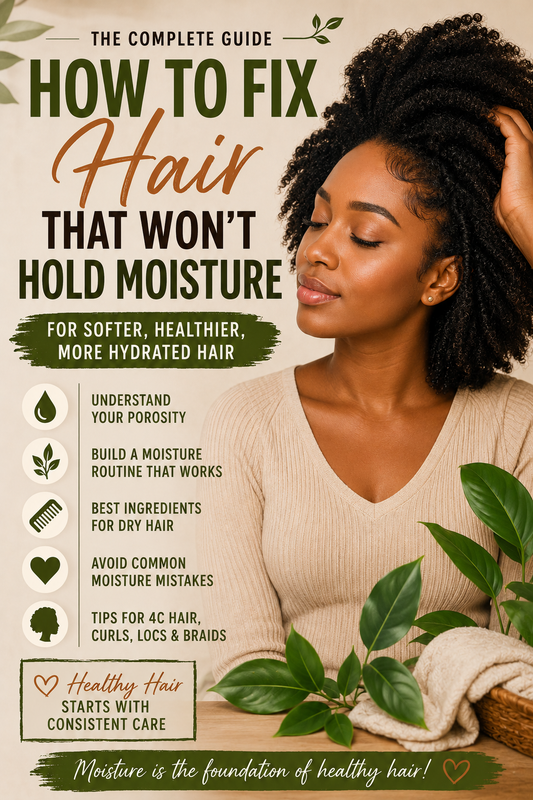
Few things are more frustrating than spending time moisturizing your hair only for it to feel dry again a few hours later. Whether you have natural hair, locs, braids, coils, curls, or waves, poor moisture retention can make hair feel rough, brittle, dull, and difficult to manage.
Many people assume their hair simply "needs more oil," but moisture retention is much more complex than applying another product. Hair that won't stay moisturized is usually responding to factors such as hair porosity, environmental conditions, product buildup, damage, washing habits, or styling practices.
The good news is that moisture retention is something you can improve with the right routine. Once you understand why your hair loses moisture so quickly, you can build habits that help keep it softer, healthier, and easier to style.
In this complete guide, you'll learn:
- Why hair loses moisture quickly
- The science behind moisture retention
- How porosity affects hydration
- The biggest mistakes that keep hair dry
- Daily, weekly, and monthly routines that help maintain moisture
- Tips specifically for natural hair, locs, braids, and curls
- Ingredients that support hydrated-looking hair
- Answers to common questions about dry hair
Let's start by understanding what moisture actually means.
What Does Moisturized Hair Really Mean?
Many people confuse moisture with oil.
They're not the same.
Moisture is water.
Oil helps reduce water loss from the hair.
Healthy hair contains water inside the hair shaft. When hair loses too much water, it begins to feel:
- Dry
- Rough
- Britle
- Frizzy
- Tangled
- Hard to detangle
- More prone to breakage
Simply coating dry hair with oil doesn't replace lost moisture. Oils can help reduce moisture loss, but they don't hydrate hair on their own. That's why a balanced routine often starts with water or a water-based moisturizing product, followed by ingredients that help reduce moisture loss.
Why Your Hair Won't Hold Moisture
There are many possible reasons your hair dries out quickly.
Often, it's a combination of several factors rather than a single cause.
1. Hair Porosity
Hair porosity describes how easily water enters and leaves the hair shaft.
This is one of the biggest reasons some people struggle with moisture retention.
Low porosity hair resists water entering the strand, while high porosity hair absorbs water quickly but also loses it quickly.
Understanding your porosity helps you choose products and techniques that match your hair's needs.
We'll cover porosity in detail later in this guide.
2. Product Buildup
Over time, styling products, oils, butters, hard water minerals, and environmental debris can accumulate on the hair.
When buildup forms a coating over the hair, moisture may have a harder time reaching the hair shaft.
Signs of buildup include:
- Hair feels coated
- Hair stays dry despite products
- Hair looks dull
- Products sit on top of hair
- Hair feels heavy
Using a clarifying shampoo occasionally may help remove excess buildup and allow conditioning products to work more effectively.
3. Heat Damage
Frequent use of:
- Flat irons
- Blow dryers
- Curling irons
- Hot combs
can affect the hair's outer protective layer over time.
Damaged cuticles may allow moisture to escape more easily, leaving hair feeling dry even after conditioning.
Reducing unnecessary heat exposure and using heat protectants may help preserve the hair's condition.
4. Overwashing
Shampoo plays an important role in keeping the scalp clean, but washing too frequently may leave some hair types feeling dry.
Natural oils produced by the scalp help condition the hair.
Finding a washing schedule that fits your hair type can help maintain a healthy balance between cleanliness and moisture.
5. Environmental Factors
Your surroundings also influence moisture levels.
Hair may become drier during:
- Winter
- Low humidity
- Windy weather
- Air-conditioned environments
- Heated indoor spaces
In contrast, humid weather may temporarily make some hair types feel more moisturized while increasing frizz in others.
6. Chemical Processing
Hair that has been:
- Bleached
- Colored
- Relaxed
- Permanently straightened
often requires additional care because chemical treatments can change the structure of the hair.
Conditioning treatments and gentle handling become even more important after chemical processing.
7. Mechanical Damage
Daily habits matter.
Repeated friction from:
- Rough towels
- Tight hairstyles
- Cotton pillowcases
- Aggressive brushing
- Frequent manipulation
can gradually wear down the hair cuticle.
Over time, this may make moisture retention more difficult.
Signs Your Hair Isn't Retaining Moisture
Dry hair doesn't always look the same.
Here are common signs that your hair may not be holding moisture effectively.
Hair Feels Dry Shortly After Moisturizing
If your hair feels soft for only an hour or two before becoming dry again, your routine may not be helping retain moisture.
Increased Breakage
Hair that lacks moisture often becomes less flexible.
Instead of bending, it may snap more easily during detangling or styling.
Dull Appearance
Moisturized hair often reflects light more evenly.
Dry hair may appear:
- Flat
- Lifeless
- Dusty
- Lackluster
Constant Frizz
Frizz can have many causes, but dry hair often develops raised cuticles that contribute to a rough appearance.
Tangles Easily
When hair lacks moisture, strands may catch on one another more frequently, making detangling more difficult.
Ends Feel Crispy
Hair ends are the oldest part of each strand.
Because they have experienced the most exposure to washing, styling, and weather, they often become dry first.
Keeping ends moisturized and trimming damaged ends when needed can improve the overall look and feel of your hair.
The Science Behind Moisture Retention
Hair is made primarily of keratin, a structural protein arranged in layers.
The outermost layer, called the cuticle, acts like protective shingles on a roof.
When the cuticle lies relatively flat:
- Hair often feels smoother
- Moisture is retained more effectively
- Hair appears shinier
- Frizz may be reduced
When the cuticle becomes raised due to damage, friction, or environmental factors:
- Moisture can escape more easily
- Hair may feel rougher
- Tangles become more common
- Breakage risk may increase
A well-rounded routine focuses on cleansing, conditioning, moisturizing, and minimizing unnecessary damage so the cuticle can better support moisture retention.
Why Black Hair Often Needs Extra Moisture
People with tightly coiled or highly textured hair frequently notice that moisture seems to disappear quickly.
One reason is that natural scalp oils have a more difficult path traveling down curved or coiled strands compared with straighter hair.
As a result, the mid-lengths and ends may receive less natural lubrication.
This doesn't mean textured hair is unhealthy—it simply means it often benefits from consistent moisturizing practices and gentle handling.
Protective styles, deep conditioning, and water-based moisturizing products can all play a role in helping textured hair stay softer between wash days.
Understanding Hair Porosity
If you've ever wondered why your friend's hair stays moisturized for days while yours feels dry by lunchtime—even when you use the same products—hair porosity may be the reason.
Hair porosity refers to how easily your hair absorbs and retains moisture. It is determined by the condition and arrangement of the hair cuticle, the outer protective layer of each strand.
There are three general porosity categories:
- Low porosity
- Medium (normal) porosity
- High porosity
Knowing your porosity can help you choose products and techniques that better suit your hair.
Low Porosity Hair
Low porosity hair has tightly packed cuticles that make it more difficult for water and conditioning ingredients to penetrate the hair shaft.
Common Signs
- Water beads on your hair instead of soaking in.
- Products tend to sit on the surface.
- Hair takes a long time to get fully wet.
- Hair takes a long time to dry.
- Heavy products can leave hair feeling greasy.
Moisture Tips for Low Porosity Hair
- Use lightweight, water-based moisturizers.
- Apply products to damp hair.
- Use warm water when washing to help lift the cuticle slightly.
- Deep condition with gentle heat (such as a warm towel or hooded dryer).
- Avoid layering multiple heavy oils and butters.
Medium Porosity Hair
Medium porosity hair generally absorbs and retains moisture with fewer challenges.
Characteristics
- Moisture lasts several days.
- Hair styles well.
- Hair has a balanced feel.
- Less prone to extreme dryness.
Maintenance Tips
- Shampoo regularly to remove buildup.
- Deep condition weekly or as needed.
- Avoid excessive heat styling.
- Continue trimming damaged ends.
High Porosity Hair
High porosity hair has more open or damaged cuticles, allowing moisture to enter quickly—but also escape quickly.
High porosity may be natural or develop from:
- Coloring
- Bleaching
- Heat styling
- Relaxers
- Environmental wear
- Mechanical damage
Signs
- Hair absorbs water immediately.
- Hair dries very quickly.
- Ends feel rough.
- Hair tangles easily.
- Hair breaks more often.
Moisture Tips
- Deep condition consistently.
- Use leave-in conditioners after washing.
- Follow with products that help reduce moisture loss.
- Minimize heat exposure.
- Handle hair gently during detangling.
The Biggest Moisture Mistakes
Many people unknowingly sabotage their moisture routine.
Here are some of the most common mistakes.
Mistake #1: Using Too Much Oil
Oil has benefits, but applying large amounts to dry hair doesn't replace moisture.
Instead:
- Start with water or a water-based leave-in.
- Add a moisturizing cream if desired.
- Finish with a light oil or butter if appropriate for your hair type.
Mistake #2: Skipping Deep Conditioning
Deep conditioners often contain ingredients designed to soften the hair and improve manageability.
If your hair constantly feels dry, adding a weekly deep conditioning session may help improve its overall feel.
Mistake #3: Using Harsh Shampoos Too Often
Some shampoos cleanse more aggressively than others.
If your hair feels stripped after every wash, consider alternating with a moisturizing shampoo while still clarifying occasionally to remove buildup.
Mistake #4: Applying Products to Dry Hair
Many leave-in conditioners work best on damp hair because moisture is already present.
Applying products immediately after washing may improve hydration compared with waiting until hair has dried completely.
Mistake #5: Ignoring Your Ends
Hair ends are the oldest and most delicate part of the strand.
Prioritize:
- Gentle detangling
- Regular conditioning
- Protective styling
- Occasional trims when needed
Healthy-looking ends contribute to healthier-looking hair overall.
Build the Perfect Moisture Routine
A consistent routine is often more effective than constantly switching products.
Step 1: Cleanse
Wash the scalp and hair to remove dirt, sweat, excess oil, and product buildup.
A clean foundation helps conditioning products perform more effectively.
Step 2: Condition
After shampooing, apply conditioner throughout the hair.
Focus on:
- Mid-lengths
- Ends
- Dry areas
Allow the conditioner to sit for several minutes before rinsing.
Step 3: Leave-In Conditioner
A leave-in conditioner helps maintain softness between wash days.
Choose a formula appropriate for your hair type and porosity.
Step 4: Moisturizer
Use a water-based moisturizing product to help replenish hydration.
For those looking for a botanical option, products such as Hairobics Raaw Roots Moisturizer Spray can fit into a routine after cleansing and conditioning by providing lightweight hydration before styling.
Step 5: Seal (If Needed)
Some hair types benefit from finishing with a light oil or butter to help reduce moisture loss.
Common choices include:
- Jojoba oil
- Argan oil
- Avocado oil
- Grapeseed oil
Use only as much as your hair needs to avoid buildup.
The LOC and LCO Methods
Many people with textured hair use layering techniques to improve moisture retention.
LOC Method
- L – Leave-in conditioner
- O – Oil
- C – Cream
This method may work well for high-porosity hair that loses moisture quickly.
LCO Method
- L – Leave-in
- C – Cream
- O – Oil
Some people with low-porosity hair prefer this order because it prevents heavy oils from blocking moisture absorption too early.
Experiment to see which approach works best for your hair.
Ingredients That Support Moisturized Hair
When choosing products, look for ingredients that help hydrate or condition the hair.
Aloe Vera
Known for its water content and lightweight feel, aloe vera is commonly used in moisturizing hair products.
Glycerin
A humectant that attracts moisture from the environment under suitable humidity conditions.
Panthenol (Pro-Vitamin B5)
Often included in conditioners to help improve softness and manageability.
Coconut Oil
May help reduce protein loss in some hair types when used appropriately.
Jojoba Oil
Lightweight and commonly used to smooth the hair.
Avocado Oil
Rich in fatty acids that help condition dry hair.
Shea Butter
A richer ingredient that many people enjoy for sealing moisture, especially on thicker hair types.
Castor Oil
Often used to help coat the hair and reduce moisture loss, though it should be used sparingly to avoid heaviness.
Ingredients to Use Carefully
Some ingredients may not work well for everyone.
Examples include:
- Heavy mineral oils (for those prone to buildup)
- Excessive waxes
- Very heavy petroleum-based products
- High concentrations of drying alcohols in leave-in styling products
Product performance varies depending on hair type, so observe how your own hair responds.
How Often Should You Moisturize?
There is no one-size-fits-all schedule.
A general starting point is:
Daily
- Refresh with a light mist if needed.
- Protect hair at night.
Every 3–7 Days
- Reapply leave-in conditioner or moisturizer if your hair feels dry.
Weekly
- Wash.
- Condition.
- Deep condition.
- Moisturize thoroughly.
Adjust the frequency based on your hair's texture, porosity, climate, and styling routine.
Moisture Routine for 4C Hair
4C hair is beautifully textured and versatile, but its tight coil pattern can make it more challenging for natural scalp oils to travel from the roots to the ends. As a result, many people with 4C hair benefit from a consistent moisturizing routine.
Daily
- Protect hair with a satin bonnet or satin pillowcase while sleeping.
- Refresh hair lightly if it feels dry using a water-based moisturizer.
- Avoid excessive manipulation unless necessary.
Weekly
- Cleanse the scalp and hair with a gentle shampoo.
- Apply a moisturizing conditioner.
- Deep condition for 20–30 minutes.
- Apply a leave-in conditioner.
- Follow with a moisturizer and, if your hair benefits from it, a light oil or butter to help reduce moisture loss.
Monthly
- Clarify your hair to remove product buildup.
- Trim damaged or split ends if needed.
- Evaluate your routine and adjust based on how your hair has responded.
Moisture Tips for Locs
Locs require moisture just like loose natural hair, but heavy products can lead to buildup that is difficult to remove.
Best Practices
- Cleanse your scalp regularly.
- Use lightweight, water-based moisturizers.
- Avoid heavy waxes unless specifically recommended by your loctician.
- Dry locs thoroughly after washing to help prevent odor or mildew.
- Cover your locs with satin or silk while sleeping.
A lightweight botanical mist, such as Hairobics Raaw Roots Moisturizer Spray, can be used between wash days to refresh locs without leaving them feeling overly greasy.
Moisture Tips for Braids
Protective styles help reduce daily manipulation, but they don't eliminate the need for moisture.
Keep Your Scalp Healthy
A clean scalp supports a comfortable protective style.
- Cleanse gently as needed.
- Massage the scalp while shampooing.
- Avoid scratching with sharp objects.
Moisturize the Length of Your Hair
Even though your natural hair is tucked away, it can still become dry.
Lightly mist your braids and the hair underneath with a water-based moisturizer several times a week if needed.
Sleep Protection
Protect braids with:
- Satin bonnet
- Satin scarf
- Satin pillowcase
Reducing friction helps preserve both the style and your hair.
Moisture Tips for Curly Hair
Curly hair often loses moisture faster than straight hair because the natural oils produced by the scalp have a more winding path to travel down the hair shaft.
Curly Hair Routine
- Cleanse gently.
- Condition generously.
- Detangle while conditioned.
- Apply leave-in conditioner.
- Use a curl cream or styling product if desired.
- Let hair dry with minimal disturbance.
Avoid touching your curls constantly throughout the day, as this can increase frizz and disrupt moisture retention.
Lifestyle Habits That Affect Hair Moisture
Healthy-looking hair is influenced by more than just the products you apply.
Stay Hydrated
Drinking enough fluids supports overall health, including the tissues involved in hair growth. While hydration alone won't instantly moisturize hair strands, it is an important part of a healthy lifestyle.
Eat a Balanced Diet
Hair is primarily made of protein, and nutrients such as iron, zinc, vitamin D, biotin, and omega-3 fatty acids play roles in overall hair health. If you have concerns about nutrient deficiencies, consult a healthcare professional.
Manage Heat Exposure
Frequent heat styling can gradually affect the hair cuticle, making moisture retention more difficult.
Whenever possible:
- Use lower heat settings.
- Apply a heat protectant.
- Limit unnecessary heat styling.
Protect Hair From the Environment
Sun, wind, chlorine, and saltwater can all contribute to dryness.
Consider:
- Wearing a hat in intense sunlight.
- Rinsing hair after swimming.
- Deep conditioning after prolonged outdoor exposure.
Frequently Asked Questions
Why does my hair feel dry immediately after moisturizing?
This may happen if:
- Products are sitting on top of the hair because of buildup.
- Your routine doesn't match your hair porosity.
- Your hair needs conditioning rather than more oil.
- Environmental factors are contributing to dryness.
Can oil moisturize hair?
Oil helps reduce moisture loss, but it does not replace water. Most moisturizing routines begin with water or a water-based product, followed by ingredients that help keep that moisture in the hair.
How often should I deep condition?
Many people benefit from deep conditioning once a week, though the ideal frequency depends on your hair type, styling routine, and level of damage.
Is dry hair the same as damaged hair?
Not necessarily.
Dry hair can often improve with a consistent moisturizing routine, while damaged hair may require more time, targeted care, and trimming if split ends are present.
What is the best hairstyle for retaining moisture?
Styles that reduce daily manipulation can help preserve moisture, including:
- Twists
- Braids
- Buns
- Locs
- Flat twists
Choose styles that are comfortable and not overly tight.
Can weather affect moisture retention?
Yes. Cold weather, low humidity, indoor heating, and strong winds can all contribute to hair feeling drier. Adjusting your routine seasonally may help.
Final Thoughts
Hair that won't hold moisture can be frustrating, but it is often possible to improve moisture retention with a consistent routine tailored to your hair's needs. Understanding your hair porosity, using gentle cleansing and conditioning practices, minimizing unnecessary damage, and choosing lightweight, water-based moisturizers can make a noticeable difference over time.
Consistency is more important than chasing the latest trend or using dozens of products. Focus on healthy habits, protect your hair while you sleep, and pay attention to how your hair responds to different routines and ingredients.
For those looking to complement their routine with botanical hair care, products like the Hairobics Raaw Roots Moisturizer Spray are designed to provide lightweight hydration for natural hair, locs, braids, and curls as part of an overall moisture regimen.
SEO FAQ (Featured Snippet Ready)
How do I fix hair that won't hold moisture?
Start with clean hair, use a moisturizing conditioner, apply a water-based leave-in to damp hair, and follow with products that help reduce moisture loss. Tailor your routine to your hair porosity and avoid excessive heat and product buildup.
Why is my natural hair always dry?
Natural hair may feel dry because natural scalp oils travel more slowly along coily strands. Factors such as porosity, weather, heat styling, buildup, and washing habits can also contribute.
Does low porosity hair need oil?
Some people with low porosity hair prefer lightweight oils in small amounts. Heavy oils can sometimes sit on the surface instead of allowing moisture to penetrate.
What keeps 4C hair moisturized the longest?
Many people with 4C hair find success with regular deep conditioning, water-based leave-in conditioners, gentle protective styling, nighttime satin protection, and a consistent weekly routine.
Is water the best moisturizer for hair?
Water is the primary source of moisture for hair. Water-based leave-ins and moisturizers can help deliver hydration, while oils and butters may help reduce moisture loss.
Conclusion
Healthy moisture retention doesn't happen overnight, but with the right routine and realistic expectations, you can help your hair become softer, more manageable, and less prone to dryness and breakage. Build habits that fit your hair type, stay consistent, and make adjustments as your hair's needs change over time. With patience and proper care, your natural hair, locs, braids, or curls can look and feel their best every day.