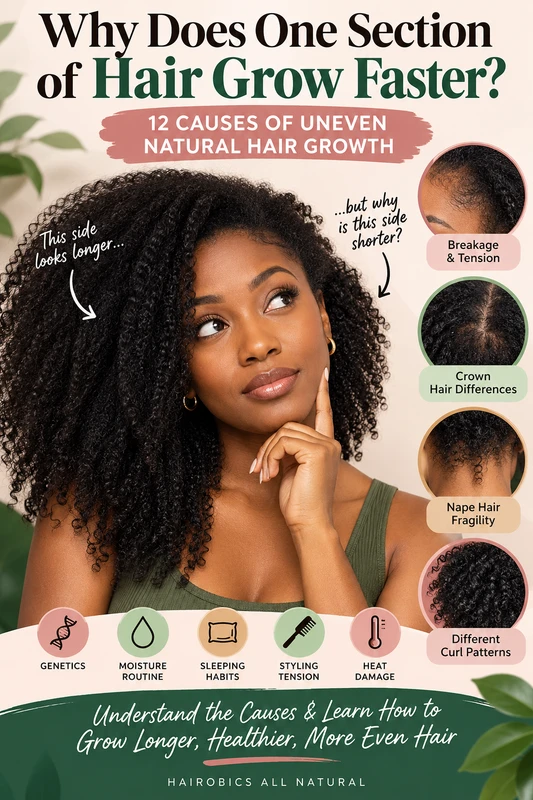
Have you ever noticed that one section of your hair seems to grow faster than the rest?
Maybe the back of your hair reaches your shoulders while the front barely touches your eyebrows. Perhaps your left side looks noticeably longer than your right side, or your crown never seems to catch up with the rest of your natural hair.
Uneven hair growth is a common concern, especially among people with curly, coily, kinky, and 4C natural hair.
You might spend months following a consistent hair care routine, moisturizing your strands, protecting your ends, and avoiding excessive heat, only to discover that certain sections still appear shorter than others.
This can leave you wondering whether something is wrong with your scalp, your hair follicles, or your hair care routine.
The truth is that different sections of your hair can have different growth patterns, but uneven length does not always mean uneven growth.
Sometimes the difference comes from genetics and individual follicle activity. Other times, one section experiences more breakage, shrinkage, friction, or styling damage than another.
Understanding the difference is essential if your goal is longer, healthier, more evenly growing natural hair.
In this complete guide, we'll explore why one section of your hair may grow faster, what causes uneven hair length, and how to create a routine that helps every section retain more of its natural growth.
Is It Normal for One Section of Hair to Grow Faster?
Yes. Some variation in hair growth and hair length across the scalp is normal.
Your scalp contains thousands of individual hair follicles, and they do not all operate on exactly the same schedule.
Each follicle follows its own growth cycle. Individual hairs can differ in growth rate, growth-phase duration, diameter, and shedding schedule.
However, an important distinction must be made.
Hair that appears shorter is not necessarily growing more slowly.
For example, imagine that the hair at the back of your head grows approximately half an inch in one month.
The hair near your temples might produce a similar amount of new growth.
But if the temple area experiences more breakage, its visible length may increase much more slowly.
After several months, the back of your hair could appear significantly longer even though both areas have been producing new hair.
This is why understanding the difference between hair growth and length retention is so important.
For a deeper explanation, read our Length Retention vs. Hair Growth guide.
How Does Hair Growth Work?
Before identifying why one section appears to grow faster, it helps to understand how hair grows.
Hair growth begins beneath the scalp inside structures called hair follicles.
Each follicle produces a strand through a repeating biological cycle.
The Anagen Phase: Active Growth
During the anagen phase, the follicle actively produces hair.
For scalp hair, this phase commonly lasts several years, although its duration varies between individuals and follicles.
The longer a strand remains in the active growth phase, the greater its potential length.
The Catagen Phase: Transition
Catagen is a short transitional stage.
The follicle stops actively producing the hair shaft and begins changing in preparation for the resting stage.
The Telogen Phase: Resting
During telogen, the hair remains in the follicle while active growth has stopped.
Eventually, the old strand is released as part of normal shedding.
The Exogen Phase: Shedding
Exogen refers to the release of the hair strand.
Because individual follicles move through these phases independently, different hairs on your scalp are constantly at different stages.
Scalp hair commonly grows around half an inch per month on average, but individual rates vary.
This natural variation can contribute to differences in hair length across your head.
12 Reasons One Section of Your Hair May Grow Faster
1. Genetics Influence Your Hair Growth Pattern
Genetics play an important role in how your hair grows.
Your inherited characteristics influence hair texture, strand diameter, density, growth-cycle duration, and other follicle characteristics.
Individual follicles can also behave differently within the same scalp.
For example, your hair may naturally be finer around your temples and coarser toward the back of your head.
You may also have different curl patterns in different areas.
These differences do not automatically indicate damage or unhealthy hair.
Some people naturally have shorter-growing hairs around the hairline, while other areas are capable of reaching greater lengths.
However, genetics should not be used to dismiss a new or worsening area of thinning.
If a section that previously grew normally begins changing significantly, other causes deserve consideration.
2. One Section Experiences More Breakage
Breakage is one of the most important explanations for uneven natural hair length.
Your hair may grow at a normal rate from the scalp but break repeatedly before it reaches the length of surrounding sections.
Common causes include rough detangling, excessive heat, tight hairstyles, friction, chemical damage, and repeated manipulation.
Imagine that two sections each produce six inches of new growth over a year.
The first section loses one inch through breakage and trimming.
The second loses four inches.
Although both sections grew the same amount, the first retains approximately five inches while the second retains only two.
This creates a noticeable difference in length.
Signs of breakage include short pieces of hair around your shoulders, thin-looking ends, strands snapping during detangling, and rough or split ends.
If this sounds familiar, our article on Why Hair Grows but Won't Retain Length explains how everyday habits can affect your progress.
3. Different Sections Have Different Curl Patterns
One of the most overlooked reasons natural hair appears uneven is variation in curl pattern.
You might have loose curls near your nape, tight coils at your crown, and a mixture of textures around your temples.
This is completely normal.
Different curl patterns contract by different amounts.
For example, a loosely curled section may hang several inches below your ears, while a tightly coiled section of similar stretched length sits close to your scalp.
The difference may be shrinkage rather than growth.
This is especially important for people with 4A, 4B, and 4C hair.
Tightly coiled strands can experience substantial shrinkage, making them appear much shorter than their actual length.
To compare sections accurately, gently stretch each one without excessive pulling.
You may discover that the supposedly shorter section is much closer in length than you originally believed.
4. Sleeping on One Side Creates More Friction
Do you sleep on the same side of your head every night?
If so, that habit may contribute to uneven breakage.
Repeated friction between your hair and pillowcase can create tangling, roughness, and mechanical wear.
Cotton pillowcases may increase friction for some hair types, particularly when strands are dry or already fragile.
If you consistently sleep on your right side, the hair on that side may experience more repeated rubbing.
Over time, that can contribute to differences in length retention.
This does not mean sleeping on one side directly slows follicle growth.
Instead, it may affect how much existing length survives.
Consider using a satin or silk bonnet, scarf, or pillowcase to reduce friction.
Also avoid tying your bonnet so tightly that it creates pressure around your hairline.
5. Your Hairstyles Put Uneven Tension on Your Hair
Protective hairstyles can help reduce daily manipulation, but not every protective style distributes tension evenly.
Braids, cornrows, ponytails, buns, twists, and extensions may place more stress on certain sections.
For example, frequently pulling your hair into a high ponytail can create repeated tension around the edges and temples.
Heavy extensions may also pull more strongly on delicate areas.
Over time, repeated tension can cause breakage and potentially traction alopecia, a form of hair loss associated with persistent pulling.
Warning signs include soreness, bumps, thinning edges, broken hairs, and a receding hairline.
A hairstyle should not cause ongoing pain or excessive pulling.
If you notice one section becoming shorter after repeatedly wearing the same hairstyle, reconsider how much tension that area receives.
6. The Crown of Your Hair Experiences More Damage
The crown is a common area of concern for people with natural hair.
Some people notice that their crown feels drier, tangles more easily, or appears shorter than surrounding sections.
There are several possible explanations.
The crown may have a tighter curl pattern, different strand characteristics, or greater exposure to styling and manipulation.
Certain hairstyles also place tension directly on the crown.
If this area repeatedly becomes tangled or breaks during detangling, it may retain less length.
However, crown thinning should not automatically be blamed on dryness.
Progressive thinning, scalp tenderness, burning, itching, or changes in the scalp at the crown can sometimes indicate a medical hair-loss condition.
In particular, central centrifugal cicatricial alopecia (CCCA) is an important condition to recognize in people of African descent.
Early evaluation by a dermatologist is important because some forms of scarring hair loss can permanently damage follicles.
If your crown is simply shorter but remains full and healthy-looking, focus on gentle handling and accurate length measurements.
If the area is becoming less dense or showing scalp symptoms, seek professional evaluation.
7. Your Nape Hair Is More Fragile
The nape is another area where people frequently notice uneven length.
The hair at the back of your neck may have a different texture, density, or strand diameter from the rest of your scalp.
It also experiences regular contact with collars, scarves, necklaces, and clothing.
This repeated friction may contribute to breakage.
For some people, nape hair grows long and hangs below the rest of their hairstyle.
For others, it remains relatively short.
Both patterns can be normal.
If your nape hair frequently breaks, consider reducing friction from rough collars and avoiding tight hairstyles that pull upward on the back of your head.
Use gentle detangling techniques and avoid repeatedly brushing delicate nape hairs into place.
The goal is to protect existing strands rather than force the nape to match the rest of your hair immediately.
8. You Apply Moisturizer Unevenly
Sometimes one section of your hair receives much more attention than another.
You may thoroughly moisturize the front and sides because those areas are easier to reach.
Meanwhile, the crown or back of your head may receive only leftover product.
Over time, inconsistent conditioning and moisture management can contribute to differences in manageability and breakage.
This is especially relevant for high-density natural hair.
When your hair is thick and full, applying moisturizer only to the surface may leave inner sections inadequately conditioned.
A better approach is to divide your hair into manageable sections.
Apply your conditioner or water-based moisturizer evenly throughout each section, paying attention to areas that feel dry or tangle easily.
Remember that oils do not replace water-based moisturizing products.
Oils may improve lubrication and help reduce moisture loss, but they cannot independently hydrate dry hair.
Consistency and even product distribution are more important than using excessive quantities.
9. Heat Damage Affects Certain Areas More Than Others
If you frequently straighten, blow-dry, or flat-iron your hair, some sections may receive more heat than others.
For example, you may repeatedly pass a flat iron over the front of your hair to achieve a smoother appearance.
You might also apply extra heat to the crown because that area has a tighter texture.
Over time, excessive heat can weaken the hair shaft and contribute to breakage.
Heat-damaged strands may appear straighter, feel rougher, or fail to return to their previous curl pattern.
They may also become more vulnerable to splitting and snapping.
If one section is noticeably shorter and has a history of repeated heat styling, heat-related breakage may be contributing to the difference.
Reduce unnecessary heat exposure, use appropriate heat protection, and avoid repeated high-temperature passes.
Severely damaged ends may eventually need trimming.
10. Detangling Habits Differ Across Your Head
Detangling can be one of the most damaging parts of a natural hair routine when performed aggressively.
Many people handle the front of their hair carefully because they can see it easily.
However, the back and crown may receive rougher treatment.
Pulling a comb through tangled sections can cause strands to snap.
This may gradually create uneven lengths.
For better results, detangle in small sections using a conditioner with good slip.
Start near the ends and work upward toward the roots.
If you encounter a stubborn knot, stop and gently separate the strands rather than pulling harder.
Avoid detangling completely dry, tightly tangled hair without adequate lubrication.
The amount of water or conditioner needed depends on your hair's texture and condition.
Gentle handling helps preserve the length your follicles have already produced.
11. Hair Density and Strand Thickness Vary
Hair density refers to the number of strands growing within a particular area of your scalp.
Strand thickness refers to the diameter of each individual hair.
These characteristics can vary across your head.
For example, your temples may contain finer strands while the back of your head contains coarser strands.
Fine strands can be more vulnerable to certain forms of mechanical stress, particularly when repeatedly pulled or brushed.
Areas with lower density may also appear shorter or less full, even when individual strands are growing normally.
Understanding your hair's characteristics can help you adjust your routine.
Read our Hair Density vs. Hair Thickness guide to understand how strand size and density influence natural hair care.
12. Scalp Conditions or Health Changes Affect Growth
Although many cases of uneven hair length involve breakage or natural variation, medical conditions can also affect certain sections of the scalp.
Potential causes include alopecia areata, traction alopecia, inflammatory scalp conditions, and some forms of scarring alopecia.
Alopecia areata may cause distinct patches of hair loss.
Traction alopecia often affects areas exposed to repeated pulling.
Scarring alopecias may cause progressive thinning or loss of follicles in particular regions.
These conditions are different from ordinary uneven length.
Signs that deserve medical attention include sudden bald patches, widening areas of visible scalp, persistent pain, redness, scaling, or progressive thinning.
Early diagnosis can make an important difference, especially when inflammation or scarring is involved.
Why Does the Back of My Hair Grow Faster Than the Front?
Many people believe the back of their hair grows faster because it appears longer.
There are several possible explanations.
The back may have a looser curl pattern, allowing strands to hang farther down.
It may also experience less heat styling or manipulation than the front.
The front of your hair is often exposed to more brushing, edge styling, ponytails, and repeated adjustments.
These activities can contribute to breakage.
Another factor is haircut shape.
Some haircuts intentionally leave the back longer, creating the appearance of faster growth as the style grows out.
To determine whether the difference is real, compare gently stretched lengths and track the same sections over time.
Why Does One Side of My Hair Grow Faster Than the Other?
If the left side of your hair is longer than the right, consider your daily habits.
Do you always sleep on one side?
Do you part your hair in the same direction?
Does one side receive more brushing, heat, or tension?
Do you frequently tuck one side behind your ear?
These habits may create uneven wear.
Natural variation in curl pattern can also contribute to the difference.
Start by observing whether the shorter side has broken ends, unusual shedding, or visible thinning.
If it does, reducing mechanical damage may help.
If both sides appear healthy, slight differences in length may simply reflect normal variation.
How to Fix Uneven Natural Hair Growth
You cannot force every follicle to grow at exactly the same speed.
However, you can create a routine that helps reduce avoidable breakage and supports healthier length retention.
Step 1: Identify Your Shortest Sections
Start by dividing your hair into four to six sections.
Examine the front, crown, sides, and back.
Look for differences in stretched length, strand condition, and density.
Pay attention to whether the shorter sections have split ends, roughness, or visible breakage.
Avoid assuming that every short section needs additional oil.
Understanding the cause is more important than immediately adding products.
Step 2: Moisturize Consistently
Keep your hair conditioned according to its needs.
Use water-based moisturizing products when appropriate and distribute them evenly.
Focus on sections that feel rough or become tangled easily.
For people wearing braids, locs, or other protective styles, the Hairobics All Natural Locs & Braids Moisturizer Spray is one option for helping keep hair soft and manageable.
Moisturizing products can support conditioning and manageability, but they do not guarantee faster follicle growth.
Step 3: Reduce Excessive Manipulation
Avoid repeatedly combing, brushing, twisting, or restyling fragile areas.
Choose hairstyles that allow your hair to remain comfortable without excessive pulling.
Loose twists, low-tension braids, and other simple styles may help reduce daily handling.
Protective styles should be maintained properly and should never create persistent scalp pain.
Step 4: Protect Your Ends
The ends of your hair are the oldest portions of each strand.
They have experienced more washing, friction, styling, and environmental exposure than the newer hair near your roots.
Because of this, ends are often especially vulnerable to splitting and breakage.
Pay extra attention to the ends of your shortest sections.
Use gentle detangling methods and trim damaged ends when necessary.
Avoid repeatedly rubbing your hair against rough clothing or accessories.
Step 5: Protect Your Hair at Night
Nighttime protection may help reduce friction and tangling.
Consider using a satin or silk bonnet, scarf, or pillowcase.
Avoid sleeping with extremely tight ponytails or buns.
If your hair is long enough, loose twists may help keep strands organized while you sleep.
Make sure any nighttime covering is comfortable and does not pull on your edges.
Step 6: Track Your Progress Monthly
Hair growth happens gradually.
Checking your length every day can make normal progress difficult to recognize.
Instead, measure selected sections approximately every four to six weeks.
Use the same method each time.
Take photographs under similar lighting and styling conditions.
This makes it easier to identify actual changes rather than differences caused by shrinkage or styling.
Step 7: Be Patient With Uneven Sections
If your shorter sections have experienced repeated breakage, improvement may take several months.
Reducing breakage can help you retain more of the hair that grows, but existing length differences will not disappear overnight.
Focus on healthy strands rather than forcing every section to become identical immediately.
Should You Cut Your Hair to Make It Even?
Not necessarily.
Whether you should trim your hair depends on your goals and the condition of your ends.
If your hair is healthy but naturally uneven, you may choose to keep the different lengths while allowing shorter sections time to catch up.
If the ends are severely damaged, trimming may improve manageability and prevent continued problems with splitting and tangling.
Some people prefer a shaped haircut that creates a balanced appearance without removing unnecessary length.
Others prefer to maintain their current length and gradually trim as shorter sections become longer.
There is no single correct approach.
However, cutting hair does not make follicles grow faster.
Trimming changes the length and condition of existing strands, not the biological growth rate beneath your scalp.
Can Hair Oils Make One Section Grow Faster?
Hair oils are popular in natural hair care, but it is important to understand what they can and cannot do.
Oils can help lubricate strands, improve shine, and sometimes reduce friction or moisture loss.
These benefits may support length retention when oils are used appropriately.
However, ordinary cosmetic oils have not been established as a reliable way to make one particular section of your scalp grow significantly faster.
Applying more oil to a shorter section does not necessarily solve the underlying problem.
If the section is short because of breakage, focus on reducing damage.
If it is thinning because of a scalp condition, seek an appropriate diagnosis.
A balanced routine is usually more useful than repeatedly applying large quantities of product.
How Long Does It Take for Uneven Hair to Catch Up?
The answer depends on why your hair is uneven.
If the difference is caused primarily by breakage, improved handling may help the shorter section retain more length over time.
If the difference is caused by shrinkage, your hair may already be closer in actual length than it appears.
If your follicles naturally produce hair at different rates or have different growth-cycle characteristics, some variation may remain.
Consider a simple example.
Suppose one section is three inches shorter than another.
If both sections continue growing at the same rate and retain the same amount of length, the difference will remain approximately three inches.
The shorter section does not automatically catch up simply because you improve your routine.
However, if the longer section previously retained more length because the shorter section was breaking, reducing that breakage can prevent the gap from widening.
Trimming and shaping can also help create a more even appearance.
For realistic expectations about annual growth, explore How Long Does Hair Grow in One Year?.
Common Mistakes When Trying to Fix Uneven Hair
One common mistake is applying excessive products to the shortest section.
More oil, cream, or scalp treatment does not automatically mean faster growth.
Another mistake is repeatedly measuring hair while it is in different curl states.
Comparing stretched hair on one side with shrunken hair on the other can produce misleading results.
Some people also respond to uneven growth by installing tighter protective hairstyles.
Unfortunately, excessive tension may worsen breakage or contribute to hair loss.
Another mistake is ignoring scalp symptoms.
A progressively thinning crown, painful scalp, or developing bald patch should not be treated as an ordinary cosmetic issue.
Finally, constantly changing products can make it difficult to identify which practices actually help.
Consistency and gentle handling are more valuable than chasing every new hair growth trend.
Frequently Asked Questions About Uneven Hair Growth
Is it normal for one side of your hair to be longer?
Yes. Slight differences in length are common. Curl pattern, natural follicle variation, haircut shape, and breakage can all contribute.
Why is my crown shorter than the rest of my hair?
Your crown may have tighter curls, experience more tangling, or suffer repeated styling damage. However, progressive thinning or scalp discomfort at the crown deserves professional evaluation.
Does 4C hair grow unevenly?
People with 4C hair can experience uneven-looking length because of shrinkage, different textures, and breakage. This does not mean 4C follicles are inherently incapable of normal growth.
Can sleeping on one side affect hair length?
Repeated friction may contribute to breakage on the side you sleep on. It does not necessarily change the biological rate of hair production.
Will trimming make all my hair grow at the same speed?
No. Trimming removes existing length and damaged ends but does not synchronize follicle growth rates.
Can stress cause uneven hair growth?
Stress can contribute to certain types of shedding and hair-cycle changes, but it does not automatically explain one consistently shorter section. Localized or persistent changes should be evaluated based on their specific symptoms.
Why does my nape hair grow faster?
Your nape may have a looser curl pattern or retain more length than surrounding areas. Natural differences in follicle behavior may also contribute.
Can damaged hair start growing normally again?
If the follicles remain healthy, they may continue producing new hair even when existing strands are damaged. However, conditions that damage follicles, particularly scarring hair loss, may require medical treatment.
How can I tell whether my hair is growing or breaking?
Look for new growth near the scalp and examine your ends for short broken pieces, splitting, and thinning. Track the same sections over time rather than relying only on how long your hairstyle looks.
Should I use different products on different sections?
Sometimes. Sections with different textures or conditioning needs may respond better to different amounts or types of products. However, avoid excessive layering and address any underlying scalp problems.
Final Thoughts: Understanding Why One Section of Hair Grows Faster
If one section of your natural hair appears to grow faster than another, there are several possible explanations.
Your follicles may naturally have different growth characteristics.
Different curl patterns may create the appearance of uneven length.
Or certain sections may experience more breakage, friction, heat damage, or styling tension.
The most important step is determining whether you are dealing with actual differences in growth, differences in shrinkage, or problems with length retention.
Once you understand the cause, you can make more effective decisions about your hair care routine.
Keep your hair conditioned, detangle gently, avoid excessive tension, protect your ends, and track your progress consistently.
Remember that healthy natural hair does not have to be exactly the same length everywhere.
Some variation is normal.
However, sudden changes in density, progressive thinning, bald patches, or persistent scalp symptoms deserve professional attention.
At Hairobics All Natural, we believe healthy hair care starts with understanding your individual hair needs.
Explore our moisturizing and conditioning products, develop a consistent routine, and focus on protecting the length your hair naturally produces.
Your goal isn't to force every strand to grow at the same speed. It's to give every section the best opportunity to remain healthy and retain its length.