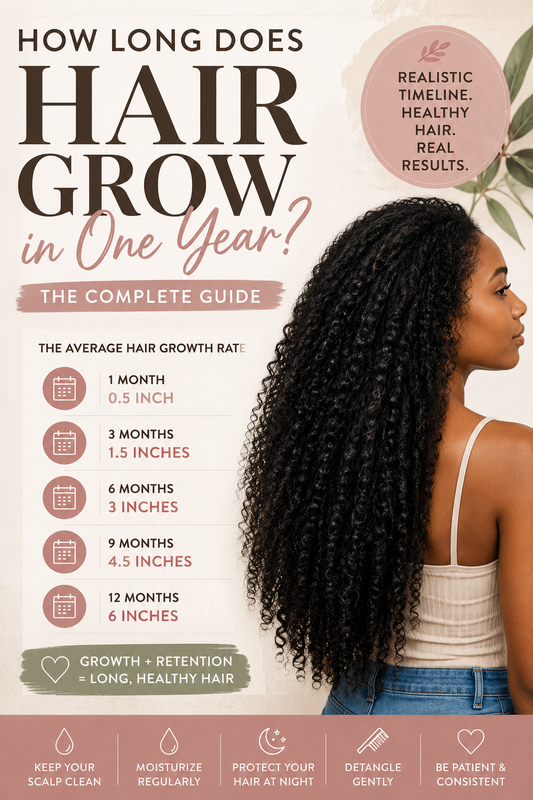
If you're trying to grow longer, healthier hair, one of the first questions you may ask is: How long does hair grow in one year?
For most people, scalp hair grows approximately 6 inches per year, based on an average growth rate of about half an inch per month. However, that number is only an average. Your actual hair growth—and especially how much new length you can see and retain—can vary considerably.
Genetics, age, nutrition, scalp health, hair-care practices, breakage, protective styling, chemical treatments, heat, stress, and your individual hair-growth cycle can all affect your results.
For people with Black hair, natural hair, curly hair, coils, locs, braids, or highly textured hair, another factor is especially important: length retention. Your follicles may be producing new hair normally, but breakage at the ends can make it appear as though your hair isn't growing.
This complete guide explains how much hair grows in a year, how quickly hair grows each month, what affects hair growth, why your hair may seem to grow slowly, and how to retain more of the length you grow.
Quick Answer: How Long Does Hair Grow in One Year?
On average, human scalp hair grows approximately:
- 0.5 inch per month
- 1.5 inches in 3 months
- 3 inches in 6 months
- 4.5 inches in 9 months
- 6 inches in 12 months
These numbers aren't guarantees. Some people may grow less than 6 inches in a year, while others may grow more.
The bigger issue for many people isn't necessarily how quickly their follicles produce hair. It's how much of that growth remains on their head without breaking off.
For example, imagine your hair grows 6 inches during the year but you lose 4 inches from breakage, excessive trimming, split ends, or damage.
Your visible length gain would only be around 2 inches.
This is why a successful hair-growth routine should focus on two things:
Hair growth + length retention.
You need both if your goal is noticeably longer hair.
How Fast Does Hair Grow?
Hair grows from follicles located beneath the scalp.
At the bottom of the follicle is the hair bulb, where cells divide and contribute to the formation of the hair shaft. As the hair develops, it eventually emerges through the scalp.
Once hair has emerged from the scalp, the visible portion is composed primarily of keratinized cells. That's one reason damaged hair can't literally heal itself in the same way living skin can.
Hair products can improve lubrication, softness, manageability, appearance, and protection, but maintaining healthy hair ultimately requires protecting the strands that your follicles have already produced.
The commonly cited average growth rate is approximately 0.5 inch per month.
Over 12 months:
0.5 × 12 = 6 inches
Therefore, someone starting with 10 inches of hair could theoretically have approximately 16 inches after one year if they grew at the average rate and retained virtually all their new length.
In real life, however, trims, shedding, breakage, shrinkage, and differences in individual growth rates make the calculation less straightforward.
Hair Growth Timeline Month by Month
If your hair grows around half an inch each month, a theoretical one-year growth timeline may look like this:
| Month | Approximate New Growth |
|---|---|
| Month 1 | 0.5 inch |
| Month 2 | 1 inch |
| Month 3 | 1.5 inches |
| Month 4 | 2 inches |
| Month 5 | 2.5 inches |
| Month 6 | 3 inches |
| Month 7 | 3.5 inches |
| Month 8 | 4 inches |
| Month 9 | 4.5 inches |
| Month 10 | 5 inches |
| Month 11 | 5.5 inches |
| Month 12 | 6 inches |
Again, this is a general estimate rather than a promise.
Your personal rate may be faster or slower.
But this timeline can be useful when setting realistic hair-growth goals.
Instead of expecting dramatic changes after two or three weeks, think about your hair journey in three-, six-, and twelve-month periods.
How Much Does Hair Grow in 3 Months?
At the average rate of approximately half an inch per month, hair may grow about:
1.5 inches in three months.
Three months is often enough time to begin noticing a measurable difference, especially around the roots.
If your hair is:
- Colored
- Relaxed
- Braided
- Twisted
- Loc'd
- Naturally curly
- Worn in protective styles
you may notice your new growth particularly clearly around the scalp.
However, curly and coily hair can make new length difficult to see because of shrinkage.
How Much Does Hair Grow in 6 Months?
Average hair growth over six months is approximately:
3 inches.
This can produce a noticeable difference in length when the hair is stretched.
Six months is also a useful milestone for evaluating whether your hair-care routine is helping you retain length.
Take photographs when you begin your journey and compare them six months later.
Try to keep the conditions similar:
- Same hairstyle
- Same shirt
- Same camera angle
- Same hair condition
- Similar stretching method
This provides a much better comparison than checking your hair in the mirror every day.
How Much Does Hair Grow in 12 Months?
At an average growth rate of half an inch per month, you could produce approximately:
6 inches of new hair in one year.
Six inches can create a significant difference in overall hair length.
However, growing 6 inches doesn't necessarily mean your hair will appear exactly 6 inches longer at the end of the year.
You might trim your ends.
Some strands will naturally shed.
Others could break.
Curly hair may shrink.
Your hair also contains thousands of individual follicles that aren't all operating on identical schedules.
Therefore, growth isn't exactly the same thing as visible length gain.
Hair Growth vs. Length Retention
This is one of the most important concepts to understand when growing natural or textured hair.
Hair growth describes new hair being produced from your follicles.
Length retention describes your ability to keep that hair without losing excessive length from breakage.
Imagine two people whose hair both grows 6 inches in a year.
Person A
Hair growth: 6 inches
Breakage/trimming: 1 inch
Length retained: approximately 5 inches
Person B
Hair growth: 6 inches
Breakage/trimming: 5 inches
Length retained: approximately 1 inch
Person B might believe their hair grows extremely slowly.
But their actual problem may be excessive breakage.
That's why constantly searching for ways to make hair grow faster isn't always the best approach.
Sometimes the better question is:
"Why am I not retaining the hair I'm already growing?"
Does Black Hair Grow Slower?
Black hair grows continuously just like other hair types, although average growth rates can vary among individuals and populations.
More importantly, tightly curled and coily hair can make length retention more challenging.
The curved structure of textured hair can make strands more vulnerable to:
- Dryness
- Tangling
- Single-strand knots
- Mechanical damage
- Split ends
- Breakage
- Friction
Sebum from the scalp can also have more difficulty traveling along tightly curved strands than along straighter hair.
As a result, the ends may become dry and fragile if they're not properly cared for.
Shrinkage can create another illusion.
A strand that is several inches long may coil tightly toward the scalp.
Someone with 12 inches of natural hair may therefore appear to have much shorter hair until it's stretched.
So when someone says:
"My natural hair doesn't grow."
The hair may actually be growing normally.
The problem may involve shrinkage, breakage, or difficulty retaining length.
Why Does My Hair Seem Like It Isn't Growing?
If you've been stuck at the same length for years, it can be frustrating.
But your hair probably hasn't completely stopped growing.
Several things can create the appearance of stalled growth.
1. Your Ends Are Breaking
This is one of the biggest reasons hair appears stuck at the same length.
Suppose your roots produce half an inch of new growth during the month.
But your ends break by roughly the same amount.
Your overall length barely changes.
The result?
You feel like your hair isn't growing.
Look for signs such as:
- Short broken hairs
- Excessive hair on clothing
- Rough ends
- Split ends
- Thin ends
- Constant tangling
- Difficulty retaining length
- Hair becoming progressively thinner toward the ends
Reducing breakage may dramatically improve your visible progress without changing your biological growth rate.
2. Shrinkage Is Hiding Your Length
Shrinkage is completely normal for curly and coily hair.
Hair can look substantially shorter in its natural state than when stretched.
This means you might have gained several inches without realizing it.
Instead of constantly straightening your hair to check growth, try gently stretching one section and photographing it periodically.
3. You're Measuring Too Frequently
Hair growth happens gradually.
If you're checking your length every three days, the difference will be almost impossible to see.
Even after one month, half an inch may not appear dramatic.
Compare your progress every three months instead.
The difference will be much easier to recognize.
4. You're Trimming Frequently
Trimming damaged ends can be beneficial for maintaining the appearance and manageability of your hair.
But trimming doesn't cause follicles to grow faster.
If you grow six inches and trim six inches during the same year, you won't see an increase in overall length.
The goal is not necessarily to avoid trimming altogether.
Instead, avoid unnecessarily removing healthy length.
5. Your Hair Is Breaking From Manipulation
Every time you:
- Detangle
- Comb
- Brush
- Style
- Braid
- Twist
- Straighten
- Blow-dry
- Tie your hair
- Remove a protective style
you create some degree of mechanical interaction with your strands.
Healthy hair can tolerate normal manipulation, but excessive or rough handling can gradually increase breakage.
Gentler hair care is often one of the simplest ways to improve length retention.
What Determines How Much Your Hair Grows in a Year?
Your hair growth rate isn't controlled by one single factor.
Several variables influence your results.
Genetics
Genetics plays an important role in characteristics such as:
- Hair-growth cycle
- Hair density
- Strand diameter
- Curl pattern
- Maximum attainable length
- Hair characteristics
This helps explain why two people can follow nearly identical routines and still experience different results.
Don't judge your hair journey by someone else's timeline.
Age
Hair characteristics can change throughout life.
Many people experience changes in density, growth patterns, pigmentation, or strand characteristics as they age.
That doesn't mean healthy hair can't be maintained later in life.
It simply means your routine may need to evolve with your hair.
Nutrition
Hair follicles require nutrients to function normally.
A balanced diet containing adequate:
- Protein
- Iron
- Zinc
- Essential fatty acids
- Vitamins
- Minerals
supports normal body functions, including hair production.
Extreme dieting and significant nutritional deficiencies can negatively affect hair.
However, taking enormous amounts of hair vitamins won't necessarily make already-normal hair grow dramatically faster.
More isn't always better.
If you suspect a nutritional deficiency or experience unexplained hair loss, speak with a qualified healthcare professional rather than attempting to diagnose yourself with supplements.
The Hair Growth Cycle Explained
To understand how long hair can grow, you need to understand the hair-growth cycle.
Hair doesn't continuously grow forever.
Each follicle cycles through different phases.
Anagen Phase
The anagen phase is the active growth phase.
During this period, the follicle is actively producing the hair shaft.
Scalp hair can remain in anagen for years.
The length of your anagen phase plays a major role in determining how long an individual strand can potentially become before it transitions into later stages of the cycle.
Someone with a longer growth phase has the potential to grow longer hair than someone whose follicles tend to transition sooner, assuming the strands aren't breaking.
Catagen Phase
The catagen phase is a relatively short transitional period.
Active growth slows and the follicle begins transitioning away from the growth stage.
Telogen Phase
The telogen phase is commonly described as the resting phase.
Eventually, the old hair is shed and the follicle progresses through its cycle.
This explains why finding some shed hairs during washing or detangling isn't automatically a sign that something is wrong.
Hair naturally sheds.
The concern is when shedding becomes unusually heavy, persistent, or is accompanied by noticeable thinning or bald areas.
How Long Can Hair Grow?
There isn't one maximum hair length that applies to everyone.
Your potential length depends partly on:
growth rate × duration of the growth phase × length retention
For example, imagine someone grows approximately 6 inches annually and has an active growth phase lasting several years.
Their theoretical potential length could be considerable.
But that potential means very little if their ends continually break.
This is why people who achieve waist-length or even longer natural hair often focus heavily on preserving older ends.
Remember:
The hair at your roots is new.
The hair at your ends may be several years old.
Those ends have survived:
- Hundreds of nights of sleeping
- Many wash days
- Detangling sessions
- Weather changes
- Hairstyles
- Clothing friction
- Combing
- Brushing
Long hair requires protecting those older sections.
How to Retain More Hair Growth Over One Year
If you want to see the biggest possible difference after 12 months, make length retention one of your primary goals.
Here are some of the most important strategies.
1. Keep Your Scalp Clean
Healthy hair care begins with the scalp.
Your scalp naturally accumulates:
- Sebum
- Sweat
- Dead skin
- Styling products
- Environmental debris
Wash your scalp regularly enough to keep it comfortable and clean.
There isn't one perfect wash schedule for everyone.
Someone who exercises frequently or has an oily scalp may need to wash more often than someone else.
Pay attention to your scalp rather than following arbitrary rules.
2. Keep Your Hair Properly Conditioned
Textured hair often benefits from consistent conditioning.
Conditioner can improve:
- Slip
- Detangling
- Manageability
- Softness
- Lubrication
Good slip is especially valuable during detangling because it can reduce unnecessary friction.
Apply conditioner thoroughly through your lengths and pay particular attention to older ends.
3. Moisturize Dry Hair
Dry, brittle strands are more vulnerable to breakage.
A good natural-hair routine often includes water-based hydration combined with products that improve softness and help reduce moisture loss.
Pay attention to how your hair responds.
Your hair shouldn't constantly feel:
- Hard
- Crispy
- Brittle
- Rough
- Straw-like
If it does, reconsider your routine and the products you're using.
4. Protect Your Ends
If your goal is longer hair, your ends deserve special attention.
They are the oldest and often most fragile part of your hair.
Reduce unnecessary friction against:
- Cotton pillowcases
- Rough clothing
- Sweaters
- Scarves
- Car seats
- Upholstery
Consider hairstyles that prevent your ends from constantly rubbing against your shoulders and clothing.
This becomes particularly important when you're trying to grow beyond shoulder length.
5. Sleep With Hair Protection
Nighttime friction can contribute to tangling and breakage.
Consider using:
- Satin bonnet
- Satin scarf
- Satin or silk pillowcase
You can also loosely braid, twist, pineapple, or otherwise secure your hair depending on your hairstyle and texture.
The goal is to minimize friction and prevent severe overnight tangling.
6. Detangle Gently
Aggressive detangling can erase months of progress.
Don't rush.
Depending on your hair, you may find it easier to work in sections.
Start near the ends and gradually work toward the roots instead of ripping a comb directly through tangles.
Use your fingers when helpful.
A conditioner or detangling product with good slip can make the process easier.
If you encounter a knot, slow down rather than pulling harder.
Patience protects length.
7. Be Careful With Heat
Heat styling isn't automatically incompatible with healthy hair.
However, excessive temperatures and repeated heat exposure can damage the hair shaft.
If you use heat:
- Avoid unnecessarily high temperatures
- Use an appropriate heat protectant
- Limit repeated passes
- Don't repeatedly straighten already-damaged hair
- Give your hair breaks when necessary
If your curls no longer return after washing, excessive heat damage may be involved.
8. Avoid Excessively Tight Hairstyles
Braids, twists, ponytails, buns, wigs, extensions, and other styles can be useful tools.
But protective styles aren't protective when they're excessively tight.
Warning signs include:
- Pain
- Headaches
- Bumps
- Redness
- Tenderness
- Excessive pulling
- Extreme tension around the hairline
Your hairstyle shouldn't require days of pain before it "loosens up."
Repeated tension can damage vulnerable areas, particularly around the edges.
9. Don't Leave Protective Styles in Forever
Braids and other low-manipulation styles can help some people retain length because they reduce daily styling.
However, leaving styles in too long can lead to:
- Matting
- Heavy buildup
- Tangling
- Difficult takedown
- Breakage
Your hair still needs appropriate scalp and strand care while it's styled.
And the takedown process should be patient.
Don't spend weeks protecting your hair only to rip through it during removal.
10. Reduce Unnecessary Manipulation
You don't necessarily need to style your hair every day.
Constant combing, brushing, slicking, redoing edges, detangling, and changing hairstyles can increase mechanical stress.
Simple styles can sometimes be extremely effective for length retention.
Examples include:
- Two-strand twists
- Braids
- Buns
- Flat twists
- Low-manipulation natural styles
The best style is one that keeps your hair comfortable without excessive tension.
Can You Grow 12 Inches of Hair in One Year?
Growing 12 inches in one year would require an average of approximately 1 inch every month.
That's considerably higher than the commonly cited average scalp-hair growth rate.
Some individuals naturally grow faster than average, but expecting 12 inches every year isn't a realistic goal for most people.
Be skeptical of products promising things such as:
"Grow 10 inches in 30 days!"
Hair biology doesn't suddenly change because of a shampoo, oil, cream, or viral social-media trick.
Products can help create better conditions for maintaining the scalp and hair, but they can't guarantee extreme growth rates.
A more realistic goal is to maximize your personal growth potential while minimizing unnecessary breakage.
Can Hair Grow 6 Inches in a Year?
Yes.
Approximately 6 inches per year is a reasonable estimate based on an average growth rate near half an inch per month.
But remember that 6 inches of growth doesn't guarantee 6 inches of retained length.
If you want your hair to appear significantly longer at the end of the year, your routine needs to protect your ends.
Can You Grow 8 Inches of Hair in a Year?
Some people may naturally grow more than the commonly cited 6-inch average.
If someone averages approximately two-thirds of an inch per month, for example, they could approach 8 inches during a year.
But you shouldn't become obsessed with achieving a specific number.
Your genetics aren't something you can copy from an influencer.
Focus on:
- Healthy scalp care
- Good nutrition
- Consistent conditioning
- Low breakage
- Gentle styling
- Protecting your ends
Those factors are more productive than chasing unrealistic growth claims.
Does Cutting Hair Make It Grow Faster?
No.
Hair is produced by follicles beneath your scalp.
Cutting the ends doesn't send a signal to the follicle telling it to increase its growth rate.
Trimming can still be useful.
Removing severely split, damaged, or tangled ends can improve the appearance and manageability of your hair and prevent certain forms of damage from becoming more troublesome.
But trimming doesn't directly accelerate follicular growth.
Does Scalp Massage Make Hair Grow Faster?
Scalp massage is popular in natural hair routines.
A gentle scalp massage can feel relaxing and may help you distribute certain scalp products.
But don't assume that aggressively massaging your scalp will suddenly double your hair-growth rate.
If you massage your scalp, use your fingertips rather than scratching with your nails.
Avoid excessive friction.
Consistency and gentleness are more important than aggressively rubbing your scalp.
Does Hair Oil Make Hair Grow Faster?
Hair oils are frequently marketed as growth miracles.
The reality is more nuanced.
Different oils can help with different aspects of hair care. Depending on the formulation and how they're used, oils may help:
- Lubricate strands
- Improve softness
- Reduce friction
- Reduce moisture loss
- Improve shine
- Make hair easier to manage
These benefits may indirectly support length retention by helping you maintain the hair you already have.
But applying oil doesn't guarantee that your follicles will suddenly produce hair at twice their normal biological rate.
The best hair-growth routine combines scalp care with strand protection.
Popular Oils for Natural Hair
Many people with natural and textured hair incorporate oils into their routines.
Common choices include:
Coconut Oil
Coconut oil is popular in hair care and can be incorporated into pre-shampoo or conditioning routines depending on how your hair responds.
Jojoba Oil
Jojoba oil is lightweight and commonly used in scalp and hair formulations.
Olive Oil
Olive oil is often used to improve lubrication and softness, especially on dry-feeling hair.
Avocado Oil
Avocado oil is another popular option in natural hair products and oil blends.
Castor Oil
Castor oil is particularly popular within Black hair care routines because of its thick consistency and ability to coat strands.
Regardless of which oil you use, remember:
Oil isn't a replacement for water.
If your hair is dehydrated, coating extremely dry hair with more and more oil may simply leave it greasy while it still feels dry.
How to Create a One-Year Hair Growth Routine
If you're serious about seeing how much length you can achieve over the next year, consistency is more important than constantly switching products.
Try building a routine you can realistically maintain.
Weekly or Regular Routine
Depending on your hair and lifestyle:
- Cleanse your scalp.
- Condition your hair.
- Detangle gently.
- Apply your preferred moisturizing products.
- Style with minimal tension.
- Protect your ends.
- Maintain the style until the next appropriate wash or refresh.
Your exact schedule doesn't need to match someone else's.
One-Year Hair Growth Challenge
Want to see what your hair can accomplish in 12 months?
Create your own hair-growth challenge.
Month 1: Establish Your Baseline
Take photographs.
Measure several areas:
- Front
- Crown
- Sides
- Back
Write down your measurements.
Evaluate your current routine and identify the biggest sources of damage.
Month 2: Improve Your Wash Routine
Focus on scalp cleanliness and conditioning.
Pay attention to how your hair feels after wash day.
You want hair that's manageable rather than excessively tangled or stripped.
Month 3: Focus on Your Ends
Evaluate your ends.
Are they:
- Splitting?
- Tangling?
- Breaking?
- Extremely dry?
- Thin?
Improve your end protection.
At the three-month mark, you might have around 1.5 inches of new growth if you're close to the average rate.
Month 4: Reduce Manipulation
Count how frequently you're restyling your hair.
Could you reduce unnecessary brushing or combing?
Experiment with simpler styles.
Month 5: Evaluate Your Night Routine
Make sure you're protecting your hair while sleeping.
This is especially important if you wake up with:
- Dry hair
- Tangled hair
- Frizz
- Broken strands
Month 6: Measure Your Progress
Six months is a major checkpoint.
Average theoretical growth:
Approximately 3 inches.
Take new photographs under conditions similar to your original photos.
Don't judge only by appearance—especially if you have high shrinkage.
Month 7: Check Your Styling Habits
Look for tension.
If you're constantly wearing tight ponytails, braids, wigs, or slick styles, consider giving vulnerable areas a break.
Month 8: Focus on Consistency
This is where many hair-growth challenges fail.
People become impatient and start purchasing new products every week.
Instead, ask:
Is my current routine keeping my hair soft, manageable, and relatively breakage-free?
If yes, consistency may be more valuable than chasing trends.
Month 9: Examine Your Ends Again
At nine months, average theoretical new growth is around:
4.5 inches.
If your hair doesn't look significantly longer, evaluate breakage.
Are your ends still full?
Or are they becoming thinner?
Length without healthy-looking ends isn't necessarily the goal.
Month 10: Review Your Diet and Lifestyle
Hair is part of your body.
Support overall health with:
- Balanced nutrition
- Adequate protein
- Appropriate hydration
- Regular sleep
- Sustainable stress management
You don't need a magical "hair diet."
You need adequate overall nutrition.
Month 11: Resist the Urge to Overdo It
You're almost at one year.
Don't suddenly begin aggressive treatments because you want another inch before your final measurement.
Stay consistent.
Month 12: Final Length Check
After one year, compare your results.
Measure the same areas you measured at the beginning.
Take photographs.
Then ask:
- How much did my hair grow?
- How much length did I retain?
- Did my ends remain healthy?
- Did my hair become easier to manage?
- Did breakage decrease?
- Which parts of my routine worked?
- Which habits should I change next year?
Even if you didn't retain a full 6 inches, improved hair health is meaningful progress.
Why Your Hair May Stop at Shoulder Length
Shoulder length is a common point where people feel their hair has reached a plateau.
One possible explanation is friction.
When your ends reach your shoulders, they begin rubbing against:
- Shirts
- Jackets
- Sweaters
- Bedding
- Car seats
This repeated friction can contribute to wear and breakage.
The solution isn't necessarily to find a stronger growth product.
You may need better end protection.
Try wearing your hair up periodically, reducing friction, maintaining moisture, and handling your ends gently.
If your follicles are producing new growth but your ends are breaking at the same rate, your hair can remain around shoulder length for years.
Why Your Hair May Be Growing but Getting Thinner
Length isn't the only measurement of healthy-looking hair.
Pay attention to density and fullness.
If your hair becomes progressively thinner toward the bottom, you may be retaining some strands while others are breaking higher up.
This can create long but see-through ends.
Potential contributors include:
- Mechanical damage
- Excessive heat
- Chemical damage
- Rough detangling
- Repeated tension
- Split ends
- Inconsistent conditioning
The goal shouldn't simply be:
"Get the longest hair possible."
A better goal is:
"Retain as much healthy, full length as possible."
Protective Styles and One-Year Hair Growth
Protective styles can be useful for people trying to retain length.
Braids, twists, wigs, and other styles may reduce daily manipulation.
But they aren't magical growth methods.
A protective style helps only when it actually protects your hair.
Avoid:
- Excessively tight braids
- Heavy extensions
- Neglecting the scalp
- Keeping styles installed too long
- Rough takedowns
- Constantly pulling your edges
- Installing one tight style immediately after another
Give your hair and scalp appropriate care between styles.
How Often Should You Measure Hair Growth?
Don't measure your hair every week.
Hair grows too gradually for weekly measurements to provide meaningful visual feedback.
A better schedule is:
Every 3 months.
That gives you four checkpoints:
- Month 0
- Month 3
- Month 6
- Month 9
- Month 12
You can also take monthly photos without physically measuring your hair.
By the end of the year, you'll have a clear visual record of your journey.
How to Measure Natural Hair Correctly
Shrinkage can make measuring curly and coily hair difficult.
For more consistent measurements:
- Choose the same section each time.
- Gently stretch the strand.
- Don't pull painfully.
- Measure from the scalp toward the end.
- Record the number.
- Repeat under similar conditions next time.
Measure several sections rather than one strand.
Hair doesn't necessarily grow or retain length identically across the entire scalp.
Signs Your Hair Is Growing
Not seeing dramatic length doesn't mean nothing is happening.
Signs of growth may include:
- Visible new growth at the roots
- More distance between your scalp and colored or chemically treated hair
- Braids becoming looser around the roots
- Locs showing new growth
- Hairstyles fitting differently
- Increased stretched length
- Hair reaching new landmarks
For example, your hair may progress from:
Chin → shoulder → collarbone → armpit → bra-strap → mid-back → waist.
Body landmarks can sometimes be easier to track than inches.
Why Consistency Beats Hair-Growth Hacks
Social media makes hair growth look complicated.
One week you're told you need rice water.
The next week it's onion juice.
Then it's a specific oil.
Then it's an inversion technique.
Then someone claims they grew four inches in a month.
Constantly switching routines can make it difficult to determine what's actually working.
A basic, consistent routine often provides a stronger foundation:
Cleanse. Condition. Moisturize as needed. Detangle gently. Protect. Repeat.
Hair growth takes time.
There is no need to turn your bathroom into a laboratory.
When Hair Growth May Require Professional Attention
Slow visible growth isn't always a cosmetic issue.
Talk with a qualified healthcare professional or dermatologist if you experience:
- Sudden hair loss
- Bald patches
- Rapid thinning
- Significant changes in density
- Persistent scalp inflammation
- Painful scalp symptoms
- Unusual amounts of shedding
- Scarring
- Persistent itching, scaling, or sores
Certain medical conditions, nutritional deficiencies, medications, hormonal changes, and scalp disorders can affect hair.
In those situations, buying more hair products may not address the underlying issue.
Frequently Asked Questions About How Long Hair Grows in One Year
How many inches does hair grow in a year?
A commonly used average is approximately 6 inches per year, based on roughly half an inch per month. Individual growth rates vary.
How much does Black hair grow in a year?
There isn't one universal growth rate for Black hair. Many people may be around the general average, while individual rates differ. Shrinkage and breakage can make growth less noticeable in tightly curled and coily hair.
How much does natural hair grow in a year?
Natural hair can potentially gain several inches of new growth over 12 months. Around 6 inches is a useful general estimate, but your actual growth and retained length may differ.
How much does hair grow in six months?
At half an inch per month, approximately 3 inches.
How much does hair grow in three months?
Approximately 1.5 inches at the commonly cited average rate.
How much does hair grow in one month?
Approximately half an inch is a useful average.
Can hair grow one inch per month?
Some people may naturally grow faster than average, but one inch every month is significantly above the commonly cited average and shouldn't be expected by everyone.
Can hair grow 12 inches in a year?
It's possible for an unusually fast grower, but it isn't a realistic expectation for most people.
Does trimming make hair grow faster?
No. Trimming removes hair from the ends and doesn't directly affect follicular growth at the scalp.
Why is my hair the same length every year?
Breakage may be occurring at roughly the same rate as new growth. Shrinkage, frequent trimming, heat damage, chemical damage, and mechanical manipulation can also affect visible length.
How can I grow longer natural hair?
Instead of focusing exclusively on speeding up growth, prioritize length retention. Keep your scalp clean, condition consistently, reduce breakage, detangle gently, protect your ends, avoid excessive tension, and minimize unnecessary heat and manipulation.
The Biggest Secret to Growing Long Hair
The biggest "secret" isn't really a secret.
Time + consistency + length retention.
If your hair grows around 6 inches every year and you can retain most of it, the difference becomes dramatic over several years.
Imagine an average growth rate of approximately 6 inches annually:
1 year: 6 inches of potential new growth
2 years: 12 inches
3 years: 18 inches
4 years: 24 inches
5 years: 30 inches
That doesn't mean everyone will retain 30 inches in five years. Natural shedding, trims, breakage, individual growth cycles, and personal growth rates all influence the final result.
But it illustrates something important:
You don't need your hair to grow three inches every month to achieve long hair.
You need to consistently retain more length than you lose.
Final Thoughts: How Long Does Hair Grow in One Year?
So, how long does hair grow in one year?
For many people, approximately 6 inches per year is a reasonable general estimate based on average scalp-hair growth of around half an inch per month.
Your personal results may be slower or faster.
More importantly, the amount of hair you grow isn't necessarily the amount of length you'll retain.
If you're trying to grow long Black hair, natural hair, curly hair, locs, or other textured hair, focus on protecting the strands you already have.
Keep your scalp clean. Condition your hair. Maintain adequate moisture. Detangle gently. Protect your ends. Avoid excessive heat and tension. Eat a balanced diet. And give your routine enough time to work.
Don't become discouraged because you don't see dramatic changes after a few weeks.
Hair growth is measured in months and years—not days.
Take a picture today.
Measure your hair.
Build a consistent routine.
Then compare your progress in three, six, nine, and twelve months.
You may discover that your hair has been growing all along—the real key was learning how to keep it.