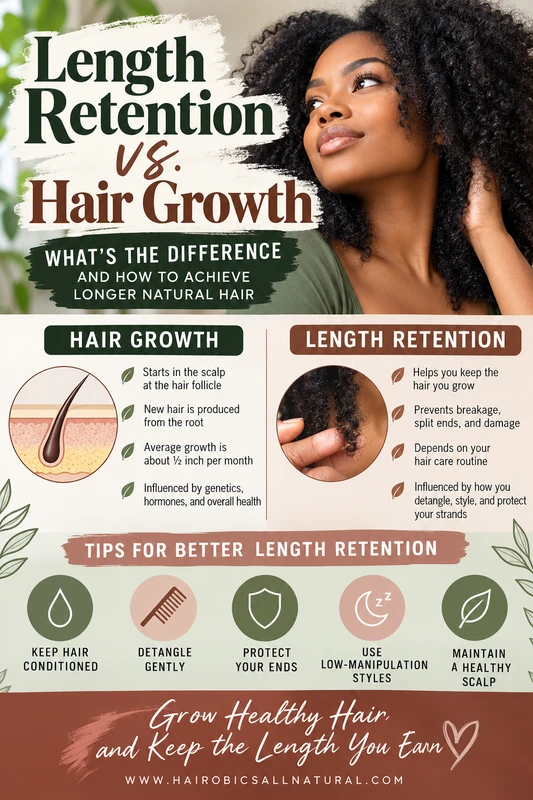
If you've been trying to grow longer natural hair but haven't noticed much progress, you may be focusing on the wrong part of your hair care journey.
Many people spend months searching for the best hair growth oils, scalp treatments, vitamins, and protective hairstyles, hoping to achieve longer, healthier hair. However, there's one important factor that often gets overlooked: length retention.
Hair growth and length retention are not the same thing.
Your hair can grow consistently from your scalp while simultaneously breaking off at the ends. When this happens, you may feel like your hair has stopped growing, even though new hair is being produced.
This is particularly important for people with natural Black hair, curly hair, coily hair, and 4C textures, where shrinkage, tangling, friction, and breakage can make visible length more challenging to maintain.
Understanding the difference between hair growth and length retention can completely change how you approach your natural hair routine.
In this guide, we'll explain how hair growth works, what length retention means, why your hair may not be getting longer, and how to create a routine that helps you keep more of the hair you grow.
What Is Hair Growth?
Hair growth is the biological process through which new hair is produced inside follicles located beneath your scalp.
Each hair follicle goes through a natural growth cycle that determines how long an individual strand continues growing before eventually shedding.
On average, scalp hair grows approximately half an inch per month, or about six inches per year. However, individual growth rates vary depending on genetics, age, hormones, nutritional status, health, and other biological factors.
Hair growth happens at the roots, not at the ends.
This means trimming your hair, applying conditioner to your ends, or wearing protective hairstyles does not directly make your follicles produce hair faster.
However, these practices can influence how much of your existing hair you keep.
Understanding the Hair Growth Cycle
The hair growth cycle consists of several stages.
1. Anagen Phase: Active Growth
During the anagen phase, hair follicles actively produce new hair.
This phase generally lasts several years on the scalp, although its duration varies among individuals.
The longer a strand remains in the growth phase, the greater its potential length.
2. Catagen Phase: Transition
The catagen phase is a relatively short transition period when active hair production stops and the follicle begins changing.
3. Telogen Phase: Resting
During the telogen phase, the hair rests before eventually being released.
4. Exogen Phase: Shedding
Exogen describes the release of an existing hair strand from the follicle.
Normal shedding is part of the hair growth cycle. Losing some full-length hairs with small bulbs at their roots does not necessarily mean your hair is unhealthy.
Understanding these stages helps explain why growing longer hair requires patience.
Hair growth is gradual, and dramatic changes rarely happen overnight.
What Is Length Retention?
Length retention refers to your ability to keep the hair that grows from your scalp without losing excessive length through breakage, damage, or unnecessary trimming.
While hair growth occurs inside the follicle, length retention depends heavily on what happens to the hair after it emerges from your scalp.
Your strands experience daily wear from washing, brushing, detangling, styling, sleeping, heat, and environmental exposure.
Over time, these activities can weaken the hair shaft, especially toward the ends.
If your ends continuously split or break, you may lose much of the length your scalp produces.
For example, imagine your hair grows six inches over twelve months.
If you lose five inches through breakage and trimming, your visible length increases by only one inch.
However, if you lose just one inch, you may retain approximately five inches of new length.
The growth rate is the same in both examples.
The difference is how much length you preserve.
For additional advice, read our guide on How to Retain Length and Avoid Breakage on Natural Hair.
Length Retention vs. Hair Growth: The Key Differences
Although these two concepts are closely related, they involve different processes.
Hair Growth
-
Happens inside hair follicles.
-
Produces new hair from the scalp.
-
Is influenced by genetics, hormones, age, and overall health.
-
Follows a natural biological growth cycle.
-
Cannot be dramatically accelerated by ordinary cosmetic products.
Length Retention
-
Involves preserving existing hair strands.
-
Depends on preventing unnecessary breakage.
-
Is influenced by detangling, conditioning, styling, and handling.
-
Requires protecting older, more fragile ends.
-
Can often be improved through consistent hair care practices.
The most important difference is that hair growth creates new length, while length retention helps you keep it.
A successful natural hair journey should address both.
You want a healthy scalp that supports normal hair growth and a gentle hair care routine that protects the strands already growing.
Why Does Natural Hair Grow but Not Get Longer?
One of the most common frustrations among people with natural hair is reaching a certain length and feeling like their hair refuses to grow any farther.
For some people, that length is around the shoulders. Others struggle to grow beyond the neck, collarbone, or bra-strap area.
Several factors may explain this experience.
1. Breakage Is Canceling Out Your Growth
When hair breaks near the ends at approximately the same rate that new hair grows from the scalp, visible length may remain unchanged.
You might notice short broken pieces in your sink, uneven ends, or strands snapping during detangling.
These are signs that your hair may be experiencing mechanical damage.
2. Your Hair Is Shrinking
Natural curls and coils can shrink considerably when exposed to moisture.
This is especially noticeable with tightly coiled hair textures.
Hair that appears only four inches long in its natural state may be significantly longer when gently stretched.
Shrinkage does not automatically mean your hair is damaged or growing slowly.
In many cases, it's simply a normal characteristic of your curl pattern.
3. Your Ends Are Becoming Weaker
The ends of your hair are the oldest portions of each strand.
They have experienced more washing, styling, friction, and environmental exposure than the newer hair near your scalp.
As a result, they are often more vulnerable to splitting and breakage.
4. Your Hair Care Routine Is Too Aggressive
Frequent heat styling, rough brushing, tight hairstyles, and excessive manipulation can contribute to unnecessary damage.
Even a routine filled with expensive products may produce disappointing results if your hair is handled roughly.
5. Your Growth Rate May Actually Be Changing
Not every length plateau is caused by breakage.
Hormonal changes, nutritional deficiencies, medical conditions, medications, and certain scalp disorders can influence hair growth.
If you notice sudden thinning, unusual shedding, bald patches, or significant changes in your hair growth pattern, consult a dermatologist.
Why Length Retention Is Especially Important for 4C Hair
Type 4C hair is known for its tightly coiled texture, beautiful volume, and significant shrinkage.
However, its structure can make length retention more challenging when the hair is not handled carefully.
Tightly coiled strands contain numerous bends and curves.
These bends can become vulnerable points when the hair experiences excessive tension or friction.
Natural scalp oils may also have difficulty spreading evenly along tightly curved strands.
This can leave the ends feeling drier than the hair near the scalp.
Additionally, tightly coiled hair may develop single-strand knots, particularly when the ends repeatedly curl around themselves.
None of this means 4C hair cannot grow long.
It means a successful routine should emphasize:
-
Gentle detangling.
-
Consistent conditioning.
-
Low-manipulation styling.
-
Protecting fragile ends.
-
Minimizing excessive heat.
-
Reducing friction during sleep.
-
Avoiding tight hairstyles.
The goal is not to force your hair into a different texture.
It's to understand your natural curl pattern and care for it in ways that reduce unnecessary damage.
10 Ways to Improve Length Retention on Natural Hair
1. Keep Your Hair Properly Conditioned
Conditioning is one of the most important steps in maintaining manageable natural hair.
Hair that feels rough, tangled, or brittle can become more difficult to detangle without causing damage.
A suitable conditioner helps improve softness, lubrication, and manageability.
After washing, use a conditioner designed for your hair's needs.
A leave-in treatment may provide additional conditioning between wash days.
For example, Hairobics All Natural Leave-In Treatment contains botanical ingredients including aloe vera, avocado oil, and jojoba oil.
It can be incorporated into a routine focused on maintaining conditioned, manageable hair.
Remember that adding more products is not always better.
Apply enough to meet your hair's needs without creating excessive buildup.
2. Detangle Gently and Patiently
Detangling is one of the most common opportunities for mechanical breakage.
When hair is tangled, pulling a comb through it aggressively can cause strands to snap.
Instead, divide your hair into manageable sections.
Apply a conditioner with adequate slip and begin separating tangles carefully.
Start near the ends and gradually work upward toward the roots.
Use your fingers, a wide-tooth comb, or an appropriate detangling brush.
Avoid repeatedly dragging tools through stubborn knots.
If you encounter resistance, stop and gently separate the tangled strands before continuing.
Taking additional time during detangling may help preserve length over the long term.
3. Protect Your Ends
Your ends deserve special attention because they are generally the oldest and most weathered parts of your hair.
Daily friction against clothing, pillowcases, towels, and accessories can contribute to gradual wear.
Protecting your ends may involve wearing loose twists, tucking ends into gentle styles, and avoiding repeated rubbing against rough fabrics.
It also means checking for split ends and knots before they become severe.
Our detailed article, How to Protect the Oldest Part of Your Hair, explains why older strands require additional care.
4. Use Low-Manipulation Hairstyles
Low-manipulation hairstyles reduce how frequently you need to comb, brush, and restyle your hair.
Examples include:
-
Loose two-strand twists.
-
Comfortable flat twists.
-
Gentle buns.
-
Loose braids.
-
Simple tucked hairstyles.
These styles can help reduce repeated handling.
However, a hairstyle is only protective when it does not create excessive tension.
Tight braids, heavy extensions, and tightly pulled ponytails can damage the hairline and contribute to traction alopecia.
If a hairstyle causes pain, headaches, bumps, or scalp tenderness, it is too tight.
5. Limit Excessive Heat
Heat styling can make natural hair easier to stretch temporarily, but excessive temperatures can damage the hair shaft.
Repeated exposure to high heat may weaken strands, increase breakage, and permanently alter some curl patterns.
When using heat tools, apply an appropriate heat protectant and choose the lowest effective temperature.
Avoid repeatedly passing a flat iron over the same section.
You can also explore gentler stretching methods such as loose banding, twists, or carefully managed roller sets.
Reducing unnecessary heat exposure may help preserve the integrity of your strands.
6. Deep Condition According to Your Hair's Needs
Deep conditioning can be helpful for hair that experiences dryness, tangling, or increased styling stress.
A suitable deep conditioner may improve softness and manageability, making detangling easier.
However, not every hair type needs the same frequency.
Some people benefit from weekly treatments, while others may need them less often.
Follow product directions and pay attention to how your hair responds.
If your hair feels coated or weighed down, reconsider the amount or frequency of conditioning products.
7. Trim Damaged Ends When Necessary
Trimming does not increase the biological speed of hair growth.
However, removing split or severely damaged ends can help prevent additional tangling and breakage.
Signs that your ends may need attention include:
-
Visible splits.
-
Persistent knots.
-
Rough or frayed tips.
-
Excessively thin ends.
-
Repeated snapping in the same areas.
There is no universal trimming schedule that works for everyone.
Some people need more frequent maintenance because of heat styling or chemical processing.
Others can go longer between trims when their ends remain in good condition.
The goal is to remove damaged hair without unnecessarily cutting away healthy length.
8. Protect Your Hair While Sleeping
Your hair continues experiencing friction while you sleep.
Repeated rubbing against bedding can increase tangling and wear, particularly around fragile ends.
Consider using a satin or silk bonnet, scarf, or pillowcase.
You can also loosely twist or gather your hair before bed to reduce tangling.
Avoid tight nighttime hairstyles that place tension on the edges.
Nighttime protection is a simple habit that can complement your overall length-retention routine.
9. Maintain a Healthy Scalp
Although length retention focuses on preserving existing strands, scalp health remains important for normal hair growth.
A healthy scalp provides the environment in which hair follicles function.
Regular cleansing helps remove sweat, excess oil, dead skin, and product residue.
Choose a shampoo appropriate for your scalp and wash as often as necessary to maintain comfort and cleanliness.
If you enjoy incorporating a scalp-conditioning product, Hairobics Hair & Scalp Booster contains a blend of botanical oils and conditioning ingredients.
It can be used as directed as part of a scalp care routine.
Keep in mind that scalp oils and cosmetic boosters are not guaranteed treatments for medical hair loss or proven ways to dramatically accelerate follicle growth.
Persistent itching, inflammation, scaling, or unexplained thinning should be evaluated by a healthcare professional.
10. Stay Consistent With Your Routine
Length retention is not achieved through one perfect wash day.
It develops through repeated habits that minimize unnecessary damage.
A consistent routine does not have to involve dozens of products.
Focus on cleansing, conditioning, gentle detangling, appropriate styling, and protecting your hair between wash days.
Evaluate your routine based on how your hair feels and behaves.
If your strands become easier to manage and you notice fewer broken pieces, your habits may be helping.
The best routine is one you can maintain without excessive time, expense, or manipulation.
How to Tell Whether You Have a Growth Problem or a Retention Problem
Determining why your hair is not getting longer can help you choose a more effective approach.
Signs You May Have a Length-Retention Problem
You may be experiencing excessive breakage if:
-
Your roots show new growth, but your ends remain at the same length.
-
You regularly find short, broken pieces of hair.
-
Your ends appear thin or uneven.
-
Detangling causes noticeable snapping.
-
Your hair tangles repeatedly near the tips.
-
You frequently notice split ends.
These signs suggest that your hair may be losing length after it grows.
Signs You May Have a Hair-Growth or Shedding Concern
Consider professional evaluation if you notice:
-
Sudden changes in hair density.
-
Increasingly visible scalp.
-
Bald patches.
-
Significant hairline recession.
-
Unusual shedding lasting several weeks.
-
Scalp pain, redness, or inflammation.
A dermatologist can help determine whether the problem involves breakage, excessive shedding, follicle damage, or another condition.
For a broader understanding of healthy strands, read How to Tell if Natural Hair Is Healthy.
How Much Length Can You Retain in One Year?
The amount of length you retain depends on your individual growth rate and how much length you lose.
Let's use an example based on six inches of annual growth.
Scenario One: Poor Length Retention
-
Annual growth: 6 inches.
-
Length lost: 5 inches.
-
Net length gained: 1 inch.
Scenario Two: Moderate Length Retention
-
Annual growth: 6 inches.
-
Length lost: 3 inches.
-
Net length gained: 3 inches.
Scenario Three: Strong Length Retention
-
Annual growth: 6 inches.
-
Length lost: 1 inch.
-
Net length gained: 5 inches.
These are simplified examples, not guaranteed results.
Actual hair growth and breakage vary from person to person.
The important lesson is that reducing unnecessary breakage can make a substantial difference in visible length, even without changing your biological growth rate.
Does Oiling Your Scalp Help With Hair Growth or Length Retention?
Scalp oils are popular in natural hair care routines, but their benefits are often misunderstood.
Oils can help lubricate hair strands, improve shine, and reduce friction.
Certain oils may also help reduce moisture loss or improve the feel of dry hair.
However, oil itself does not supply water to dehydrated strands.
And while individual ingredients are being studied for potential hair-related benefits, most cosmetic scalp oils have not been proven to significantly accelerate hair growth in humans.
For length retention, the most practical benefit of an appropriate oil is often improved lubrication and manageability.
Apply products according to your hair's needs, and avoid excessive layering that leaves your scalp or strands coated.
Healthy hair care involves balance rather than using the largest possible amount of oil.
Does Protective Styling Actually Help Hair Grow?
Protective hairstyles do not automatically make hair follicles grow faster.
Their primary benefit is reducing manipulation and exposure to certain forms of damage.
When installed comfortably and maintained properly, styles such as twists and loose braids may help preserve existing length.
However, protective styling can become harmful when extensions are too heavy, braids are too tight, or the hair is neglected for extended periods.
Continue cleansing and caring for your scalp while wearing protective styles.
Also pay attention to dryness, tangling, and buildup.
A protective style should make hair care easier without sacrificing scalp comfort or strand health.
How to Track Your Natural Hair Length Accurately
Natural hair shrinkage can make visual progress difficult to measure.
Instead of judging growth only by how your hair looks in its shrunken state, use a consistent measurement method.
Choose a small section of hair and gently stretch it without pulling painfully.
Measure from the same starting point each time.
Record the length and take a photograph under similar conditions.
Repeat approximately every four to six weeks.
Avoid measuring every day, because normal growth is gradual and small differences can be difficult to detect.
You can also monitor changes in the condition of your ends, how easily your hair detangles, and whether you notice less breakage.
For more perspective on realistic growth expectations, explore How Long Does Hair Grow in One Year?.
A Simple Weekly Routine for Better Length Retention
Building a practical routine can make it easier to care for your hair consistently.
Wash Day
Begin by gently separating your hair into sections if necessary.
Cleanse your scalp with an appropriate shampoo.
Follow with a conditioner that provides enough slip for comfortable detangling.
Work through knots carefully, beginning near the ends.
Rinse and apply your preferred leave-in treatment according to its directions.
Between Wash Days
Check your hair's condition before adding more products.
If your strands feel dry or difficult to manage, use an appropriate moisturizing or conditioning product.
Avoid repeatedly soaking, brushing, or restyling your hair without a clear reason.
Choose hairstyles that minimize unnecessary tension and manipulation.
Nighttime
Protect your hair using a comfortable satin or silk accessory.
Keep longer strands loosely contained to reduce tangling.
Monthly Maintenance
Evaluate your ends for knots, splits, and thinning.
Take a progress photograph if you're tracking length.
Consider whether your routine is helping your hair remain manageable and resilient.
Make adjustments based on actual results rather than following every new hair trend.
Common Myths About Hair Growth and Length Retention
Myth 1: Cutting Your Hair Makes It Grow Faster
Trimming removes hair from the ends.
It does not change the rate at which follicles produce new hair.
However, trimming damaged ends can help maintain a healthier-looking shape and reduce problems associated with severe splitting.
Myth 2: 4C Hair Cannot Grow Long
Tightly coiled hair can achieve substantial length.
Its appearance may be influenced by shrinkage, while retention can be affected by tangling, friction, and mechanical stress.
Texture alone does not determine whether someone can have long hair.
Myth 3: More Products Mean Faster Growth
Using multiple oils, creams, sprays, and treatments does not guarantee better results.
Excessive layering may create buildup and make hair harder to manage.
A simple routine using suitable products is often easier to maintain.
Myth 4: Protective Styles Guarantee Length Retention
Protective styles are helpful only when they reduce damage.
Tight or poorly maintained styles can contribute to breakage and hair loss.
Myth 5: Healthy Hair Never Breaks
All hair experiences some degree of wear over time.
The goal is not to eliminate every broken strand.
It's to reduce avoidable damage while maintaining overall hair health.
Frequently Asked Questions About Length Retention vs. Hair Growth
Is length retention more important than hair growth?
Both are important, but they serve different purposes. Hair growth produces new strands, while length retention helps preserve existing hair. If your hair grows normally but breaks excessively, improving retention may be the most useful priority.
Can your hair grow without retaining length?
Yes. Hair can grow from the scalp while breaking at the ends. If the amount of length lost is similar to the amount produced, your hair may appear to remain the same length.
How long does it take to improve length retention?
Some people notice reduced tangling or breakage relatively quickly after changing their routine. However, measurable increases in retained length generally require several months of consistent care. Results vary.
What is the best hairstyle for length retention?
There is no single best hairstyle for everyone. Loose twists, comfortable braids, and other low-manipulation styles may help reduce damage when they are installed and maintained properly.
Does moisturizing hair help with length retention?
Appropriate conditioning and moisture management can improve softness and manageability. This may reduce friction and breakage during styling and detangling.
Can damaged hair be repaired permanently?
Conditioning products can temporarily improve the appearance and feel of damaged strands, but severely split hair cannot be permanently restored to its original structure by ordinary cosmetic products. Trimming may be necessary when damage is extensive.
Does hair grow faster when you stop using heat?
Avoiding excessive heat does not necessarily change your biological growth rate. However, reducing heat damage may help prevent breakage, allowing you to retain more length.
Why does my hair look shorter after washing?
Natural curls and coils often shrink when exposed to water. This is normal and does not mean your hair suddenly lost length.
Final Thoughts: Grow Healthy Hair and Keep the Length You Earn
Understanding length retention vs. hair growth is one of the most valuable lessons in natural hair care.
Hair growth begins beneath your scalp, but visible length depends partly on how well you protect the strands that have already grown.
You can have a healthy growth rate and still struggle to achieve longer hair if your ends experience constant breakage.
That's why a successful routine should focus on both scalp care and strand protection.
Keep your hair conditioned, detangle gently, protect fragile ends, limit unnecessary heat, and choose hairstyles that reduce excessive manipulation.
Most importantly, be patient and consistent.
Healthy hair care is not about chasing unrealistic growth promises. It's about developing habits that support your hair's natural potential.
At Hairobics All Natural, we believe caring for your scalp and protecting your strands should work together.
Explore our Hair & Scalp Booster and Leave-In Treatment to discover conditioning products you can incorporate into a consistent natural hair care routine.
Remember: Hair growth gives you new length. Length retention helps you keep it.