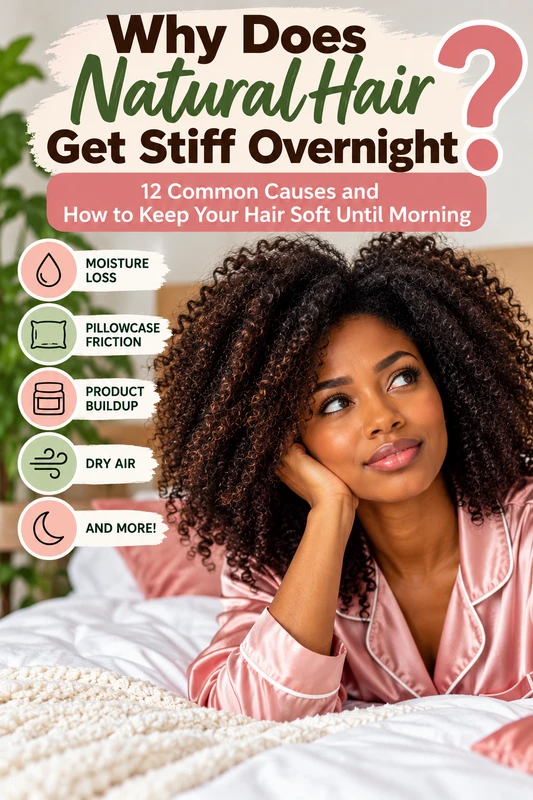
Have you ever gone to bed with soft, moisturized natural hair, only to wake up the next morning with hair that feels stiff, rough, hard, or difficult to manage?
Maybe your curls were soft before bedtime. Your twist-out looked beautiful, your afro felt moisturized, and your ends seemed perfectly healthy. But when you woke up, everything had changed.
Your natural hair felt hard.
Your curls were less flexible.
Your ends felt dry, and your strands were difficult to separate.
If you've been wondering, "Why does my natural hair get stiff overnight?", you're not alone.
Overnight hair stiffness is a common concern for people with curly, coily, kinky, and tightly textured natural hair, including 3C, 4A, 4B, and 4C hair.
The good news is that waking up with stiff natural hair doesn't necessarily mean your hair is damaged.
In many cases, the problem comes from moisture changes, product buildup, styling products, nighttime friction, or the way your hair dries while you're sleeping.
Understanding these factors can help you develop a nighttime routine that keeps your natural hair feeling softer, smoother, and easier to manage.
In this complete guide, we'll explain 12 common reasons natural hair gets stiff overnight, how to identify the cause, and the best ways to keep your curls and coils soft until morning.
What Does It Mean When Natural Hair Gets Stiff Overnight?
Natural hair stiffness occurs when your strands feel less flexible, smooth, or manageable than they did before bedtime.
Instead of feeling soft and easy to manipulate, your hair may become:
-
Hard or crunchy
-
Rough to the touch
-
Dry and brittle
-
Difficult to detangle
-
Less flexible
-
Tangled or matted
-
Frizzy or undefined
-
Coated with product
-
Stiff around the ends
-
Difficult to stretch or style
Some people experience stiffness throughout their entire head, while others notice it primarily around their ends, crown, or nape.
The location of the stiffness can provide clues about the underlying cause.
For example, stiff ends may indicate accumulated damage, inadequate conditioning, or friction against bedding.
Stiff roots may be associated with product buildup, styling products, or tangling.
If your hair feels stiff everywhere, your moisturizing or styling routine may need adjustment.
It's also important to understand that hair stiffness and hair dryness aren't exactly the same thing.
Hair can feel stiff because of styling-product hold even when it isn't severely dry.
Likewise, hair can feel soft on the surface while still experiencing breakage.
For more information, read our guide on why natural hair can feel soft but still break.
1. Your Natural Hair Is Losing Moisture Overnight
One of the most common reasons natural hair feels stiff in the morning is that its moisture content changes overnight.
Natural hair exchanges moisture with the surrounding environment, especially when indoor air is dry.
During the day, your hair may feel soft because you've recently applied water, conditioner, or moisturizing products.
However, as your hair dries and adjusts to the surrounding air, the strands may begin feeling less flexible.
This can become particularly noticeable with tightly coiled hair.
Because the hair shaft follows a curved or spiral pattern, natural scalp oils may not distribute as easily along the lengths as they do on straighter hair.
Consequently, the ends may require more conditioning attention.
How to Prevent Overnight Moisture Loss
Start by examining your nighttime moisturizing routine.
If your hair feels noticeably dry before bed, consider lightly refreshing it with a water-based leave-in conditioner.
Apply the product in sections so that it reaches more than just the outer surface.
Pay particular attention to the ends.
Avoid soaking your hair immediately before bedtime. If you apply moisture, give your hair adequate time to dry before covering it.
You can also use a small amount of an appropriate conditioning cream or oil if your hair benefits from additional lubrication.
Remember that applying more product doesn't always produce softer hair.
The goal is balanced moisture and conditioning, not excessive product buildup.
2. You're Sleeping on a Cotton Pillowcase
Your pillowcase can influence how your natural hair feels in the morning.
Traditional cotton pillowcases create friction as your head moves during sleep.
When curly or coily strands repeatedly rub against fabric, they can become tangled, frizzy, and rough.
Cotton can also absorb some moisture and hair-product residue, although the effect depends on the fabric and products used.
Over time, repeated friction may contribute to cuticle wear and breakage.
Why Friction Makes Natural Hair Feel Stiff
Imagine going to bed with a freshly moisturized twist-out.
Throughout the night, you turn your head against your pillow.
Individual strands rub against one another and against the pillowcase.
By morning, your curls may be compressed, tangled, and less smooth.
This change in texture can make your hair feel stiffer even if the underlying problem isn't severe dehydration.
How to Fix It
Try sleeping on a satin or silk pillowcase.
You can also protect your hair with a satin bonnet or scarf.
These smoother surfaces can reduce friction and help preserve your hairstyle.
Make sure your bonnet fits comfortably.
An extremely tight bonnet may compress your hair or create unnecessary tension around your hairline.
For additional protection, loosely section your hair before bedtime.
3. You're Using Too Much Oil Before Bed
Hair oils can be helpful, but using excessive amounts may contribute to stiffness.
Some people believe that applying more oil automatically makes natural hair softer.
Unfortunately, this isn't always true.
Oil can lubricate the hair shaft, improve shine, and reduce friction.
However, oil alone isn't a complete replacement for water-based conditioning.
When you repeatedly apply oil without adequately cleansing or conditioning your hair, the strands may develop a heavy coating.
This can leave your hair feeling greasy and stiff at the same time.
Signs You're Using Too Much Oil
You may notice:
-
Hair that feels oily but still rough
-
Dull-looking curls
-
Heavy or waxy strands
-
Product collecting around the roots
-
Reduced curl movement
-
Hair that becomes increasingly difficult to style
What to Do Instead
Start with a water-based moisturizing product when your hair needs hydration.
Distribute it evenly throughout your strands.
If your hair benefits from additional lubrication, apply a small amount of oil afterward.
Focus on the lengths and ends rather than automatically covering your scalp.
You don't necessarily need to apply oil every night.
For a deeper explanation, read our article on why oil doesn't moisturize dry hair and what your hair actually needs.
4. Your Styling Gel Is Making Your Hair Hard
Styling gel is another common cause of overnight stiffness.
Many gels are formulated to create hold by forming a film around the hair.
As the product dries, it may produce a firm cast that keeps curls or waves in place.
This isn't automatically a sign of damage.
In fact, a gel cast can help maintain curl definition and reduce frizz.
However, some gels create a stronger cast than others.
If you apply a large amount before bedtime, your hair may feel particularly hard the following morning.
How to Soften a Gel Cast
First, make sure your hair is completely dry.
Then gently squeeze or scrunch the hair to break the cast.
If appropriate for your style, use a tiny amount of lightweight oil on your hands to reduce friction.
Avoid aggressively combing through hardened curls.
If the gel consistently leaves your hair excessively stiff, consider using less product or choosing a formula with a softer hold.
For a detailed explanation, read why natural hair gets hard after gel and how to keep your curls soft.
5. You're Going to Bed With Wet Hair
Going to sleep with wet natural hair can create several problems.
When your hair is wet, it becomes more flexible and can stretch more easily.
As it dries, the strands settle into the position in which they're held.
If you sleep with loose, wet curls pressed against your pillow, your hair may dry in compressed or irregular shapes.
This can leave your curls feeling stiff, tangled, or difficult to reshape the next morning.
Wet hair is also more vulnerable to certain types of mechanical damage.
What Happens When Hair Dries Overnight?
Imagine washing your hair at 10 p.m.
You apply conditioner, styling cream, and gel.
Then you immediately put on a bonnet and go to sleep.
Your hair remains damp for hours.
Some sections dry while compressed, while others stay moist longer.
By morning, the hairstyle may feel uneven, stiff, or tangled.
A Better Approach
Whenever possible, wash or heavily moisturize your hair earlier in the day.
Allow your hair enough time to dry before bedtime.
If you need to refresh your curls at night, use a light mist instead of completely saturating them.
You can also place your hair into loose twists or braids while it dries, provided the style isn't excessively tight.
The goal is to minimize friction and avoid trapping soaking-wet hair underneath a bonnet.
6. Your Hair Has Product Buildup
Sometimes your natural hair becomes stiff overnight because too many products have accumulated on the strands.
This is particularly common when several styling products are used repeatedly without adequate cleansing.
For example, your routine might include:
Monday: moisturizing cream.
Tuesday: hair oil.
Wednesday: leave-in conditioner.
Thursday: curl gel.
Friday: more oil.
Saturday: additional styling cream.
Over time, these layers can create a coating that affects how your hair feels.
Instead of becoming softer, your hair may feel heavier, rougher, or less responsive to moisturizing products.
How to Identify Product Buildup
Common signs include:
-
Hair that feels coated
-
Dull curls
-
Sticky or waxy strands
-
Excessive product residue
-
Hair that remains stiff after moisturizing
-
Reduced movement and flexibility
-
Products that appear to sit on the surface
How to Remove Product Buildup
Use a shampoo appropriate for your hair type and styling routine.
If buildup is substantial, occasional clarifying may be helpful.
Follow cleansing with a moisturizing conditioner.
Pay attention to how your hair feels after removing accumulated residue.
You may discover that your hair doesn't need another expensive moisturizer.
It may simply need a fresh start.
7. Your Natural Hair Has High Porosity
Hair porosity describes how your hair interacts with water.
Some strands absorb water relatively quickly and may also experience faster changes in moisture content.
High-porosity hair often has more weathered or damaged cuticle layers, although porosity varies naturally and isn't determined by curl pattern alone.
If your hair is highly porous, it may feel soft immediately after conditioning but become rough again as it dries.
This can be especially noticeable overnight.
Signs Your Hair May Be Highly Porous
You might notice:
-
Hair that wets quickly
-
Hair that dries relatively fast
-
Frequent frizz
-
Rough-feeling ends
-
Increased tangling
-
Difficulty maintaining softness
-
A history of heat or chemical damage
These signs aren't a definitive porosity test, but they may help you evaluate your routine.
How to Care for High-Porosity Natural Hair
Focus on consistent conditioning.
Use a suitable leave-in treatment after washing.
Reduce excessive heat styling and rough detangling.
Some damaged hair may benefit from strengthening treatments designed for its specific condition.
Avoid assuming that every case of dryness requires protein.
Too much emphasis on strengthening without adequate conditioning may leave some hair feeling less manageable.
Your goal is to improve softness while minimizing further damage.
8. Your Hair Ends Are Dry or Damaged
The ends of your natural hair are usually the oldest portions of your strands.
They've experienced more washing, styling, detangling, heat exposure, and environmental wear than the newer hair near your scalp.
As a result, your ends may become rough or stiff more easily.
This can explain why your roots feel soft in the morning while the ends feel hard.
Why Hair Ends Need Extra Attention
Your scalp produces natural oils that can help lubricate nearby strands.
However, those oils may not travel efficiently down tightly curled hair.
Your ends also experience more accumulated wear.
If they're already weathered, they may become noticeably rough as products dry overnight.
How to Keep Your Ends Soft
Apply conditioner throughout your hair, concentrating on the ends.
Use a suitable leave-in treatment after washing.
Minimize friction by protecting your hair at night.
Avoid excessive heat and aggressive detangling.
Inspect your ends for splitting or significant damage.
If your ends are visibly split, trimming the damaged portions may be necessary.
No moisturizer can permanently reconnect a split hair shaft.
9. Your Bedroom Air Is Too Dry
Your sleeping environment can affect how your hair feels.
Air-conditioned rooms, indoor heating, and naturally dry climates may have low humidity.
Hair exchanges moisture with the surrounding air, so changes in humidity can influence how flexible or rough the strands feel.
During dry weather, your natural hair may feel less soft by morning.
This can be especially noticeable if your hair was already inadequately conditioned.
How to Reduce Environmental Dryness
Consider monitoring your bedroom's humidity.
A humidifier may be useful if the air is excessively dry.
However, avoid creating an overly humid environment, which can encourage mold and other indoor air problems.
Maintain a consistent conditioning routine.
Protect your hair with satin or silk.
Avoid sleeping directly beneath strong airflow when possible.
Remember that a humidifier isn't a substitute for proper hair care.
It's simply one environmental adjustment that may help.
10. You're Not Using Enough Leave-In Conditioner
Rinse-out conditioner and leave-in conditioner serve different purposes.
Rinse-out conditioner is generally designed to be washed away after a short period.
Leave-in conditioner is formulated to remain on the hair and provide ongoing conditioning benefits.
If you shampoo and condition your natural hair but skip leave-in products entirely, your hair may become less manageable as it dries.
This doesn't mean everyone needs a heavy leave-in cream.
Fine hair may respond well to a lightweight spray, while thicker or coarser hair may prefer a richer formula.
How to Apply Leave-In Conditioner Correctly
After washing, gently remove excess water.
Divide your hair into manageable sections.
Apply your leave-in conditioner according to the product directions.
Distribute it carefully through the recommended areas.
Use enough product to provide coverage without making your hair excessively coated.
Allow your hair to dry before sleeping.
Try Hairobics All Natural Leave-In Treatment
If your natural hair regularly feels stiff after drying, incorporating a leave-in treatment into your routine may help improve softness and manageability.
The Hairobics All Natural Leave-In Treatment features a botanical formula containing aloe vera, avocado oil, jojoba oil, rosemary oil, and other plant-derived ingredients.
The treatment is designed for hair and scalp care, making it an option for people who want to add conditioning support to their regular routine.
Follow the product's application directions and test a small area before widespread use.
A leave-in treatment can be particularly useful when your hair needs additional conditioning after washing.
For more information about choosing and using leave-in products, read our complete guide to the best leave-in conditioners for natural hair.
11. Your Hair Is Becoming Tangled While You Sleep
Natural hair can become tangled overnight, especially when worn loose.
As you move during sleep, individual curls and coils may wrap around one another.
This can create knots and compacted sections that feel stiff or difficult to separate.
Hair tangling isn't always caused by dryness.
It can also result from friction, shed hairs, styling techniques, and the natural shape of curly strands.
How to Prevent Nighttime Tangling
Consider loosely dividing your hair into several sections before bedtime.
Two-strand twists, loose braids, or a comfortable pineapple hairstyle may help keep strands organized.
Avoid securing your hair with extremely tight elastics.
Protect the style with a satin bonnet or scarf.
If your hair is already tangled in the morning, don't force a comb through it.
Instead, use an appropriate detangling product and gently separate the strands.
Start at the ends and work gradually toward the roots.
12. You're Using Too Much Styling Product
Sometimes the problem isn't a lack of moisture.
It's excessive styling product.
Heavy creams, butters, gels, and pomades can make natural hair feel stiff when applied in large quantities.
This can be particularly noticeable when multiple products are layered together.
For example, combining a thick leave-in cream, heavy butter, strong-hold gel, and oil may leave some hair types feeling weighed down.
As the products dry overnight, the hairstyle may become harder or less flexible.
How to Fix Product-Related Stiffness
Simplify your routine.
Try using one suitable leave-in conditioner and one styling product.
Observe how your hair responds.
If you need additional lubrication, add only a small amount of oil.
Avoid layering multiple heavy products simply because they're popular.
Your natural hair may respond better to fewer products used consistently.
If your hair seems to become dry immediately after applying moisturizing products, our article on why hair feels dry right after moisturizing explores additional causes and solutions.
How to Keep Natural Hair Soft Overnight: Step-by-Step Nighttime Routine
Now that you understand the possible causes, let's build a simple nighttime routine designed to help your natural hair stay soft and manageable.
Step 1: Check Your Hair Before Bed
Before applying anything, touch your hair.
Does it actually feel dry?
Is it already soft and moisturized?
Does it feel coated with product?
This quick assessment helps prevent unnecessary product layering.
If your hair already feels soft, you may not need to add anything.
Step 2: Lightly Refresh Dry Sections
If your hair needs moisture, lightly apply a water-based moisturizing product.
Focus on dry sections rather than automatically saturating your entire head.
You can work in four to six sections for easier distribution.
Use your hands to gently smooth the product along your strands.
Step 3: Apply Leave-In Conditioner When Needed
If your hair feels rough or difficult to manage, a suitable leave-in conditioner may help.
Pay particular attention to the ends when using a product intended for application along the hair shaft.
Avoid applying excessive amounts.
Your hair should feel conditioned rather than sticky or heavily coated.
Step 4: Use Oil Only if Necessary
If your hair benefits from additional lubrication, apply a small amount of lightweight oil.
Don't assume that every nighttime routine requires oil.
Some hair types respond better to leave-in conditioner alone.
Step 5: Choose a Protective Nighttime Style
Try loose twists, braids, or another low-manipulation hairstyle.
The goal is to reduce tangling and friction while you sleep.
Avoid styles that pull tightly around your edges or scalp.
Step 6: Cover Your Hair With Satin or Silk
Use a comfortable bonnet or scarf.
A satin or silk pillowcase provides another protective option.
Make sure your hair has had adequate time to dry if you've applied water or moisturizing products.
Step 7: Avoid Excessive Manipulation
Once your hair is prepared for bedtime, leave it alone.
Constantly combing, brushing, or restyling your hair can increase friction and unnecessary wear.
A good nighttime routine should be simple enough to maintain consistently.
How to Make Stiff Natural Hair Soft Again in the Morning
What if you wake up and your hair already feels hard?
You don't necessarily need to wash it immediately.
Try the following approach.
First: Determine Why Your Hair Feels Stiff
If your hair feels crunchy because of gel, gently scrunching may soften the cast.
If your hair feels dry, a lightweight moisturizing product may help.
If your hair feels greasy and coated, adding more product may make things worse.
Second: Work in Sections
Divide your hair into manageable sections.
Avoid aggressively pulling apart tangled curls.
Use your fingers to separate the hair gently.
Third: Apply a Small Amount of Moisture
If dryness appears to be the problem, lightly mist the affected areas.
Follow with a small amount of suitable leave-in conditioner if appropriate.
Allow the product to distribute through your strands.
Fourth: Gently Reshape Your Hairstyle
Use your fingers to fluff your roots or redefine individual curls.
Avoid excessive brushing.
If your hair is severely tangled, use a detangling product with enough slip before attempting to separate the strands.
Fifth: Reevaluate Your Routine
If your hair becomes stiff every morning, the solution probably isn't adding more product indefinitely.
Instead, examine your washing, conditioning, styling, and sleeping habits.
Consistent adjustments are often more effective than temporary fixes.
Best Nighttime Hairstyles for Keeping Natural Hair Soft
Your nighttime hairstyle can make a significant difference in how manageable your hair feels the next morning.
Loose Two-Strand Twists
Two-strand twists can keep your hair organized and reduce tangling.
They're particularly helpful for people who experience shrinkage or knots overnight.
Apply an appropriate moisturizing product before styling, if needed.
Avoid twisting too tightly.
Loose Braids
Loose braids can help reduce friction between individual strands.
They may also help preserve stretched hairstyles.
Make sure the braids are comfortable and don't create excessive scalp tension.
The Pineapple Method
The pineapple method involves loosely gathering curls near the top of the head.
It can help preserve curl definition and reduce compression.
This technique may work especially well for longer curly styles.
Satin Bonnet With Loose Hair
Some people prefer sleeping with their natural hair loose underneath a satin bonnet.
This can work well when the bonnet is large enough to accommodate the hairstyle without excessive compression.
Choose the method that best suits your hair length, density, and styling preferences.
Does 4C Hair Get Stiff Overnight More Easily?
People with 4C hair frequently report overnight dryness, shrinkage, and stiffness.
However, 4C hair isn't automatically unhealthy or deficient in moisture.
Its tightly coiled structure can make natural oils less evenly distributed along the strands.
Shrinkage can also cause curls to compact together, which may make the hair feel denser or harder to separate.
If your 4C hair feels stiff every morning, focus on conditioning, minimizing friction, and reducing excessive product buildup.
You don't need to force your hair to behave like a looser curl pattern.
Instead, choose products and techniques that support your natural texture.
A consistent routine may include gentle shampooing, regular conditioning, leave-in conditioner when needed, low-manipulation hairstyles, satin nighttime protection, careful detangling, and periodic trimming of damaged ends.
The objective is healthy, manageable hair rather than eliminating natural shrinkage.
Why Does My Hair Feel Soft at Night but Hard in the Morning?
If your hair feels soft immediately after applying products but hard the following morning, the products may be temporarily changing how your strands feel.
Water can make hair more flexible.
Conditioners can improve slip and reduce friction.
Some styling products provide softness while wet but become firmer as they dry.
By morning, your hair may have dried completely, revealing a different texture.
This doesn't automatically mean all the moisture disappeared overnight.
It may simply mean the hair and products have reached their dry state.
If your hair feels consistently hard after drying, try changing one part of your routine at a time.
For example, use less gel for several styling sessions.
If that doesn't help, evaluate your leave-in conditioner.
Then consider whether buildup or accumulated damage may be contributing.
Making one adjustment at a time helps you identify what actually works.
Can Sleeping With a Bonnet Make Natural Hair Stiff?
A satin bonnet generally helps reduce friction, but it doesn't guarantee soft hair.
If your hair is already heavily coated with styling products, the bonnet won't remove that buildup.
Likewise, if you put your hair into an extremely tight style before covering it, the strands may become compressed.
A bonnet that's too small can also flatten or bunch up your hairstyle.
Choose a bonnet that comfortably accommodates your hair.
Avoid wrapping damp hair tightly and leaving it wet for hours.
Remember that the bonnet is one part of your nighttime routine, not a complete moisturizing treatment.
Should You Moisturize Natural Hair Every Night?
Not necessarily.
Some people benefit from frequent lightweight moisturizing.
Others find that applying products every night creates buildup.
Your ideal schedule depends on several factors, including hair texture, porosity, styling products, environmental conditions, and how frequently you wash your hair.
Instead of following a rigid schedule, pay attention to how your hair feels.
If your hair is still soft and manageable, additional product may not be necessary.
If your ends feel rough or dry, a small amount of appropriate moisturizer may help.
The goal is consistency without overloading your strands.
How Often Should You Wash Natural Hair That Gets Stiff?
There's no universal washing schedule for every natural hair type.
Your ideal frequency depends on your scalp condition, activity level, styling products, and personal needs.
If you regularly use heavy creams, oils, or gels, you may need to cleanse more frequently to prevent buildup.
If your hair becomes stiff immediately after washing, consider whether your shampoo is too harsh or whether your conditioning routine needs improvement.
A suitable shampoo should remove accumulated dirt, oil, and product residue.
Follow with conditioner to improve manageability.
Deep conditioning may be useful when your hair needs additional softness, but it isn't necessary to use an intensive treatment every day.
If your hair remains unusually rough despite appropriate conditioning, consider whether heat damage, chemical processing, or split ends may be contributing.
Can Overnight Hair Stiffness Cause Breakage?
Stiffness itself doesn't automatically mean your hair will break.
For example, a firm gel cast may feel hard without indicating significant structural damage.
However, hair that is rough, severely weathered, or difficult to detangle may experience greater friction during manipulation.
Aggressive combing can worsen the problem.
This is why it's important to understand the cause of stiffness before attempting to fix it.
If your hair feels hard because of styling gel, gently breaking the cast may be enough.
If your hair feels brittle and snaps easily, you may need to focus on conditioning, reducing damage, and handling the strands more carefully.
Persistent breakage deserves attention, especially when accompanied by thinning or changes in hair density.
A Simple Weekly Routine to Prevent Stiff Natural Hair
You don't need a complicated collection of products to maintain soft natural hair.
A straightforward routine can help you understand what works.
On Wash Day
Cleanse your scalp and hair with an appropriate shampoo.
Apply conditioner throughout the lengths.
Detangle gently while the hair has sufficient slip.
Deep condition if your hair needs additional care.
Apply a suitable leave-in treatment.
Style without excessive tension.
During the Week
Check your hair for dryness.
Lightly refresh sections when necessary.
Avoid repeatedly layering heavy products.
Protect your hair from unnecessary friction.
Every Night
Choose a comfortable, low-manipulation hairstyle.
Use satin or silk protection.
Avoid sleeping with soaking-wet hair.
Don't apply products automatically if your hair doesn't need them.
Every Morning
Assess your hair before restyling.
Gently separate curls or twists.
Apply moisture only where needed.
Avoid excessive combing and brushing.
Periodically
Inspect your ends for damage.
Trim visibly split or severely weathered portions when appropriate.
Evaluate whether your products are leaving buildup.
Adjust your routine as the weather or your hairstyle changes.
Frequently Asked Questions About Natural Hair Getting Stiff Overnight
Why does my natural hair get hard after sleeping?
Natural hair may feel hard after sleeping because of drying styling products, friction, tangling, insufficient conditioning, or product buildup. The exact cause depends on your routine and hair condition.
Why does my 4C hair feel like straw in the morning?
Your hair may need additional conditioning, especially around the ends. Friction, accumulated damage, heavy product residue, and dry indoor air may also contribute.
Is it bad if my natural hair gets stiff overnight?
Not always. Stiffness caused by a styling-product cast isn't necessarily harmful. However, persistent brittleness, excessive tangling, or frequent breakage may indicate that your hair care routine needs adjustment.
Should I spray water on my natural hair every night?
You can lightly mist your hair when it needs moisture, but daily spraying isn't necessary for everyone. Avoid repeatedly soaking your hair immediately before bedtime.
Does oil keep natural hair soft overnight?
Some oils can improve lubrication and reduce friction. However, oil alone may not provide the conditioning that dry hair needs. Excessive oil application can also contribute to buildup.
Can a satin bonnet prevent overnight stiffness?
A satin bonnet may help reduce friction and tangling. However, it cannot completely prevent stiffness caused by styling products, buildup, or damaged hair.
Why does my hair get stiff after applying moisturizer?
Some moisturizing and styling products contain ingredients that form films or create hold as they dry. Applying excessive product may also leave a heavy coating. Try adjusting the amount or choosing a different formula.
Can deep conditioning stop natural hair from getting stiff?
Deep conditioning may improve softness and manageability, particularly when hair feels rough or inadequately conditioned. However, it won't permanently repair split ends or eliminate stiffness caused by every styling product.
Why is my natural hair stiff only at the ends?
Your ends are older and have experienced more accumulated wear. They may also receive less natural lubrication than the hair near your scalp. Extra conditioning, reduced friction, and trimming damaged ends when necessary may help.
How can I keep my afro soft overnight?
Use a suitable leave-in conditioner when needed, minimize heavy product buildup, loosely section your hair, and protect it with satin or silk. Avoid sleeping with soaking-wet hair or creating excessive tension.
Final Thoughts: How to Stop Natural Hair From Getting Stiff Overnight
Waking up with stiff natural hair can be frustrating, especially when you've spent time moisturizing and styling your curls.
However, overnight stiffness doesn't always mean your hair is damaged or that you need to purchase more products.
In many cases, the solution involves making small adjustments to your existing routine.
Start by identifying whether your hair feels dry, coated, tangled, or simply firm because of styling products.
Then focus on appropriate cleansing, consistent conditioning, gentle handling, and nighttime protection.
Avoid excessive oil and heavy product layering.
Protect your ends from friction.
Give your hair adequate time to dry before bedtime.
Most importantly, pay attention to how your own hair responds.
Natural hair comes in many textures, densities, and porosity levels. A routine that works beautifully for one person may not work the same way for another.
With patience and consistent care, you can develop a nighttime routine that helps your curls, coils, twists, or afro feel softer and easier to manage when morning arrives.
Give Your Natural Hair the Care It Deserves With Hairobics All Natural
At Hairobics All Natural, we believe that maintaining beautiful natural hair starts with a simple, consistent routine.
Whether you're caring for 4C hair, maintaining a twist-out, or trying to reduce everyday dryness, choosing appropriate conditioning products can make your hair care routine easier.
Our Hairobics All Natural Leave-In Treatment contains a botanical blend of ingredients including aloe vera, jojoba oil, avocado oil, and rosemary oil. It's designed to complement your hair and scalp care routine while helping improve the feel and manageability of your strands.
Discover the benefits of incorporating botanical conditioning into your routine in our guide to herbal leave-in hair treatments.
Beautiful natural hair starts with understanding what your strands need and giving them consistent care.
Shop Hairobics All Natural Leave-In Treatment and give your hair the conditioning attention it deserves.