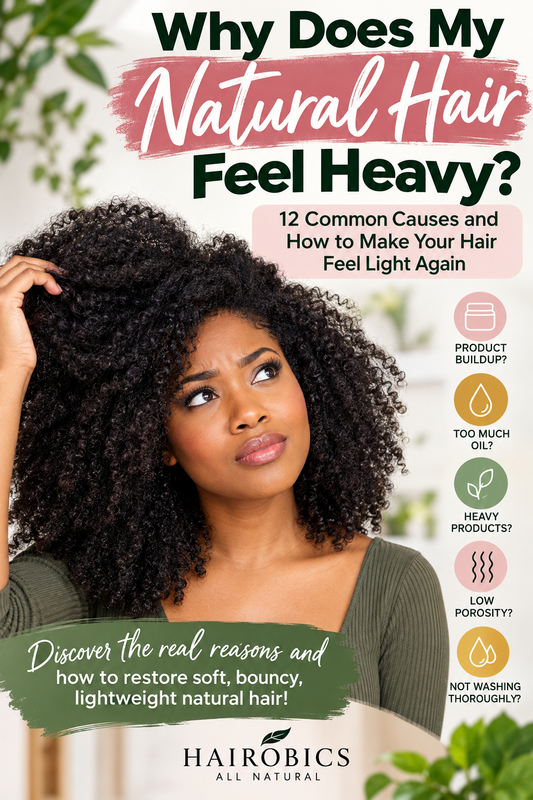
Natural hair should feel soft, manageable, and comfortable to wear. Whether you have beautiful 4C coils, thick 4B curls, a voluminous afro, or naturally curly 3C hair, your strands should have the flexibility and movement that suit your natural texture.
But what happens when your natural hair suddenly starts feeling unusually heavy?
Maybe your curls seem weighed down after moisturizing. Perhaps your afro has lost its volume, your roots feel greasy, or your hair feels thick and coated even though you recently washed it.
You might even notice that your hair feels heavy at the roots but dry at the ends.
If you've been asking yourself, "Why does my natural hair feel heavy?", you're not alone.
Heavy-feeling natural hair is a common concern among people with curly, coily, kinky, and tightly textured hair. Although having naturally thick or dense hair can contribute to a feeling of weight, excessive heaviness often develops because of product buildup, heavy oils, over-moisturizing, improper cleansing, or using products that aren't suited to your hair.
The good news is that heavy hair doesn't automatically mean damaged or unhealthy hair.
In many cases, a few adjustments to your cleansing, moisturizing, and styling routine can help restore softness, movement, and manageability.
In this complete guide, we'll explore 12 reasons your natural hair feels heavy, how to identify what's causing the problem, and practical ways to make your natural hair feel lighter without sacrificing moisture.
What Does It Mean When Natural Hair Feels Heavy?
When someone describes their natural hair as feeling heavy, they may be referring to several different experiences.
For some people, heaviness means their curls have lost volume and movement. For others, it describes an uncomfortable coating that makes their strands feel greasy, thick, or overloaded with products.
Sometimes the sensation comes from the actual weight of long, dense hair, particularly when it's wet or pulled into a hairstyle.
Common signs of heavy-feeling natural hair include:
-
Curls appear flat or weighed down.
-
Hair feels greasy shortly after moisturizing.
-
Roots lose their natural volume.
-
Strands feel coated or waxy.
-
Hair takes longer than usual to dry.
-
Twist-outs lose their definition.
-
Hair feels sticky when touched.
-
Products seem to accumulate on the strands.
-
The scalp feels uncomfortable beneath heavy hairstyles.
-
Hair looks dull despite using moisturizing products.
-
Natural curls feel less bouncy.
-
Hair feels heavy even after washing.
Not every symptom has the same cause.
For example, hair that feels heavy immediately after applying oil may need less product, while hair that feels physically heavy when placed in a tight bun may need a different hairstyle.
Understanding the difference is essential.
Let's explore the most common causes.
1. Product Buildup Is Weighing Down Your Natural Hair
One of the biggest reasons natural hair feels heavy is product buildup.
Natural hair routines often involve several products designed to improve moisture retention, softness, shine, and styling.
These may include leave-in conditioners, curl creams, hair oils, styling gels, edge controls, pomades, and hair butters.
Although these products can provide benefits, repeatedly applying them without thoroughly cleansing your hair can leave accumulated residue.
Over time, that residue may make your strands feel heavier.
How Product Buildup Develops
Imagine your weekly hair routine looks like this:
On Monday, you apply leave-in conditioner and a thick moisturizing cream.
On Tuesday, you refresh your curls with another layer of cream.
On Wednesday, you add castor oil to your scalp and ends.
On Thursday, you use additional styling gel.
By Friday, your hair may contain several layers of conditioning and styling ingredients.
Instead of feeling increasingly moisturized, your curls may begin to feel greasy, sticky, or unusually heavy.
Signs of Product Buildup
Watch for these symptoms:
-
Hair feels waxy or coated.
-
Curls lose their natural bounce.
-
Your usual moisturizer seems less effective.
-
Hair feels dirty shortly after styling.
-
White residue appears on your strands.
-
Your fingers feel greasy after touching your hair.
-
Your hairstyle looks flatter than usual.
How to Fix It
Start by thoroughly washing your hair with an appropriate shampoo.
If your regular shampoo isn't removing accumulated residue, consider using a clarifying shampoo.
Clarifying shampoos are formulated to remove stubborn styling products, oils, and other deposits.
After clarifying, follow with a moisturizing conditioner to restore softness and manageability.
Avoid immediately applying several heavy products after washing.
For more information, read our guide on why your hair feels coated and how to remove product buildup.
2. You're Using Too Much Hair Oil
Hair oils are popular in natural hair care, particularly among people with 4A, 4B, and 4C hair.
Oils can improve lubrication, add shine, reduce friction, and help limit moisture loss.
However, using too much oil can leave natural hair feeling weighed down.
Some oils have a thicker consistency than others.
For example, castor oil is relatively viscous and can leave a noticeable coating when applied generously.
Even lighter oils can feel excessive when used in large amounts.
Why Too Much Oil Makes Hair Heavy
Oil doesn't evaporate from your hair as quickly as water.
Depending on the formulation and application, some oil remains on or near the hair's surface.
When you repeatedly apply oil without cleansing, it can combine with other styling ingredients.
This may leave your hair looking shiny while feeling greasy and difficult to manage.
How to Fix Heavy, Oily Hair
Begin by reducing how much oil you apply.
Instead of coating your entire head, concentrate on areas that actually need additional lubrication.
For example, your ends may benefit from a small amount of oil while your roots need none.
Try applying a few drops to your hands, rubbing your palms together, and distributing the oil lightly.
You can always add more if necessary.
Remember that oils and water-based moisturizers perform different functions.
If your hair feels dry underneath an oily coating, additional oil may not solve the problem.
3. Your Hair Products Are Too Heavy for Your Hair Type
Not all natural hair responds to moisturizing products in the same way.
Some people have coarse strands that tolerate rich creams and butters comfortably.
Others have fine strands that become weighed down quickly.
Your hair's thickness, density, porosity, length, and styling preferences all influence how products feel.
Ingredients That May Feel Heavy
Depending on the formula and amount applied, these ingredients can create a richer, heavier feel:
-
Castor oil
-
Shea butter
-
Cocoa butter
-
Mango butter
-
Petrolatum
-
Certain styling waxes
-
Thick pomades
-
Rich conditioning creams
These ingredients aren't inherently harmful.
Many provide useful conditioning or styling benefits.
The problem develops when the product is too rich for your individual needs or applied excessively.
How to Choose Lighter Products
If your hair feels heavy after moisturizing, consider experimenting with products that have a lighter texture.
Look for water-based leave-in conditioners, moisturizing sprays, and lightweight styling creams.
Products containing aloe vera, panthenol, or appropriate conditioning agents may provide softness without requiring several thick layers.
Start with one product and evaluate the results before adding another.
The goal is to achieve softness and manageability, not to coat your strands with as many products as possible.
4. You're Applying Too Many Products at Once
Layering products is common in natural hair care.
Many people follow the LOC method, which involves liquid, oil, and cream.
Others prefer the LCO method, applying liquid, cream, and oil.
Both approaches can work for certain hair types.
However, neither method requires excessive quantities of product.
When Product Layering Becomes a Problem
Consider a routine involving:
-
Leave-in conditioner
-
Moisturizing spray
-
Curl cream
-
Shea butter
-
Hair oil
-
Styling gel
Each product may serve a purpose individually.
But combining all six can leave some hair types feeling excessively coated.
This is especially noticeable when several products contain overlapping conditioning ingredients.
How to Simplify Your Routine
Start with a basic routine.
After washing and conditioning, apply one leave-in treatment.
Allow it to distribute evenly through your hair.
If your hairstyle requires additional hold, add an appropriate styling product.
If your ends need additional lubrication, apply a small amount of oil.
Avoid adding extra products automatically.
Your hair may respond better to two carefully selected products than six generously applied ones.
For a related discussion, explore why hair products sit on top of your strands.
5. Your Natural Hair Has Low Porosity
Hair porosity describes how readily your hair takes up and releases water.
Low-porosity hair tends to be relatively resistant to wetting.
People with low-porosity hair may notice that water initially beads on their strands or that certain conditioning products leave noticeable residue.
When thick creams and oils are repeatedly applied, the hair may develop a heavy feeling.
Common Signs of Low-Porosity Hair
You might notice:
-
Hair takes time to become thoroughly wet.
-
Water initially beads on the strands.
-
Rich moisturizers leave noticeable residue.
-
Hair takes a long time to dry.
-
Products accumulate quickly.
-
Lightweight conditioners feel more comfortable than thick butters.
These signs aren't definitive proof of low porosity.
Product buildup, hair density, and styling techniques can produce similar effects.
How to Care for Low-Porosity Hair
Begin with clean hair.
Apply a modest amount of water-based conditioner or leave-in treatment.
Work in sections to ensure even distribution.
During rinse-out conditioning, gentle warmth may help improve the conditioning experience.
Avoid excessive heat.
You may also benefit from reducing heavy oils and butters.
Most importantly, don't assume that low-porosity hair requires more product.
Sometimes it responds best to a simpler routine.
6. Your Hair Isn't Being Washed Thoroughly
Sometimes natural hair feels heavy because shampoo, conditioner, and styling residue haven't been removed adequately.
This can happen when you have thick, dense hair and don't work through the sections carefully.
For example, applying shampoo only to the top layer of your hair may leave some areas insufficiently cleansed.
Similarly, failing to rinse conditioner thoroughly can leave unwanted residue.
How to Wash Dense Natural Hair Properly
Divide your hair into manageable sections before washing.
Wet each section thoroughly.
Apply shampoo according to the product directions, concentrating on cleansing your scalp while allowing the cleanser to move through your strands.
Use your fingertips rather than aggressively scratching your scalp.
Rinse thoroughly.
If your hair contains significant oil or styling residue, a second shampoo application may sometimes be helpful.
Follow with conditioner and rinse according to the label.
The goal is to remove unwanted buildup while maintaining manageable, conditioned hair.
7. Your Hair Is Being Over-Moisturized With Heavy Products
Moisture is important for natural hair.
However, applying more moisturizer than your hair needs can create an uncomfortable feeling.
Some people assume that natural hair must be moisturized heavily every single day.
That isn't necessarily true.
Your hair's needs depend on its condition, environment, hairstyle, and the products you're using.
Signs You May Be Applying Too Much Moisturizer
Your hair may:
-
Feel sticky after moisturizing.
-
Lose volume.
-
Take longer to dry.
-
Feel greasy at the roots.
-
Become difficult to separate.
-
Develop visible residue.
-
Feel limp rather than flexible.
These symptoms don't necessarily mean your hair contains too much water.
Often, they indicate excessive product application or buildup.
How to Fix It
Reduce how frequently you reapply moisturizer.
Instead of automatically moisturizing every morning and evening, evaluate your hair first.
If your strands already feel soft and manageable, you may not need another application.
When refreshing dry sections, use a small amount of product.
Focus on the areas that need attention rather than covering your entire head.
For more detailed troubleshooting, read why hair feels sticky after moisturizing.
8. Hard Water Minerals May Be Affecting Your Hair
Hard water contains relatively high concentrations of dissolved minerals, particularly calcium and magnesium.
Depending on your water supply and hair-care products, mineral deposits can contribute to changes in how your hair feels.
You may notice roughness, dullness, or an unusual coating.
Although hard water doesn't always make hair physically heavier, deposits can contribute to the sensation of buildup.
Signs Hard Water May Be a Factor
Common observations include:
-
Hair feels coated after washing.
-
Strands appear dull.
-
Hair becomes difficult to detangle.
-
Conditioner seems less effective.
-
Hair feels rough despite moisturizing.
These symptoms can have several causes, so they don't confirm a hard-water problem.
How to Address Mineral Buildup
Consider whether your home has hard water.
If mineral deposits appear to be affecting your hair, a chelating shampoo may help.
Chelating shampoos contain ingredients designed to bind certain minerals so they can be rinsed away.
Not every clarifying shampoo removes mineral deposits effectively.
Follow cleansing with conditioner.
Avoid using stronger cleansing products more frequently than necessary.
9. Your Hair Is Naturally Thick or Dense
Not every heavy feeling comes from product buildup.
Sometimes your hair simply has substantial natural density or length.
Hair density refers to the number of strands growing within a particular area of your scalp.
Strand thickness describes the diameter of individual strands.
You can have fine strands and high-density hair, or coarse strands and relatively low-density hair.
Why Dense Hair Can Feel Heavy
When you have a large amount of hair, its combined weight can become noticeable.
This is particularly true when your hair is long, wet, or gathered into one hairstyle.
For example, a long, dense afro may feel comfortable when worn loose but noticeably heavier when pulled into a high bun.
How to Manage Naturally Heavy Hair
Consider hairstyles that distribute weight comfortably.
Loose twists, braid-outs, and appropriately sized sections may help make styling easier.
Avoid repeatedly pulling all your hair tightly into one position.
If your hair feels heavy because of its length, you may also prefer occasional trims or a shape that makes styling more comfortable.
There is nothing inherently unhealthy about naturally dense hair.
The goal is to find styles that support comfort without unnecessary tension.
10. Your Protective Hairstyle Is Creating Too Much Tension
Braids, twists, locs, extensions, and other protective hairstyles are popular ways to reduce daily manipulation.
However, some styles can create a feeling of heaviness because of their weight or tension.
This is particularly common with long extensions or tightly secured hairstyles.
Signs Your Hairstyle Is Too Heavy
Pay attention to:
-
Scalp tenderness
-
Pulling around the edges
-
Headaches after styling
-
Pain when moving your hair
-
Redness or bumps around the hairline
-
Difficulty sleeping comfortably
-
A constant pulling sensation
These symptoms shouldn't be ignored.
How to Reduce Hairstyle Weight
Choose lighter extensions when possible.
Avoid installing more hair than your natural strands and scalp can comfortably support.
Request less tension around your hairline.
Consider shorter lengths or larger, appropriately sized sections.
If your hairstyle causes persistent pain, loosen or remove it promptly.
Repeated tension can contribute to traction alopecia, a form of hair loss caused by ongoing pulling.
Protective hairstyles should protect your natural hair, not place excessive stress on your scalp.
11. Your Natural Hair Is Staying Wet Too Long
Wet hair can feel considerably heavier than dry hair.
This is because water adds weight to the hair until it evaporates.
Dense natural hair, thick twists, braids, and locs may retain water for an extended period.
When you combine wet hair with heavy styling products, the feeling becomes even more noticeable.
Why Drying Time Matters
Hair that remains wet for hours can feel uncomfortable.
Certain dense hairstyles may also trap moisture close to the scalp.
Keeping the scalp persistently damp can contribute to irritation in some circumstances.
How to Dry Natural Hair More Effectively
After washing, gently squeeze excess water from your strands.
Use a microfiber towel or soft cotton T-shirt rather than rubbing aggressively.
Allow your hair to dry in sections when practical.
If using a blow-dryer, choose an appropriate low or moderate heat setting and avoid excessive heat exposure.
For braids or locs, make sure the thicker interior sections dry thoroughly.
Avoid covering soaking-wet hair with an airtight cap for extended periods.
Remember that drying time varies significantly according to hair density, length, porosity, and styling products.
12. Your Hair Needs a Different Moisture and Styling Balance
Sometimes heavy-feeling natural hair results from a routine that no longer matches your needs.
Your hair can change over time because of length, weathering, chemical treatments, coloring, styling habits, and environmental conditions.
A routine that worked beautifully when your hair was short may feel excessive once your hair grows longer.
Similarly, a rich winter styling routine may feel too heavy during humid summer weather.
How to Recognize When Your Routine Needs Adjustment
Ask yourself:
-
Does my hair feel heavy immediately after applying products?
-
Does the heaviness develop several days after washing?
-
Does my hair feel lighter after clarifying?
-
Are my roots greasy while my ends remain dry?
-
Am I using more products than I did previously?
-
Has my hair grown significantly longer?
-
Does my hairstyle create tension?
-
Do my curls feel softer when I use fewer products?
Your answers can help identify which adjustments are most useful.
You don't necessarily need an entirely new collection of products.
Often, changing the quantity, frequency, or combination of products makes the biggest difference.
How to Make Heavy Natural Hair Feel Light Again: Step-by-Step Routine
If your natural hair feels greasy, coated, or weighed down, consider trying this straightforward routine during your next wash day.
Step 1: Remove Excess Product Buildup
Begin by thoroughly cleansing your scalp and hair.
Use a shampoo appropriate for your needs.
If you suspect significant buildup, consider a clarifying shampoo.
Work through your hair in sections, especially if you have dense 4B or 4C hair.
Rinse completely.
Step 2: Condition Without Overloading Your Strands
After shampooing, apply a moisturizing rinse-out conditioner.
Concentrate on the mid-lengths and ends.
Use enough product to provide slip and manageability without unnecessarily coating every strand.
Detangle gently while your hair is conditioned.
Rinse according to the manufacturer's directions.
Step 3: Remove Excess Water
Gently squeeze excess water from your hair.
Avoid rough towel drying.
Your hair can remain slightly damp before applying leave-in products.
This makes it easier to distribute certain moisturizing formulas evenly.
Step 4: Apply a Modest Amount of Leave-In Treatment
Choose a leave-in treatment that suits your hair and scalp.
Start with a small amount.
Distribute it carefully and follow the product's directions.
If your hair already feels soft and manageable, avoid adding multiple extra moisturizing products.
Step 5: Use Oil Only If Necessary
Not every natural hair routine requires an additional oil layer.
If your ends need more lubrication, apply a small amount.
Avoid automatically coating your scalp and entire hair length.
Step 6: Choose One Primary Styling Product
Select a product based on your hairstyle.
For example:
-
Twist-out: a suitable styling cream
-
Wash-and-go: a curl-defining gel
-
Braid-out: a lightweight styling lotion
-
Afro: a leave-in treatment and minimal additional styling product
These are examples, not strict rules.
The best choice depends on how your hair responds.
Step 7: Allow Your Hair to Dry Properly
Let your hairstyle dry thoroughly before judging the results.
Wet hair naturally feels heavier.
Once dry, evaluate the movement, softness, and volume.
If your hair feels noticeably lighter, your previous routine may have involved too much product.
Step 8: Avoid Unnecessary Product Reapplication
During the following days, monitor your hair before adding more moisturizer.
Refresh only where needed.
If your curls remain soft and manageable, leave them alone.
This can help reduce buildup between wash days.
How to Keep 4C Hair From Feeling Heavy
4C hair is known for its tightly coiled structure, versatility, and beautiful volume.
However, some people with 4C hair experience excessive heaviness because they rely on multiple rich moisturizing products.
Although 4C hair often benefits from regular conditioning, it doesn't automatically require heavy layers of butter and oil.
Tips for Lightweight 4C Hair Care
First, cleanse your hair consistently.
Second, use a leave-in conditioner suited to your strand thickness and styling needs.
Third, avoid assuming that every section requires the same quantity of product.
Your ends may need additional conditioning while your roots require very little.
Fourth, apply styling products in sections to improve distribution.
Finally, experiment with reducing product quantities.
You may discover that your coils retain their softness and definition without feeling overloaded.
How to Keep Natural Hair Moisturized Without Weighing It Down
One of the biggest misconceptions in natural hair care is that moisture requires thick products.
Water-based conditioning and heavy oils aren't interchangeable.
A rich butter can improve lubrication and provide a protective coating, but that doesn't necessarily mean your strands need a large amount.
The ideal moisturizing routine balances hydration, conditioning, and manageable product application.
Focus on Water-Based Conditioning
Clean, slightly damp hair can be a useful starting point for moisturizing.
Apply a suitable leave-in treatment according to its directions.
Distribute it evenly.
Avoid Unnecessary Oil Layers
Oil can be useful, but it isn't mandatory after every moisturizing session.
If your strands feel comfortable without it, additional oil may simply create residue.
Pay Attention to Your Ends
The ends are the oldest portions of your hair.
They may require more conditioning than your roots.
Applying products strategically can help prevent an excessively greasy scalp and weighed-down hairstyle.
Choose Products Based on Performance
Don't judge a product solely by whether it contains a popular natural ingredient.
Evaluate how your hair looks and feels after use.
If your curls feel soft, flexible, and manageable, your routine may already be providing what you need.
If your hair feels dry despite being covered in oil, read why natural hair can feel rough and how to make it softer.
Choosing a Leave-In Treatment for Heavy-Feeling Natural Hair
A leave-in treatment can be useful when your hair needs additional conditioning after washing.
However, the amount and formulation matter.
Some leave-ins are lightweight sprays.
Others are rich creams or botanical oil blends.
Neither type is universally better.
For people experiencing heavy-feeling hair, starting with a modest application can help prevent unnecessary buildup.
Try Hairobics All Natural Leave-In Treatment
If you're looking to simplify your natural hair routine, consider incorporating Hairobics All Natural Leave-In Treatment.
This botanical hair-and-scalp treatment contains ingredients including purified water, aloe vera, jojoba oil, avocado oil, and other plant-derived ingredients.
It's designed to help condition hair and support softness, sheen, and manageability.
Because the formula also contains several oils, use it according to the label directions and begin with a small test area, particularly if your hair becomes weighed down easily.
You don't necessarily need to layer multiple thick creams and oils over your leave-in treatment.
The objective is to keep your natural hair conditioned without creating an excessive coating.
For additional guidance, explore the benefits of a herbal leave-in hair treatment.
Heavy Natural Hair vs. Healthy Thick Hair: What's the Difference?
It's important to understand that thick, full natural hair isn't the same as hair that feels weighed down by products.
Healthy dense hair can naturally have substantial weight.
This doesn't mean something is wrong.
The difference often comes down to how your hair feels and behaves.
| Healthy, Naturally Dense Hair | Hair Weighed Down by Products |
|---|---|
| Natural fullness and volume | Flattened roots |
| Comfortable scalp | Greasy or uncomfortable scalp |
| Soft, manageable strands | Waxy or coated strands |
| Natural curl movement | Reduced curl movement |
| Products distribute appropriately | Excess residue accumulates |
| Hair feels clean after washing | Hair quickly feels dirty again |
These differences are useful clues, not definitive diagnostic tests.
Hair length, porosity, density, and styling methods also affect how your hair behaves.
How Often Should You Wash Heavy-Feeling Natural Hair?
There isn't one perfect wash schedule for everyone.
Many people with natural hair find that washing approximately every seven to fourteen days works for their routine.
Others need more frequent cleansing, especially when exercising regularly or using substantial styling products.
Factors that influence washing frequency include:
-
Scalp oil production
-
Product usage
-
Sweating
-
Hair density
-
Protective hairstyles
-
Scalp sensitivity
-
Environmental conditions
If your hair regularly becomes heavy several days after washing, evaluate whether you're applying too many products or waiting too long between cleansing sessions.
Clarifying shampoo can be helpful when buildup is present, but it doesn't need to replace every regular wash.
A balanced routine keeps your scalp clean while maintaining comfortable, manageable strands.
Frequently Asked Questions About Heavy Natural Hair
Why does my natural hair feel heavy after moisturizing?
Your hair may feel heavy because you're applying too much moisturizer, layering several products, or using formulas that are too rich for your strands.
Try reducing the amount of product and applying it evenly to clean, damp hair.
Why does my 4C hair feel heavy?
4C hair may feel heavy because of product buildup, thick butters, excessive oils, high density, or the weight of a particular hairstyle.
Tightly coiled hair doesn't automatically require heavy products.
Experiment with a simpler moisturizing routine.
Can too much oil make natural hair heavy?
Yes.
Excessive oil can leave a noticeable coating that reduces volume and makes your hair feel greasy.
Use only the amount needed for lubrication and manageability.
Does heavy hair mean my hair is damaged?
Not necessarily.
Heavy-feeling hair often results from buildup, product application, natural density, or styling weight.
Damage may cause other symptoms, including roughness, breakage, and tangling.
Why does my natural hair feel heavy after washing?
Possible explanations include incomplete rinsing, remaining product residue, mineral deposits, wet hair weight, or applying too much conditioner afterward.
Make sure your hair is thoroughly cleansed and rinsed.
Can low-porosity hair feel heavy?
Yes.
Low-porosity hair can sometimes develop noticeable surface buildup, particularly when several thick products are layered together.
Try a lighter routine and appropriate cleansing.
Should I stop using shea butter if my hair feels heavy?
Not automatically.
Shea butter can be useful for conditioning and styling.
However, you may benefit from using a smaller amount or choosing a lighter formulation.
Why does my hair feel heavy but dry?
Your hair may have a coating of oil, butter, or styling products without enough effective water-based conditioning.
Try cleansing accumulated residue and applying a suitable conditioner.
Can heavy hair cause hair loss?
Product buildup alone doesn't automatically cause hair loss.
However, heavy hairstyles that repeatedly pull on the follicles can contribute to traction alopecia.
If you notice scalp pain, persistent irritation, or thinning around your hairline, consult a dermatologist.
How can I make my natural hair feel lighter without cutting it?
Start by cleansing thoroughly, reducing excessive oils, simplifying your styling routine, and choosing products appropriate for your hair.
If your hairstyle itself is creating tension, consider a lighter style.
Is it normal for long natural hair to feel heavy?
Yes.
Long, dense natural hair can have noticeable physical weight, especially when wet or gathered into a bun.
However, persistent scalp pain or pulling isn't something you should simply tolerate.
How do I know if my hair has too much product?
Look for waxiness, stickiness, greasy roots, dullness, reduced curl movement, or residue that accumulates between washes.
If your hair feels noticeably better after thorough cleansing, buildup may have been contributing.
Final Thoughts: Why Does My Natural Hair Feel Heavy?
If your natural hair feels unusually heavy, the problem may be simpler than you think.
Product buildup, excessive oils, thick styling creams, inadequate cleansing, and unnecessary product layering are among the most common explanations.
Hair density, length, porosity, and protective styling can also influence how much weight you feel.
The solution isn't always to purchase more products.
Sometimes the best thing you can do is simplify your routine.
Start with a clean scalp, condition your hair appropriately, apply moisturizing products in modest amounts, and avoid adding extra oils or creams unless your strands actually need them.
Pay attention to how your hair responds.
Your natural hair doesn't have to feel greasy, sticky, or weighed down to be properly conditioned.
With a consistent routine and products suited to your individual needs, you can maintain beautiful natural curls, coils, twists, and afros that feel soft, manageable, and comfortable.
Looking for a way to simplify your natural hair care routine? Explore Hairobics All Natural Leave-In Treatment and discover how thoughtful conditioning can fit into a routine that prioritizes softness without unnecessary product layering.