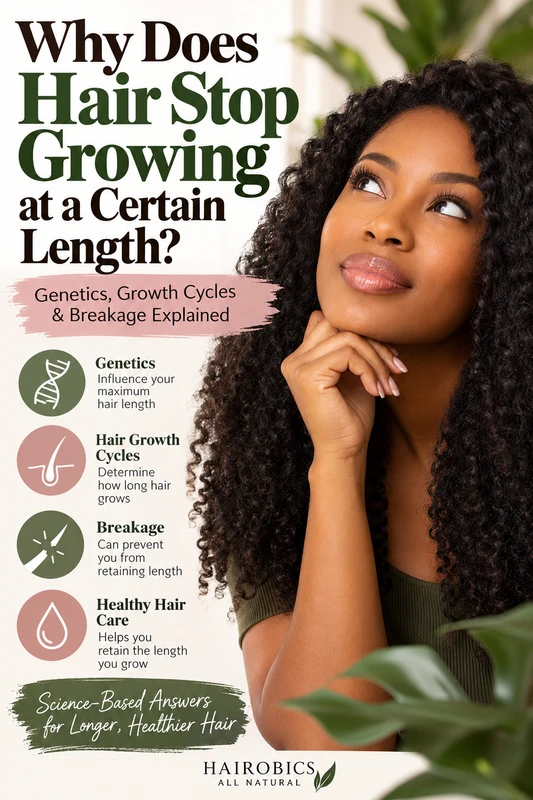
Have you ever noticed that your hair seems to reach a certain length and then refuses to grow any longer?
Maybe your natural hair grows beautifully until it reaches your shoulders. Perhaps it stays around your collarbone, even after years of moisturizing, protective styling, and avoiding heat. Or maybe your hair was much longer when you were younger, but now it seems impossible to achieve that same length.
This experience can leave you wondering: Does hair have a maximum length, or is something preventing it from growing?
The answer involves more than simply using the right hair products.
Your maximum hair length depends on several factors, including genetics, the length of your hair growth cycle, your overall health, and how well your hair retains the length it produces.
For people with natural Black hair, curly hair, coily hair, and 4C textures, shrinkage and breakage can make understanding hair growth even more challenging.
The good news is that reaching a certain length does not automatically mean your hair has stopped growing.
In this guide, we'll explore the science behind maximum hair length, explain why hair sometimes appears stuck, and share practical ways to support healthier hair and improve length retention.
Does Hair Actually Stop Growing at a Certain Length?
Yes, individual hairs have a biological limit to how long they can grow during one growth cycle.
However, this doesn't mean every hair follicle suddenly stops producing hair when your strands reach a particular length.
Hair follicles follow a repeating cycle of growth, transition, rest, and shedding.
The amount of time each follicle remains in its active growth phase plays an important role in determining how long that hair can become.
For example, someone whose scalp hairs remain in the growing phase for several years may be able to achieve significantly longer hair than someone with a naturally shorter growth phase.
But there's another important factor.
Even when your follicles are producing new hair normally, your strands can break before reaching their potential maximum length.
This creates two different situations:
Biological length limitation: Your hair reaches the end of its genetically influenced growth cycle before becoming significantly longer.
Length retention limitation: Your hair continues growing, but breakage, damage, or excessive trimming prevents visible length gains.
Understanding which situation applies to you is essential before changing your hair care routine.
1. Genetics Influence Your Maximum Hair Length
Genetics play an important role in determining your natural hair growth characteristics.
Your inherited traits can influence your hair's growth-cycle duration, strand characteristics, texture, density, and susceptibility to certain forms of hair loss.
One particularly important genetic factor is the duration of the anagen phase.
Anagen is the active growing stage of the hair cycle.
For scalp hair, this phase often lasts approximately two to seven years, although there is considerable individual variation.
The longer a follicle remains in anagen, the more time that strand has to grow before eventually shedding.
Imagine two people whose hair grows at approximately half an inch per month.
Person A has a three-year growing phase.
Person B has a six-year growing phase.
Under simplified conditions, Person A's hair could produce approximately 18 inches of growth during one cycle, while Person B's could produce approximately 36 inches.
These are illustrations, not guaranteed maximum lengths. Actual hair length depends on growth rate, shedding, breakage, and other factors.
The important lesson is that everyone has a different potential maximum hair length.
However, genetics do not mean you should automatically accept shoulder-length hair as your permanent limit.
If your ends are constantly breaking, you may never have discovered your actual length potential.
2. Understanding the Four Stages of Hair Growth
To understand why hair reaches certain lengths, you first need to understand the natural hair growth cycle.
Your scalp contains thousands of follicles, and each follicle progresses through its own cycle.
Anagen: The active growth phase
Anagen is when your hair actively grows.
Cells within the hair follicle produce the developing hair shaft.
This is the stage responsible for increasing strand length.
The longer anagen lasts, the greater the potential length of an individual hair.
Catagen: The transition phase
Catagen is a short transitional stage that generally lasts a few weeks.
During this period, active hair production slows and the follicle begins changing in preparation for the resting phase.
The hair is no longer actively gaining length.
Telogen: The resting phase
During telogen, the follicle rests.
The existing hair remains in place for a period while the follicle prepares for another cycle.
This stage commonly lasts several months.
Exogen: The shedding phase
Exogen describes the release of an older hair from the follicle.
Shedding is a normal part of the hair cycle.
Because individual follicles operate independently, your entire head of hair does not normally enter the shedding phase at the same time.
For a more detailed explanation, read our Complete Black Hair Growth Cycle Explained.
Understanding these stages helps explain why hair growth is gradual and why healthy hair naturally sheds.
3. Your Hair May Be Growing but Breaking at the Ends
One of the most common reasons hair appears to stop growing is breakage.
Your scalp may continue producing new hair while the oldest parts of your strands gradually break away.
This can make your hair appear to remain the same length for months or years.
For example, suppose your hair grows approximately six inches in one year.
During that same period, repeated detangling, friction, heat styling, and dryness cause you to lose five inches through breakage.
Your visible length increases by only one inch.
If you lose approximately six inches, your hair may appear not to grow at all.
This is why hair growth and length retention are two different things.
Hair growth occurs at the follicle.
Length retention involves preserving the strands after they emerge from your scalp.
Signs that breakage may be limiting your length include:
-
Short broken hairs around your sink or clothing
-
Ends that become increasingly thin
-
Uneven hair lengths
-
Excessive snapping during detangling
-
Split ends and rough strands
-
Hair that tangles repeatedly near the ends
If you recognize these signs, read our guide on How to Stop Natural Hair From Breaking.
Reducing preventable breakage may help you achieve longer-looking hair without changing how quickly your follicles grow.
4. Why Shoulder Length Is a Common Hair Growth Plateau
Many people notice that their hair seems to stop growing once it reaches their shoulders.
This can happen because shoulder-length hair experiences frequent contact with clothing and other surfaces.
As your strands become longer, their ends may repeatedly rub against:
-
Shirt collars
-
Sweaters and jackets
-
Scarves
-
Seat belts
-
Backpack straps
-
Cotton pillowcases
-
Rough fabrics
This repeated friction can gradually wear down the protective outer cuticle of the hair shaft.
Over time, weakened strands may split, tangle, and break.
Shoulder-length hair can also be especially vulnerable when frequently worn loose against clothing.
If your hair repeatedly reaches the same length before becoming thin or damaged, friction may be one contributing factor.
Try wearing low-tension styles that keep your ends away from rough fabrics.
You can also choose smoother clothing materials and protect your hair at night.
Our article on Why Your Hair Stops Growing at Shoulder Length explores this particular challenge in greater detail.
5. Natural Hair Shrinkage Can Hide Your Actual Length
Natural Black hair often appears shorter than its true stretched length.
This is especially noticeable with tightly curled and coily textures.
When natural hair dries, its curl pattern contracts.
A strand that measures eight inches when gently stretched may appear considerably shorter in its natural state.
This is called shrinkage.
Shrinkage is a normal characteristic of textured hair and does not automatically indicate damage or poor growth.
In fact, healthy curls often demonstrate significant elasticity and shrinkage.
However, shrinkage can make it difficult to recognize gradual length gains.
You might believe your hair has remained the same length for six months when your strands have actually gained measurable length.
How to measure natural hair growth accurately
Choose a small section of hair in the same location each time.
Gently stretch the section without pulling aggressively.
Measure from the scalp toward the ends using a flexible measuring tape.
Record the measurement and take a photograph.
Repeat the process approximately every eight to twelve weeks.
Try to measure under similar conditions each time.
Consistent measurements can help you distinguish true length stagnation from ordinary shrinkage.
Avoid repeatedly stretching fragile strands simply to check progress.
6. The Oldest Parts of Your Hair Need the Most Protection
The longer your hair becomes, the older its ends are.
Consider a strand that has been growing for several years.
The ends of that strand may have experienced hundreds of washing, detangling, drying, and styling sessions.
They may also have been exposed to sunlight, heat, chemical treatments, and everyday friction.
Unlike living skin, the visible hair shaft cannot biologically regenerate damaged tissue.
Conditioners can improve its surface, reduce friction, and temporarily make damaged strands feel smoother, but they cannot permanently restore severely split hair.
This makes protecting your ends especially important.
How to care for older hair ends
Apply conditioner thoroughly during wash day.
Use a leave-in conditioner when additional conditioning is needed.
Detangle gently, starting near the ends and working upward.
Avoid excessive heat and unnecessary manipulation.
Keep your ends protected from rough clothing.
Trim split or severely damaged ends when necessary.
The goal is to preserve as much healthy hair as possible.
Healthy length retention is not about avoiding every haircut. It is about reducing preventable damage while removing ends that can no longer be maintained comfortably.
7. Dryness Can Make Length Retention More Difficult
Dry, brittle hair is often more vulnerable to mechanical damage.
This is particularly relevant for curly and coily hair because the natural oils produced by the scalp may not spread as easily along tightly curved strands.
As a result, the ends may require additional conditioning and careful handling.
Common signs of poorly conditioned hair include roughness, tangling, stiffness, and frequent snapping.
However, dryness is not always the only cause of these symptoms.
Heat damage, chemical processing, product buildup, and excessive friction can produce similar problems.
How to improve your moisturizing routine
Start with a gentle cleansing routine that removes dirt and excess product.
Follow with a conditioner that provides sufficient slip for detangling.
Apply a water-based leave-in treatment when appropriate.
If your hair benefits from oil, use a small amount to lubricate the strands and help reduce moisture loss.
Remember that oil does not replace water or a conditioning treatment.
Heavy layers of oil can also create buildup, making your hair harder to manage.
For a simple approach, focus on products that help your hair feel soft, flexible, and manageable rather than applying multiple products every day.
8. Tight Hairstyles Can Prevent You From Retaining Length
Protective hairstyles are popular because they can reduce daily manipulation.
However, not every protective style is truly protective.
Braids, twists, ponytails, extensions, and buns can cause damage when installed too tightly or worn with excessive tension.
Repeated pulling can weaken strands and place stress on hair follicles.
Over time, persistent tension may contribute to traction alopecia, a form of hair loss that can become permanent if the pulling continues.
Warning signs include scalp tenderness, bumps, broken hairs around the hairline, and thinning near areas of repeated tension.
How to wear protective styles safely
Choose comfortable styles that do not pull on your scalp.
Avoid heavy extensions.
Do not ignore pain or persistent tightness.
Keep your scalp clean according to your needs.
Moisturize exposed hair when necessary.
Remove styles carefully rather than pulling or tearing through tangles.
Give stressed areas a break from repeated tension.
Protective styling should reduce damage, not create additional stress.
If a hairstyle causes pain, loosening or removing it is more important than preserving the style.
9. Scalp Health Can Affect Hair Growth
Healthy hair growth begins within the follicle.
Although scalp oils and conditioners cannot change your genetic hair-growth limit, caring for your scalp can support comfort and help you maintain a consistent hair care routine.
A healthy scalp should not regularly experience severe itching, painful inflammation, persistent sores, or significant flaking.
Scalp conditions such as seborrheic dermatitis, psoriasis, and certain inflammatory disorders can interfere with scalp comfort and, in some cases, contribute to hair shedding or loss.
Regular cleansing can help remove sweat, excess oil, and styling-product buildup.
However, excessive washing with harsh products may leave some people experiencing irritation or dryness.
The best cleansing frequency depends on your scalp condition, activity level, hair texture, and styling habits.
Supporting a comfortable scalp
Use a shampoo appropriate for your scalp.
Avoid scratching or aggressively scraping away flakes.
Limit products that cause irritation.
Keep styling tools and accessories clean.
Avoid hairstyles that place excessive tension on follicles.
Seek professional evaluation for persistent scalp symptoms.
For those who enjoy scalp treatments, Hairobics All Natural Hair & Scalp Booster can be incorporated into a scalp-care routine according to its directions.
It contains a blend of botanical oils and conditioning ingredients. As with any topical product, perform a patch test and discontinue use if irritation occurs.
A cosmetic scalp treatment should not be considered a substitute for medical treatment of hair loss.
10. Nutrition and Overall Health Can Influence Hair Growth
Hair follicles require nutrients to support normal hair production.
Because hair is primarily composed of keratin, adequate protein intake is important.
Iron, zinc, and other nutrients also play roles in normal hair growth and follicle function.
Certain nutritional deficiencies can contribute to excessive shedding or changes in hair quality.
However, taking large amounts of vitamins does not automatically make healthy hair grow faster.
In fact, excessive intake of some nutrients, including vitamin A and selenium, may contribute to hair loss.
Rather than taking multiple hair-growth supplements without a clear need, focus on a balanced eating pattern.
Include appropriate sources of protein, fruits, vegetables, whole grains, and healthy fats.
If you experience unusual shedding, fatigue, unexplained weight changes, or other concerning symptoms, a healthcare professional can help determine whether testing is appropriate.
Thyroid disorders, iron deficiency, certain medications, hormonal changes, and other health conditions can affect hair growth.
Addressing an underlying medical cause is often more important than purchasing another cosmetic product.
11. Age and Hormonal Changes May Affect Your Hair
Hair characteristics can change throughout life.
Some people notice that their hair becomes finer, less dense, or slower-growing as they age.
Hormonal changes can also influence hair growth and shedding patterns.
For example, pregnancy, the postpartum period, menopause, thyroid changes, and androgen-related conditions may affect the hair cycle.
These changes do not affect everyone in the same way.
A person who previously grew very long hair may later notice that their hair behaves differently.
However, age-related changes should not automatically be blamed for sudden or significant hair loss.
If your hair has become noticeably thinner, your part is widening, or you are experiencing patchy loss, consider speaking with a dermatologist.
Early evaluation can be particularly important for conditions that may cause permanent follicle damage.
12. How to Tell Whether Your Hair Has Reached Its Maximum Length
There is no simple home test that reveals your exact genetically determined maximum hair length.
However, you can look for patterns that suggest whether breakage or changes in the hair cycle may be affecting your results.
Signs that breakage may be the main problem
Your ends are noticeably thinner than your roots.
You find short broken strands during styling.
Your hair tangles repeatedly near the ends.
You frequently use heat or high-tension hairstyles.
Your hair seems to reach the same length before breaking.
These patterns suggest that improving length retention may help.
Signs that further evaluation may be useful
Your hair density has decreased significantly.
You notice a widening part or visible scalp.
You experience sudden excessive shedding.
You have bald patches or scalp inflammation.
Your hair has changed dramatically without an obvious explanation.
These symptoms may reflect changes in follicle activity rather than ordinary breakage.
Learn more about distinguishing the two in our guide to Shedding vs. Breakage.
13. How to Grow Hair Beyond Your Usual Length Plateau
If breakage has been limiting your length, changing your daily habits may help you retain more of the hair you grow.
The goal is not to force your follicles to exceed their biological limits.
Instead, focus on helping your existing strands remain intact for longer.
Step 1: Establish a consistent wash routine
Cleanse your scalp regularly according to your needs.
Use conditioner to improve manageability and reduce friction.
Avoid allowing heavy product buildup to accumulate for extended periods.
Step 2: Detangle with patience
Divide your hair into manageable sections.
Apply conditioner or another product with sufficient slip.
Begin near the ends and gradually work upward.
Use your fingers or an appropriate detangling tool.
Avoid forcing a comb through tightly tangled hair.
Step 3: Condition your ends
Pay particular attention to the oldest portions of your strands.
A leave-in conditioner can help improve softness and manageability between wash days.
Use only as much product as your hair needs.
Step 4: Reduce unnecessary heat
Frequent high-temperature styling can weaken the hair shaft.
When using heat, select an appropriate temperature, apply a suitable heat protectant, and avoid repeated passes.
Consider lower-heat or heat-free styles when practical.
Step 5: Protect your hair while sleeping
Use a satin or silk bonnet, scarf, or pillowcase if it helps reduce tangling and friction.
Avoid sleeping with hairstyles that place uncomfortable tension on your scalp.
Step 6: Rotate low-tension hairstyles
Try loose twists, comfortable braids, low-tension buns, or other styles that reduce manipulation.
Avoid repeatedly pulling the same areas of your hair.
Step 7: Trim based on condition
There is no universal trimming schedule that works for everyone.
Inspect your ends regularly.
Trim when you notice persistent splitting, severe tangling, or damage that cannot be managed through conditioning.
Step 8: Monitor progress over time
Take photographs and record stretched measurements approximately every two to three months.
Look for changes in length, thickness, and breakage rather than expecting dramatic weekly results.
Small improvements in retention can add up over time.
14. A Simple Weekly Hair Routine for Better Length Retention
A successful hair routine does not need to involve dozens of products or complicated styling techniques.
Consistency and gentle handling are more important than constantly changing products.
Wash day
Cleanse your scalp with an appropriate shampoo.
Apply conditioner throughout your hair.
Detangle gently in sections.
Rinse thoroughly.
Apply a leave-in treatment if needed.
Style your hair without excessive tension.
Midweek maintenance
Check whether your hair feels dry or tangled.
Refresh with a lightweight moisturizing product if necessary.
Avoid repeatedly combing hair that does not need detangling.
Keep your scalp comfortable and free from excessive buildup.
Nighttime care
Loosely secure your hair if needed.
Protect your strands from friction.
Avoid sleeping with tight ponytails or uncomfortable extensions.
Monthly maintenance
Inspect your ends.
Review your length photographs.
Evaluate whether your current styles are causing unnecessary breakage.
Adjust your routine based on your hair's condition.
If you want a more detailed explanation of why strands can grow without producing visible length gains, read Why Hair Grows but Won't Retain Length.
15. How Long Does It Take to Notice Longer Hair?
Hair growth is a gradual process.
Many people grow approximately half an inch of scalp hair per month, although individual rates vary.
That means three months of growth may produce roughly one and a half inches before accounting for breakage and trimming.
Six months may produce approximately three inches.
One year may produce around six inches.
These figures are general illustrations rather than guarantees.
Your actual visible length gains depend on your growth rate, hair cycle, shrinkage, and length retention.
If you have been experiencing significant breakage, improvements in hair condition may become noticeable before measurable length gains appear.
For example, your hair may become easier to detangle, your ends may appear fuller, and you may find fewer broken pieces during styling.
These are encouraging changes, even when your hair does not immediately look much longer.
16. Common Myths About Maximum Hair Length
Myth: Black hair cannot grow long
False.
Black hair can grow to considerable lengths.
Natural texture does not automatically determine a person's maximum hair length.
Growth-cycle characteristics, individual genetics, hair health, and length retention all contribute to the outcome.
Myth: Cutting hair makes it grow faster
False.
Hair grows from follicles beneath the scalp.
Trimming the ends does not directly increase follicle growth speed.
However, removing severely damaged ends can improve manageability and help reduce additional breakage.
Myth: Applying more oil makes hair grow faster
Not necessarily.
Oils can provide lubrication, improve softness, and help reduce friction.
However, there is limited clinical evidence that ordinary cosmetic hair oils reliably accelerate scalp hair growth.
Myth: Protective styles automatically grow hair
False.
Protective styles do not inherently increase the rate of follicle growth.
Their main benefit is potentially reducing manipulation and breakage.
Poorly installed styles can actually cause damage.
Myth: Everyone can grow waist-length hair
Not necessarily.
People have different growth-cycle durations and hair characteristics.
Some individuals can achieve waist-length hair, while others may have a shorter biological maximum.
The most useful goal is to maintain healthy hair and improve retention within your individual potential.
Frequently Asked Questions
Why does my hair always stop growing at the same length?
Your hair may be breaking at approximately the same rate it grows. Repeated friction, rough detangling, split ends, and high-tension hairstyles can contribute. Genetics and the duration of your hair growth cycle may also influence maximum length.
Can hair grow longer than its genetic limit?
Hair care cannot reliably extend your genetically influenced growth cycle beyond its natural potential. However, reducing breakage may allow you to retain more length and discover that your hair can grow visibly longer than you previously thought.
Why does my hair grow at the roots but not get longer?
New growth at the roots combined with unchanged overall length often suggests breakage or trimming is offsetting growth. Shrinkage can also conceal length gains in curly and coily hair.
Does 4C hair have a shorter maximum length?
Not automatically. Hair texture alone does not establish maximum length. Tightly coiled hair may experience greater shrinkage and require careful handling to reduce mechanical breakage.
Can damaged hair prevent length retention?
Yes. Heat damage, chemical processing, friction, and rough styling can weaken strands. When weakened strands break, overall length may remain unchanged despite continued growth at the scalp.
Will scalp massage make my hair grow longer?
Scalp massage may feel relaxing and can be part of a comfortable scalp-care routine. However, evidence that massage substantially increases hair growth or maximum length remains limited.
How do I know whether my hair is growing?
Compare stretched measurements and photographs taken under consistent conditions every few months. Also observe changes in breakage, shedding, and hair density.
When should I see a dermatologist about slow hair growth?
Seek evaluation if you notice sudden or substantial shedding, patchy hair loss, a widening part, painful scalp symptoms, or progressive thinning. A dermatologist can help distinguish normal variation from medical causes.
Final Thoughts: Your Hair May Have More Length Potential Than You Think
If your hair seems to stop growing at a certain length, the most important thing is understanding why.
Some people naturally have shorter hair growth cycles, which influence their maximum possible strand length.
Others experience preventable breakage that keeps their hair from reaching its full potential.
For many people with natural hair, the solution involves improving how they care for their strands rather than constantly searching for faster hair-growth products.
Focus on protecting your ends, reducing unnecessary manipulation, conditioning regularly, maintaining scalp health, and avoiding excessive tension.
Remember that healthy hair does not need to reach a particular length to be beautiful.
The goal is not simply to grow more hair. It is to preserve the healthy hair you already have while supporting normal growth.
With patience, consistent care, and realistic expectations, you may discover that your hair can retain more length than you previously believed.
Support Your Natural Hair Journey With Hairobics All Natural
At Hairobics All Natural, we believe healthy hair care begins with a consistent routine that supports your scalp and protects your strands.
Whether you're maintaining a short natural hairstyle, growing out your curls, or working toward longer, healthier-looking hair, choosing products that complement your hair's needs can make everyday care easier.
Explore our Hairobics Hair & Scalp Booster as part of your scalp-care routine, and discover more natural hair care education at Hairobics All Natural.
Healthy hair is a journey. Give your strands the attention, protection, and patience they deserve.