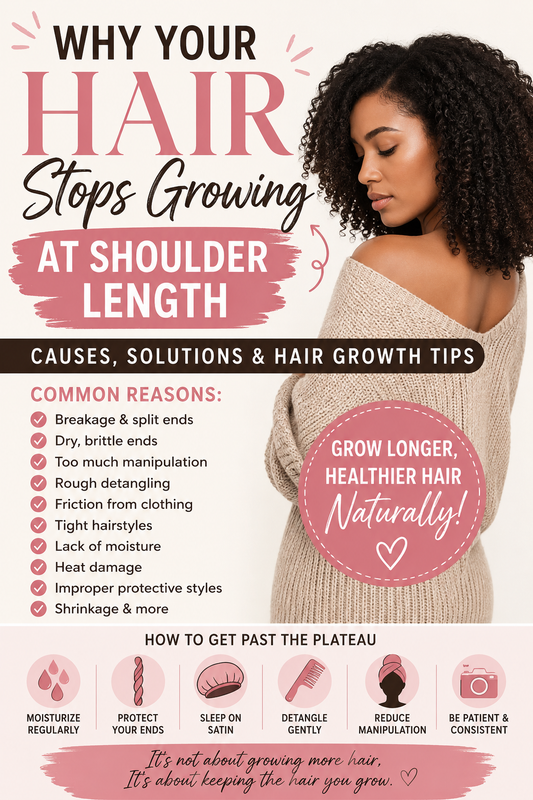
The Real Reasons Hair Gets “Stuck” and How to Break Through the Growth Plateau
Many people with natural, curly, or textured hair notice something frustrating: their hair seems to grow normally until it reaches shoulder length—then it suddenly stops.
Months pass. Sometimes years. Yet the hair never seems to grow past that point.
This phenomenon is commonly called the shoulder-length plateau, and it affects millions of people with natural hair.
But here’s the truth:
Your hair probably isn’t actually stopping growth.
In most cases, hair is still growing from the scalp, but the ends are breaking off at the same rate they grow. When that happens, it creates the illusion that hair growth has stopped.
Understanding why this happens—and how to fix it—can help you finally grow your hair beyond shoulder length and into longer, healthier styles.
In this guide, we’ll break down:
-
Why hair seems to stop growing at shoulder length
-
The science behind hair growth plateaus
-
Why textured hair is especially affected
-
The most common mistakes that cause shoulder-length stagnation
-
How to finally grow past the shoulder barrier
If you’ve been stuck at the same length for years, the answers are here.
The Truth: Hair Rarely Stops Growing
Before we talk about the causes, we need to clear up a major myth.
Hair does not stop growing at a certain length.
Hair grows from follicles in the scalp, and the average growth rate is:
About 0.5 inches per month (6 inches per year).
That means in theory, someone could grow:
-
12 inches in two years
-
24 inches in four years
However, this assumes perfect retention, which almost never happens.
Instead, most people experience breakage, shedding, and environmental damage that prevents length retention.
So when hair appears stuck at shoulder length, what’s actually happening is this:
Hair growth = breakage rate
Example:
Hair grows: 6 inches per year
Breakage removes: 6 inches per year
Result:
Hair never gets longer.
This is the true cause of most hair growth plateaus.
Why Shoulder Length Is a Major Breaking Point
Shoulder length is one of the most common places hair seems to stall.
This isn’t random.
Shoulder length is where hair begins to experience constant friction and stress.
Your hair starts rubbing against:
-
Clothing
-
Jackets
-
Seat belts
-
Backpacks
-
Pillowcases
-
Scarves
-
Chairs
This repeated friction slowly weakens the hair shaft.
Over time, the ends begin to split and break.
Once breakage matches growth rate, hair length appears stuck.
The Hair Growth Cycle (Understanding the Science)
Hair growth follows a biological cycle made up of four phases.
1. Anagen (Growth Phase)
This is when hair actively grows from the follicle.
The anagen phase lasts 2–7 years, depending on genetics.
The longer your anagen phase, the longer your hair can grow.
2. Catagen (Transition Phase)
A short phase where growth slows and the follicle shrinks.
Lasts about 2–3 weeks.
3. Telogen (Resting Phase)
Hair stops growing and rests inside the follicle.
Lasts about 3 months.
4. Exogen (Shedding Phase)
Old hair sheds to make room for new growth.
We naturally lose 50–100 hairs per day.
This is normal.
The problem begins when breakage adds to natural shedding, reducing the amount of hair retained.
10 Reasons Hair Stops Growing Past Shoulder Length
1. Breakage at the Ends
The number one reason for hair plateaus is breakage at the ends.
Hair ends are the oldest part of your hair.
They’ve been exposed to:
-
Heat
-
Weather
-
Styling
-
Detangling
-
Friction
By the time hair reaches shoulder length, those ends may be 2–3 years old.
Without proper care, they eventually weaken and snap.
2. Dry Hair
Dry hair is extremely fragile.
Natural hair is especially prone to dryness because curly strands make it harder for scalp oils to travel down the shaft.
Dry hair leads to:
-
Split ends
-
Tangling
-
Breakage
Moisture is essential for length retention.
3. Lack of Protective Styling
Loose hair constantly exposed to friction breaks faster.
Protective styles reduce manipulation and protect fragile ends.
Examples include:
-
Braids
-
Twists
-
Buns
-
Locs
-
Updos
Protective styling allows hair to retain more growth.
4. Heat Damage
Frequent heat styling weakens hair protein bonds.
Over time, heat causes:
-
Brittleness
-
Split ends
-
Reduced elasticity
Once hair becomes brittle, it snaps easily.
5. Over-Manipulation
Constant styling can damage hair.
Common manipulation habits include:
-
Daily combing
-
Tight ponytails
-
Frequent brushing
-
Re-styling
Every time hair is handled, it experiences stress.
Reducing manipulation preserves length.
6. Improper Detangling
Many people lose large amounts of hair while detangling.
Hair should never be detangled when:
-
Dry
-
Brittle
-
Unconditioned
Instead, detangle with conditioner or a moisturizing product to reduce friction.
7. Split Ends
Split ends travel upward along the hair shaft.
If they’re not trimmed, the split spreads until the hair eventually breaks.
Regular trims prevent splits from destroying length.
8. Friction from Clothing
Clothing friction is a major cause of shoulder-length plateaus.
Materials like cotton and wool are particularly damaging.
Solutions include:
-
Protective styles
-
Silk scarves
-
Satin-lined clothing
-
Hair buns or braids
9. Poor Scalp Health
Healthy hair starts with a healthy scalp.
Issues like buildup and inflammation can slow hair growth.
A healthy scalp should be:
-
Clean
-
Balanced
-
Moisturized
10. Unrealistic Expectations
Hair growth is slow.
Even healthy hair takes years to reach extreme lengths.
Consistency matters more than quick fixes.
Why Natural Hair Often Stalls at Shoulder Length
Textured hair faces unique challenges.
Curly and coily strands are more fragile because of their structure.
Each bend in the hair strand creates a potential weak point.
These bends make hair more susceptible to:
-
Breakage
-
Tangling
-
Dryness
This is why proper moisture and gentle handling are essential for natural hair growth.
Signs Your Hair Is in a Growth Plateau
Common signs include:
-
Hair staying the same length for years
-
Ends thinning
-
Excessive breakage
-
Split ends
-
Slow progress despite growth
The good news?
Growth plateaus are fixable.
How to Grow Hair Past Shoulder Length
Focus on Length Retention
Growing longer hair isn’t just about growth.
It’s about keeping the hair you grow.
Length retention strategies include:
-
Moisturizing regularly
-
Protective styling
-
Gentle detangling
-
Limiting heat
-
Reducing friction
Moisturize Consistently
Hydrated hair is stronger and more flexible.
Moisturizing helps prevent breakage.
Look for products containing:
-
Natural oils
-
Botanical extracts
-
Hydrating ingredients
Seal Moisture with Oils
Oils help lock moisture into the hair shaft.
Popular oils include:
-
Castor oil
-
Jojoba oil
-
Coconut oil
-
Argan oil
Oils also add shine and protection.
Protect Hair at Night
Nighttime care is critical.
Cotton pillowcases pull moisture from hair and create friction.
Instead, use:
-
Satin bonnets
-
Silk scarves
-
Satin pillowcases
This reduces breakage dramatically.
Trim Strategically
Trims remove damaged ends before splits travel upward.
However, trimming too frequently can remove progress.
Most people benefit from trimming every 3–4 months.
Limit Heat Styling
Heat tools should be used sparingly.
If heat is necessary:
-
Use a heat protectant
-
Keep temperatures low
-
Avoid daily styling
Reducing heat preserves hair strength.
How Long It Takes to Grow Past Shoulder Length
Hair grows about 6 inches per year.
So if your hair is currently shoulder length, it may take:
-
1 year to reach bra-strap length
-
2 years to reach mid-back
-
3–4 years to reach waist length
Consistency is key.
The Best Routine for Growing Longer Hair
Here is a simple weekly routine.
Wash Day
-
Cleanse scalp
-
Deep condition
-
Detangle gently
-
Moisturize hair
-
Apply protective style
During the Week
-
Lightly moisturize
-
Avoid excessive manipulation
-
Protect hair at night
Monthly
-
Clarify scalp
-
Assess ends
-
Maintain protective styles
Foods That Support Hair Growth
Hair health is influenced by nutrition.
Key nutrients include:
-
Protein
-
Iron
-
Vitamin D
-
Omega-3 fatty acids
-
Zinc
Healthy foods include:
-
Salmon
-
Eggs
-
Leafy greens
-
Nuts
-
Beans
Hair grows best when the body is nourished.
The Psychological Side of Hair Growth
Many people feel discouraged when hair seems stuck.
This can lead to frustration and frequent product changes.
But hair growth requires long-term consistency.
Stick with routines that work.
Common Myths About Hair Length
Myth: Hair stops growing after a certain length
False.
Hair grows continuously during the anagen phase.
Myth: Cutting hair makes it grow faster
Trimming improves appearance but doesn’t affect follicle growth rate.
Myth: Oils alone grow hair
Oils support scalp health but don’t directly change growth speed.
The Key to Breaking the Shoulder-Length Plateau
The real secret is simple:
Reduce breakage more than you increase growth.
Focus on:
-
Moisture
-
Protection
-
Gentle handling
-
Healthy scalp care
When breakage decreases, length retention increases.
Eventually, hair begins to grow past the plateau.
Final Thoughts
If your hair seems stuck at shoulder length, you’re not alone.
This growth plateau happens to millions of people.
But the truth is encouraging:
Hair rarely stops growing.
In most cases, the issue is breakage—not growth.
By focusing on:
-
Moisture
-
Protective styling
-
Gentle care
-
Scalp health
You can finally break through the shoulder-length barrier and grow your hair longer than ever before.
Consistency, patience, and proper hair care make all the difference.