If you have natural hair, you may have heard that understanding your hair porosity is one of the keys to building a better hair care routine. Porosity can affect how easily your hair absorbs water, how long it stays moisturized, how products behave on your strands, and even how your hair responds to chemical treatments, heat, coloring, and environmental conditions.
But one question causes a lot of confusion:
Can hair porosity change?
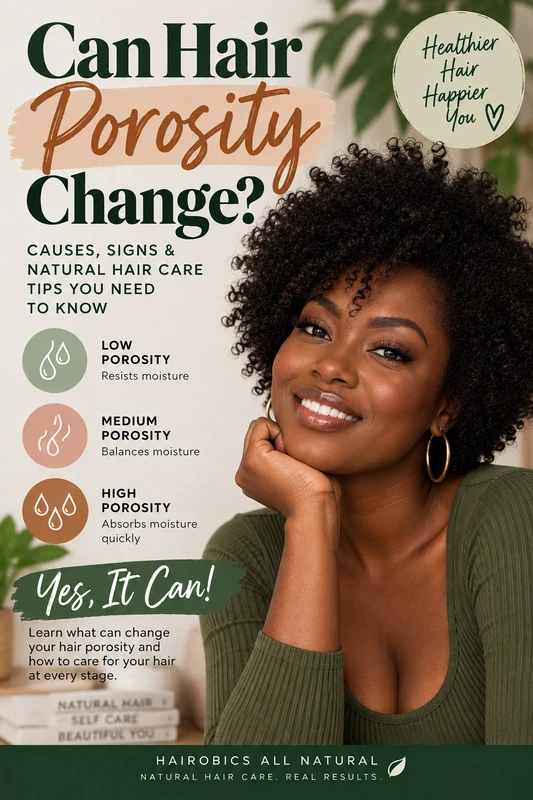
The short answer is yes, the effective porosity of your hair can change, especially as the hair shaft becomes weathered or damaged. However, the subject is more complicated than simply moving permanently from "low porosity" to "high porosity."
Your natural hair characteristics influence how your strands behave, but hair is also exposed to shampooing, styling, heat, chemicals, sunlight, friction, water, and everyday wear. Over time, these factors can alter the condition of the hair shaft and change how easily it takes in and loses moisture.
You can even have different porosity levels on different parts of the same head of hair—or along the same strand.
In this guide, we'll explain what hair porosity means, why it can change, how to recognize changes in your hair, and how to adjust your natural hair routine accordingly.
What Is Hair Porosity?
Hair porosity describes how readily the hair fiber interacts with and takes up water and other substances.
The outside of each hair strand contains a protective layer called the cuticle. The condition of this outer structure plays an important role in how the strand responds to water, conditioning treatments, chemicals, heat, and styling.
Porosity is commonly divided into three categories:
- Low porosity
- Medium or normal porosity
- High porosity
These categories are useful for discussing hair care, although real hair does not always fit perfectly into one of three boxes.
Two people who both consider themselves low porosity can still need completely different routines. Curl pattern, strand thickness, density, scalp condition, styling habits, previous chemical treatments, climate, and product use can all influence how hair behaves.
That is why it is better to use porosity as a hair-care guide rather than a rigid label.
What Is Low-Porosity Hair?
Low-porosity hair is generally described as hair that does not wet or absorb products as readily.
You may notice that:
Water initially sits on the hair instead of immediately soaking in.
Products sometimes seem to coat the strands.
Heavy creams and oils can lead to buildup quickly.
Your hair takes a while to become completely saturated in the shower.
Some conditioning products seem to sit on your hair.
Your hair may take a long time to dry.
People with low-porosity natural hair often do well with lighter layers of product and thorough cleansing when buildup develops.
Warm water during washing and conditioning may also make the process of thoroughly wetting and conditioning the hair easier, although you do not need extremely hot water.
What Is Medium-Porosity Hair?
Medium-porosity hair generally falls somewhere between the two extremes.
The hair tends to become wet without excessive difficulty and can often maintain a comfortable moisture balance when cared for consistently.
People with medium-porosity hair may notice that:
Products absorb relatively easily.
The hair responds well to regular conditioning.
Hair does not constantly feel coated or excessively dry.
Wash day is reasonably predictable.
The hair can maintain softness for several days depending on the style and environment.
However, medium porosity does not mean your hair cannot become damaged.
Repeated chemical treatments, excessive heat, mechanical stress, and environmental exposure can gradually alter the condition of the hair fiber.
What Is High-Porosity Hair?
High-porosity hair generally interacts with water more readily and may lose moisture quickly as well.
This can be associated with naturally occurring characteristics, accumulated weathering, or damage to the hair shaft.
Common signs may include:
Hair gets wet very quickly.
Hair dries relatively quickly.
The strands frequently feel rough.
Hair tangles easily.
The ends become dry soon after moisturizing.
Hair experiences frequent breakage.
Color-treated or chemically processed sections feel different from untreated new growth.
Your hair becomes frizzy easily in humid conditions.
High-porosity hair often benefits from conditioning, gentle handling, reduced damaging practices, and products that improve lubrication and help the hair feel smoother.
Can Hair Porosity Actually Change?
Yes.
The physical condition of your hair can change throughout the life of the strand.
Hair fiber is nonliving once it emerges from the scalp. Unlike living skin, a damaged section of hair cannot biologically heal itself and return completely to its original state.
Cosmetic products can make damaged hair feel smoother, reduce friction, improve manageability, and temporarily reinforce weak areas, but they do not literally regenerate the hair shaft.
This distinction is extremely important.
Imagine growing your natural hair for four years.
The hair near your scalp is relatively new. The hair at your ends may have been exposed to years of washing, detangling, brushing, heat, sunlight, styling, friction, and environmental conditions.
Those two sections can behave very differently.
Your roots might act like lower-porosity hair while your ends behave like higher-porosity hair.
Therefore, saying:
"My hair is low porosity."
may sometimes be less accurate than saying:
"Most of my newer hair behaves like low-porosity hair, but my older ends appear more porous."
Understanding this can completely change the way you care for natural hair.
What Causes Hair Porosity to Change?
Several factors can alter the condition of the hair shaft over time.
Some produce relatively minor changes, while others can cause significant structural damage.
1. Heat Damage
Frequent exposure to excessive heat is one of the most common reasons natural hair starts behaving differently.
Heat styling includes:
Flat ironing
Blow-drying
Hot combing
Curling irons
Heated brushes
Repeated high-temperature styling can damage the hair fiber, especially when high temperatures, frequent passes, or inadequate protection are involved.
You may notice that previously healthy hair begins to:
Dry faster.
Feel rougher.
Break more easily.
Lose some curl definition.
Tangle more.
Require more conditioning.
These changes can indicate damage rather than simply a mysterious change in "hair type."
If you regularly straighten natural hair, pay attention to how your curls behave after washing.
A section that no longer returns to its previous curl pattern may have experienced heat-related structural changes.
2. Hair Coloring
Coloring can significantly affect how hair behaves.
Permanent hair color and especially lightening or bleaching can alter the hair fiber.
The more aggressively hair is chemically lightened, the greater the potential for damage.
You may have healthy, relatively low-porosity roots while the lightened ends behave much more like high-porosity hair.
This creates a situation where one product may not work equally well on every section of your hair.
For example, a lightweight conditioner may be enough for your roots while your processed ends need additional conditioning and protection.
3. Chemical Relaxers and Texturizers
Chemical processes designed to alter hair texture intentionally change the structure of the hair.
That means relaxed or texturized sections may behave differently from untreated new growth.
This becomes especially noticeable when transitioning from chemically treated hair back to natural hair.
You essentially have two different conditions along the strand:
Natural new growth.
Previously processed hair.
The processed section may require additional attention because it can be more vulnerable to breakage.
The point where the two textures meet—often called the line of demarcation—can also require gentle handling.
4. Everyday Wear and Tear
You do not need to chemically process your hair for its condition to change.
Hair experiences normal weathering simply from existing for months or years.
Think about everything your ends experience:
Wash days.
Detangling.
Combing.
Brushing.
Twisting.
Braiding.
Taking down styles.
Rubbing against clothing.
Sleeping.
Exposure to sunlight.
Swimming.
Dry air.
Humidity.
Repeated manipulation.
Over time, the oldest sections of your hair naturally accumulate more wear than the newest sections.
This is one reason the ends of long natural hair often require more attention than the roots.
Can Low-Porosity Hair Become High Porosity?
Hair that originally behaves as relatively low porosity can become more porous as the fiber becomes damaged or weathered.
However, this usually does not happen overnight.
If you suddenly notice your hair acting completely differently after one wash, first consider simpler explanations such as:
Product buildup.
A new shampoo.
A new conditioner.
Hard water.
Different weather.
A recent protective style.
A styling product combination.
Protein-heavy products.
Clarifying your hair and simplifying your routine may help determine whether you are dealing with buildup or a more lasting change in the hair itself.
But if you have repeatedly bleached, chemically processed, or exposed your hair to damaging levels of heat, increased porosity becomes more plausible.
Can High-Porosity Hair Become Low Porosity?
This question requires an important distinction.
Products can make high-porosity hair behave better, but that does not necessarily mean damaged hair has permanently transformed into naturally low-porosity hair.
Conditioners and other treatments can coat or temporarily reinforce the surface of the hair, reducing friction and helping the strand retain softness.
That can make your hair feel:
Smoother.
Stronger.
Less tangled.
More manageable.
Better conditioned.
But if a portion of the hair shaft has sustained permanent structural damage, cosmetic treatment cannot turn that older damaged section back into brand-new hair.
The most significant long-term change happens through new growth.
As healthier new hair grows from the scalp and damaged ends are gradually trimmed away, the overall behavior of your hair can change substantially.
Can New Growth Have Different Porosity?
Yes, your new growth may behave differently from your older hair.
But that does not automatically mean something is wrong.
Older hair has experienced more environmental and mechanical exposure than newer hair.
For someone with long natural hair, this difference can become very noticeable.
You might have:
Lower-porosity roots.
Medium-porosity mid-lengths.
Higher-porosity ends.
This is sometimes described informally as mixed-porosity hair.
Instead of forcing every section of your hair into one category, you can adjust your routine based on what different areas actually need.
Can Your Hair Have Multiple Porosity Levels?
Absolutely.
This is one of the most overlooked aspects of natural hair care.
You can have different porosity levels:
Across different areas of your head.
Between new growth and older hair.
Between natural and color-treated sections.
Between natural and relaxed sections.
Between healthy lengths and weathered ends.
For example, imagine someone with waist-length natural hair who highlights the bottom half.
Her roots may resist water initially.
Her middle sections may absorb products normally.
Her lightened ends may become wet quickly and dry quickly.
Calling all of that hair simply "high porosity" or "low porosity" ignores the differences between sections.
A customized approach often works better.
Signs Your Hair Porosity May Have Changed
Pay attention to patterns rather than one isolated wash day.
Possible signs include:
Your Hair Suddenly Dries Much Faster
If hair that once stayed wet for hours begins drying unusually quickly, increased porosity may be one possible explanation.
However, consider your haircut, hair density, climate, products, and drying method as well.
Your Ends Stay Dry
If your roots remain moisturized while your ends quickly become rough and dry, the ends may be more weathered or porous.
Products Behave Differently
A moisturizer that once worked beautifully might suddenly seem to disappear into your hair.
Or the opposite can happen.
Products may begin sitting on the hair because buildup has accumulated.
This is why product behavior alone should not be used to diagnose porosity.
Your Hair Tangles More
Damage to the hair surface can increase roughness and friction.
More friction can mean more tangling.
If your hair suddenly starts forming knots and tangles, examine whether your ends are damaged, split, or overdue for trimming.
Your Hair Breaks More Easily
Porosity and breakage are not the same thing.
However, highly weathered or damaged hair may also be mechanically weaker.
If you see increasing numbers of short broken hairs, review your styling routine.
Your Curl Pattern Has Changed
Curl pattern changes after frequent heat styling can be a warning sign of heat damage.
If certain sections remain unusually straight or loose after washing, consider reducing heat and treating those sections gently.
Does Age Change Hair Porosity?
Hair can change as we age, although porosity is only one piece of the picture.
Changes in hair growth, strand diameter, oil production, graying, grooming habits, and chemical treatments can all influence how hair feels and behaves.
Gray hair can also have different physical properties from pigmented hair, but it is inaccurate to assume that all gray hair is automatically high porosity or extremely dry.
Instead of choosing products based on age alone, pay attention to what your hair currently needs.
Does Weather Change Hair Porosity?
Weather does not necessarily permanently transform your hair's underlying structure, but the environment can dramatically change how your hair behaves.
Humidity can increase water interactions with the hair fiber and contribute to swelling and frizz.
Dry conditions can make hair feel rougher or require adjustments to your conditioning and styling routine.
Cold weather can also coincide with indoor heating and lower humidity, which may affect how your hair feels.
So you might think:
"My porosity changed this winter."
But your hair may actually be responding to environmental conditions rather than undergoing a permanent structural change.
Does Hard Water Affect Hair Porosity?
Hard water contains relatively high levels of dissolved minerals.
Over time, mineral deposits can contribute to buildup and change how the hair feels.
You might notice:
Hair feels coated.
Hair looks dull.
Products seem less effective.
Hair becomes difficult to manage.
The strands feel rough.
This can sometimes be mistaken for a porosity change.
If hard water is contributing to buildup, an appropriate clarifying or chelating shampoo may help, depending on the products and minerals involved.
Follow cleansing with conditioning, especially if your hair tends to be dry.
Can Product Buildup Make Your Porosity Seem Different?
Yes.
This is an extremely important point for natural hair.
Imagine repeatedly applying:
Heavy oils.
Butters.
Creams.
Gels.
Pomades.
Leave-in conditioners.
Styling products.
Without sufficiently cleansing the hair, residue can accumulate.
Eventually water and conditioning products may not seem to interact with your hair the way they once did.
You might conclude:
"My hair became low porosity."
But the actual issue could be buildup.
Before completely changing your routine, consider whether your hair needs a thorough cleanse.
Is the Hair Porosity Float Test Accurate?
You may have seen the popular water-glass test.
The instructions usually say to place a strand of hair into a glass of water.
If it floats, it is supposedly low porosity.
If it sinks slowly, it is supposedly medium porosity.
If it sinks quickly, it is supposedly high porosity.
Unfortunately, this is not a reliable scientific way to determine your overall hair porosity.
A loose strand can behave differently depending on surface oils, product residue, trapped air, surface tension, strand thickness, and how the test is performed.
That means you should not completely redesign your hair routine because one strand floated in a cup.
Observing your hair's behavior over time is more useful.
A Better Way to Evaluate Your Hair
Instead of relying on one DIY test, ask yourself several questions.
How quickly does clean hair become thoroughly wet?
How does it feel after shampooing?
How well does conditioner improve manageability?
How quickly does your hair dry under similar conditions?
Do your roots and ends behave differently?
Have you recently colored or chemically treated your hair?
How often do you use high heat?
Are your ends rough or splitting?
Does your hair have heavy product buildup?
Has your routine changed recently?
Looking at the complete picture gives you far more useful information than a single float test.
How to Care for Low-Porosity Natural Hair
If your hair behaves like low-porosity hair, focus on effective cleansing, hydration, conditioning, and avoiding unnecessary buildup.
Cleanse Regularly
Do not be afraid of shampoo.
Natural hair needs cleansing.
How often you wash depends on your scalp, styling routine, activity level, and products, but allowing layers of buildup to remain indefinitely can make moisturizing more difficult.
Use Lightweight Products When Appropriate
You do not necessarily need multiple heavy oils, butters, creams, and pomades every wash day.
If your hair becomes coated easily, simplify your layers.
Apply Products to Damp Hair
Applying your conditioning or styling products while the hair is damp can help you distribute them more evenly.
Use Warm Water Rather Than Extreme Heat
Warm water can help make washing and conditioning comfortable and effective.
There is no need to use dangerously hot water in an attempt to "open" your hair cuticles.
Clarify When Necessary
If your hair feels coated despite regular washing, occasional deeper cleansing may help remove stubborn buildup.
How to Care for High-Porosity Natural Hair
If your hair behaves as high porosity—especially because of accumulated damage—the goal should be to improve manageability and reduce further damage.
Condition Consistently
Conditioning is especially important for damaged or weathered hair because it can improve lubrication and reduce friction.
Handle Your Hair Gently
Avoid aggressively combing through knots.
Work in sections and detangle carefully.
Reduce Excessive Heat
If you suspect heat damage, continuing to expose the hair to excessive temperatures can make the problem worse.
Reduce the temperature and frequency.
Protect Your Ends
The ends are usually the oldest part of your hair.
Protective or low-manipulation styles may help reduce unnecessary handling, provided the styles are not excessively tight.
Trim Damaged Ends When Needed
Sometimes an end is simply too damaged to maintain effectively.
Regular trimming can gradually remove split and severely weathered sections.
How to Care for Mixed-Porosity Hair
Mixed porosity requires flexibility.
Suppose your roots behave as low porosity while your ends are highly weathered.
You do not necessarily need to apply the exact same amount of product everywhere.
You might use:
Lighter products near the roots.
More conditioner on the ends.
Additional leave-in on damaged sections.
A small amount of oil or pomade where extra lubrication is helpful.
The goal is not to make every strand behave identically.
The goal is to give each section what it needs.
Should You Use Protein If Your Porosity Changes?
Protein treatments are often recommended online for high-porosity hair, but they should not be treated as an automatic solution for everyone.
Some damaged hair may benefit from products containing hydrolyzed proteins or other strengthening ingredients.
However, more is not always better.
If your hair becomes stiff, brittle, rough, or difficult to manage after frequent protein treatments, reduce the frequency and reassess your routine.
A balanced hair care routine should prioritize both conditioning and protection from additional damage.
Can Deep Conditioning Change Hair Porosity?
Deep conditioning can significantly improve how your hair feels and behaves.
It may improve:
Softness.
Manageability.
Slip.
Flexibility.
Detangling.
Surface smoothness.
But deep conditioning should not be confused with permanently reversing structural damage.
Think of conditioning as maintenance and protection, not biological repair.
Healthy hair practices can preserve your strands and reduce future damage while new hair continues growing.
Can Oils Change Hair Porosity?
Oils can affect how hair feels and interacts with water, but applying oil does not permanently convert high-porosity hair into low-porosity hair.
Depending on the oil and your routine, oils can help with:
Lubrication.
Reducing friction.
Improving softness.
Sealing or slowing moisture loss in some routines.
Adding shine.
Protecting ends from excessive manipulation.
However, oil does not replace water or conditioner.
If your hair is dry, repeatedly adding more oil without adequate cleansing and conditioning may simply leave it feeling greasy and dry at the same time.
Can Hair Porosity Improve?
Yes—but define "improve" carefully.
If by improve you mean:
"My hair feels softer."
"My hair breaks less."
"My hair stays manageable longer."
"My ends don't tangle as badly."
"My hair looks healthier."
"My routine works better."
Then absolutely.
Changing your routine can produce dramatic improvements.
But if you mean:
"Can severely chemically damaged hair completely rebuild itself?"
No.
Once the hair fiber is significantly damaged, it cannot biologically regenerate.
The long-term strategy is to prevent further damage, condition the existing hair, protect it, and gradually remove damaged portions as healthier new growth comes in.
How to Prevent Your Hair From Becoming More Porous
Prevention is extremely important, particularly if length retention is your goal.
Limit Excessive Heat
You do not necessarily have to eliminate heat entirely.
Instead, use it carefully.
Avoid repeatedly running a flat iron over the same section and using unnecessarily high temperatures.
Be Careful With Bleach
Lightening dark hair dramatically can require aggressive chemical processing.
If maintaining length is important to you, consider the potential tradeoff before repeatedly bleaching your hair.
Avoid Extremely Tight Hairstyles
Tight braids, ponytails, extensions, wigs, and other styles that repeatedly pull on the hair can contribute to breakage.
Protective styles should actually protect your hair.
Detangle Carefully
Detangling is one of the easiest times to accidentally break natural hair.
Use adequate slip and work through knots carefully instead of ripping a comb through them.
Protect Your Hair at Night
A satin or silk bonnet, scarf, or pillowcase can help reduce friction while sleeping.
Pay Attention to Your Ends
Do not spend all your time moisturizing the roots while ignoring the oldest portion of your hair.
Your ends often need the most protection.
Porosity vs. Dry Hair: They're Not the Same Thing
One of the biggest natural hair misconceptions is assuming that dry hair automatically equals high porosity.
It doesn't.
Low-porosity hair can feel dry.
High-porosity hair can feel dry.
Medium-porosity hair can feel dry.
Dryness can result from many things, including insufficient conditioning, product buildup, harsh cleansing, environmental conditions, excessive heat, chemical processing, or an ineffective routine.
That is why diagnosing every hair problem as "porosity" can lead you in the wrong direction.
Porosity vs. Hair Texture
Hair texture and hair porosity are also different concepts.
Curl pattern usually refers to the shape of the hair, often described with classifications such as:
3A
3B
3C
4A
4B
4C
Porosity describes a different property of the hair.
Therefore, two women with 4C natural hair can have completely different porosity characteristics.
One may struggle with buildup.
The other may struggle with rapidly drying, damaged ends.
Copying someone else's routine simply because you share the same curl pattern may not produce the same results.
Why Understanding Porosity Matters for Black Hair
Black hair is incredibly diverse.
Even within one family, people may have dramatically different:
Curl patterns.
Densities.
Strand diameters.
Porosity characteristics.
Scalp conditions.
Styling routines.
Because tightly curled hair can also be vulnerable to mechanical breakage, understanding how your individual hair responds to water and products can help you develop a gentler, more effective routine.
Instead of chasing every viral natural hair trend, pay attention to what your own hair is telling you.
How Often Should You Check Your Hair Porosity?
You do not need to test your porosity every week.
Instead, observe your hair during your regular routine.
Reassess when you notice consistent changes, particularly after:
Coloring.
Bleaching.
Relaxing.
Texturizing.
Frequent heat styling.
Long periods in protective styles.
Major product changes.
Swimming regularly.
Significant changes in your environment.
Remember that one unusual wash day does not necessarily mean your porosity has permanently changed.
Look for consistent patterns.
Building a Routine Around Your Current Hair
Instead of asking:
"What porosity am I?"
Try asking:
"What does my hair need right now?"
Maybe your hair needs better cleansing.
Maybe your ends need more conditioner.
Maybe you're using too many heavy products.
Maybe you need to reduce heat.
Maybe your hair needs a trim.
Maybe your protective styles are too tight.
Maybe you simply need a more consistent routine.
Hair porosity is useful because it helps you understand your hair—but it should never become a rule that prevents you from responding to what your hair actually needs.
Frequently Asked Questions About Hair Porosity
Can hair porosity change naturally?
Hair characteristics can vary, and the condition of a strand changes as it ages. Older portions have experienced more weathering than new growth, so your ends may behave differently from your roots even without chemical treatments.
Can low-porosity hair become high porosity?
It can become more porous when the hair shaft experiences significant weathering or damage from processes such as bleaching, chemical treatments, or excessive heat.
Can high-porosity hair become low porosity?
Products can temporarily make damaged hair behave smoother and less porous, but severely damaged sections cannot biologically regenerate. Healthier new growth combined with gradually trimming damaged hair can change how your overall head of hair behaves over time.
Does bleaching change hair porosity?
Bleaching can increase damage and alter the hair fiber, which may increase porosity and make hair more fragile.
Does heat change hair porosity?
Excessive or repeated heat can damage the hair structure and change how it responds to water and styling products.
Can you have low- and high-porosity hair at the same time?
Yes. Different sections of your hair can behave differently. Untreated roots may be less porous while older, colored, heat-styled, or weathered ends are more porous.
Does hair porosity change with length?
Longer hair does not automatically become high porosity, but older sections have been exposed to more wear. This is why long hair often has more weathered ends than roots.
Can products permanently change your hair porosity?
Conditioners, oils, and styling products can temporarily change the way the hair surface behaves and feels, but they generally do not permanently reconstruct a damaged hair fiber.
Is low porosity healthier than high porosity?
Not necessarily.
Porosity alone does not determine whether someone's hair is "good" or healthy. The condition of the hair, amount of breakage, grooming practices, chemical history, and overall routine matter more.
What's the best porosity for natural hair?
There isn't one perfect porosity category.
Instead of trying to force your hair into a particular porosity level, focus on keeping your hair conditioned, manageable, protected from unnecessary damage, and compatible with your styling goals.
Final Thoughts: Can Hair Porosity Change?
So, can hair porosity change?
Yes. The way your hair interacts with water and products can change as the strand ages and experiences chemical treatments, heat, environmental exposure, mechanical manipulation, and everyday wear.
However, not every change in your hair means its underlying porosity has permanently changed.
Product buildup, hard water, humidity, seasonal changes, and changes in your routine can temporarily make your hair behave differently.
The biggest lesson is to stop thinking of porosity as a permanent label.
Your roots may behave differently from your ends. Your colored sections may need different care from your natural sections. Your hair today may require a different routine than it did several years ago.
Pay attention to how your hair responds to cleansing, water, conditioning, styling products, and manipulation.
Cleanse when buildup develops. Condition consistently. Limit unnecessary damage. Handle your ends gently. Adjust your products when your hair's needs change.
When you understand your hair instead of simply labeling it, creating an effective natural hair routine becomes much easier.