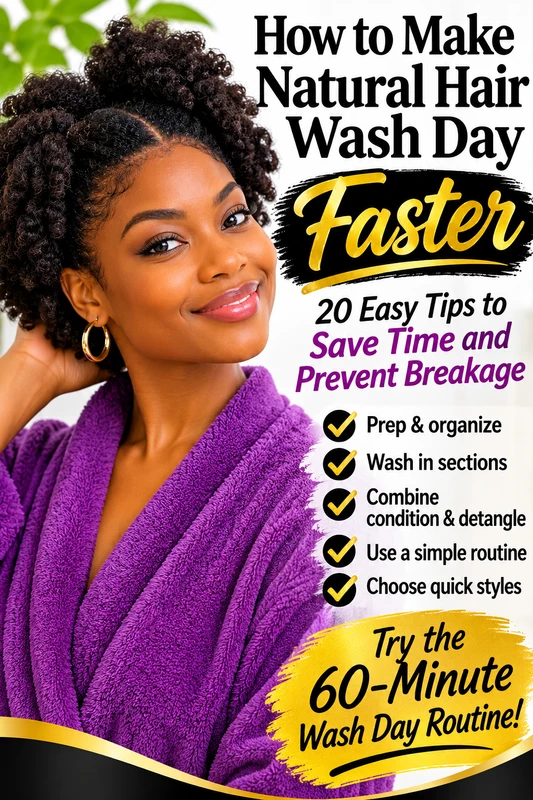
Natural hair wash day should be a refreshing part of your hair care routine, not an exhausting experience that takes up your entire weekend.
However, for many women with natural hair, washing, detangling, conditioning, moisturizing, drying, and styling can take several hours.
If you have thick 4C hair, high-density curls, long natural hair, or strands that tangle easily, wash day can feel especially overwhelming.
The good news is that you can make natural hair wash day faster without sacrificing healthy hair, moisture, or length retention.
You don't need to rush through your routine, pull aggressively through tangles, or eliminate every conditioning treatment.
Instead, the secret is learning how to simplify your wash day, combine compatible steps, prevent unnecessary tangling, and choose techniques that work for your hair.
In this complete guide, we'll explore 20 practical ways to shorten your natural hair wash day while keeping your curls clean, manageable, moisturized, and protected from unnecessary breakage.
Whether you have 3C, 4A, 4B, or 4C hair, these techniques can help you develop a faster, more efficient wash day routine.
Why Does Natural Hair Wash Day Take So Long?
Before learning how to speed up wash day, it's important to understand why the process sometimes takes several hours.
Natural hair has unique characteristics that influence how long cleansing and styling take.
Curly and coily strands naturally bend, twist, and wrap around neighboring hairs. This can make detangling more complicated than it is for straighter hair textures.
Several factors can increase wash day time:
-
High hair density
-
Longer hair length
-
Significant shrinkage
-
Dry or tangled strands
-
Product buildup
-
Complicated styling routines
-
Excessive product layering
-
Repeated detangling
-
Washing without sections
-
Using too many treatments
One of the biggest problems is trying to complete every possible hair treatment during one wash day.
For example, you might pre-poo, detangle, shampoo twice, deep condition, apply a protein treatment, moisturize, oil your scalp, blow-dry, and install a detailed hairstyle.
Although some of these steps can be beneficial when needed, they don't necessarily belong in every routine.
The goal should be to create an efficient wash day that addresses your hair's actual needs.
For a more detailed explanation of wash day timing, read our guide on How Long Should Natural Hair Wash Day Take?.
1. Prepare Everything Before Starting Wash Day
One of the easiest ways to make natural hair wash day faster is to organize your supplies before getting your hair wet.
Many people waste time searching for conditioner, looking for hair clips, or deciding which products to use.
These small interruptions can add unnecessary time to an already lengthy routine.
Before washing, gather your essential supplies:
-
Shampoo
-
Rinse-out conditioner
-
Leave-in treatment
-
Detangling brush
-
Wide-tooth comb
-
Sectioning clips
-
Spray bottle
-
Microfiber towel
-
Hair moisturizer
-
Scalp oil, if needed
-
Styling accessories
Place everything within reach.
You can even create a dedicated wash day basket that contains your favorite products and tools.
This simple organizational habit makes your routine smoother and eliminates unnecessary interruptions.
Time-saving tip: Decide how you're going to style your hair before you begin washing it.
Knowing your final hairstyle helps you determine how many sections you'll need and which products to prepare.
2. Divide Your Natural Hair Into Sections
Sectioning is one of the most effective ways to make natural hair wash day faster.
Instead of trying to wash and detangle your entire head at once, divide your hair into manageable sections.
For many people, four to eight sections work well.
However, the ideal number depends on your hair density, length, texture, and tendency to tangle.
Sectioning helps you:
-
Keep strands organized
-
Reduce unnecessary tangling
-
Apply shampoo more evenly
-
Distribute conditioner efficiently
-
Detangle smaller areas
-
Prevent already-detangled hair from mixing with tangled sections
For example, someone with medium-density natural hair might only need four sections.
Someone with very thick 4C hair may find six or eight sections more manageable.
The goal isn't to create the greatest number of sections.
It's to find the number that makes washing and detangling easier.
Read our detailed guide on How Many Sections Should You Use on Wash Day? to determine the best approach for your hair.
3. Detangle Before Shampooing When Necessary
Trying to shampoo extremely tangled hair can make wash day longer.
As water moves through the hair, loose strands and existing knots may become more difficult to manage if the hair is handled roughly.
If your hair has significant tangling, gently separate major knots before shampooing.
You don't necessarily need to perform a complete detangling session.
Instead, focus on removing large tangles that could interfere with cleansing.
Start by dividing your hair into sections.
Lightly dampen the hair or apply a suitable detangling product with enough slip.
Use your fingers to separate larger knots.
Work slowly from the ends toward the roots.
Once the section is manageable, twist or clip it out of the way.
This preparation can make shampooing easier and reduce the amount of detangling required afterward.
However, if your hair detangles best with rinse-out conditioner, you can save your main detangling session until conditioning.
For additional techniques, explore The Complete Guide to Detangling Natural Hair Without Breakage or Pain.
4. Stop Detangling the Same Hair Multiple Times
Repeated detangling is one of the most overlooked reasons wash day takes too long.
Some people detangle before shampooing, again while conditioning, again after rinsing, and once more before styling.
This repeated manipulation isn't always necessary.
Instead, develop a routine that minimizes how often you comb or brush the same strands.
For example:
-
Remove major tangles before shampooing if needed.
-
Shampoo gently without roughing up the hair.
-
Complete your main detangling session while conditioner provides slip.
-
Twist each finished section.
-
Keep the sections organized until styling.
Once a section is thoroughly detangled, avoid repeatedly brushing through it unless necessary.
This reduces unnecessary handling and can help limit mechanical breakage.
5. Combine Conditioning and Detangling
One of the best natural hair wash day hacks is combining two compatible steps.
Instead of conditioning your hair and then starting a completely separate detangling session, detangle while the conditioner is still in your hair.
A suitable conditioner provides lubrication that can help strands slide past one another.
After shampooing:
-
Apply conditioner generously enough to coat the hair.
-
Add water as needed to improve distribution.
-
Divide your hair into manageable sections.
-
Begin finger-detangling the ends.
-
Follow with a wide-tooth comb or detangling brush if appropriate.
-
Twist each completed section.
-
Rinse according to the conditioner instructions.
This technique allows you to condition and detangle during the same stage of wash day.
Important: Never force a brush through stubborn knots simply to finish faster.
Gentle detangling is more important than completing the process within a particular number of minutes.
6. Use a Conditioner With Good Slip
Not all conditioners perform equally when it comes to detangling.
If your conditioner doesn't provide enough lubrication, you may spend extra time separating knots.
A conditioner with good slip helps reduce friction between strands.
This can make combing and finger-detangling more manageable.
Look for a conditioner that leaves your hair feeling smooth and easy to separate.
Apply enough product to cover the section, but avoid assuming that excessive amounts automatically produce better results.
Add water if needed to help distribute the conditioner.
Allow the product to work according to its instructions before detangling.
If you regularly struggle with tangling, consider whether your current conditioner is suitable for your hair's needs.
Sometimes changing one product can make your routine noticeably easier.
7. Focus Shampoo on Your Scalp
You don't need to aggressively scrub every inch of your hair to achieve a thorough wash.
The scalp is where sweat, sebum, dead skin cells, and product residue commonly accumulate.
During shampooing, concentrate on cleansing the scalp.
Use the pads of your fingertips to massage gently.
Avoid scratching with your fingernails.
Allow shampoo and rinse water to move through the lengths of your hair, gently cleansing them as needed.
If the lengths have significant buildup, they may require more direct attention.
The key is to avoid unnecessary rubbing and tangling.
For more information, read How to Reduce Breakage While Shampooing.
8. Avoid Shampooing More Times Than Necessary
Some natural hair routines involve shampooing two or three times automatically.
However, the number of washes should depend on your scalp condition, product buildup, and the effectiveness of your shampoo.
If one thorough shampoo leaves your scalp and hair clean, an additional wash may not be necessary.
On the other hand, heavy buildup, oils, or styling products may require a second cleanse.
Don't skip necessary cleansing just to save time.
Instead, pay attention to how your scalp and hair feel.
Your routine should be efficient without compromising cleanliness.
9. Stop Deep Conditioning Every Wash Day Unless Needed
Deep conditioning can be a useful part of natural hair care, particularly when hair needs additional conditioning.
However, not every wash day requires an extended treatment.
If your regular conditioner leaves your hair manageable and comfortable, you may not need an additional mask every time.
Consider your hair's condition, chemical processing history, dryness, and styling habits.
When using a deep conditioner, follow the manufacturer's recommended processing time.
Leaving a product on for several hours doesn't necessarily produce better results.
You can also use the recommended processing time to complete other tasks, such as cleaning your tools or preparing your styling accessories.
A streamlined wash day is about choosing treatments intentionally rather than automatically adding every possible step.
10. Use a Simple Moisturizing Routine
After shampooing and conditioning, your hair needs appropriate post-wash care.
However, applying five or six different products can make the process unnecessarily complicated.
A simple routine may include:
-
A suitable leave-in treatment
-
An optional oil-based product for additional conditioning
-
A styling product when needed
You don't need to layer several creams, oils, butters, and sprays simply because they're popular.
Too much product can contribute to buildup and make future wash days more difficult.
For a streamlined post-wash routine, consider incorporating Hairobics All Natural Leave-In Treatment.
This botanical-based treatment can be used according to its directions as part of your hair and scalp conditioning routine.
Apply the appropriate amount while your hair is still manageable and sectioned.
The goal is to support softness and manageability without adding unnecessary steps.
11. Keep Your Hair Stretched During Wash Day
Natural hair shrinkage is normal and isn't automatically a sign of damage.
However, when tightly coiled hair contracts significantly, strands may wrap around one another and create additional tangles.
Keeping your hair organized in twists or braids can help reduce unnecessary tangling during washing.
After detangling a section, twist it loosely.
Keep it separated from the remaining hair.
When you're ready to moisturize or style, release one section at a time.
You can also use banding, loose braids, or other gentle stretching techniques after washing.
Avoid tight tension, especially around fragile edges.
If you're interested in maintaining a more elongated hairstyle, read How to Keep Natural Hair Stretched on Wash Day.
12. Choose Hairstyles That Don't Take Hours
Sometimes washing and conditioning aren't the longest parts of wash day.
Styling is.
Installing dozens of tiny twists or braids can easily turn a relatively quick cleansing routine into a lengthy process.
When you're short on time, choose a hairstyle that requires less manipulation.
Some practical options include:
-
Chunky two-strand twists
-
Large braids
-
Simple natural hair puffs
-
Loose buns
-
Wash-and-go hairstyles
-
Low-manipulation updos
-
Headband styles
The best choice depends on your hair length, texture, and personal preferences.
For example, eight large twists generally require less installation time than forty small twists.
You can still enjoy elaborate hairstyles when you have more time.
But your everyday wash day doesn't need to include complicated styling.
13. Use Larger Sections When Possible
Very small sections can increase the time needed to moisturize, detangle, and style.
Although smaller sections are useful for stubborn tangles, they aren't always necessary for every step.
Try using larger sections for easier parts of your routine.
For example, you might shampoo in four sections, detangle in eight sections, and return to four sections for moisturizing.
This flexible approach prevents you from creating more work than necessary.
Pay attention to your hair's response.
If larger sections cause tangling or uneven product distribution, make them smaller.
The ideal routine balances efficiency with gentle handling.
14. Reduce Product Buildup Between Wash Days
A faster wash day often begins with what you do during the week.
Heavy product buildup can make shampooing more difficult and may require additional cleansing.
If you're applying multiple layers of creams, oils, gels, and pomades every day, consider simplifying your maintenance routine.
Use products according to your hair's actual needs.
Avoid applying more oil simply because your hair feels dry; oil alone doesn't replace water-based conditioning.
When your hair needs refreshing, assess whether a light application of an appropriate moisturizing product is sufficient.
Keeping buildup under control can help make your next cleansing session more manageable.
15. Protect Your Hair at Night
Nighttime hair care can influence how long your next wash day takes.
Sleeping with loose natural hair may increase friction and tangling for some people.
Over several nights, this can create knots that require additional detangling.
Consider protecting your hair with:
-
A satin bonnet
-
A satin scarf
-
A satin pillowcase
-
Loose twists
-
Loose braids
-
A comfortable pineapple hairstyle
Choose a method that works with your hair length and preferred style.
The goal is to reduce unnecessary friction and keep strands manageable.
If you wake up with fewer tangles, you may spend less time detangling on wash day.
16. Prevent Hair From Retangling After Washing
Few things make wash day more frustrating than detangling your hair only to discover that it has become tangled again.
Retangling often occurs when separated strands are allowed to shrink, mix together, or dry without being organized.
To reduce this problem, keep completed sections separated.
After detangling, twist or braid each section loosely.
Avoid repeatedly combining freshly detangled hair with tangled areas.
Apply your post-wash products methodically.
Work on one section at a time until you're ready to style.
If your hair frequently becomes tangled again immediately after washing, read our guide on How to Prevent Hair From Retangling.
17. Use a Microfiber Towel or Soft Cotton T-Shirt
Drying your hair doesn't have to involve vigorous towel rubbing.
Aggressively rubbing natural hair can create friction, frizz, and tangling.
Instead, use a microfiber towel or soft cotton T-shirt to gently absorb excess water.
Squeeze or blot the hair rather than rubbing it.
Keep your sections organized during the process.
You don't need to remove every drop of water before applying leave-in care.
Many moisturizing products are intended for damp hair.
Follow the directions for your chosen products.
This approach helps transition smoothly from washing to moisturizing.
18. Simplify Your Scalp Care Routine
A clean, comfortable scalp is an important part of healthy hair maintenance.
However, scalp care doesn't need to involve several different oils and lengthy massages every wash day.
After cleansing, assess whether your scalp needs additional conditioning.
If you prefer an oil-based scalp product, consider Hairobics Scalp Rejuvenator.
It can be incorporated into your scalp-care routine according to the product directions.
Apply an appropriate amount and massage gently with your fingertips.
Avoid scratching, pulling, or applying excessive pressure.
If you have persistent scalp itching, flaking, irritation, or inflammation, don't simply cover the symptoms with oil. Seek appropriate professional guidance.
The goal is a manageable routine that supports scalp comfort without unnecessary product layering.
19. Use Hairobics Hair & Scalp Booster When Additional Conditioning Is Needed
Dry-feeling hair and scalp areas may benefit from additional conditioning after washing.
However, you don't necessarily need several different oil-based products.
Hairobics Hair & Scalp Booster contains a blend of botanical ingredients and oils, including coconut oil, olive oil, jojoba oil, almond oil, rosemary oil, and vitamin E oil.
It can be incorporated into a hair and scalp conditioning routine.
Apply an appropriate amount according to the directions, concentrating on areas that need attention.
Avoid excessive application that could leave your hair feeling coated.
Remember that oil-rich products don't replace water-based conditioning.
For many people, simplifying the number of products used after shampooing can make wash day more efficient.
20. Create a Consistent Wash Day Schedule
Consistency can make natural hair maintenance easier.
When you wait until your hair is extremely tangled or covered with heavy buildup, washing may require more effort.
Develop a cleansing schedule based on your scalp, hair, lifestyle, and styling habits.
Some people prefer washing weekly.
Others find that a different interval works better.
There isn't one universal wash day schedule for every natural hair texture.
Factors such as exercise, sweating, scalp oiliness, product use, and protective styling all influence how frequently cleansing may be needed.
For more guidance, read How Often Should You Wash Natural Hair?.
A predictable routine can make preparation easier and help prevent wash day from becoming overwhelming.
The 60-Minute Natural Hair Wash Day Routine
Can you complete a natural hair wash day in approximately one hour?
For some people, yes.
However, this depends on hair density, length, tangling, drying requirements, and styling preferences.
Someone with shorter natural hair may finish considerably faster than someone with waist-length, high-density 4C hair.
Here's an example of a streamlined routine.
Minutes 0–5: Prepare and Section
Gather your supplies.
Divide your hair into four manageable sections.
Remove obvious large tangles if necessary.
Minutes 5–15: Shampoo
Wet your hair thoroughly.
Apply shampoo to the scalp.
Massage gently.
Rinse completely.
Repeat only if necessary.
Minutes 15–35: Condition and Detangle
Apply conditioner.
Work through one section at a time.
Finger-detangle before using a suitable tool.
Twist completed sections.
Rinse according to the product instructions.
Minutes 35–45: Moisturize
Gently blot excess water.
Apply your leave-in treatment.
Use additional conditioning products only where needed.
Keep your sections organized.
Minutes 45–60: Simple Styling
Choose a low-manipulation hairstyle.
Install chunky twists, a simple puff, or another manageable style.
If you prefer a wash-and-go, apply your styling product according to its directions.
Note: This example doesn't include complete drying time. If your hairstyle requires fully dry hair, allow additional time.
Don't sacrifice thorough rinsing or gentle detangling simply to meet a 60-minute goal.
How to Make 4C Natural Hair Wash Day Faster
People with tightly coiled 4C hair may experience significant shrinkage and tangling.
However, 4C hair doesn't automatically require an all-day wash routine.
The key is to adapt your techniques to your hair's individual needs.
Start by keeping your hair in manageable sections.
Avoid piling all your hair together while shampooing.
Use a conditioner that provides enough slip for detangling.
Work from the ends toward the roots.
Keep completed sections twisted or braided when appropriate.
Choose hairstyles that don't require excessive manipulation.
Most importantly, avoid comparing your wash day to someone with a different hair density, length, or curl pattern.
A routine that works beautifully for one person may not be ideal for another.
Your goal should be a consistent routine that protects your strands while fitting your schedule.
How to Make Wash Day Faster for High-Density Natural Hair
High-density natural hair contains a greater number of strands per area of scalp.
This can increase the amount of time required for cleansing, detangling, and product distribution.
If you have high-density hair, consider using six to eight sections instead of four.
Make sure shampoo reaches the scalp rather than remaining on the outer layers.
Apply conditioner section by section.
Detangle patiently, especially around the crown and nape.
Use larger sections for styling when possible.
High-density hair may require additional time, but a structured routine can prevent unnecessary repetition.
How to Make Wash Day Faster for Low-Porosity Natural Hair
Low-porosity hair can sometimes resist becoming thoroughly wet, depending on its condition and product buildup.
If your hair takes time to become saturated, begin by allowing warm—not hot—water to flow through it thoroughly.
Separate dense sections so water can reach the inner layers.
Use products suited to your hair rather than automatically layering heavy creams and oils.
Rinse conditioners completely according to their directions.
If buildup is present, use an appropriate cleansing product.
Don't assume that low-porosity hair always needs extra treatments or extended processing times.
A simple, consistent routine is often easier to maintain.
Common Mistakes That Make Natural Hair Wash Day Longer
Even when you're trying to be efficient, certain habits can add unnecessary time.
Washing Without a Plan
Starting wash day without knowing your products or hairstyle can lead to interruptions and indecision.
Using Too Many Products
Layering unnecessary treatments can increase application time and create buildup.
Detangling Aggressively
Pulling through knots may seem faster initially, but it can cause breakage and make hair more difficult to manage.
Skipping Sections
Washing your entire head as one tangled mass can make detangling more complicated.
Repeating the Same Steps
Detangling several times or shampooing repeatedly without a reason adds time.
Choosing Complicated Hairstyles
An elaborate style can turn a short wash routine into an hours-long process.
Ignoring Hair Maintenance During the Week
Allowing severe tangling or buildup to accumulate may make your next wash day more demanding.
Best Hairobics Products for a Simple Natural Hair Wash Day
A streamlined wash day doesn't require an excessive number of products.
Instead, choose products that complement your cleansing, conditioning, and styling routine.
Here are three Hairobics All Natural products to consider.
Hairobics Leave-In Treatment
A leave-in treatment can be a convenient part of post-wash hair care.
Hairobics Leave-In Treatment is designed for hair and scalp conditioning.
Use it according to its directions after cleansing and rinsing out your regular conditioner.
It can fit into a simplified moisturizing routine without requiring multiple additional steps.
Shop Hairobics Leave-In Treatment
Hairobics Hair & Scalp Booster
For hair and scalp areas that need additional oil-based conditioning, Hairobics Hair & Scalp Booster is another option.
Its botanical oil blend can complement a routine focused on maintaining conditioned, manageable hair.
Apply an appropriate amount rather than heavily coating the strands.
Shop Hairobics Hair & Scalp Booster
Hairobics Scalp Rejuvenator
If scalp conditioning is part of your routine, Hairobics Scalp Rejuvenator offers an oil-based option.
Use as directed and avoid unnecessary product layering.
A simple scalp-care routine can fit into your regular wash day without adding excessive time.
Shop Hairobics Scalp Rejuvenator
You can also explore the Hairobics Hair Growth Bundle, which includes Hair & Scalp Booster, Leave-In Treatment, and Scalp Rejuvenator.
Shop the Hairobics Hair Growth Bundle
Remember that conditioning products complement a hair-care routine but don't replace shampoo, rinse-out conditioner, gentle detangling, or appropriate scalp care.
Frequently Asked Questions About Faster Natural Hair Wash Days
How can I make natural hair wash day faster?
The most effective strategies include washing in sections, combining conditioning with detangling, preparing products beforehand, reducing unnecessary treatments, and choosing simple hairstyles.
Keeping your hair organized throughout the process can also reduce repeated detangling.
Can I wash 4C hair in one hour?
Some people can complete a basic 4C wash day in approximately one hour, especially with shorter hair or a simple hairstyle.
However, longer or high-density hair may require more time.
Complete drying and elaborate styling can extend the routine.
Should I detangle before or after shampooing?
Both methods can work.
If your hair has major tangles, gently separating them before shampooing may help.
If your hair detangles best with conditioner, complete your main detangling session during conditioning.
Choose the approach that minimizes breakage and unnecessary manipulation.
Do I need to deep condition every wash day?
Not necessarily.
Deep-conditioning frequency depends on your hair's condition, needs, and the product being used.
Follow product directions and assess whether the additional treatment benefits your hair.
What is the fastest hairstyle after washing natural hair?
Simple puffs, chunky twists, large braids, and certain wash-and-go styles can be relatively quick.
The fastest choice depends on your hair length, density, curl pattern, and styling experience.
How can I prevent tangles between wash days?
Protect your hair at night, minimize unnecessary manipulation, keep strands appropriately conditioned, and avoid allowing severe tangles to accumulate.
Loose twists or braids may help keep your hair organized.
Does faster wash day mean more hair breakage?
Not necessarily.
An efficient routine can reduce unnecessary manipulation.
However, rushing through knots, brushing aggressively, or skipping needed conditioning can increase breakage.
Efficiency should never come at the expense of gentle handling.
Final Thoughts: Natural Hair Wash Day Doesn't Have to Take All Day
Learning how to make natural hair wash day faster is about creating a routine that works for your hair and lifestyle.
You don't need to spend your entire weekend washing, detangling, moisturizing, and styling.
Simple changes can make a meaningful difference.
Prepare your supplies before starting.
Wash in manageable sections.
Combine conditioning and detangling.
Avoid unnecessary product layering.
Keep your hair organized to reduce retangling.
Choose hairstyles that fit your available time.
Most importantly, focus on maintaining clean, conditioned, manageable hair rather than following every popular hair-care trend.
Your natural hair deserves consistent attention, but that doesn't mean your routine has to be complicated.
With the right techniques and a little preparation, wash day can become a simpler, more enjoyable part of your weekly hair-care routine.
Explore Hairobics All Natural Hair Growth Products to find botanical-based products that complement your natural hair maintenance routine.
Healthy natural hair care begins with consistency, gentle handling, and a routine you can realistically maintain.