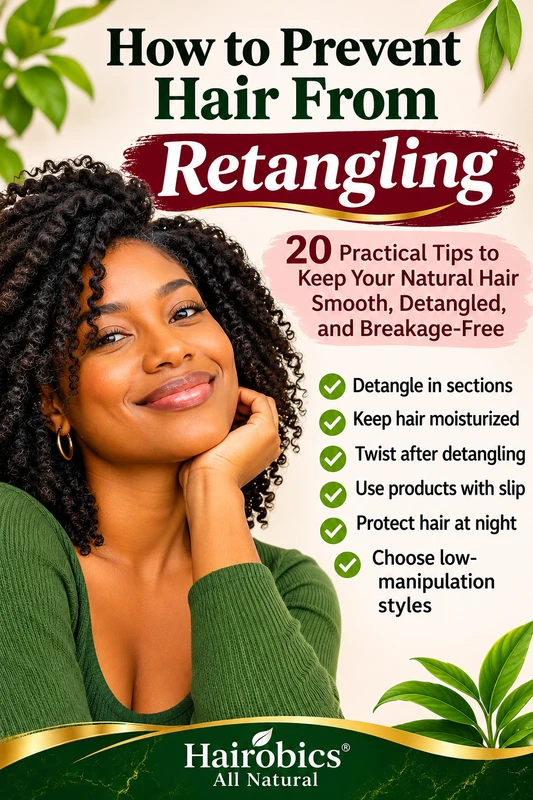
Have you ever spent an hour carefully detangling your natural hair, only to discover that it has become tangled again just minutes later?
You separate every knot, work through each section, and finally get your curls feeling smooth. Then you rinse your hair, let it shrink, or begin styling—and suddenly, those frustrating tangles return.
If this sounds familiar, you're not alone.
Retangling is one of the most common challenges for people with natural, curly, coily, and kinky hair. It can be especially frustrating for individuals with tightly coiled 4A, 4B, and 4C hair because the strands naturally curl, twist, and wrap around one another.
The good news is that you can significantly reduce how often your natural hair retangles by making a few important changes to your wash-day routine, moisturizing techniques, and styling habits.
Preventing retangling isn't about forcing your curls to remain straight. It's about reducing friction, maintaining moisture, controlling shrinkage when necessary, and keeping freshly detangled strands organized.
In this complete guide, we'll explain why natural hair retangles, how to stop knots from returning after detangling, and 20 practical ways to keep your hair more manageable.
Whether you're growing out your natural hair, maintaining shoulder-length curls, or trying to retain more length, these techniques can help make your hair-care routine easier.
What Does It Mean When Hair Retangles?
Hair retangling occurs when strands that were previously separated become intertwined again.
This can happen immediately after detangling or gradually throughout the day.
For example, you might completely detangle your hair while applying conditioner. However, after rinsing, your curls shrink and begin wrapping around neighboring strands.
By the time you're ready to style, your hair feels tangled again.
Retangling can also happen when hair dries without being separated into sections, when loose strands rub against clothing, or when shed hairs remain trapped among healthy strands.
Although some tangling is normal, frequent severe retangling can make styling more difficult and increase the risk of mechanical breakage.
Understanding what causes your hair to retangle is the first step toward preventing it.
Why Does Natural Hair Retangle So Quickly?
Natural hair has unique structural characteristics that influence how strands interact.
Unlike straight hair, curly and coily strands follow curved or spiral patterns.
These curves allow neighboring strands to catch, overlap, and wrap around one another.
Several factors can make this happen more frequently.
1. Natural Hair Shrinkage
Shrinkage occurs when curly or coily hair returns toward its natural shape after being stretched.
As the hair contracts, individual strands may wrap around one another.
This is particularly noticeable with tightly coiled hair.
Shrinkage itself is not damage. However, allowing freshly detangled hair to shrink freely without separating it can sometimes encourage new tangles.
2. Dry Hair
Dry-feeling hair often has less slip, making strands more likely to catch against one another.
When hair lacks adequate conditioning, detangling can become increasingly difficult.
3. Raised or Damaged Cuticles
The outer layer of each hair strand is called the cuticle.
When cuticles become damaged or rough, neighboring strands may experience more friction.
This can make hair feel coarse and encourage tangling.
4. Shed Hair Accumulation
Hair naturally sheds as part of its growth cycle.
However, tightly curled hair can hold onto shed strands instead of allowing them to fall away.
These loose hairs may become wrapped around surrounding strands, creating knots.
5. Excessive Manipulation
Constantly touching, brushing, separating, or restyling natural hair can disturb curl patterns and encourage tangling.
6. Split Ends and Single-Strand Knots
Damaged ends can catch on neighboring strands.
Single-strand knots, sometimes called fairy knots, can also increase friction and make detangling more challenging.
For a deeper explanation, read our guide on why natural hair tangles so easily.
20 Ways to Prevent Natural Hair From Retangling
1. Always Detangle Your Hair in Sections
One of the most effective ways to prevent retangling is to divide your hair into manageable sections before detangling.
Instead of working through your entire head at once, separate your hair into four to eight sections.
People with very thick, long, or tightly coiled hair may benefit from additional sections.
Working in sections allows you to focus on smaller amounts of hair while preventing freshly detangled strands from mixing with tangled areas.
How to do it:
-
Divide your hair into four to eight sections.
-
Secure each section with a clip or loose hair tie.
-
Work on one section at a time.
-
Detangle carefully from the ends upward.
-
Twist or braid each completed section.
The final step is especially important.
Once a section is detangled, avoid leaving it loose while working on the rest of your hair.
2. Twist Each Section Immediately After Detangling
This simple technique can dramatically improve your detangling routine.
After detangling a section, place it into a loose two-strand twist or braid.
Twisting keeps neighboring strands organized and limits how much they move around.
It also helps reduce immediate shrinkage and prevents freshly detangled hair from becoming mixed with untreated sections.
For example, if you're detangling six sections, you should finish with six loosely twisted or braided sections.
You can then move directly into washing, conditioning, or styling without allowing your entire head of hair to become tangled again.
3. Use Products That Provide Plenty of Slip
Slip describes how easily hair strands glide past one another.
Products with good slip make detangling easier by reducing friction.
Conditioners, detangling creams, and suitable leave-in products can improve manageability.
Look for products that help hair feel soft and flexible rather than stiff or sticky.
When applying a detangling product, distribute it evenly throughout the section.
Pay particular attention to the ends because they are generally the oldest and most vulnerable portions of your hair.
Add Leave-In Care to Your Routine
After washing and conditioning, consider incorporating Hairobics Leave-In Treatment into your hair-care routine.
This botanical-based formula contains ingredients such as aloe vera, avocado oil, jojoba oil, and other plant-derived ingredients.
It can complement a conditioning routine focused on softness, shine, and manageability.
Follow the product directions and test a small area before use.
Remember that a leave-in treatment works best alongside gentle detangling techniques.
4. Detangle From the Ends Toward the Roots
Starting at the roots and dragging a comb downward can push tangles together.
This creates additional tension and may cause unnecessary breakage.
Instead, begin near the ends.
Once the ends are separated, gradually work upward toward the roots.
Hold the section above the area you're detangling to reduce pulling on your scalp.
If you encounter resistance, stop immediately.
Add more conditioner or detangling product and carefully separate the knot with your fingers.
Never force a comb through stubborn tangles.
For additional techniques, explore our complete guide to detangling natural hair without breakage.
5. Avoid Detangling Completely Dry Hair Without Lubrication
Dry detangling can create unnecessary friction, especially when hair is tightly coiled or already tangled.
For many natural hair textures, detangling with conditioner or another product that provides slip is more comfortable.
However, your hair doesn't always need to be soaking wet.
Some people find that slightly damp hair works best.
Others prefer detangling while conditioner is applied during wash day.
Experiment with different moisture levels to determine which method allows your strands to separate with the least resistance.
Avoid repeatedly brushing fragile hair when it feels dry, rough, or difficult to manage.
6. Keep Your Hair Stretched After Detangling
Stretching can help reduce retangling by limiting how tightly strands coil around one another.
This doesn't mean you need to straighten your hair with heat.
Heat-free stretching methods can be effective.
Popular options include:
-
Two-strand twists
-
Loose braids
-
African threading
-
Banding
-
Braid-outs
-
Twist-outs
The goal is to keep strands organized while maintaining your natural texture.
For tightly coiled hair that experiences significant shrinkage, keeping hair stretched after wash day may make future styling easier.
Avoid stretching methods that pull tightly on your roots or edges.
7. Wash Your Hair in Sections
Washing natural hair while it is completely loose can sometimes create unnecessary tangling.
As you shampoo, strands may move around and become intertwined.
Instead, consider washing your hair in sections.
You can use loose twists, braids, or clips to keep sections separated.
When shampooing, focus on cleansing your scalp.
Use your fingertips to massage gently without aggressively rubbing your hair together.
Allow the shampoo to move down the lengths as you rinse.
This reduces unnecessary manipulation.
Section washing can be especially helpful for people with dense, long, or high-shrinkage hair.
8. Never Pile Your Hair on Top of Your Head While Shampooing
Piling hair on top of your head may seem convenient, but it can encourage strands to wrap around one another.
This is particularly problematic when washing tightly coiled hair.
Instead, keep your hair directed downward whenever possible.
Apply shampoo primarily to the scalp and gently work through the roots.
Avoid scrubbing the lengths together.
When rinsing, allow water to flow through each section.
These small adjustments can reduce the amount of detangling required afterward.
For more wash-day advice, read How to Reduce Breakage While Shampooing.
9. Condition Your Hair After Shampooing
Conditioning is essential for maintaining manageable natural hair.
Shampoo removes dirt, excess oils, and product buildup.
However, depending on the shampoo and your hair's condition, cleansing may leave strands feeling less slippery.
A suitable rinse-out conditioner helps improve softness and reduce friction.
Apply conditioner throughout your hair, paying special attention to the ends.
Allow it to remain on your hair according to the manufacturer's directions.
Then gently detangle while the conditioner provides lubrication.
After rinsing, keep each section separated.
Conditioning can make a noticeable difference in how easily your hair tangles during styling.
10. Avoid Aggressive Towel Drying
Traditional bath towels can create friction when rubbed against curly or coily hair.
Rough towel drying may disturb your curls, encourage tangling, and contribute to breakage.
Instead, use a microfiber towel or soft cotton T-shirt.
Gently squeeze excess water from your hair.
Avoid rubbing the towel back and forth.
If your hair is already divided into twists or braids, keep those sections organized while removing excess water.
Once your hair is no longer dripping, continue with your moisturizing and styling routine.
11. Keep Your Hair Properly Moisturized
Hair that feels consistently dry may become harder to detangle.
Maintaining adequate conditioning can help improve flexibility and manageability.
A practical moisturizing routine often includes a water-based product followed by additional conditioning when needed.
For example:
-
Start with clean hair.
-
Apply an appropriate leave-in product.
-
Distribute it evenly.
-
Add a small amount of oil-based conditioning product if your hair benefits from it.
-
Style your hair in a way that limits unnecessary friction.
Remember that oils do not replace water-based conditioning.
Support Your Hair and Scalp With Hairobics
Hairobics Hair & Scalp Booster contains a blend of botanical oils and conditioning ingredients, including coconut oil, olive oil, jojoba oil, aloe vera, rosemary oil, and vitamin E.
It can be incorporated into a regular hair-and-scalp care routine according to the product directions.
Use an appropriate amount rather than applying excessive product.
Too much product can create buildup without solving the underlying cause of tangling.
12. Protect Your Hair While Sleeping
Nighttime friction can contribute to tangling.
When hair rubs against cotton pillowcases, individual strands may shift, catch, and become intertwined.
Sleeping with your hair completely loose can make this worse for some curl patterns.
Consider using a satin or silk bonnet, scarf, or pillowcase.
You can also place your hair into loose twists or braids before bed.
Avoid securing your hair too tightly.
The goal is to minimize friction and movement while keeping your scalp comfortable.
A consistent nighttime routine can make morning styling much easier.
13. Remove Shed Hair Regularly
Shed hair is a major contributor to natural hair tangling.
Because tightly coiled strands wrap around one another, shed hairs may remain trapped instead of falling away.
Over time, these loose strands can create knots.
During detangling, carefully remove shed hairs as they separate.
Pay attention to sections that feel unusually tangled near the roots.
Avoid repeatedly pulling through a knot without identifying what is causing the resistance.
The appropriate detangling frequency depends on your hairstyle, texture, and how quickly shed hairs accumulate.
The goal is to prevent excessive buildup without manipulating your hair unnecessarily.
14. Trim Damaged Ends When Necessary
Split ends and damaged hair can increase friction between strands.
When ends become rough, they may catch on neighboring hairs.
This can contribute to recurring tangles.
Trimming damaged ends when necessary may improve manageability.
However, everyone does not need a haircut on the same schedule.
Some people require more frequent maintenance because of heat styling, chemical treatments, or mechanical damage.
Others can go longer between trims.
Watch for signs such as persistent split ends, severe end tangling, and visible breakage.
If your ends repeatedly knot together despite careful conditioning, consider having them assessed by an experienced stylist.
15. Choose Low-Manipulation Hairstyles
Low-manipulation hairstyles reduce the amount of daily handling your hair receives.
This can help limit unnecessary friction and repeated detangling.
Examples include loose two-strand twists, flat twists, medium braids, and comfortably secured buns.
These styles keep hair organized and may reduce how frequently loose strands become intertwined.
However, a hairstyle is only beneficial when it is installed and maintained gently.
Avoid tight braids, excessive extension weight, or styles that place constant tension on your hairline.
Low manipulation should mean less pulling—not more tension.
16. Prevent Excessive Shrinkage When Necessary
Shrinkage is a normal characteristic of healthy curly and coily hair.
It is not something that must be eliminated.
However, if your hair repeatedly tangles when it shrinks, controlled stretching may help.
Try allowing your hair to dry in large twists or braids.
Once your hair is sufficiently dry, carefully unravel each section.
Avoid pulling apart the curls excessively.
For people who prefer wash-and-go hairstyles, maintaining defined curl clumps and minimizing unnecessary touching may help reduce tangling.
Choose a method that works with your preferred hairstyle rather than against it.
17. Avoid Constantly Touching Your Hair
It can be tempting to run your fingers through your curls throughout the day.
However, repeatedly separating curls may increase friction and disrupt sections that were previously organized.
This is particularly noticeable with tightly coiled hair.
Once your hairstyle is complete, try to leave it alone.
If your hair becomes tangled in one area, address that section gently instead of repeatedly combing your entire head.
Reducing unnecessary manipulation can help preserve your hairstyle and minimize mechanical stress.
18. Protect Your Ends From Clothing Friction
The ends of your hair are particularly vulnerable because they have experienced more washing, styling, and environmental exposure than newer growth.
When hair repeatedly rubs against rough clothing, scarves, collars, or jackets, friction can increase.
This may contribute to knots and breakage.
If your hair reaches your shoulders, pay attention to how the ends interact with your clothing.
Consider wearing your hair in a loose updo or protective style when using rough fabrics.
Avoid constantly pulling your hair away from collars or accessories.
Small changes can help reduce unnecessary wear on your oldest strands.
19. Avoid Excessive Product Buildup
Applying more product does not always make hair easier to manage.
Excessive layering of oils, creams, gels, and styling products may leave hair feeling coated, sticky, or difficult to separate.
Some combinations can also produce residue.
When hair becomes difficult to detangle despite regular moisturizing, consider whether buildup is contributing.
Cleanse your hair as needed using a shampoo appropriate for your hair and scalp.
Follow with a suitable conditioner.
Then use only the amount of styling product necessary.
A simple routine with well-chosen products can sometimes be more effective than using numerous products at once.
20. Develop a Consistent Weekly Hair-Care Routine
Preventing retangling requires consistency.
Even the best detangling technique may provide limited benefits if your hair is repeatedly allowed to dry out, become matted, or accumulate shed strands.
Create a manageable routine based on your hair's needs.
You don't need to detangle every day.
Instead, focus on keeping your hair conditioned, protected, and organized between wash days.
A consistent routine can reduce the amount of time spent removing knots and make styling less stressful.
How to Prevent 4C Hair From Retangling
4C hair often experiences significant shrinkage and has tightly coiled strands that can wrap around one another.
This makes sectioning particularly useful.
However, 4C hair is not automatically unhealthy, weak, or unmanageable.
The key is choosing techniques that work with its natural structure.
A Simple 4C Hair Routine
Step 1: Divide your hair into six to eight sections, adjusting the number according to density.
Step 2: Apply conditioner or a detangling product with sufficient slip.
Step 3: Gently finger-detangle each section before using a wide-tooth comb if needed.
Step 4: Twist or braid each section immediately after detangling.
Step 5: Wash and condition your hair while keeping sections separated whenever practical.
Step 6: Apply your leave-in care according to the product directions.
Step 7: Style your hair in twists, braids, or another low-manipulation hairstyle.
Step 8: Protect your hair with satin or silk while sleeping.
Following these steps can help reduce how frequently your hair becomes tangled again.
How to Stop Hair From Retangling After Washing
One of the most frustrating experiences is detangling during conditioning and discovering that your hair has become tangled again after rinsing.
This usually happens because strands are allowed to move freely and shrink together.
To reduce this problem, keep your hair organized throughout the washing process.
After detangling a section, place it into a loose twist.
Rinse carefully, making sure the conditioner is removed thoroughly.
If necessary, temporarily unravel a section to rinse and then twist it again.
Avoid aggressively shaking or rubbing your hair.
Once washing is complete, gently squeeze out excess water.
Apply your post-wash conditioning products and proceed with styling.
For additional wash-day strategies, explore How to Reduce Wash Day Time.
How to Prevent Retangling During Styling
Even after successful detangling, styling can cause knots to return.
This often happens when hair is repeatedly separated, brushed, or pulled into different directions.
To reduce retangling during styling, keep unused sections clipped away.
Work through one section at a time.
Use your fingers to separate hair gently instead of repeatedly brushing the same area.
Apply additional conditioning product only when necessary.
If you're creating twists or braids, maintain consistent section sizes and avoid pulling tightly.
For twist-outs and braid-outs, allow the hair to dry sufficiently before unraveling.
When separating the finished style, avoid excessive fluffing or pulling.
The less unnecessary friction you create, the easier it may be to maintain your results.
Can Retangling Cause Hair Breakage?
Retangling does not automatically mean your hair is damaged.
However, repeated tangling can increase the amount of manipulation required during styling.
When knots are pulled apart aggressively, strands may stretch beyond their limits and break.
Over time, this can affect length retention.
For example, your hair may continue growing from the scalp while the ends repeatedly break during detangling.
This can make it appear as though your hair is not growing.
Preventing unnecessary tangles helps reduce the need for forceful detangling.
Gentle handling, suitable conditioning, and regular assessment of damaged ends are important parts of maintaining healthy natural hair.
How to Prevent Single-Strand Knots From Returning
Single-strand knots form when a strand loops around itself and creates a small knot.
They are especially common in curly and coily hair.
Although they cannot always be prevented, you can reduce conditions that encourage them.
Keep your ends conditioned and avoid excessive friction.
Use stretched hairstyles when appropriate.
Limit unnecessary manipulation and trim damaged ends when necessary.
If you encounter a stubborn knot, avoid pulling it apart forcefully.
Apply a suitable detangling product and carefully examine the strand.
If the knot cannot be removed without damaging the hair, trimming the affected end with proper hair shears may be preferable to repeated pulling.
A Simple Weekly Routine to Reduce Retangling
Consistency matters more than complicated styling techniques.
Here is an example of a weekly routine that can help keep natural hair manageable.
Wash Day
-
Divide hair into manageable sections.
-
Apply conditioner or detangling product.
-
Detangle gently from the ends upward.
-
Remove accumulated shed hairs.
-
Twist each completed section.
-
Shampoo and condition while maintaining separation.
-
Apply appropriate leave-in care.
-
Style in loose twists, braids, or another preferred hairstyle.
During the Week
Check whether your hair feels dry or difficult to manage.
Refresh conditioning only when necessary.
Avoid repeatedly brushing or restyling your hair.
Keep your ends protected from unnecessary friction.
Before Bed
Place loose hair into a few large twists or another comfortable style when appropriate.
Cover your hair with a satin or silk bonnet or use a smooth pillowcase.
Before the Next Wash
Assess how much tangling has developed.
If your hair remains manageable, continue your routine.
If severe knots are developing, consider adjusting your detangling frequency, styling method, or conditioning products.
Common Mistakes That Make Natural Hair Retangle
Even with a consistent routine, certain habits can make tangling worse.
Leaving freshly detangled hair loose: This allows separated strands to become intertwined again.
Using too little conditioner: Insufficient lubrication can make detangling more difficult.
Aggressively brushing from the roots: This can push knots together and increase breakage.
Skipping shed-hair removal: Loose strands may accumulate and form larger tangles.
Rubbing hair with a towel: Excessive friction can disturb curl patterns.
Ignoring damaged ends: Split ends may repeatedly catch on surrounding strands.
Overusing styling products: Buildup can make hair feel coated and difficult to manage.
Constantly restyling hair: Repeated manipulation increases friction.
Avoiding these mistakes can make a significant difference in how manageable your natural hair feels.
Frequently Asked Questions About Hair Retangling
Why does my hair retangle immediately after detangling?
Your hair may be shrinking back into its natural curl pattern, allowing neighboring strands to wrap around one another. Insufficient slip, accumulated shed hairs, and leaving freshly detangled sections loose can also contribute.
Try twisting or braiding each section immediately after detangling.
Why does my 4C hair tangle so quickly?
4C hair has tightly coiled strands that naturally interact with one another. Significant shrinkage can make tangling more noticeable.
Keeping hair sectioned, properly conditioned, and protected from unnecessary friction can help.
Should I detangle my natural hair every day?
Not necessarily.
Daily detangling may create unnecessary manipulation for some people.
The appropriate frequency depends on your hair texture, hairstyle, and how quickly tangles develop.
Focus on maintaining manageable hair rather than following a rigid daily schedule.
Is it better to detangle natural hair wet or dry?
Many people find that damp hair with a slippery conditioner is easier to detangle.
However, soaking-wet hair can be vulnerable to excessive stretching, especially when damaged.
Choose the method that provides sufficient lubrication and allows gentle handling.
Can leave-in conditioner prevent retangling?
A suitable leave-in product can improve softness, conditioning, and manageability.
However, it cannot completely prevent tangling.
Sectioning, gentle detangling, and appropriate styling habits remain important.
Does stretching natural hair prevent knots?
Stretching can help reduce the amount of coiling and intertwining that occurs between neighboring strands.
Heat-free stretching methods such as twists and braids may be useful.
However, some tangling is still normal.
Why does my hair keep knotting at the ends?
The ends are older and may have experienced more friction and styling damage.
Split ends, single-strand knots, dryness, and shrinkage can contribute.
Regular conditioning, gentle handling, and trimming damaged ends when needed may help.
Can I completely stop natural hair from tangling?
Probably not.
Some tangling is a normal characteristic of curly and coily hair.
The realistic goal is to reduce excessive knots, minimize breakage, and make detangling easier.
What should I do if my hair becomes severely matted?
Avoid pulling or ripping through the matted section.
Apply a product with good slip and gently separate small portions.
Severe matting may require assistance from an experienced natural hair stylist.
For more guidance, read How to Detangle Matted Natural Hair Without Causing Breakage.
Build a Better Natural Hair Routine With Hairobics All Natural
Preventing retangling begins with the right habits.
Gentle detangling, consistent conditioning, low-manipulation styling, and nighttime protection can help make your natural hair easier to manage.
Choosing products that complement your routine is another important step.
At Hairobics All Natural, we offer botanical-based hair and scalp products designed to support regular hair care.
Hairobics Leave-In Treatment
Our Leave-In Treatment contains a blend of botanical ingredients, plant oils, and conditioning components.
It can complement your post-wash routine and support softer, more manageable hair.
Hairobics Hair & Scalp Booster
Our Hair & Scalp Booster combines conditioning oils and botanical ingredients in a formula intended for hair and scalp care.
Use according to the directions as part of your regular routine.
Neither product replaces gentle detangling or repairs split ends, but suitable conditioning can be an important part of reducing unnecessary friction.
Final Thoughts: How to Keep Natural Hair From Retangling
If your natural hair keeps retangling after washing, detangling, or styling, the solution often involves changing what happens immediately after you remove the knots.
The most important habit is to keep freshly detangled hair organized instead of allowing it to shrink and intertwine freely.
Working in sections, twisting completed sections, using products with adequate slip, and protecting your hair at night can make a noticeable difference.
Remember that some tangling is completely normal, especially with tightly coiled textures.
You don't need to eliminate your natural curl pattern to maintain healthy, manageable hair.
Instead, focus on reducing unnecessary friction, protecting your ends, and maintaining a consistent conditioning routine.
With patience and the right techniques, you can spend less time fighting knots and more time enjoying your natural hair.
Discover botanical-based hair and scalp care at HairobicsAllNatural.com.