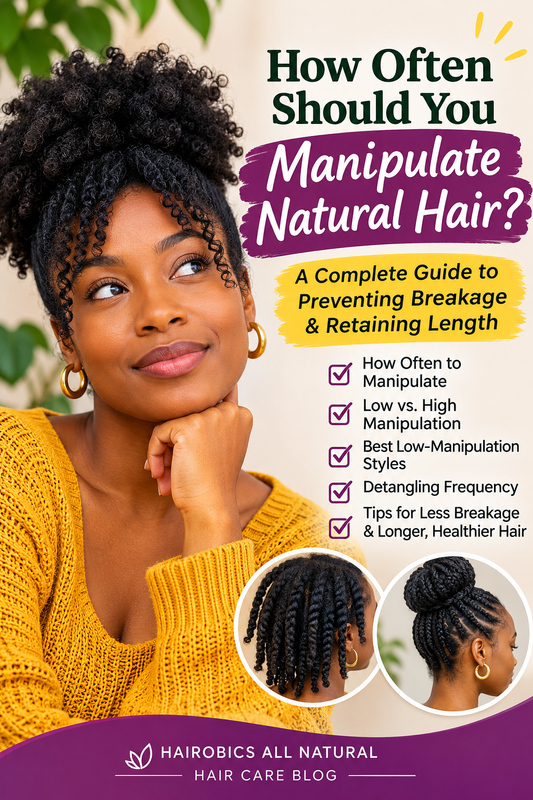
Natural hair is beautiful, versatile, and capable of thriving with the right care. However, one of the biggest challenges many people experience is knowing how often they should touch, comb, brush, detangle, or restyle their hair.
If you've ever wondered whether you're manipulating your natural hair too much, you're not alone.
Many women spend significant time moisturizing, detangling, twisting, braiding, brushing, and styling their curls. Although these activities are part of maintaining natural hair, excessive manipulation can contribute to breakage, split ends, thinning edges, and difficulty retaining length.
The solution isn't to stop touching your hair completely.
Instead, it's about understanding how often natural hair should be manipulated, which activities cause unnecessary stress, and how to create a routine that protects your strands.
Whether you have 3C curls, 4A coils, 4B hair, or tightly coiled 4C natural hair, learning to balance styling with gentle handling can make a noticeable difference in your hair-care journey.
In this complete guide, we'll explain how often to manipulate natural hair, the difference between low and high manipulation, the best hairstyles for reducing breakage, and how to develop a routine that supports healthy hair and length retention.
What Does Manipulating Natural Hair Mean?
Hair manipulation refers to physically handling, moving, separating, stretching, or styling your hair.
Almost every hair-care activity involves some degree of manipulation.
Common examples include:
-
Combing and brushing
-
Finger detangling
-
Creating parts and sections
-
Twisting and untwisting
-
Braiding and unbraiding
-
Installing extensions
-
Styling ponytails and buns
-
Applying edge control
-
Stretching natural hair
-
Refreshing twist-outs
-
Repeatedly separating curls
-
Pulling hair into tight hairstyles
Not all manipulation is harmful.
In fact, some manipulation is necessary for maintaining clean, moisturized, manageable hair.
Problems can develop when your hair experiences more physical stress than it can comfortably tolerate.
For example, completely detangling your hair every morning may be unnecessary if your curls were already detangled during wash day.
Similarly, repeatedly brushing your edges into tight hairstyles can place additional tension on delicate strands.
The goal is to eliminate unnecessary handling while maintaining a healthy hair-care routine.
How Often Should You Manipulate Natural Hair?
For many people, a practical starting point is to limit major manipulation to approximately once or twice per week, while performing gentle maintenance as needed.
Major manipulation includes thorough detangling, completely changing hairstyles, extensive combing, and repeatedly separating sections.
However, there is no scientifically established number of times that everyone should manipulate natural hair.
Your ideal frequency depends on several factors:
-
Hair texture and curl pattern
-
Hair density
-
Strand thickness
-
Hair length
-
Porosity and conditioning needs
-
Current hairstyle
-
Tendency to tangle
-
Amount of breakage
-
Scalp condition
-
Washing frequency
Someone wearing loose natural curls may need more frequent light detangling than someone wearing two-strand twists.
A person with fine, fragile hair may benefit from fewer styling sessions than someone whose hair tolerates manipulation well.
The most important principle is simple:
Manipulate your natural hair enough to keep it clean, conditioned, and free from severe tangles, but not so frequently that you're constantly stressing the strands.
Why Too Much Manipulation Can Cause Natural Hair Breakage
Every hair strand has an outer protective layer called the cuticle.
The cuticle helps protect the inner structure of the hair shaft.
When hair experiences repeated friction, pulling, twisting, and brushing, the cuticle can gradually become worn.
This process is known as mechanical weathering.
Over time, mechanical wear may contribute to:
-
Rough-feeling strands
-
Increased tangling
-
Split ends
-
Hair snapping during styling
-
Uneven lengths
-
Fragile ends
-
Reduced length retention
Curly and coily hair can be particularly vulnerable because its curved structure creates additional opportunities for strands to catch on one another.
This doesn't mean natural hair is inherently unhealthy or weak.
It means that technique, conditioning, and the amount of force used during styling are especially important.
If you're experiencing frequent breakage, read our detailed guide on how to stop natural hair from breaking.
Understanding the causes of breakage can help you identify which habits need to change.
Low Manipulation vs. High Manipulation: What's the Difference?
Understanding the difference between low- and high-manipulation hair care is essential.
Low-Manipulation Hair Care
Low manipulation means choosing hairstyles and maintenance techniques that reduce unnecessary physical handling.
Examples include:
-
Wearing two-strand twists for several days
-
Keeping hair in loose braids
-
Wearing a low-tension bun
-
Refreshing curls without completely restyling
-
Detangling primarily during wash day
-
Protecting hair with a satin bonnet at night
-
Keeping hair in organized sections during washing
Low manipulation allows you to maintain your hairstyle without repeatedly combing, brushing, or pulling the strands.
It can also save considerable time.
High-Manipulation Hair Care
High manipulation involves frequent handling, restyling, or tension.
Examples include:
-
Combing hair thoroughly every morning
-
Repeatedly installing and removing tight ponytails
-
Brushing edges aggressively every day
-
Constantly redoing twist-outs
-
Switching hairstyles multiple times per week
-
Frequently using heated styling tools
-
Repeatedly separating curls that are already defined
High manipulation doesn't automatically mean damage will occur.
However, it increases opportunities for friction, tangling, and mechanical stress.
If your hair is already fragile, reducing these activities may help improve length retention.
Should You Comb Natural Hair Every Day?
For most people with tightly curled or coily natural hair, daily combing is unnecessary.
Combing is useful for removing tangles, distributing certain products, and preparing hair for styling.
However, repeatedly combing hair that doesn't need detangling can increase mechanical wear.
A better approach is to detangle according to your hair's condition.
Many people find that detangling once per wash day works well.
Others may need a gentle touch-up between wash days.
How to Comb Natural Hair Without Excessive Breakage
Start by dividing your hair into manageable sections.
Apply water and a conditioner or detangling product that provides enough slip.
Begin at the ends and gradually work toward the roots.
Avoid pulling forcefully through knots.
Use your fingers to separate difficult tangles before introducing a comb or detangling brush.
Work slowly and pay attention to how your hair responds.
For additional guidance, explore our article on finger detangling vs. comb detangling.
The best method is the one that removes tangles effectively while minimizing unnecessary pulling and breakage.
How Often Should You Manipulate 4C Natural Hair?
Type 4C natural hair often has tightly packed coils and significant shrinkage.
These characteristics can make frequent combing and restyling more challenging.
However, 4C hair does not automatically require less manipulation than every other curl pattern.
Strand thickness, density, damage, and styling technique also matter.
For many people with 4C hair, a useful starting routine includes:
Daily: Check moisture needs, protect hair at night, and make minor adjustments without completely restyling.
Every few days: Refresh sections when necessary, using gentle finger separation rather than aggressive combing.
Weekly or according to wash frequency: Cleanse, condition, thoroughly detangle, and create a hairstyle that can last several days.
If your 4C hair becomes severely tangled between washes, you may need more frequent gentle detangling.
If your hair remains manageable in twists for a week, additional combing may be unnecessary.
The goal is to work with your hair's natural characteristics rather than forcing it into a daily styling routine that creates unnecessary stress.
Can You Manipulate Natural Hair Every Day?
Yes, you can handle your natural hair daily.
However, daily maintenance is not the same as daily intensive manipulation.
For example, gently applying a moisturizing product to your ends is different from completely combing out and restyling your entire head.
You can maintain natural hair without repeatedly disturbing every curl.
Gentle daily activities might include:
-
Checking your scalp
-
Applying a small amount of moisturizer when needed
-
Adjusting a loose bonnet or scarf
-
Lightly arranging an existing hairstyle
-
Separating a few tangled strands with your fingers
-
Protecting your ends before bedtime
These activities generally involve less physical stress than repeated brushing or detangling.
Pay attention to whether your daily routine creates pulling, snapping, or discomfort.
If it does, simplify your approach.
The Best Low-Manipulation Hairstyles for Natural Hair
Choosing the right hairstyle can dramatically reduce how often you need to manipulate your hair.
The best options are comfortable, easy to maintain, and gentle on your hairline.
1. Two-Strand Twists
Two-strand twists are among the most versatile low-manipulation hairstyles.
They help keep hair organized while reducing the need for daily detangling.
Twists can also limit how often individual strands rub against one another.
Depending on your hair and lifestyle, they may remain manageable for several days or longer.
Avoid twisting too tightly at the roots.
2. Loose Braids
Loose braids can help organize natural hair and reduce tangling.
They are especially useful for people who want to minimize daily styling.
However, braids should never create persistent scalp pain or excessive tension.
Heavy extensions and tight installations can contribute to hairline damage.
3. Flat Twists
Flat twists provide a neat hairstyle without requiring daily restyling.
They can be especially convenient for busy schedules.
Because the hair remains organized, you may be able to maintain the style with minimal adjustments.
4. Loose Buns
A loose bun can protect your ends from unnecessary exposure and friction.
However, wearing the same tight bun in the same position every day can stress particular areas.
Alternate placement and avoid pulling the hairline tightly.
5. Mini Twists
Mini twists are popular among people who want a longer-lasting style.
They can reduce the need for daily combing while allowing access to the scalp.
Keep them moisturized and avoid leaving them installed until the roots become excessively tangled.
6. Low-Tension Updos
A comfortable updo can keep hair organized without requiring repeated styling.
Choose soft accessories and avoid pulling fragile areas.
For more ideas, read the complete guide to protective styles.
Remember that a hairstyle is only protective when it reduces damage rather than creating additional tension.
How Often Should You Detangle Natural Hair?
There is no perfect detangling schedule for everyone.
For many people, detangling every wash day is a reasonable starting point.
That might mean once a week, every seven to ten days, or another interval that works for their hair.
The important consideration is how quickly tangles accumulate.
If you wait too long, naturally shed strands may become trapped among neighboring hairs.
This can contribute to knots and matting.
On the other hand, repeatedly detangling hair that is already separated may cause unnecessary wear.
Signs You May Need to Detangle More Frequently
Your hair may benefit from more frequent gentle detangling if:
-
Large knots develop between washes
-
Shed hairs become trapped near the roots
-
Sections begin matting together
-
Wash day becomes unusually difficult
-
You experience excessive tangling during shampooing
Signs You May Be Detangling Too Frequently
Consider reducing unnecessary detangling if:
-
Your hair is already relatively tangle-free
-
You notice numerous short broken pieces
-
Your ends become rough after brushing
-
You repeatedly comb out hairstyles that could last longer
-
Your hair feels increasingly fragile after styling
Learn more in our guide explaining why natural hair tangles easily.
Why Moisture Matters When Manipulating Natural Hair
Conditioned, manageable hair is generally easier to style gently.
When natural hair feels extremely dry, rough, or tangled, combing may require more force.
This increases the likelihood of breakage.
A consistent moisturizing routine can help reduce friction and improve manageability.
However, moisturizing does not mean repeatedly soaking your hair or layering excessive products.
A balanced routine may include:
-
Cleansing your hair and scalp when needed.
-
Applying a suitable rinse-out conditioner.
-
Using a leave-in treatment when appropriate.
-
Applying a small amount of oil or an emollient product if your hair benefits from it.
-
Styling gently and protecting your ends.
Water-based conditioners can help provide hydration and slip.
Oils and other conditioning ingredients may help lubricate strands and reduce friction, but oils alone do not replace water-based conditioning.
Hairobics Leave-In Treatment
The Hairobics Leave-In Treatment is formulated with botanical ingredients, plant oils, and other conditioning components.
It can be incorporated into a natural hair-care routine to support softness and manageability.
Hair that is easier to manage may require less pulling and repeated manipulation during styling.
Always follow the product directions and adjust the amount according to your hair's needs.
Can Hair & Scalp Booster Help With Low-Manipulation Hair Care?
A low-manipulation routine works best when your hair and scalp receive appropriate care.
The Hairobics Hair & Scalp Booster contains a blend of conditioning oils and botanical ingredients, including coconut oil, olive oil, jojoba oil, rosemary oil, aloe vera, and vitamin E oil.
It can be incorporated into a hair-and-scalp conditioning routine according to the product directions.
Use only the amount your hair and scalp need.
Applying excessive product will not compensate for aggressive detangling, tight hairstyles, or repeated breakage.
The most effective approach combines suitable products with gentle styling habits.
For people working toward longer natural hair, reducing unnecessary breakage is just as important as maintaining a consistent conditioning routine.
How Often Should You Change Your Natural Hairstyle?
Changing hairstyles can be enjoyable, but frequent restyling may increase manipulation.
If your goal is length retention, consider choosing hairstyles that last several days.
For example, instead of creating a completely new hairstyle every morning, you might wear two-strand twists during the week.
Later, you could gently unravel them for a twist-out.
This allows you to enjoy multiple looks without repeatedly combing and restyling your entire head.
A useful starting point is to plan one main styling session each week, with occasional adjustments as needed.
However, don't keep an uncomfortable or tangled hairstyle simply to meet a schedule.
Hair health should determine when a style needs to be changed.
Can Protective Styles Cause Too Much Manipulation?
Yes.
Although protective styles are designed to reduce daily handling, installation and removal can involve substantial manipulation.
For example, installing small braids may require repeated parting, combing, pulling, and braiding.
Removing those braids can involve additional detangling.
If protective styles are installed too tightly or changed too frequently, they may create more stress than expected.
How to Make Protective Styling Safer
Choose styles that do not pull excessively on the scalp.
Avoid heavy extensions when your hair is fragile.
Keep the scalp clean and maintain appropriate moisture.
Remove styles before excessive matting develops.
Take your time during takedown.
After removing extensions, carefully separate accumulated shed hair before washing.
If you're experiencing breakage after braids or twists, read why protective styles sometimes cause more breakage.
Protective styling should make hair care easier, not create additional damage.
How Over-Manipulation Affects Your Edges
Your edges deserve special attention because hair around the hairline can be vulnerable to repeated tension.
Common sources of stress include:
-
Tight ponytails
-
Heavy braids
-
Repeated brushing
-
Tight headbands
-
Frequent edge styling
-
Extensions attached to fragile hair
-
Constant pulling around the temples
Over time, repeated tension can contribute to traction alopecia, a form of hair loss associated with pulling on hair follicles.
Early traction-related hair loss may improve when the tension stops, but longstanding damage can become permanent.
If you notice thinning edges, tenderness, bumps, or a receding hairline, reduce tension immediately.
Persistent or progressive hair loss should be evaluated by a dermatologist.
For more information, visit our guide on how to protect fragile hair around the hairline.
A Simple Weekly Low-Manipulation Natural Hair Routine
Building a routine can help you reduce unnecessary handling without neglecting your hair.
Here is an example schedule.
Sunday: Wash Day
Cleanse your scalp and hair with a suitable shampoo.
Apply conditioner and gently detangle in sections.
Use your fingers or an appropriate detangling tool, starting at the ends.
Apply your leave-in treatment according to its directions.
Style your hair into loose twists, braids, or another comfortable low-manipulation hairstyle.
This is your primary styling session.
Monday: Minimal Handling
Leave your hairstyle intact.
Avoid unnecessary combing or brushing.
Protect your hair at night with a satin bonnet or scarf.
Tuesday: Moisture Check
Check whether your hair feels dry.
If needed, apply a suitable moisturizing product without completely taking down your hairstyle.
Avoid applying excessive product.
Wednesday: Scalp and Hair Check
Examine your scalp for irritation, buildup, or discomfort.
Check that your hairstyle isn't pulling on your edges.
Make minor adjustments only when necessary.
Thursday: Gentle Maintenance
Refresh any loose sections without completely restyling.
Avoid repeatedly brushing or combing the same areas.
Friday: Maintain Your Style
Continue wearing your existing hairstyle if it remains comfortable and manageable.
Protect your hair at night.
Saturday: Prepare for Wash Day
Assess your hair for tangles, dryness, and buildup.
If your hair needs cleansing, prepare for your next wash day.
If your scalp or hairstyle requires earlier attention, adjust your schedule.
This is an example, not a strict rule. Some people need to wash more frequently, while others can comfortably follow a different routine.
The objective is consistency without unnecessary manipulation.
Does Low Manipulation Help Natural Hair Grow Faster?
Low manipulation does not directly increase the biological growth rate of your hair follicles.
Hair growth occurs beneath the scalp and is influenced by genetics, age, hormones, nutrition, health, and other factors.
However, reducing unnecessary breakage may help you retain more of the length your hair naturally grows.
This distinction is important.
Hair Growth vs. Length Retention
Hair growth refers to new hair produced by follicles.
Length retention refers to how much of that growth remains after accounting for breakage and trimming.
Imagine your hair grows approximately half an inch in a month.
If your ends continually break, you may not notice much change in overall length.
Reducing mechanical damage can help preserve more of that growth.
This is why gentle detangling, proper conditioning, low-tension styling, and protecting your ends are valuable parts of a length-retention routine.
How to Tell If You're Manipulating Your Hair Too Much
Your hair may provide clues that your current routine needs adjustment.
Watch for the following signs.
1. Frequent Short Broken Hairs
Finding numerous short pieces during styling can indicate breakage.
Occasional broken strands are not unusual, but persistent snapping deserves attention.
2. Rough or Fragile Ends
If your ends constantly feel rough, catch on one another, or develop splits, they may be experiencing mechanical wear.
3. Increasing Tangles
Repeated handling can sometimes disturb curl groupings and contribute to additional tangling.
4. Thinning Around the Hairline
Hairline thinning may indicate excessive tension from certain hairstyles.
5. Hair That Never Seems to Gain Length
Your hair may be growing at the roots while breakage prevents visible length retention.
6. Scalp Tenderness
Persistent soreness after styling is a warning sign.
Healthy hairstyles should not require pain.
If several of these symptoms occur together, consider reducing intensive styling and evaluating your routine.
Common Mistakes That Increase Natural Hair Manipulation
Even people who are careful with their hair sometimes develop habits that create unnecessary stress.
Mistake 1: Combing Hair Every Morning
Unless your hair genuinely needs detangling, daily combing may be unnecessary.
Try maintaining a hairstyle for several days instead.
Mistake 2: Constantly Touching Your Curls
Repeatedly pulling, separating, and twisting individual curls can increase friction.
Enjoy your hairstyle without constantly adjusting it.
Mistake 3: Styling Hair Without Enough Slip
Detangling rough, tangled hair without an appropriate conditioning product can increase pulling.
Use sufficient slip and work in sections.
Mistake 4: Wearing Tight Hairstyles
A hairstyle that causes discomfort or excessive pulling is not protecting your hair.
Choose comfortable alternatives.
Mistake 5: Neglecting Nighttime Protection
Hair can experience friction while sleeping.
A smooth satin or silk covering may help reduce friction and preserve your hairstyle.
Mistake 6: Ignoring Damaged Ends
Split ends and persistent knots can make detangling more difficult.
Inspect your ends periodically and trim damaged areas when necessary.
Mistake 7: Leaving Hair Tangled for Too Long
Low manipulation should never mean ignoring severe tangles.
Waiting too long between detangling sessions can make the eventual process more difficult.
Balance is essential.
How Long Does It Take to Notice Less Breakage?
Some people notice that their hair feels easier to manage soon after adopting gentler styling habits.
However, evaluating changes in length retention generally requires more time.
A useful approach is to monitor your hair over approximately eight to twelve weeks.
Pay attention to:
-
The amount of breakage during detangling
-
The condition of your ends
-
How easily your hair tangles
-
The comfort of your hairstyles
-
The appearance of your hairline
-
Changes in retained length
Take monthly photographs under similar lighting and styling conditions.
Avoid judging progress solely by how long your hair looks when curled.
Shrinkage can make healthy natural hair appear shorter than its stretched length.
Consistency is more important than constantly changing your routine.
Frequently Asked Questions About Natural Hair Manipulation
Is it bad to touch natural hair every day?
No. Gentle daily maintenance is not necessarily harmful. Problems are more likely when handling involves repeated pulling, aggressive brushing, or unnecessary restyling.
How many times a week should I comb 4C hair?
Many people with 4C hair find that combing during wash day is sufficient. Others need occasional gentle detangling between washes. Adjust the frequency according to tangling, breakage, and hairstyle.
Should I leave my natural hair alone to make it grow?
Reducing unnecessary manipulation may improve length retention, but you should still cleanse, condition, moisturize when needed, and detangle appropriately. Neglecting hair care can create additional problems.
Is finger detangling better than brushing?
Finger detangling allows you to feel and separate individual knots, which may help reduce forceful pulling. However, a suitable brush or wide-tooth comb can also work well when used gently with enough slip.
Can I wear a twist-out every day?
Yes, but repeatedly combing out and recreating the style may increase manipulation. Consider preserving your twist-out overnight and refreshing only the sections that need attention.
Are braids better than wearing natural hair loose?
Neither option is automatically healthier. Loose braids may reduce daily tangling, but tight or heavy braids can damage hair. The best hairstyle is one that minimizes tension and unnecessary breakage.
Does low manipulation help with thinning edges?
Reducing pulling and tension may help prevent further traction-related damage. However, thinning edges can have several causes. Persistent hair loss should be evaluated by a qualified healthcare professional.
How often should I moisturize natural hair?
Moisturize according to how your hair feels, your hairstyle, and the products you use. Some people need moisture more frequently than others. Avoid unnecessary product buildup.
Can too much brushing stop natural hair from growing?
Brushing does not usually stop follicles from producing hair. However, excessive brushing can damage hair shafts and contribute to breakage, making it harder to retain visible length.
What is the best low-manipulation hairstyle for 4C hair?
Loose two-strand twists, flat twists, comfortable braids, and low-tension updos can be useful options. Choose a hairstyle that suits your hair's condition and does not pull on the scalp.
Final Thoughts: How Often Should You Manipulate Natural Hair?
Natural hair doesn't need constant styling to remain beautiful, healthy-looking, and manageable.
For many people, limiting intensive manipulation to once or twice per week is a reasonable starting point.
However, your individual hair needs should determine your routine.
The goal isn't to avoid touching your hair completely.
It's to eliminate unnecessary combing, brushing, pulling, and restyling while maintaining proper cleansing, conditioning, and detangling.
Choose comfortable low-manipulation hairstyles, protect your ends, maintain appropriate moisture, and pay attention to signs of breakage.
Most importantly, remember that healthy natural hair care is about consistency, gentle handling, and protecting the length you've already grown.
At Hairobics All Natural, we believe a simple, consistent hair-care routine can make maintaining natural curls and coils easier.
Explore our Hairobics Leave-In Treatment and Hair & Scalp Booster to complement your natural hair conditioning routine.
Healthy natural hair doesn't require constant manipulation. It requires the right balance of care, moisture, protection, and patience.
Visit Hairobics All Natural to explore our natural hair and scalp care collection.