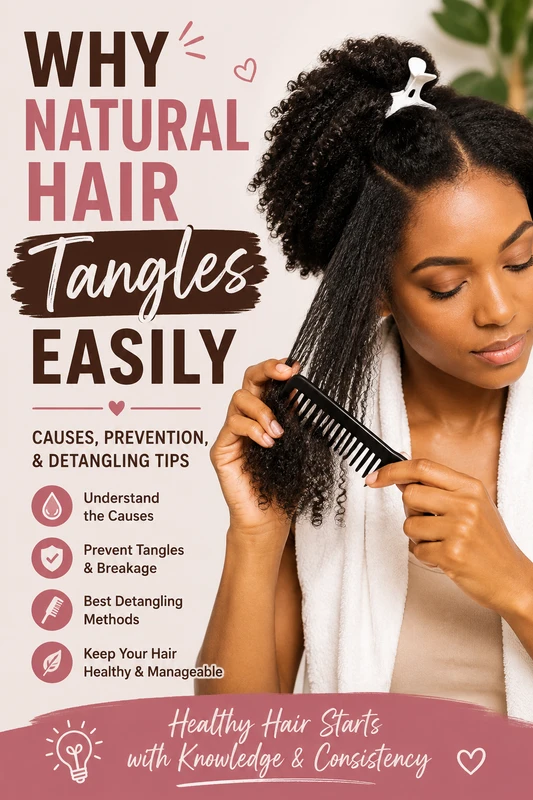
Natural hair is beautiful, versatile, and capable of creating everything from defined curls and fluffy afros to twists, braids, locs, and sleek protective styles. But if you have natural hair, there is one challenge you have probably experienced more than once: tangles.
You may carefully detangle your hair on wash day only to discover knots again a few days later. Your ends may wrap around each other, individual strands may form tiny knots, and sections of your hair may seem determined to stick together.
So, why does natural hair tangle so easily?
The answer has a lot to do with the structure of curly and coily hair. Natural hair tends to bend, curl, twist, shrink, and overlap with neighboring strands. When you combine this natural structure with dryness, friction, shed hairs, split ends, product buildup, or improper detangling, tangles can develop quickly.
The good news is that tangled natural hair doesn't have to become a constant struggle. Understanding why your hair tangles can help you prevent excessive knots, reduce breakage, make wash day easier, and retain more length.
In this guide, we'll explain the most common causes of tangled natural hair, how to prevent knots, the best way to detangle natural hair, and how to create a routine that keeps your curls and coils manageable.
Why Does Natural Hair Tangle So Easily?
Natural hair tends to tangle because individual strands don't always lie flat next to each other.
Straight hair generally falls in a relatively uniform direction. Curly, kinky, and coily strands behave differently. One strand may curl to the left while another curls to the right. Some strands may spiral around neighboring hairs while others shrink toward the scalp.
As hundreds or thousands of these strands interact, they can easily become intertwined.
This doesn't mean anything is wrong with your hair.
Tangling is a normal characteristic of textured hair. However, excessive tangling can sometimes indicate that your hair needs more moisture, more frequent detangling, a trim, less manipulation, or a change in your hair-care routine.
Let's look at the biggest reasons natural hair becomes tangled.
1. Curly and Coily Hair Strands Naturally Intertwine
The shape of natural hair is one of the biggest reasons it tangles.
Curly and coily strands have bends and curves throughout the hair shaft. Instead of hanging completely straight, the strands can wrap around one another.
This becomes even more noticeable with tightly coiled hair.
When your curls contract, neighboring strands are brought closer together. As you move throughout the day, sleep, exercise, style your hair, or touch it, the strands can continue interacting.
Eventually, several strands may become intertwined.
This is why some level of tangling is completely normal for natural hair.
Your goal shouldn't necessarily be to eliminate every tangle. Instead, focus on preventing tangles from becoming severe enough to cause unnecessary breakage.
2. Natural Hair Shrinkage Encourages Tangles
Shrinkage is another major factor.
When wet natural hair dries, curls and coils contract. Depending on your curl pattern, your hair may appear significantly shorter after drying.
Although shrinkage is a normal sign of elasticity, it can also encourage tangling.
Imagine several stretched curls sitting next to each other. As those curls shrink, they begin contracting in different directions.
One curl may wrap around another.
Your ends may curl back toward the rest of your hair.
Loose strands may become trapped inside neighboring curls.
The tighter your shrinkage, the easier it can be for strands to become intertwined.
This is one reason stretched hairstyles such as twists, braids, banding, and certain low-manipulation styles can help some people manage tangles.
You don't have to eliminate shrinkage. But controlling excessive shrinkage when necessary can make detangling easier.
3. Dry Natural Hair Tangles More Easily
Dryness is one of the biggest contributors to tangles.
Well-moisturized hair generally feels softer and more flexible. When strands are dry and rough, they create more friction against neighboring hairs.
More friction means more opportunities for strands to catch on one another.
Natural hair can be particularly vulnerable to dryness because scalp oils have a more difficult journey traveling down curved strands than they do down straight hair.
That's why a consistent moisture routine is so important.
If your hair constantly feels:
- Rough
- Brittle
- Straw-like
- Stiff
- Difficult to separate
- Extremely tangled
it may need more attention to moisture and conditioning.
Water-based moisturizing products, conditioners, leave-in treatments, and properly formulated hair-care products can help improve manageability.
4. Your Ends Are the Oldest Part of Your Hair
If most of your tangles occur at the ends, there's a reason.
The ends of your hair are the oldest part.
If your hair is several years old, the ends have potentially been through hundreds of wash days, hairstyles, nights of sleeping, detangling sessions, weather changes, and other forms of manipulation.
Over time, those ends may become rougher.
When the ends of several strands rub together, they can form knots.
This is especially common when hair is overdue for a trim.
Split, damaged, or weathered ends may catch onto neighboring strands much more easily than smooth ends.
If you constantly detangle your hair but the same sections immediately knot again, inspect your ends.
A trim may make a dramatic difference in manageability.
5. Shed Hair Gets Trapped Inside Natural Hair
Everyone naturally sheds hair.
Normally, those hairs eventually fall away from the head. With tightly curled natural hair, however, shed strands don't always fall out immediately.
They may remain trapped inside your curls.
Think about a long shed hair sitting inside hundreds of curly strands.
As you style and manipulate your hair, that shed strand can wrap around neighboring hairs.
Eventually, it can contribute to knots and tangles.
This is why regular detangling is important.
Detangling isn't only about separating your curls. It also helps remove shed hairs before they become deeply intertwined with the rest of your hair.
If you wait too long between detangling sessions, accumulated shed hair may make the process considerably more difficult.
6. Single-Strand Knots Are Common With Natural Hair
Have you ever felt a tiny hard knot near the end of a single strand?
This is commonly called a single-strand knot or fairy knot.
These knots are especially common with curly and coily hair because the strand can curl around itself and form a tiny knot.
Single-strand knots may occur more frequently when hair is:
- Very tightly coiled
- Worn loose frequently
- Extremely dry
- Highly shrunken
- Manipulated often
- Exposed to friction
- Overdue for trimming
You may not be able to prevent every single-strand knot, but keeping your ends moisturized and protected can help reduce them.
7. Wearing Your Natural Hair Loose Every Day Can Increase Tangling
There's nothing wrong with wearing an afro, wash-and-go, or other loose natural hairstyle.
However, loose hair has more opportunities to move around and interact with neighboring strands.
Your ends may rub against your clothing.
Your curls may shrink around each other.
Wind can move your hair.
Your hands may constantly touch it.
Sleeping on loose hair can create additional friction.
Over several days, these factors can create tangles.
If you're experiencing excessive tangling, alternate loose hairstyles with low-manipulation or protective styles.
Two-strand twists, braids, buns, and similar styles can keep groups of hair organized and reduce how much individual strands interact.
8. Sleeping Without Protecting Your Hair
Your nighttime routine can have a major effect on tangling.
If you sleep with natural hair completely loose against cotton bedding, your hair may move against the fabric for hours.
That creates friction.
By morning, your curls may be:
- Flattened
- Dry
- Frizzy
- Matted
- Tangled
Consider protecting your hair with a satin or silk bonnet, scarf, or pillowcase.
You can also put longer natural hair into several loose twists or braids before bed.
Keeping the hair organized overnight can make your morning routine much easier.
9. Cotton Clothing Can Tangle Your Ends
Your pillowcase isn't the only fabric that matters.
If your natural hair reaches your shoulders, your ends may constantly rub against your clothing.
Sweaters, jackets, scarves, hoodies, and rough fabrics can create friction.
This can be especially problematic during colder months when people wear heavier fabrics more frequently.
If you have shoulder-length or longer natural hair, pay attention to how your ends feel after wearing certain clothes.
Protective styles and updos can help keep vulnerable ends away from rough fabrics.
10. Product Buildup Can Make Hair Stick Together
Using more products doesn't necessarily mean your hair will be easier to manage.
Sometimes the opposite happens.
Heavy layering of gels, creams, butters, oils, edge controls, and styling products can eventually leave buildup on your strands.
Instead of moving freely, hairs may begin sticking together.
This can make detangling more difficult.
If your hair feels coated, sticky, unusually heavy, or difficult to separate even after moisturizing it, buildup could be contributing to the problem.
Regular cleansing is important.
How frequently you need to clarify depends on your routine and the products you use, but occasionally removing accumulated buildup can help restore manageability.
11. Waiting Too Long Between Wash Days
Some people can comfortably go longer between wash days than others.
However, waiting too long can sometimes lead to more tangles.
During that time, your hair accumulates:
- Shed strands
- Styling products
- Sweat
- Sebum
- Dust and environmental debris
- Friction from styling
- Knots
The longer those factors accumulate, the more difficult detangling may become.
Pay attention to your own hair rather than following an arbitrary schedule.
If detangling becomes dramatically harder after two or three weeks, your hair may benefit from more frequent wash days.
12. Washing Natural Hair While It's Completely Loose
The way you shampoo your hair matters.
Piling all of your natural hair on top of your head and aggressively scrubbing it can create a tangled mess.
Instead, consider washing your hair in sections.
Depending on your hair's length and density, you might divide it into four, six, or eight sections.
Work through one section at a time.
Concentrate shampoo primarily on your scalp and allow the cleanser to travel down your strands as you rinse.
Avoid unnecessarily bunching and rubbing the lengths together.
Section washing can make a huge difference for long, dense, or tightly coiled natural hair.
13. Shampooing Too Aggressively
Your scalp needs to be properly cleansed, but aggressive scrubbing isn't necessary.
Using your fingernails, rubbing hair together, or creating circular motions through loose strands can contribute to tangling.
Instead, use your fingertips to gently massage the scalp.
Keep the lengths relatively organized while cleansing.
Your scalp can become clean without turning your hair into one giant knot.
14. Skipping Conditioner
Conditioner is extremely helpful when detangling natural hair.
A good conditioner can provide slip, which allows strands to slide past one another more easily.
Without enough slip, you may have to use considerably more force to separate tangles.
More force can mean more breakage.
After shampooing, apply conditioner thoroughly, paying particular attention to your lengths and ends.
Allow the conditioner to soften your hair before attempting to remove difficult knots.
15. Detangling Natural Hair When It's Too Dry
Trying to force a brush or comb through extremely dry, tightly coiled hair can cause unnecessary breakage.
Dry strands may have less flexibility and more friction.
Instead, many people find it easier to detangle when their hair is damp or saturated with conditioner.
The right amount of moisture and slip allows strands to separate more easily.
However, remember that wet hair can also be vulnerable.
The goal is not to rip through soaking-wet hair. Work slowly and gently.
16. Starting at the Roots Instead of the Ends
One of the most common detangling mistakes is placing a comb near the roots and pulling it all the way down.
This pushes every tangle toward the ends.
Eventually, several small tangles can become one enormous knot.
Instead, start near the ends.
Once the ends are free, move slightly higher.
Continue working upward until you reach the roots.
This technique helps prevent small knots from being pushed together.
17. Detangling Sections That Are Too Large
Trying to detangle your entire head at once can be frustrating, especially if you have thick or dense natural hair.
Divide your hair into manageable sections.
For example:
- Divide the hair into four main sections.
- Secure three sections.
- Divide the remaining section into smaller pieces if necessary.
- Apply water or conditioner.
- Finger-detangle obvious knots.
- Follow with your preferred detangling tool.
- Twist the completed section.
- Move to the next section.
Keeping completed sections twisted prevents them from tangling again.
18. Your Detangling Tool May Be Causing Problems
Not every brush or comb works well for every head of natural hair.
If your tool constantly snags, pulls, snaps strands, or gets trapped in your hair, it may not be the best choice for your texture or density.
Some people prefer:
- Fingers
- Wide-tooth combs
- Flexible detangling brushes
- A combination of finger detangling and brushing
Experiment carefully.
The best detangling tool is one that allows you to remove knots without excessive pulling or breakage.
19. Your Hair May Need More Slip
If your fingers or detangling tool won't glide through your hair, don't automatically use more force.
You may simply need more slip.
Slip describes how easily hair strands move past one another.
Conditioners and detangling products can provide slip and make stubborn tangles easier to separate.
When you encounter a difficult knot, add a little more product and work the knot apart gently with your fingers.
Patience can save strands.
20. Split Ends Can Cause Constant Tangling
Split ends aren't just a cosmetic issue.
They can make detangling significantly more difficult.
A healthy strand has a relatively smooth end. A split strand may branch into multiple pieces.
Those damaged pieces can catch on neighboring hairs.
If you notice:
- Frequent knots at your ends
- Rough ends
- See-through ends
- Excessive breakage
- Ends that constantly catch on your fingers
you may benefit from a trim.
Trimming damaged ends can sometimes make your entire hair routine feel easier.
21. Heat Damage Can Change How Your Hair Tangles
Heat damage can alter your natural curl pattern.
Some sections may remain curly while others become stretched, limp, or partially straight.
When multiple textures exist on the same head, they may interact differently.
The point where textures meet can also become vulnerable to tangling and breakage.
If you regularly use blow dryers, flat irons, or other heated tools, use appropriate heat-protection practices and avoid unnecessary exposure to high temperatures.
22. Chemical Damage Can Increase Tangling
Coloring, bleaching, relaxing, and other chemical processes can change the structure of the hair.
When hair becomes damaged, the surface may feel rougher and strands may become more vulnerable to breakage.
Rough strands create additional friction.
That friction encourages tangling.
If your hair suddenly becomes much more difficult to detangle after a chemical treatment, damage may be contributing to the problem.
Focus on gentle handling, conditioning, reduced manipulation, and trimming severely damaged ends when necessary.
23. High-Porosity Hair May Tangle More Easily
Hair porosity describes how readily your hair absorbs and loses moisture.
Highly porous hair may have a more raised or damaged cuticle structure.
When the outer surface isn't smooth, neighboring strands may catch against one another.
High-porosity hair may also lose moisture quickly, which can contribute to dryness.
This combination can increase tangling.
A balanced routine emphasizing moisture, conditioning, gentle handling, and reduced damage can help improve manageability.
24. Your Hair Density Makes a Difference
People with very dense hair simply have more strands interacting within a given area.
More strands can mean more opportunities for tangling.
This doesn't necessarily mean your hair is unhealthy.
It may simply mean that sectioning is especially important.
Someone with lower-density natural hair may comfortably detangle in four sections, while someone with very dense hair might need eight or more.
Customize your routine instead of copying someone else's exactly.
How to Prevent Natural Hair From Tangling
Now that we know why natural hair tangles, let's talk about prevention.
You probably won't eliminate every knot. However, a consistent routine can dramatically reduce severe tangling.
Keep Your Natural Hair Moisturized
Moisturized hair tends to be softer and easier to manipulate.
Your exact routine will depend on your hair, but moisture often begins with water.
After cleansing and conditioning, apply products designed to help your hair remain soft and manageable.
Pay particular attention to your ends because they're the oldest and often most vulnerable portion of your hair.
Avoid assuming that applying large amounts of oil automatically moisturizes dry hair.
Oil can be useful in a hair-care routine, but water and water-based products are generally central to hydration.
Detangle Regularly
Don't allow months of shed hair to accumulate.
How frequently you need to detangle depends on your hairstyle and hair type.
Someone wearing loose natural styles may need to detangle more frequently than someone wearing a protective style.
The important thing is consistency.
Regular detangling helps prevent small tangles from developing into mats.
Sleep With Your Hair Protected
Create a simple nighttime routine.
For loose natural hair, consider putting your hair into several chunky twists, braids, or another organized style.
Then cover your hair with a satin or silk bonnet or scarf.
A satin pillowcase can provide another layer of protection.
This reduces overnight friction and can help prevent morning tangles.
Keep Your Hair in Sections During Wash Day
Sectioning is one of the easiest ways to maintain control over natural hair.
Before shampooing, divide your hair into sections.
Keep those sections separated while:
- Shampooing
- Conditioning
- Detangling
- Applying leave-in products
- Styling
This prevents already-detangled strands from immediately tangling with the rest of your hair.
Protect Your Ends
Length retention depends heavily on protecting your ends.
Your scalp grows new hair, but keeping that length requires minimizing breakage.
Try hairstyles that reduce excessive manipulation of your ends.
Examples include:
- Two-strand twists
- Braids
- Buns
- Flat twists
- Updos
- Other low-manipulation styles
You don't have to keep your hair hidden constantly. Balance is key.
Trim When Necessary
Holding onto damaged ends doesn't necessarily help you achieve longer-looking hair.
If your ends constantly split, knot, and break, they can make length retention more difficult.
Regularly examine your ends.
How often you need a trim depends on the condition of your hair rather than a universal schedule.
Reduce Excessive Manipulation
Natural hair doesn't need to be restyled constantly.
Every time you comb, brush, twist, pull, separate, or restyle your hair, you create some degree of mechanical stress.
That doesn't mean you should never style your hair.
It means unnecessary manipulation should be minimized.
If you create a style that lasts several days, allow your hair to remain in that style instead of completely redoing it every morning.
The Best Way to Detangle Natural Hair
A good detangling session should prioritize patience.
Here's a simple method.
Step 1: Divide Your Hair Into Sections
Create four to eight sections depending on your length and density.
Secure each section separately.
Step 2: Add Moisture and Slip
Apply water if needed, followed by a conditioner or detangling product with good slip.
Make sure the section feels soft enough to manipulate.
Step 3: Use Your Fingers First
Before grabbing your comb or brush, feel through the section with your fingers.
Identify large knots.
Gently separate strands rather than pulling them apart.
Step 4: Start at the Ends
Work through the last few inches first.
Once those are detangled, move higher.
Continue upward toward your roots.
Step 5: Hold the Hair Above the Tangle
Holding the section above the area you're detangling can reduce pulling on your scalp.
Step 6: Work Slowly Through Difficult Knots
If you hit resistance, stop.
Don't repeatedly rake through the same knot.
Add more conditioner if necessary and use your fingers to loosen individual strands.
Step 7: Twist the Finished Section
Once a section is completely detangled, twist or braid it.
This prevents it from tangling again while you work on the rest of your head.
Should You Finger Detangle Natural Hair?
Finger detangling can be extremely useful because your fingers can feel knots that a brush or comb may simply pull through.
When you encounter resistance, you can stop and identify the exact strands causing the knot.
However, finger detangling takes time.
Some people use a combination approach.
They first finger-detangle major knots and then use a wide-tooth comb or flexible detangling brush to remove smaller tangles and shed hairs.
Choose the method that produces the least breakage while still thoroughly removing shed hair.
Why Does Natural Hair Tangle Immediately After Detangling?
This can be particularly frustrating.
You spend an hour detangling, only for your hair to feel tangled again shortly afterward.
Several things could be happening.
Your hair may be shrinking aggressively after detangling.
Your ends may need trimming.
You may have incomplete removal of shed hairs.
Your hair may be too dry.
You may be leaving detangled sections loose instead of twisting them.
Your strands may also naturally have a high tendency to wrap around one another.
Try twisting each section immediately after detangling.
If the ends remain difficult even when freshly conditioned, inspect them for damage.
Why Does Natural Hair Tangle at the Roots?
Root tangles may develop from shed hair, new growth, friction, or insufficient detangling.
This can become especially noticeable after wearing protective styles.
For example, after keeping braids installed for several weeks, shed hair may accumulate near the roots.
When the braids are removed, the shed hairs can create what looks like a small cluster or mat.
Don't immediately shampoo tangled roots after removing a long-term protective style.
First, carefully separate and detangle the hair.
Adding water to heavily tangled shed hair without first loosening it can sometimes make knots more difficult to manage.
Why Does Natural Hair Tangle at the Ends?
Ends are especially vulnerable because they're older and have experienced more wear.
Frequent end tangles can result from:
- Dryness
- Split ends
- Single-strand knots
- Friction
- Shrinkage
- Rough clothing
- Excessive manipulation
- Lack of trimming
If your roots and middle sections detangle easily but your ends are constantly fighting you, your ends deserve special attention.
How to Detangle Severely Matted Natural Hair
Severely tangled or matted hair requires patience.
Avoid immediately pulling a comb through the mat.
First, divide the surrounding hair into manageable sections.
Apply a product that provides plenty of slip.
Use your fingers to loosen the outside edges of the tangle.
Work a few strands at a time.
Start from the ends whenever possible and gradually move inward.
Don't assume every knot needs to be cut out immediately.
Some mats can be carefully separated.
However, if hair is severely damaged or impossible to separate without significant breakage, professional assistance from a stylist experienced with textured hair may be worthwhile.
How to Prevent Natural Hair From Tangling Overnight
Your nighttime routine can make your morning dramatically easier.
Before bed:
- Lightly moisturize your hair if necessary.
- Divide long or dense hair into sections.
- Create loose twists or braids.
- Keep your ends protected.
- Wear a satin or silk bonnet or scarf.
- Consider sleeping on a satin pillowcase as backup protection.
In the morning, gently unravel your sections instead of aggressively combing through your entire head.
Are Protective Styles Good for Preventing Tangles?
They can be.
Protective and low-manipulation styles keep strands organized and reduce daily handling.
However, protective styles aren't completely maintenance-free.
Hair continues shedding while you're wearing braids, twists, and similar styles.
When you eventually remove the style, those shed hairs need to be carefully removed.
Rushing through takedown can create severe tangles.
Take your time.
Detangle each section as you remove the style rather than taking everything down and allowing loose hair to become intertwined.
Does Longer Natural Hair Tangle More?
It can.
Longer strands have more surface area and more opportunities to wrap around neighboring hairs.
Long hair may also have older ends that require extra care.
As your natural hair becomes longer, you may need to adjust your routine.
You might increase the number of sections you use during wash day, detangle more carefully, or wear stretched and low-manipulation styles more frequently.
What worked when your hair was six inches long may not work when it's 16 inches long.
Your routine should evolve with your hair.
Common Natural Hair Detangling Mistakes
If wash day feels unnecessarily difficult, look for these common mistakes:
Detangling Without Enough Slip
Don't fight your hair. Add more conditioner or detangling product when needed.
Ripping Through Knots
Speed isn't worth unnecessary breakage.
Starting at the Roots
Begin at your ends and gradually move upward.
Working With Huge Sections
Smaller sections give you more control.
Ignoring Your Ends
Constantly tangled ends may need additional moisture, protection, or trimming.
Detangling Only Once in a Great While
Excessive shed-hair accumulation can create difficult tangles.
Leaving Detangled Hair Loose
Twist or braid completed sections to prevent them from tangling again.
Using Too Much Force
If a brush isn't moving, stop. Determine what's blocking it before pulling harder.
A Simple Anti-Tangle Natural Hair Routine
You don't need an extremely complicated routine.
Try this basic approach.
Wash Day
Divide your hair into manageable sections.
Cleanse your scalp and hair without aggressively piling or rubbing your strands together.
Apply conditioner generously.
Detangle each section from ends to roots.
Rinse while maintaining your sections.
Apply your leave-in and styling products.
Twist or braid sections until you're ready to style.
During the Week
Monitor your hair's moisture level.
Avoid unnecessary daily combing.
Keep your ends protected when possible.
If wearing your hair loose, gently separate obvious tangles before they become larger.
At Night
Put long or loose hair into sections.
Protect your hair with satin or silk.
Avoid sleeping with wet, completely loose natural hair if doing so consistently leads to matting.
Between Wash Days
Pay attention to your hair.
If it becomes extremely tangled before your scheduled wash day, don't feel obligated to wait.
Your hair's condition should determine your routine.
Frequently Asked Questions About Natural Hair Tangling
Is It Normal for Natural Hair to Tangle?
Yes. Some tangling is completely normal, particularly with tightly curled and coily hair.
Your strands naturally bend and wrap around neighboring hairs.
Excessive tangling, however, may indicate dryness, damaged ends, product buildup, accumulated shed hair, or a routine that needs adjustment.
Why Does 4C Hair Tangle So Easily?
Very tightly coiled hair contains many bends along each strand.
These curls and coils can easily interact with neighboring strands, particularly when the hair shrinks.
Keeping 4C hair moisturized, working in sections, using products with good slip, and minimizing unnecessary manipulation can make detangling easier.
Should I Detangle Natural Hair Wet or Dry?
Many people find damp or conditioned natural hair easier to detangle because added slip helps strands move past one another.
Avoid aggressively brushing through either extremely dry or fragile soaking-wet hair.
Use a method that allows the hair to remain flexible while minimizing breakage.
How Often Should Natural Hair Be Detangled?
There's no universal schedule.
It depends on your texture, density, length, hairstyle, shedding, and wash routine.
The goal is to detangle frequently enough that shed hairs and small knots don't develop into severe tangles.
Why Do I Lose So Much Hair When Detangling?
Some of the hair you see may be normal shed hair that remained trapped inside your curls.
If you haven't detangled for several days or weeks, multiple days of shed strands may come out during one session.
However, short broken pieces or excessive snapping may indicate breakage rather than normal shedding.
Gentler handling and improved moisture can help minimize unnecessary breakage.
Can Oil Prevent Natural Hair From Tangling?
Oil alone won't necessarily prevent tangles.
The overall condition of your hair matters.
Keeping strands moisturized, conditioned, protected, and properly detangled is more important than relying on one product.
Oil can be incorporated into your routine based on your hair's needs, but it shouldn't replace proper cleansing, conditioning, and hydration.
Why Does My Hair Tangle More After Washing?
Hair can tangle during washing if strands are allowed to move around excessively.
Aggressive shampooing, washing loose hair, skipping conditioner, and allowing curls to shrink together can all contribute.
Try washing in sections and keeping your strands organized throughout the process.
Can Tangled Hair Stop Hair Growth?
Tangles don't stop follicles from producing new hair.
However, excessive tangling can contribute to breakage.
If your hair grows from the scalp but continually breaks at the ends, it may appear as though your hair isn't growing.
Reducing tangles can therefore support better length retention.
Tangling vs. Breakage: Why the Difference Matters
It's important to understand the difference between hair growth and length retention.
Your hair grows from follicles in your scalp.
But maintaining that length depends on preserving the strands that have already grown.
Imagine your hair grows several inches during the year, but your ends repeatedly snap because of knots, dryness, and aggressive detangling.
You may see very little increase in overall length.
This is why detangling isn't just about appearance.
A gentle detangling routine can be an important part of a healthy length-retention strategy.
Why Patience Matters With Natural Hair
Natural hair often rewards patience.
Trying to rush through a difficult detangling session may save 15 minutes but potentially cost you healthy strands.
When you encounter a knot, don't immediately pull harder.
Stop.
Feel where the strands are intertwined.
Add more slip if necessary.
Separate the surrounding hairs.
Slowly loosen the knot.
Sometimes simply changing the angle you're working from can release strands that seemed completely stuck.
The objective is to preserve as much healthy hair as possible.
Build a Routine Around Your Own Hair
One of the biggest mistakes in natural hair care is assuming everyone needs the same routine.
Two people can both have tightly coiled natural hair and still have completely different experiences.
Your hair's behavior can be influenced by:
- Strand thickness
- Density
- Length
- Porosity
- Curl pattern
- Styling habits
- Chemical history
- Heat usage
- Environment
- Products
- Wash frequency
Instead of following another person's routine exactly, observe your own hair.
Ask yourself:
When does my hair tangle the most?
Are the knots mostly at my roots or ends?
Does my hair tangle more when worn loose?
Does wash day become harder when I wait longer?
Do certain products make detangling easier?
Are my ends rough?
Does my hair stay more manageable when stretched?
These answers can help you build a routine that works specifically for you.
Final Thoughts: Why Natural Hair Tangles Easily
Natural hair tangles easily primarily because curly and coily strands naturally bend, shrink, overlap, and wrap around one another.
Tangling can become worse when hair is dry, damaged, heavily shrunken, overdue for detangling, filled with shed hairs, exposed to friction, or manipulated improperly.
You don't need completely tangle-free hair to have healthy natural hair.
Instead, focus on manageable tangling and minimal breakage.
Keep your hair moisturized and conditioned. Work in sections. Detangle from the ends upward. Protect your hair at night. Remove shed hairs regularly. Pay attention to damaged ends. Reduce unnecessary manipulation. And most importantly, don't rush through stubborn knots.
As you learn how your individual strands behave, detangling can become much easier.
Healthy natural hair care isn't about forcing your curls and coils to behave like straight hair. It's about understanding how textured hair naturally behaves and developing a routine that works with it instead of against it.
With consistent moisture, gentle detangling, protected ends, and a little patience, you can spend less time fighting knots and more time enjoying your natural hair.