Detangling is one of the most important—and sometimes most frustrating—parts of caring for natural hair. Whether you have loose curls, tight coils, thick 4C hair, long natural hair, transitioning hair, or hair that seems to tangle almost immediately after wash day, the way you remove knots can have a major impact on breakage, length retention, and the overall appearance of your hair.
Two of the most popular methods are finger detangling and comb detangling.
Finger detangling involves using your fingers to carefully separate knots, shed hairs, and tangled sections. Comb detangling uses a wide-tooth comb, detangling comb, or similar tool to work through the hair.
So, which method is better?
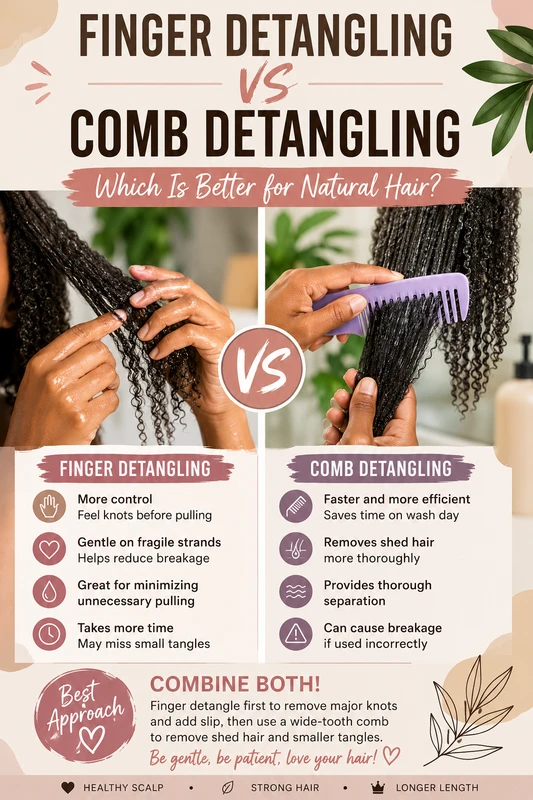
For many people with natural hair, neither method is automatically better in every situation. Finger detangling can provide greater control and may help reduce unnecessary pulling, while comb detangling can be faster and more effective at removing smaller tangles and shed hairs.
The best choice depends on your hair texture, density, length, condition, styling habits, and how tangled your hair becomes between wash days.
In this complete guide, we'll compare finger detangling vs comb detangling, explain the advantages and disadvantages of each, and show you how to choose a detangling routine that helps minimize breakage while keeping your natural hair manageable.
What Is Finger Detangling?
Finger detangling is exactly what it sounds like: using your fingers instead of a comb or brush to remove knots and separate tangled strands.
Rather than pulling a tool through an entire section of hair, you feel your way through the section with your hands.
When your fingers encounter resistance, you can stop and determine exactly what is causing it.
It might be:
- A single-strand knot
- Several hairs wrapped around one another
- Shed hair trapped inside your curls
- Product buildup
- Dry ends sticking together
- A small mat
- A section that simply needs more conditioner or water
This ability to feel the knot before applying more force is one of the biggest advantages of finger detangling.
With a comb, it can be easy to continue pulling without realizing that several strands have become tightly intertwined.
Your fingers give you much more feedback.
What Is Comb Detangling?
Comb detangling involves using a comb—usually a wide-tooth comb or specially designed detangling comb—to separate tangled strands and remove shed hair.
Wide-tooth combs are generally preferable to very fine-tooth combs for detangling thick, curly, coily, and natural hair because there is more space between the teeth.
A comb can move through more strands at once than your fingers.
This makes comb detangling particularly attractive to people who:
- Have very thick hair
- Have high-density natural hair
- Have long hair
- Need to detangle quickly
- Wear styles that trap shed hairs
- Go longer periods between detangling sessions
However, speed isn't everything.
Using a comb incorrectly can contribute to unnecessary breakage, especially when hair is dry, severely tangled, or detangled aggressively from the roots downward.
Technique matters just as much as the tool.
Finger Detangling vs Comb Detangling: Quick Comparison
Here is the basic difference between the two methods.
Finger Detangling
Potential advantages:
- Provides excellent control
- Allows you to feel knots
- Can be gentler on fragile hair
- Makes it easier to stop before pulling through a knot
- Requires no special tools
- Works well for targeted tangles
- Can help with length-retention-focused routines
Potential disadvantages:
- Can take significantly longer
- May not remove every shed hair
- Small tangles can be missed
- Can be difficult with extremely dense hair
- Requires patience
Comb Detangling
Potential advantages:
- Usually faster
- Helps remove shed hairs efficiently
- Can provide more thorough separation
- Helpful for preparing hair for certain styles
- Works well for large amounts of hair
Potential disadvantages:
- Can cause breakage if used aggressively
- Can snag knots
- May encourage you to move too quickly
- Fine teeth can create excessive tension
- Improper technique can damage fragile ends
The choice doesn't necessarily have to be one or the other.
In fact, one of the best strategies for many natural hair routines is combining finger detangling with gentle tool detangling.
We'll discuss exactly how to do that later.
Why Natural Hair Tangles So Easily
Before comparing detangling methods further, it's helpful to understand why natural hair tangles in the first place.
Curly and coily strands don't grow in a perfectly straight line.
They bend, twist, curl, and coil.
As individual strands move around one another, they can become intertwined.
Shed hairs can make the problem worse.
Humans naturally shed hair as part of the hair growth cycle. With straight hair, shed strands may fall away relatively easily.
With tightly curled hair, a shed strand may remain trapped among neighboring strands instead.
Over several days, those shed hairs can wrap around other strands and contribute to tangles.
Other factors can increase tangling, including:
- Dryness
- Split ends
- Rough handling
- Sleeping without protecting the hair
- Excessive manipulation
- Wearing hair loose for long periods
- Shrinkage
- Going too long between detangling sessions
- Product buildup
- Damaged ends
- Friction from clothing
- Shampooing tangled hair without sectioning it
This is why detangling should not simply be viewed as "combing your hair."
It's an important part of maintaining healthy natural hair.
Is Finger Detangling Better for Natural Hair?
Finger detangling can be an excellent choice for natural hair because your hands can detect tangles before you accidentally pull through them.
Imagine that five strands have twisted together into a knot.
When a comb encounters that knot, the teeth may stop suddenly.
If you continue pulling, one of several things can happen.
The knot might loosen.
But the strands might also stretch excessively, snap, or become even more tightly tangled.
When you're using your fingers, you can stop immediately.
You can add more conditioner, separate individual strands, and gradually work the knot apart.
That extra control is especially helpful for fragile ends.
The Biggest Benefit of Finger Detangling: Control
One of the greatest advantages of finger detangling is the amount of information your hands give you.
You can feel:
- Where a knot begins
- How tight the knot is
- Whether your ends feel rough
- Whether strands are stuck together
- Whether you need additional slip
- Whether the hair is stretching too much
- Whether you are dealing with shed hair
A comb can't provide that type of sensory feedback.
This is why people who experience frequent breakage sometimes find that incorporating finger detangling helps them become more aware of how much tension they're placing on their hair.
Can Finger Detangling Reduce Breakage?
Finger detangling may help reduce mechanical breakage when it encourages slower, gentler handling.
But simply using your fingers doesn't guarantee that breakage won't occur.
You can still damage your hair by:
- Pulling knots apart aggressively
- Ripping through tangles
- Detangling without enough moisture
- Separating strands too forcefully
- Using your fingernails to tear knots
- Manipulating extremely fragile hair repeatedly
The real advantage of finger detangling is that it makes it easier to control the amount of force being used.
When you feel resistance, stop.
Don't treat the knot like something that needs to be conquered.
Add more slip and work around it.
Does Finger Detangling Help With Length Retention?
It potentially can.
Remember that hair growth and length retention aren't exactly the same thing.
Your scalp produces new hair, but you only see significant increases in length when you're able to keep older hair from breaking excessively.
Suppose your hair grows consistently but your ends are breaking almost as quickly.
Your hair may appear to stay around the same length.
Reducing unnecessary manipulation and mechanical damage can therefore support better length retention.
For someone whose hair frequently breaks during detangling, switching to a gentler technique—including finger detangling—may help protect the ends.
However, detangling is only one piece of the puzzle.
Length retention also depends on factors such as:
- Moisture
- Hair condition
- Chemical treatments
- Heat exposure
- Styling habits
- Protective practices
- Trimming damaged ends
- Overall handling
Is Finger Detangling Good for 4C Hair?
Finger detangling can work extremely well for 4C natural hair, especially because tightly coiled strands can become intertwined very easily.
With 4C hair, shrinkage can make tangles appear even tighter.
Trying to force a comb through heavily shrunken hair may create unnecessary tension.
Finger detangling allows you to separate the hair gradually before introducing a tool.
For example, you could divide your hair into six or eight sections and apply a slippery conditioner.
Then:
- Separate obvious tangles with your fingers.
- Remove loose shed hairs.
- Gently stretch the section.
- Work from the ends toward the roots.
- Twist the finished section.
If you want additional detangling, you can follow with a wide-tooth comb.
This hybrid technique can be very effective for dense Type 4 hair.
The Disadvantages of Finger Detangling
Finger detangling isn't perfect.
The biggest drawback is time.
If you have long, thick, high-density natural hair, thoroughly finger detangling your entire head can take a while.
For some people, that isn't realistic every wash day.
Another issue is that fingers are relatively large compared with the spaces between comb teeth.
You may separate the major tangles while leaving behind smaller tangles and shed hairs.
Over time, trapped shed hairs can contribute to additional tangling.
That's one reason some people believe finger detangling isn't working for them.
They're separating large knots but aren't removing enough shed hair.
In these situations, periodically using a wide-tooth comb or appropriate detangling brush after finger detangling may help.
Is Comb Detangling Bad for Natural Hair?
No.
Using a comb does not automatically damage natural hair.
The problems usually come from the way the comb is used.
For example, imagine taking dry, tangled 4C hair and dragging a comb from the scalp straight to the ends.
That places significant tension on the strands.
Now compare that with:
- Dividing the hair into small sections
- Applying water and conditioner
- Finger detangling obvious knots
- Holding the section securely
- Starting at the ends
- Slowly working upward
The same comb can produce a completely different experience.
Technique is everything.
Why Wide-Tooth Combs Are Popular for Natural Hair
Wide-tooth combs have larger spaces between the teeth than fine-tooth combs.
This allows thicker sections and curls to move through the comb more easily.
They can be especially helpful for:
- Thick natural hair
- Curly hair
- Coily hair
- Long hair
- Wet detangling
- Conditioner-assisted detangling
When selecting a comb, inspect the teeth.
Rough seams or sharp edges can potentially snag strands.
A smooth comb that moves through the hair without scraping or catching is generally preferable.
The Biggest Advantage of Comb Detangling: Efficiency
Finger detangling might take 30 minutes, 45 minutes, or longer depending on the person's hair.
A comb can potentially reduce that time considerably.
That's important because extremely long wash-day routines can become difficult to maintain consistently.
The goal should be finding a routine that is both gentle and realistic.
A perfect two-hour detangling routine isn't necessarily useful if you dread it so much that you avoid wash day.
For many people, combining methods provides a better balance.
Comb Detangling Can Remove Shed Hair More Thoroughly
Another major benefit of comb detangling is shed-hair removal.
Because the comb teeth pass through a section repeatedly, they can collect strands that have already detached from the scalp but remain trapped inside the hair.
Removing shed hair is important because those loose strands can wrap around healthy strands.
This can eventually contribute to:
- Knots
- Matting
- Tangling
- Difficult wash days
If you only finger detangle and notice that your hair becomes increasingly tangled each week, trapped shed hair could be part of the problem.
Should You Detangle Natural Hair Wet or Dry?
For many people, detangling natural hair with moisture and plenty of slip makes the process easier.
Conditioner is particularly useful because it reduces friction between strands.
However, soaking wet hair can also be more vulnerable to stretching.
The goal isn't simply "make it wet."
You want the hair to be pliable enough to separate without excessive friction while still handling it carefully.
A good detangling mixture might involve:
- Water
- Rinse-out conditioner
- Deep conditioner
- Detangling product
- Leave-in conditioner designed for detangling
The right choice depends on your hair.
Why Slip Matters During Detangling
You've probably heard natural hair products described as having "slip."
Slip refers to how easily strands can slide past one another after a product is applied.
Good slip can make a huge difference during detangling.
Instead of rough strands rubbing against one another, conditioner helps create a smoother surface.
This can make it easier to separate tangles without applying excessive force.
If your detangling product seems to disappear immediately and your hair still feels rough, try adding a little more water before piling on more product.
Sometimes water helps distribute conditioner throughout the section.
Never Start Detangling at the Roots
Whether you're finger detangling or using a comb, one of the most important rules is:
Start near the ends and gradually work toward the roots.
If you begin at the roots and pull downward, you're pushing every tangle toward the ends at the same time.
Those tangles can combine into one larger knot.
Instead, detangle the last few inches first.
Once they're clear, move slightly higher.
Continue until you reach the roots.
This creates a clear path for the comb—or your fingers—to move through.
How to Finger Detangle Natural Hair Step by Step
A good finger-detangling routine doesn't have to be complicated.
Step 1: Divide Your Hair Into Sections
Start with four to eight sections depending on your hair's density and length.
Thicker hair may require more sections.
Working in sections prevents already-detangled hair from mixing with tangled hair.
Step 2: Add Moisture
Apply water, conditioner, or your preferred detangling product.
Make sure the section feels flexible and slippery.
Step 3: Separate the Section With Your Fingers
Don't immediately rake through the entire section.
Start by gently separating the hair into smaller pieces.
Step 4: Begin at the Ends
Hold the section above the area you're working on.
Use your fingers to separate the ends.
Step 5: Feel for Knots
When you encounter a knot, stop.
Don't pull harder.
Try separating the individual strands surrounding the knot.
Step 6: Add More Slip When Necessary
A stubborn knot may need more water or conditioner.
Step 7: Remove Shed Hairs
Gently slide loose shed hairs away from the section.
Step 8: Move Upward
Once the ends are clear, work toward the middle and eventually the roots.
Step 9: Twist the Detangled Section
Put the completed section into a loose twist.
This keeps it from tangling again while you work on the rest of your head.
How to Comb Detangle Natural Hair Correctly
If you prefer a comb, technique becomes especially important.
Step 1: Section Your Hair
Don't try to comb your entire head at once.
Divide your hair into manageable sections.
Step 2: Apply Conditioner
Make sure the section has plenty of slip.
Step 3: Finger Detangle Large Knots First
Even if you're primarily comb detangling, quickly checking for major knots with your fingers can save strands.
Step 4: Hold the Hair
Hold the section several inches above the area you're detangling.
This can reduce pulling directly against the scalp.
Step 5: Start at the Ends
Comb the last inch or two.
Once the comb moves through easily, move higher.
Step 6: Work Toward the Roots
Continue gradually until the entire section is detangled.
Step 7: Never Force the Comb
If the comb stops, you stop.
Remove it and inspect the tangle.
Step 8: Twist the Section
Keep completed sections separated.
The Best Method: Finger Detangling Followed by a Comb
For many people with natural hair, the best answer to the finger detangling vs comb detangling debate may be:
Use both.
Finger detangling and comb detangling don't have to compete.
They can complement each other.
Try this sequence:
Step 1: Apply conditioner.
Step 2: Separate large tangles with your fingers.
Step 3: Remove obvious shed hairs.
Step 4: Work through stubborn knots individually.
Step 5: Use a wide-tooth comb to finish the section.
This approach gives you the control of finger detangling with the efficiency and thoroughness of comb detangling.
Finger Detangling vs Comb Detangling for Thick Hair
Very thick or high-density hair presents a unique challenge.
Finger detangling the entire head can take a long time.
Instead of abandoning finger detangling completely, use it as the first stage.
For example:
Finger detangle: 2–5 minutes per section.
Then:
Comb detangle: Finish removing smaller tangles and shed hair.
The exact timing isn't important.
The goal is to catch major knots before a tool does.
Finger Detangling vs Comb Detangling for Fine Hair
Fine strands can be particularly vulnerable to excessive tension.
People with fine natural hair may benefit from being especially cautious with tools.
Finger detangling provides greater control over individual tangles.
However, fine hair can still trap shed strands.
A gentle wide-tooth comb may therefore be useful occasionally.
Pay attention to what your hair is telling you.
If you consistently see short broken pieces after combing, reassess your technique, tool, and detangling frequency.
Finger Detangling vs Comb Detangling for Long Natural Hair
Longer hair means older ends.
The ends of long hair have been exposed to months or years of:
- Washing
- Styling
- Weather
- Clothing
- Pillows
- Products
- Detangling
- Heat
- Manipulation
That makes protecting the ends particularly important.
Finger detangling can be useful for long hair because it allows you to carefully work through tangles near the oldest portion of the strand.
However, long hair can also take a very long time to finger detangle.
A combination approach may provide the best balance.
Finger Detangling vs Comb Detangling for Kids
Children's detangling routines should prioritize gentleness, patience, and comfort.
Trying to rush through a child's tangled hair can create unnecessary pulling and make wash day stressful.
Start by dividing the hair into sections.
Apply plenty of conditioner.
Finger detangle major knots first.
Then use a wide-tooth comb if necessary.
Most importantly, don't force a comb through resistance.
Smaller sections usually make children's hair much easier to manage.
How Often Should You Detangle Natural Hair?
There isn't one perfect schedule.
Some people detangle every wash day.
Others need light detangling between washes.
Your ideal frequency depends on:
- Hair texture
- Density
- Length
- Styling routine
- Wash frequency
- How quickly your hair tangles
- Whether you wear protective styles
Waiting too long can allow shed hair and tangles to accumulate.
But constantly detangling can also increase manipulation.
You want the middle ground: often enough to prevent matting but not so often that you're constantly manipulating your strands.
Why Your Hair Keeps Tangling After Detangling
If you thoroughly detangle your hair only for it to become tangled again almost immediately, investigate what's happening afterward.
Common causes include:
Leaving Hair Loose While Washing
Freshly detangled curls can tangle again during shampooing.
Try keeping your hair in sections.
Not Protecting Your Hair at Night
Friction and movement while sleeping can encourage tangles.
Consider a satin bonnet, scarf, or satin pillowcase.
Damaged Ends
Split, weathered ends may catch on neighboring strands.
Excessive Shrinkage
Shrinkage itself isn't bad, but tightly shrunken strands can wrap around one another.
Stretching certain styles may help reduce tangling.
Product Buildup
Heavy buildup can cause strands to stick together.
Waiting Too Long Between Wash Days
More shed hair accumulates over time.
How Much Hair Loss During Detangling Is Normal?
Seeing hair in your hands, comb, or shower doesn't automatically mean your hair is breaking excessively.
Some of it may simply be shed hair.
A shed strand typically comes from the root as part of the normal hair cycle.
Breakage occurs somewhere along the strand.
One reason detangling sessions can look alarming is that curly hair tends to hold onto shed strands.
If you haven't detangled for several days or weeks, multiple days of shedding may come out during one session.
However, sudden or significant changes in shedding, thinning, bald areas, scalp symptoms, or unexplained hair loss are worth discussing with a qualified healthcare professional or dermatologist.
How to Tell Whether You're Breaking Hair While Detangling
Look closely at the hair you're losing.
Lots of very short pieces may indicate breakage.
Other warning signs include:
- Increasingly uneven ends
- Excessive snapping sounds
- Hair becoming shorter in certain areas
- Tiny pieces covering the sink
- Rough, frayed ends
- Difficulty retaining length
If this happens primarily during detangling, change your technique.
Use more slip.
Work in smaller sections.
Slow down.
And stop forcing tools through knots.
Common Finger Detangling Mistakes
Finger detangling is gentle only when you actually use a gentle technique.
Avoid these mistakes:
Ripping Knots Apart
Don't pull a knot from opposite directions until something breaks.
Carefully separate individual strands.
Using Your Nails
Your fingernails can potentially scrape or snag hair.
Use the pads of your fingers whenever possible.
Working on Sections That Are Too Large
Smaller sections give you greater control.
Detangling Without Slip
Dry, rough strands create more friction.
Ignoring Shed Hair
Make sure loose strands are actually removed from the section.
Common Comb Detangling Mistakes
Comb detangling mistakes can quickly turn a useful tool into a source of breakage.
Avoid:
- Starting at the roots
- Using extremely small comb teeth
- Detangling huge sections
- Pulling through resistance
- Detangling too quickly
- Using damaged combs
- Working without adequate slip
- Repeatedly combing already-detangled sections
Once a section is detangled, leave it alone.
More combing doesn't necessarily make it healthier.
Does Detangling Make Hair Grow Faster?
Detangling itself does not make the hair follicles grow faster.
However, proper detangling can help support length retention.
That's an important distinction.
Hair growth occurs at the scalp.
Detangling primarily affects the hair that has already grown.
If gentle detangling reduces breakage, you may retain more of the length your scalp produces.
Over time, that can make your hair appear to grow longer more successfully.
Should You Detangle Before Shampooing?
Pre-shampoo detangling can be very helpful for natural hair.
If your hair is already heavily tangled before shampooing, adding water and massaging everything together may make those tangles worse.
Instead, try:
- Divide dry hair into sections.
- Lightly dampen each section.
- Apply conditioner or a pre-shampoo product.
- Finger detangle major knots.
- Twist each section.
- Shampoo in sections.
You don't necessarily have to completely detangle before shampooing.
The goal is simply to prevent existing tangles from becoming larger.
Should You Detangle With Conditioner?
Conditioner is one of the most popular choices for detangling natural hair because it can provide slip.
Apply enough conditioner to coat the section.
Add water as necessary.
Give the product a moment to distribute through the hair before you start pulling strands apart.
You'll often notice that tangles become easier to separate once the hair is properly saturated.
How to Make Detangling Faster Without Causing More Breakage
Gentle doesn't have to mean painfully slow.
You can improve efficiency by:
Detangling Regularly
Don't wait until your hair is severely matted.
Working in Sections
Organization saves time.
Using Plenty of Slip
Struggling with dry strands wastes time and increases friction.
Keeping Sections Separated
Twist completed sections immediately.
Finger Detangling Only Where Needed
You don't necessarily need to separate every single strand individually.
Focus your fingers on major tangles.
Then finish with your preferred tool.
Maintaining Your Ends
Healthy ends generally tangle less than severely split or damaged ends.
Which Method Is Best for Preventing Breakage?
There isn't a universal winner.
If you're patient and thorough, finger detangling can provide excellent control.
If you're careful with tools, comb detangling can also be effective.
The bigger factors are:
- Technique
- Moisture
- Slip
- Section size
- Patience
- Hair condition
- Tool quality
- Detangling frequency
A person who aggressively finger detangles could experience more breakage than someone who gently uses a wide-tooth comb.
The method matters, but how you perform the method matters more.
Finger Detangling vs Comb Detangling: Which Is Better for Hair Growth?
Neither method directly increases your biological hair growth rate.
But if your goal is growing longer natural hair, choose the method that results in less breakage for your particular hair.
Try monitoring your detangling sessions.
Ask yourself:
- How much broken hair am I seeing?
- Are my ends staying full?
- Am I retaining length?
- Does my hair feel easier to manage?
- Am I seeing fewer knots?
- Is detangling becoming easier or harder?
Your own hair provides valuable feedback.
A Simple Low-Breakage Detangling Routine
If you're not sure where to start, try this routine.
1. Divide Hair Into 6–8 Sections
Use more sections for thicker hair.
2. Add Water
Dampen the section without necessarily soaking it.
3. Apply Conditioner
Use enough to create good slip.
4. Finger Detangle
Separate major knots and remove obvious shed hairs.
5. Start at the Ends
Never begin by pulling from the scalp downward.
6. Use a Wide-Tooth Comb
If desired, gently comb from the ends upward.
7. Stop When You Feel Resistance
Go back to your fingers.
8. Twist the Section
Keep it separated.
9. Repeat
Continue until the entire head is finished.
This routine combines the best features of both techniques.
Finger Detangling vs Comb Detangling FAQ
Is finger detangling healthier than using a comb?
Finger detangling can provide more control and may reduce unnecessary pulling for some people. However, a wide-tooth comb used gently can also be part of a healthy natural hair routine.
Can I finger detangle only?
Yes. Some people exclusively finger detangle successfully. However, make sure you're removing enough shed hair and preventing small tangles from accumulating.
Can finger detangling cause breakage?
Yes. Pulling or ripping knots apart with your fingers can still break strands. Finger detangling should be slow and controlled.
Is combing natural hair every day bad?
Daily combing may be unnecessary for many natural hairstyles and could increase manipulation. How often you need to comb depends on your style and hair characteristics.
Is a wide-tooth comb better for natural hair?
Wide-tooth combs are commonly preferred for initial detangling because the wider spacing can accommodate thicker sections and curls more easily than fine-tooth combs.
Should I finger detangle before using a comb?
This can be an excellent strategy. Finger detangling major knots first reduces the chance of the comb unexpectedly hitting a severe tangle.
Should I detangle 4C hair wet?
Many people find that damp or wet 4C hair coated with a slippery conditioner is easier to detangle. However, wet hair should still be handled carefully because it can stretch significantly.
Why does so much hair come out when I detangle?
Some of the hair may be normal shed strands that have accumulated since your previous detangling session. Curly and coily hair can hold onto shed strands rather than allowing them to fall away immediately.
Does finger detangling help retain length?
It may support length retention if it helps you reduce mechanical breakage during detangling.
What's the fastest way to detangle natural hair?
Work in sections, use plenty of slip, finger detangle major knots, and then use a wide-tooth comb to finish if your hair tolerates it well.
Final Verdict: Finger Detangling vs Comb Detangling
So, is finger detangling better than comb detangling?
For many people with natural hair, finger detangling offers one major advantage: control.
Your fingers allow you to feel knots and stop before applying too much tension. This makes finger detangling particularly useful for fragile hair, tight coils, damaged ends, and anyone focused on reducing breakage and improving length retention.
Comb detangling has its own major advantages.
It's faster, can remove trapped shed hairs more efficiently, and may provide more thorough separation than fingers alone.
That's why the best method for many natural hair routines is not necessarily choosing between the two.
It's combining them strategically.
Finger detangle first to remove large knots and separate tangled areas. Then, if needed, follow with a smooth wide-tooth comb to remove remaining tangles and shed hairs.
Above all, remember that detangling should never be a battle between you and your hair.
Slow down when you encounter resistance, use enough moisture and slip, work in manageable sections, protect your ends, and pay attention to how much breakage your technique produces.
The goal isn't perfectly combed hair.
The goal is detangled, manageable hair with as many healthy strands still attached as possible.
When you find the right balance between finger detangling and comb detangling, wash day can become easier—and your natural hair can have a better opportunity to retain length, stay manageable, and thrive.