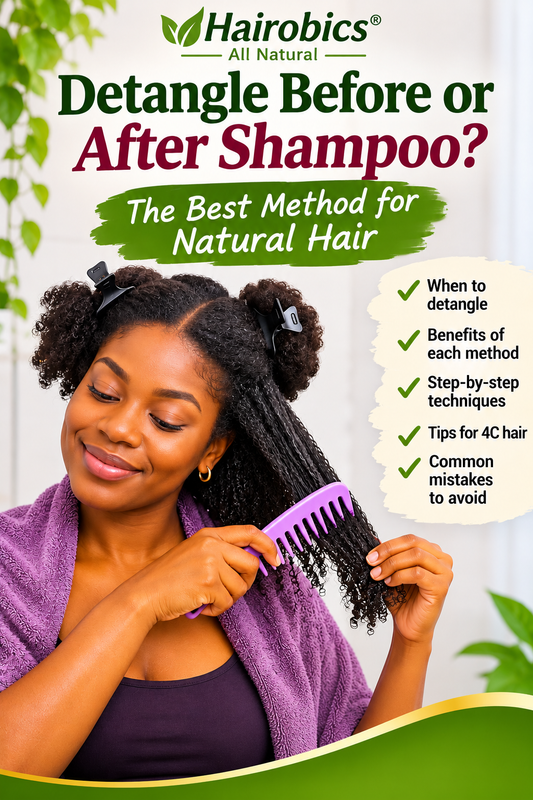
If you have natural hair, you have probably wondered whether you should detangle before or after shampooing. It is one of the most common wash day questions, especially for women with curly, coily, thick, or tightly textured hair.
Some people insist that detangling before shampooing is the secret to preventing breakage. Others believe that hair should only be detangled after shampooing, when it is wet and covered with conditioner.
So which method is actually better?
The answer depends on your hair's texture, condition, length, density, and how tangled it becomes between washes.
For many women with natural hair, the most practical approach is to remove major tangles before shampooing and complete thorough detangling during the conditioning stage.
This combination can help minimize unnecessary pulling, reduce tangling during cleansing, and make wash day more manageable.
However, it is not the only effective method. Some people can safely complete all their detangling after shampooing, particularly when their hair is already relatively free of knots.
In this comprehensive guide from Hairobics All Natural, we will explain when to detangle natural hair, how to handle stubborn knots, what works best for 4C hair, and how to create a gentle wash day routine that supports healthier-looking hair and better length retention.
Why Is Detangling Important for Natural Hair?
Natural hair is beautiful, versatile, and capable of forming many different curl and coil patterns.
However, those same patterns can make strands more likely to wrap around one another.
As hair naturally sheds, loose strands may become trapped within surrounding curls rather than falling away immediately.
Over time, these loose hairs can contribute to tangles, knots, and matting.
Detangling helps remove shed hair, separate intertwined strands, and prepare the hair for cleansing and styling.
When performed carefully, detangling can also make it easier to distribute conditioner, apply styling products, and create protective hairstyles.
The challenge is that detangling involves mechanical manipulation.
Pulling too aggressively, using the wrong tools, or repeatedly combing resistant sections can damage the hair shaft.
That is why the goal should never be to detangle as quickly or forcefully as possible.
Instead, the goal is to remove tangles while minimizing unnecessary stress on individual strands.
For additional techniques, explore our complete guide to detangling natural hair without breakage or pain.
Should You Detangle Before or After Shampoo?
Both methods can work, but they offer different advantages.
Detangling Before Shampoo
Detangling before shampooing involves gently separating knots and removing trapped shed hair before cleansing.
This method can be particularly useful when your hair is heavily tangled, has been in a protective style, or tends to become more tangled during washing.
Removing major knots beforehand may prevent loose strands from becoming further intertwined while shampooing.
It also allows you to organize the hair into sections before entering the shower.
However, detangling completely dry hair without lubrication can create friction and unnecessary breakage.
For that reason, many people prefer to apply water, conditioner, or a suitable pre-shampoo detangling product first.
Detangling After Shampoo
Detangling after shampooing usually takes place while a rinse-out conditioner is still on the hair.
Conditioner can provide slip, allowing strands to move past one another more easily.
This may reduce the force needed to separate tangles.
For hair that is not severely tangled before washing, this approach can be convenient and effective.
However, if the hair contains large mats or substantial amounts of trapped shed hair, shampooing aggressively before addressing those tangles can make the process more difficult.
Which Method Is Best?
For many people, the best approach combines both methods.
Before shampooing, remove obvious knots and separate heavily tangled areas.
After shampooing, apply a conditioner with good slip and complete the remaining detangling.
You do not need to perform two complete detangling sessions.
The first stage is preparation. The second stage is thorough detangling.
This approach can be particularly useful for tightly coiled natural hair.
Benefits of Detangling Before Shampoo
There are several reasons to consider detangling before cleansing.
1. Removes Accumulated Shed Hair
Hair naturally sheds as part of its growth cycle.
When you wear braids, twists, buns, or other protective hairstyles, some shed strands remain trapped.
If these strands are not separated carefully, they can wrap around neighboring hairs.
Removing loose shed hair before shampooing can make subsequent cleansing easier.
2. Helps Prevent Additional Tangling
Natural hair can shrink and contract when exposed to water.
Although shrinkage is a normal characteristic of textured hair, existing tangles may become harder to manage when strands contract around one another.
Separating major knots before washing can help reduce this problem.
3. Makes Section Washing Easier
Detangled or partially detangled hair is easier to divide into manageable sections.
You can create loose twists, braids, or clipped sections to keep different areas organized.
This is particularly helpful for high-density natural hair.
Read our related guide, How Many Sections Should You Use on Wash Day?, for more information.
4. May Reduce Wash Day Frustration
Trying to remove stubborn knots while shampooing can make wash day stressful.
Addressing major tangles beforehand allows you to concentrate on cleansing your scalp.
This can make your overall routine feel more organized.
5. Helps With Protective Style Takedown
If you have recently removed braids, twists, or extensions, pre-shampoo detangling is especially important.
Accumulated shed hairs around the roots can create dense tangles.
Gently separating them before vigorous washing may help prevent additional matting.
Benefits of Detangling After Shampoo
Although pre-shampoo detangling offers advantages, detangling during conditioning can be equally valuable.
1. Conditioner Provides Slip
A well-formulated rinse-out conditioner helps reduce friction between strands.
This can make it easier to work through tangles without excessive pulling.
For many women, conditioner is the most important part of a comfortable detangling routine.
2. Hair Is Easier to Separate
When hair is properly saturated with water and conditioner, strands may become easier to manipulate.
However, wet hair can also be vulnerable to stretching and damage, particularly when already weakened.
Always use gentle pressure and avoid forcing tools through knots.
3. Saves Time
Combining conditioning and detangling can eliminate the need for a separate, lengthy pre-shampoo session.
This may be particularly helpful if your hair is already manageable.
4. Helps Distribute Conditioner
Working through sections allows you to distribute conditioner more evenly.
You can pay extra attention to the ends, which are generally older and more weathered than hair near the roots.
5. Prepares Hair for Styling
Once the hair is detangled, you can twist or clip each section.
Keeping sections organized during rinsing can make moisturizing and styling easier afterward.
How to Detangle Natural Hair Before Shampoo
If you prefer pre-shampoo detangling, follow these steps.
Step 1: Divide Your Hair Into Sections
Start by dividing your hair into approximately four to eight manageable sections.
Short or lower-density hair may require fewer sections.
Longer, thicker, or high-density hair may benefit from additional sections.
Use smooth clips or loose hair ties to secure each area.
Avoid tight rubber bands that can catch on delicate strands.
Step 2: Add Lubrication
If your hair feels dry or resistant, apply water and a suitable conditioner or detangling product.
The purpose is to provide enough slip to separate strands comfortably.
Some people use a pre-shampoo conditioning treatment.
Others prefer a product specifically designed for detangling.
Choose a product compatible with your hair and follow its directions.
Step 3: Start With Your Fingers
Use your fingers to identify large knots and clusters of shed hair.
Gently separate the strands instead of pulling directly through them.
Finger detangling provides greater control when working with stubborn tangles.
Step 4: Begin at the Ends
Hold a small section above the area you are working on.
Start separating tangles near the ends.
Once the ends are manageable, move gradually toward the roots.
Working from the ends upward helps prevent tangles from being pushed together.
Step 5: Use a Wide-Tooth Comb if Necessary
After removing major knots with your fingers, you may use a wide-tooth comb.
Move slowly and stop whenever you encounter resistance.
Never force the comb through a knot.
If necessary, add more conditioner and separate the tangle manually.
Step 6: Secure the Completed Section
Once a section is manageable, place it in a loose twist or clip.
Repeat the process throughout your hair.
You are now ready to shampoo.
How to Detangle Natural Hair After Shampoo
If you prefer to complete most of your detangling during conditioning, use the following method.
Step 1: Shampoo Gently
Wet your hair thoroughly.
Apply shampoo primarily to the scalp and massage gently with your fingertips.
Avoid piling all your hair on top of your head or rubbing the lengths aggressively.
Allow the shampoo and rinse water to move through the hair without unnecessary friction.
Step 2: Rinse Thoroughly
Rinse away shampoo and loosened buildup.
Keep your hair organized in sections whenever possible.
Avoid twisting and rubbing the strands together.
Step 3: Apply a Rinse-Out Conditioner
Distribute conditioner throughout the hair, paying attention to tangled areas and the ends.
Choose a conditioner that provides sufficient slip for your texture.
Follow the manufacturer's instructions for application and processing time.
Step 4: Finger-Detangle
Separate each section into smaller portions.
Begin at the ends and gently work upward.
Remove loose shed strands as you go.
Step 5: Use a Detangling Tool
Once major knots are separated, use a wide-tooth comb or suitable detangling brush if needed.
Work slowly and use minimal tension.
A tool that works well for one person's hair may not be ideal for another.
Step 6: Twist Each Section
After detangling, loosely twist or clip the section.
This helps keep the strands organized while you finish the rest of your hair.
Step 7: Rinse and Moisturize
Rinse according to the conditioner directions.
After washing, apply a suitable leave-in treatment and proceed with your preferred styling routine.
Avoid repeatedly detangling hair that is already manageable.
Is It Better to Detangle 4C Hair Before or After Washing?
Women with 4C hair often experience substantial shrinkage and tightly packed coils.
These characteristics can make tangles more difficult to identify and separate.
However, 4C hair does not automatically require a completely different wash day routine.
For many people with 4C hair, a combination approach works well.
Before shampooing, gently separate major tangles and remove trapped shed strands.
During conditioning, complete the remaining detangling while the hair has sufficient slip.
The key is controlling tension and working in manageable sections.
Tips for Detangling 4C Hair
-
Use smaller sections when necessary.
-
Keep the hair adequately lubricated.
-
Separate major knots with your fingers first.
-
Work from the ends toward the roots.
-
Avoid aggressive brushing.
-
Secure completed sections.
-
Take breaks if detangling becomes uncomfortable.
Do not assume that every detangling session must leave your hair completely stretched or perfectly smooth.
The objective is manageable, separated strands—not forcing your natural curl pattern into submission.
Should You Detangle Hair When It Is Wet or Dry?
This is another important consideration.
There is no universal rule that all natural hair must be detangled exclusively wet or dry.
Completely dry detangling may create substantial friction, especially when hair is tightly coiled or heavily tangled.
On the other hand, wet hair can stretch more easily and may be vulnerable to mechanical damage.
Many people find that damp hair coated with a slippery conditioner offers a useful balance.
The ideal approach depends on your hair's condition and how it responds to manipulation.
If your hair stretches excessively, snaps easily, or feels unusually weak when wet, reduce tension and reassess your routine.
Never continue pulling through strands that are clearly resisting.
What Should You Do If Your Hair Is Severely Tangled?
Severely tangled or matted hair requires additional patience.
Trying to shampoo heavily matted hair without first addressing the tangles can sometimes make separation more difficult.
Start by identifying the most tangled areas.
Apply a suitable conditioner or detangling product and allow it to work according to the directions.
Use your fingers to separate small groups of strands.
Begin at the outside edges of the tangle rather than pulling directly through the center.
Work slowly and avoid excessive force.
If the hair is tightly matted near the scalp, professional assistance may be the safest option.
Cutting through mats without understanding how the hair is intertwined can result in unnecessary hair loss.
Common Detangling Mistakes That Can Cause Breakage
Even when you choose the right stage of wash day, your technique matters.
Starting at the Roots
Dragging a comb from the roots through tangled lengths can concentrate force on knots.
Start near the ends and work upward instead.
Detangling Without Enough Slip
Trying to comb through resistant hair without adequate lubrication may increase friction.
Add a suitable conditioner or detangling product when necessary.
Using Too Much Force
Detangling should not require aggressive pulling.
If a tool becomes stuck, stop and separate the knot with your fingers.
Working With Sections That Are Too Large
Large sections can hide knots and make it difficult to control tension.
Smaller sections may improve precision.
Repeatedly Brushing the Same Area
Excessive brushing can create unnecessary mechanical stress.
Once a section is detangled, secure it and move on.
Rubbing Hair Aggressively During Shampooing
Vigorous rubbing can encourage strands to intertwine.
Focus on cleaning the scalp and use gentle movements through the lengths.
For more guidance, read How to Reduce Breakage While Shampooing.
How Often Should You Detangle Natural Hair?
The ideal detangling frequency depends on your hairstyle, texture, length, and how quickly tangles develop.
Some people prefer a thorough detangling session on wash day.
Others benefit from occasional gentle finger detangling between washes.
Hair worn loose may require more frequent attention than hair maintained in twists or braids.
However, more detangling is not automatically better.
Repeated manipulation can create additional mechanical stress.
Instead of following a rigid schedule, pay attention to how your hair behaves.
If you notice tangles accumulating rapidly, consider adjusting your styling, nighttime protection, or wash day frequency.
If your hair remains manageable between washes, there may be no reason to detangle it daily.
Does Detangling Help Natural Hair Grow Longer?
Detangling does not directly increase the biological rate of hair growth.
Hair grows from follicles beneath the scalp, and its growth cycle is influenced by factors including genetics, age, hormones, and overall health.
However, gentle detangling may help reduce mechanical breakage.
This matters because hair length depends on both growth and length retention.
If your hair grows but repeatedly breaks at the ends, you may struggle to see noticeable length gains.
By minimizing unnecessary breakage, you may retain more of the length your hair naturally produces.
This is why gentle handling is an important part of a long-term natural hair care routine.
How to Prevent Hair From Tangling During Shampooing
Prevention can make detangling easier.
Before washing, divide your hair into manageable sections.
Remove major knots if necessary.
During shampooing, concentrate on cleansing your scalp rather than rubbing your hair together.
Allow the lengths to remain relatively organized.
Avoid creating a large pile of hair on top of your head.
After shampooing, apply conditioner and separate any remaining tangles.
Secure completed sections before rinsing.
If your hair shrinks significantly during washing, loose twists may help maintain organization.
For additional techniques, see How to Keep Natural Hair Stretched on Wash Day.
How to Make Detangling Faster Without Damaging Your Hair
A faster wash day does not have to involve rushing.
The most effective time-saving strategies often involve reducing unnecessary steps.
Prepare your tools before washing.
Divide your hair into sections.
Remove major tangles before shampooing only when necessary.
Complete your main detangling session during conditioning.
Keep finished sections organized.
Avoid detangling the same hair repeatedly.
You can also reduce tangling between washes by protecting your hair at night and choosing hairstyles that minimize friction.
If wash day regularly takes several hours, review which steps actually benefit your hair.
For more ideas, read How to Reduce Wash Day Time for Natural Hair.
Best Hairobics Products to Include in Your Detangling Routine
A successful detangling routine starts with gentle handling and sufficient lubrication.
After cleansing and conditioning, complementary hair care products can help maintain softness, manageability, and scalp comfort.
Hairobics All Natural offers several products that can fit into a consistent natural hair maintenance routine.
1. Hairobics Leave-In Treatment
After shampooing and rinsing out your conditioner, a leave-in treatment can be a useful part of your moisturizing routine.
Hairobics Leave-In Treatment can be incorporated into your post-wash hair care regimen according to its directions.
Apply to appropriate sections and distribute gently.
A leave-in treatment does not replace a slippery rinse-out conditioner when substantial detangling is required.
Shop Hairobics Leave-In Treatment: Hairobics All Natural Hair Care
2. Hairobics Hair & Scalp Booster
For those who prefer oil-based conditioning after washing, Hairobics Hair & Scalp Booster is another option.
Its ingredient blend includes coconut oil, jojoba oil, olive oil, wheat germ oil, aloe vera, vitamin E oil, and botanical oils.
The product can complement a routine focused on conditioning and maintaining healthy-looking natural hair.
Use an appropriate amount according to directions, especially if your hair is prone to product buildup.
Remember that oil-based conditioning products do not replace cleansing or rinse-out conditioning.
Shop Hair & Scalp Booster: Explore Hairobics Hair Care Products
3. Hairobics Scalp Rejuvenator Oil
A comfortable scalp is another important part of a consistent hair care routine.
Hairobics Scalp Rejuvenator Oil can be incorporated into your scalp-conditioning regimen.
Apply according to the product directions and massage gently without scratching or pulling at the roots.
Avoid using excessive amounts of oil immediately before cleansing if buildup is already a concern.
Shop Scalp Rejuvenator Oil: Visit Hairobics All Natural
Products can support your routine, but none can guarantee that detangling will be completely free of breakage.
The foundation remains proper conditioning, careful technique, and minimal unnecessary tension.
A Simple Natural Hair Wash Day Routine
If you are unsure how to organize your wash day, start with this straightforward routine.
Step 1: Inspect Your Hair
Check for large knots, tangled roots, and accumulated shed hair.
Step 2: Section Your Hair
Create four to eight sections, adjusting the number to your hair's length and density.
Step 3: Remove Major Tangles
If necessary, apply a suitable detangling product and gently separate stubborn knots.
Step 4: Shampoo Your Scalp
Cleanse gently while keeping your hair organized.
Step 5: Apply Conditioner
Use a rinse-out conditioner that provides sufficient slip.
Step 6: Complete Detangling
Work from the ends toward the roots, using your fingers and an appropriate tool.
Step 7: Rinse and Moisturize
Rinse thoroughly and apply your preferred leave-in treatment.
Step 8: Style Gently
Choose a manageable hairstyle that does not place excessive tension on your strands.
This routine can be adjusted for short natural hair, shoulder-length curls, long coils, or high-density textures.
For additional planning tips, explore How Long Should Natural Hair Wash Day Take?.
Frequently Asked Questions About Detangling Before or After Shampoo
Is it better to detangle before washing natural hair?
Detangling before washing can be helpful when your hair contains major knots, accumulated shed strands, or tangles from protective styles. You do not necessarily need to complete a thorough detangling session before shampooing.
Should you comb natural hair after shampooing?
You can comb natural hair after shampooing, preferably while it is coated with a rinse-out conditioner that provides adequate slip. Use gentle movements and work from the ends toward the roots.
Should you detangle 4C hair before shampooing?
Many people with 4C hair benefit from gently separating major tangles before shampooing and completing the remaining detangling during conditioning. However, the best method depends on the individual hair's condition.
Can shampoo make natural hair more tangled?
Aggressive rubbing, excessive manipulation, and washing heavily tangled hair without preparation can contribute to tangling. Gentle scalp cleansing and section washing may help.
Is finger detangling better than using a brush?
Finger detangling provides control when separating stubborn knots. Brushes and wide-tooth combs may also be useful when used gently. The best method is the one that allows you to remove tangles without excessive pulling.
Should you detangle hair before deep conditioning?
You can remove major knots before deep conditioning, but some people find detangling easier while a conditioning product is applied. Follow the treatment's directions and avoid unnecessary manipulation.
Does detangling prevent split ends?
Gentle detangling can reduce mechanical stress, but it cannot guarantee that split ends will not develop. Existing split ends cannot be permanently repaired by conditioning products.
Can you detangle natural hair every day?
You can gently separate tangles when necessary, but daily thorough combing may create unnecessary manipulation for some textures. Detangle according to your hair's needs rather than following a rigid schedule.
Why does my hair tangle immediately after washing?
Possible reasons include shrinkage, friction, damaged ends, accumulated shed strands, and inadequate conditioning. Keeping the hair organized in sections may help reduce immediate retangling.
What is the best detangling method for length retention?
Use sufficient slip, work in manageable sections, begin at the ends, and avoid excessive force. Consistent gentle handling may reduce breakage and support length retention.
Final Thoughts: Should You Detangle Before or After Shampoo?
So, should you detangle before or after shampooing?
For many women with natural hair, the answer is both—but for different purposes.
Before shampooing, gently remove major knots and accumulated shed hair when necessary.
After shampooing, use a slippery conditioner to complete thorough detangling.
This combination can help make wash day easier while reducing unnecessary pulling and friction.
However, if your hair is already relatively tangle-free, you may prefer to complete your entire detangling session during conditioning.
The most important factors are not simply when you detangle, but how gently you handle your strands.
Use adequate lubrication, work in sections, begin at the ends, and stop whenever you encounter significant resistance.
Healthy natural hair care is built on consistency, patience, and techniques that protect your strands from avoidable damage.
Ready to build a better natural hair care routine?
Explore the conditioning and scalp-care products available at Hairobics All Natural and discover options to complement your wash day routine.
With the right techniques and a manageable routine, detangling can become a simpler, more comfortable part of caring for your natural hair.