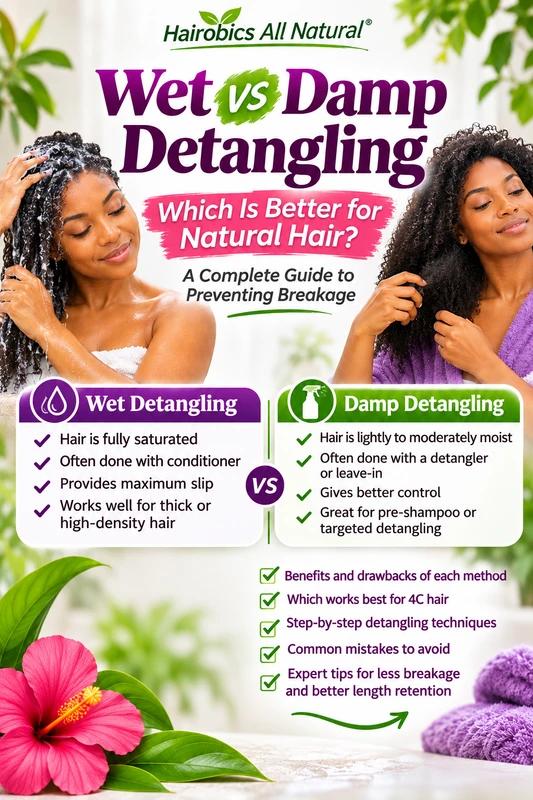
Detangling natural hair can be one of the most challenging parts of maintaining healthy curls and coils. Whether you have 3C curls, tightly coiled 4C hair, thick natural hair, or delicate strands that break easily, choosing the right detangling method can make a significant difference in your hair care routine.
One question many women with natural hair ask is: Should you detangle your hair when it is soaking wet or slightly damp?
Some people prefer detangling in the shower while their hair is completely saturated with water and conditioner. Others find that lightly damp hair provides better control and makes stubborn knots easier to separate.
Both approaches have advantages, but neither is automatically best for everyone.
The right choice depends on your hair texture, density, porosity, condition, products, and how much tangling you experience.
Understanding the difference between wet and damp detangling can help you reduce unnecessary breakage, preserve your ends, improve manageability, and maintain healthier-looking natural hair.
In this comprehensive guide from Hairobics All Natural, we'll explore the benefits and disadvantages of each method, explain which works best for 4C hair, and share step-by-step techniques for detangling without excessive pulling.
What Is Wet Detangling?
Wet detangling means removing tangles while your hair is thoroughly saturated with water.
This method is commonly performed during wash day, usually after shampooing and while applying a rinse-out conditioner.
When hair absorbs water, its physical properties temporarily change. Water makes hair more flexible and allows curls and coils to stretch more easily.
For many people, this increased flexibility makes it easier to separate intertwined strands.
However, flexibility does not necessarily mean strength.
Hair that is completely wet may be more vulnerable to excessive stretching and mechanical damage, particularly when it is already weakened.
This is why wet detangling should always involve gentle handling and adequate conditioning.
Benefits of Wet Detangling
1. Conditioner can provide excellent slip.
One of the biggest advantages of wet detangling is the opportunity to use a slippery rinse-out conditioner.
Slip describes how easily hair strands slide past one another.
A conditioner with good slip can reduce friction, making knots easier to separate.
2. Water makes curls more flexible.
Water temporarily changes the hydrogen bonding within the hair shaft.
As a result, curls can become more elongated and flexible.
This can make it easier to work through dense or tightly coiled sections.
3. Wet detangling fits naturally into wash day.
Instead of creating an entirely separate detangling session, you can combine conditioning and detangling.
This may save time and reduce unnecessary manipulation.
4. Shed hair can be removed during conditioning.
Curly and coily hair often traps naturally shed strands.
Detangling during conditioning allows you to remove these strands before styling.
5. It works well for some high-density textures.
People with thick, tightly coiled hair may find that thoroughly wet hair coated with conditioner is easier to separate than hair that is only lightly damp.
Disadvantages of Wet Detangling
Wet detangling also has potential drawbacks.
Hair can stretch significantly when saturated, especially if it has existing damage.
Aggressive brushing may cause weakened strands to snap.
Additionally, some hair becomes difficult to control when completely saturated.
If you notice excessive stretching, snapping, or repeated knots, consider adjusting your technique or trying damp detangling.
For a closer look at wet hair vulnerability, read our guide on Why Is My Hair Weak When Wet?.
What Is Damp Detangling?
Damp detangling involves removing tangles when your hair contains some moisture but is not completely saturated.
Your hair should feel flexible and lightly moisturized rather than dripping wet.
This method is popular among people who prefer detangling before shampooing, refreshing natural hairstyles, or preparing their hair for twists and braids.
Damp detangling often involves using a spray bottle, a suitable detangling product, or a leave-in conditioner formulated to provide adequate slip.
The goal is to create enough lubrication to separate strands without excessive tension.
Benefits of Damp Detangling
1. Greater control over individual sections.
Damp hair may be easier to hold, separate, and organize.
This can be particularly useful when working through stubborn knots.
2. Less dripping and mess.
You can detangle outside the shower without constantly dealing with dripping water.
3. Convenient for pre-shampoo detangling.
If your hair becomes heavily tangled between wash days, damp detangling can help you remove major knots before cleansing.
4. Useful for targeted detangling.
You can focus on specific areas, including the nape, crown, and ends, without completely wetting your entire head.
5. Can work well for fragile hair.
Some people find damp detangling easier to control when their hair stretches excessively while saturated.
However, damp hair is not automatically stronger or safer in every situation. Adequate lubrication and gentle technique remain essential.
Disadvantages of Damp Detangling
The biggest disadvantage is insufficient slip.
If your hair is barely damp and lacks a suitable conditioning product, friction may increase.
This can make tightly coiled strands difficult to separate.
Additionally, some hair textures require more water and conditioner to become manageable.
If damp detangling causes repeated snagging, add more water or use a conditioner that provides better slip.
Wet vs Damp Detangling: What's the Difference?
Although both methods involve moisture, they can produce different detangling experiences.
| Feature | Wet Detangling | Damp Detangling |
|---|---|---|
| Moisture level | Fully saturated | Lightly to moderately moist |
| Common products | Rinse-out conditioner | Detangler or suitable leave-in |
| Best timing | During wash day | Before washing or styling |
| Hair flexibility | Often greater | Moderate |
| Control | Depends on texture | Often easier section control |
| Breakage risk | Possible with excessive stretching | Possible with insufficient slip |
| Convenience | Usually in shower | Can be done anywhere |
| Best overall use | Thorough conditioning detangling | Controlled, targeted detangling |
The most important difference is not simply how much water is present. It is how easily your strands separate without excessive force.
For some hair types, soaking-wet hair with conditioner provides the best detangling experience.
For others, damp hair with sufficient lubrication is more manageable.
The safest approach is generally the one that minimizes pulling, snagging, and breakage.
Is Wet or Damp Detangling Better for 4C Hair?
For many women with 4C natural hair, detangling requires extra patience because the strands form tight coils that can wrap around one another.
However, 4C hair is not inherently unhealthy or incapable of growing long.
The challenge often involves managing shrinkage, accumulated shed strands, and friction.
Wet Detangling for 4C Hair
Wet detangling can work particularly well when the hair is coated with a conditioner that provides excellent slip.
The water and conditioner combination may make tightly coiled sections easier to separate.
However, aggressive brushing can still cause damage.
Damp Detangling for 4C Hair
Damp detangling may be preferable when you need more control over knots or want to remove tangles before shampooing.
For example, if your 4C hair has been worn in a twist-out for several days, lightly dampening each section before detangling may help you separate accumulated shed strands.
Recommended Approach for 4C Hair
Consider combining both methods.
First, lightly dampen your hair and gently remove major knots before shampooing when necessary.
Next, shampoo carefully without rubbing the hair together.
Finally, complete your main detangling session while your hair is coated with a slippery rinse-out conditioner.
This combination can reduce unnecessary manipulation and make wash day more manageable.
For more guidance, explore our Complete Guide to Detangling Natural Hair Without Breakage or Pain.
How to Wet Detangle Natural Hair Without Breakage
Wet detangling can be effective when performed carefully.
Follow these steps to minimize unnecessary tension.
Step 1: Divide Your Hair Into Sections
Before shampooing, divide your hair into approximately four to eight manageable sections.
If your hair is especially thick or long, additional sections may be helpful.
Sectioning prevents strands from becoming mixed together while you work.
Step 2: Thoroughly Wet Your Hair
Allow lukewarm water to flow through each section.
Make sure the inner layers of your hair become wet, not just the surface.
Avoid aggressively rubbing your strands together.
Step 3: Apply a Conditioner With Good Slip
After shampooing, distribute a suitable rinse-out conditioner throughout each section.
Pay particular attention to the ends.
Choose a conditioner that allows your strands to glide past one another.
Step 4: Finger Detangle First
Use your fingers to identify larger knots.
Gently separate intertwined strands instead of pulling directly through them.
This allows you to feel resistance before applying too much force.
Step 5: Start at the Ends
Begin detangling near the tips.
Once the ends are manageable, gradually move upward toward the roots.
Hold the section above the area you're detangling to reduce pulling on the scalp.
Step 6: Use a Wide-Tooth Comb if Necessary
After finger detangling, use a wide-tooth comb or suitable detangling brush if your hair tolerates it.
Work slowly.
If the tool becomes stuck, stop and separate the knot manually.
Step 7: Secure the Completed Section
Twist or clip the detangled section.
Continue until your entire head is manageable.
Rinse conditioner according to its directions while keeping sections organized.
This helps reduce immediate retangling.
How to Damp Detangle Natural Hair Without Breakage
Damp detangling is particularly useful when you want to work through tangles before shampooing or between wash days.
Step 1: Start With Manageable Sections
Separate your hair into four to eight sections.
Use more sections if your hair is especially dense or tangled.
Step 2: Lightly Mist With Water
Use a spray bottle to add moisture.
Your hair should feel flexible but not necessarily dripping wet.
Avoid assuming that a few sprays are sufficient for every texture.
Dense hair may require additional moisture to reach the inner strands.
Step 3: Apply a Suitable Detangling Product
Use a product specifically designed to improve manageability and provide slip.
Distribute it evenly.
If the product does not provide enough lubrication, switch to a more suitable detangler or conditioner.
Step 4: Separate Large Knots With Your Fingers
Carefully identify tangled areas.
Work through small groups of strands instead of trying to separate an entire section at once.
Step 5: Detangle From the Ends Upward
Begin at the tips and gradually move toward the roots.
Never pull forcefully through resistance.
Step 6: Add More Moisture When Necessary
If your hair begins drying before you finish, lightly mist it again.
Do not continue brushing strands that have become rough or difficult to separate.
Step 7: Twist or Braid Each Section
Once a section is detangled, secure it in a loose twist or braid.
This helps prevent neighboring strands from becoming tangled again.
For additional techniques, read How to Prevent Hair From Retangling.
Which Method Causes Less Hair Breakage?
There is no universal rule that wet detangling always causes more breakage than damp detangling, or vice versa.
Breakage depends on several factors.
These include:
-
Existing hair damage
-
Amount of conditioning slip
-
Detangling technique
-
Hair density and curl pattern
-
Type of brush or comb
-
Amount of pulling
-
Condition of the ends
-
Frequency of manipulation
For example, wet detangling with a slippery conditioner may cause less friction than trying to comb through barely damp hair.
On the other hand, someone with severely weakened hair may find that fully saturated strands stretch excessively under tension.
The objective is to use the method that requires the least force.
If you notice short broken hairs accumulating during detangling, evaluate your technique and products.
You may also benefit from reviewing our article on Why Does My Hair Break When Detangling?.
How Hair Porosity Affects Wet and Damp Detangling
Hair porosity describes how readily hair takes in and releases water.
Although porosity is only one factor affecting detangling, understanding your hair's behavior can help you choose an appropriate routine.
Low-Porosity Hair
Low-porosity hair may take longer to become thoroughly saturated.
Product buildup can also make water distribution more difficult.
When wet detangling, allow enough water to reach the inner layers before applying conditioner.
When damp detangling, avoid coating the hair with excessive products before it has enough moisture.
High-Porosity Hair
High-porosity hair may absorb water readily and lose moisture relatively quickly.
Some high-porosity hair has cuticle damage caused by chemical processing, heat, or mechanical wear.
If your hair is fragile, use gentle pressure and a conditioner that provides sufficient lubrication.
Avoid excessive stretching, regardless of whether your hair is wet or damp.
Medium-Porosity Hair
Medium-porosity hair may respond well to either method.
Experiment with both approaches and evaluate which produces less snagging.
Remember that porosity alone cannot determine the safest detangling technique.
Should You Detangle Before or After Shampooing?
This question is closely connected to the wet versus damp detangling debate.
Detangling before shampooing is often useful when your hair contains significant knots or trapped shed strands.
Detangling after shampooing may be more convenient when your hair responds well to rinse-out conditioner.
For many natural hair routines, a combination works well.
Remove major tangles before shampooing if necessary, then complete your main detangling session during conditioning.
However, you do not need to detangle thoroughly twice.
Repeated brushing can create unnecessary manipulation.
Learn more in our guide on Detangle Before or After Shampoo?.
Best Detangling Tools for Natural Hair
Choosing the right tool can be just as important as choosing the right moisture level.
Your Fingers
Finger detangling gives you direct control over knots.
It allows you to feel resistance and separate individual strands carefully.
This can be especially helpful for fragile ends and tightly coiled textures.
Wide-Tooth Comb
A wide-tooth comb can help separate larger groups of strands.
Choose a comb with smooth teeth and avoid dragging it forcefully through knots.
Flexible Detangling Brush
Some detangling brushes have flexible bristles designed to move through curly hair.
These can work well for certain textures when sufficient conditioner is present.
However, no brush is universally suitable for every curl pattern.
Spray Bottle
A spray bottle is useful for damp detangling.
It allows you to add moisture gradually without completely soaking your hair.
Sectioning Clips
Smooth sectioning clips keep finished sections separate.
They can make the entire detangling process more organized.
The best tools are the ones that allow you to remove tangles comfortably without excessive pulling.
10 Common Detangling Mistakes That Cause Breakage
Even with the right moisture level, certain habits can make detangling unnecessarily damaging.
1. Starting at the Roots
Pulling a comb from the roots through tangled ends can push knots together.
Always begin near the ends.
2. Detangling Without Enough Slip
Water alone may not provide sufficient lubrication.
Use a suitable conditioner or detangling product.
3. Working With Sections That Are Too Large
Large sections can hide knots.
Divide difficult areas into smaller portions.
4. Pulling Through Stubborn Tangles
Never force a brush or comb through resistance.
Stop and separate the knot gently.
5. Detangling Too Quickly
Rushing can lead to excessive tension.
Allow enough time to work carefully.
6. Ignoring Damaged Ends
Split ends and severely weathered strands can catch on neighboring hairs.
Trimming damaged ends when necessary may improve manageability.
7. Brushing the Same Section Repeatedly
Once a section is detangled, secure it.
Repeated brushing is not always necessary.
8. Allowing Hair to Dry During Detangling
If your hair loses moisture and becomes difficult to manage, add more water or an appropriate conditioning product.
9. Using Excessive Heat Before Detangling
Repeated heat exposure can damage hair over time.
Heat is not required for effective detangling.
10. Leaving Detangled Sections Loose
Freshly detangled curls can become intertwined again.
Twist or clip finished sections to maintain separation.
How Hairobics All Natural Can Support Your Detangling Routine
At Hairobics All Natural, we believe healthy-looking natural hair begins with consistent care, appropriate conditioning, and gentle handling.
While no cosmetic product can guarantee completely breakage-free detangling, suitable hair care products can complement a routine focused on softness, moisture management, and length retention.
Hairobics Leave-In Treatment
After shampooing and rinsing out your regular conditioner, a leave-in treatment can be a useful addition to your routine.
Hairobics Leave-In Treatment is designed for hair and scalp conditioning.
It can complement your post-wash moisturizing and styling routine, particularly when your hair needs additional manageability.
Use according to the product directions.
A leave-in treatment does not replace a slippery rinse-out conditioner when substantial detangling is required.
Shop Hairobics Leave-In Treatment
Hairobics Hair & Scalp Booster
For natural hair that benefits from additional oil-based conditioning, Hairobics Hair & Scalp Booster is another option.
Its formula contains botanical oils and conditioning ingredients, including coconut oil, olive oil, jojoba oil, rosemary oil, and vitamin E.
Oil-based products can help lubricate strands and complement a moisturizing routine.
However, oils do not replace water-based conditioning and should not be relied upon to remove stubborn knots.
Use an appropriate amount according to the directions to avoid excessive buildup.
Shop Hairobics Hair & Scalp Booster
Both products can be incorporated into a consistent natural hair care routine alongside gentle cleansing, effective conditioning, and low-tension styling.
How Often Should You Detangle Natural Hair?
The ideal detangling frequency depends on your hairstyle, texture, length, and tendency to tangle.
Some people detangle thoroughly on wash day.
Others benefit from occasional gentle finger detangling between washes.
Hair worn loose may require more attention than hair maintained in twists or braids.
However, daily thorough detangling is not automatically necessary.
Excessive manipulation can create additional mechanical stress.
Instead, focus on preventing severe tangling and removing accumulated shed strands when appropriate.
If your hair remains manageable between washes, there may be no need to comb through it every day.
Does Wet or Damp Detangling Help Hair Grow Longer?
Neither wet nor damp detangling directly increases the biological rate of hair growth.
Hair grows from follicles beneath the scalp.
However, gentle detangling may help reduce mechanical breakage.
This is important because visible hair length depends on both growth and length retention.
If your hair continues growing but repeatedly breaks at the ends, you may struggle to notice progress.
By minimizing unnecessary pulling, protecting fragile ends, and maintaining a suitable conditioning routine, you may retain more of the length your hair naturally produces.
The goal is not to force faster growth.
It is to protect the hair you already have.
A Simple Weekly Detangling Routine for Natural Hair
A consistent routine can help make detangling easier.
Before Wash Day
Examine your hair for large knots and accumulated shed strands.
If necessary, lightly dampen the hair and gently remove major tangles.
Keep the hair organized in sections.
During Wash Day
Shampoo gently without rubbing the lengths together.
Apply a suitable rinse-out conditioner.
Complete your main detangling session using your fingers and an appropriate tool.
Work from the ends toward the roots.
Twist completed sections.
After Washing
Rinse thoroughly.
Gently blot excess water with a microfiber towel or soft cotton T-shirt.
Apply your preferred leave-in treatment according to its directions.
Style your hair without excessive tension.
Between Wash Days
Protect your hair at night with a satin bonnet, scarf, or smooth pillowcase.
Avoid unnecessary brushing.
Refresh conditioning when needed.
Monitor your ends for excessive tangling or visible damage.
For more ideas on simplifying this process, read How to Make Natural Hair Wash Day Faster.
Frequently Asked Questions About Wet vs Damp Detangling
Is it better to detangle natural hair wet or damp?
Both methods can work. Wet detangling with conditioner may provide excellent slip, while damp detangling may offer better control for some people. Choose the method that minimizes friction and pulling.
Should you detangle 4C hair when it is soaking wet?
You can detangle 4C hair while wet if sufficient conditioner is present and you handle the strands gently. However, soaking-wet hair can stretch significantly, so avoid aggressive brushing.
Does damp detangling prevent breakage?
Damp detangling may help some people control tangles more easily, but it does not guarantee less breakage. Adequate slip and gentle technique are essential.
Can you detangle natural hair with just water?
Water can improve flexibility, but it may not provide enough lubrication for heavily tangled hair. A suitable conditioner or detangling product is often helpful.
Should I finger detangle before using a brush?
Finger detangling major knots first can help reduce the chance of a brush catching on stubborn tangles.
Why does my hair break when I detangle it wet?
Possible causes include existing damage, excessive stretching, insufficient conditioner, aggressive brushing, and weakened ends.
Is damp detangling better for damaged hair?
It may be easier to control for some damaged hair, but there is no universal rule. Choose the approach that creates the least tension and avoid forcing tools through fragile strands.
How many sections should I use when detangling?
Four to eight sections are a practical starting point for many people. Adjust the number according to your hair's length, density, and tangling.
Can I detangle natural hair every day?
Daily thorough detangling may create unnecessary manipulation for some textures. Detangle when needed rather than following a rigid daily schedule.
Why does my hair tangle again after detangling?
Shrinkage, friction, accumulated shed strands, damaged ends, and leaving freshly detangled sections loose can contribute to retangling.
Keeping completed sections twisted or braided may help.
Does wet detangling cause more shedding?
Wet detangling can release shed hairs that were already trapped in your curls. This does not necessarily mean detangling caused additional shedding.
However, short broken pieces may indicate mechanical damage.
Can I use oil to detangle natural hair?
Some oils can provide lubrication, but oil alone may not offer enough slip for severe knots. A suitable conditioner or detangling product is often more effective.
What is the safest way to detangle severely tangled natural hair?
Work in small sections, apply sufficient slip, use your fingers to separate knots, and avoid pulling. Severe matting may require help from an experienced natural hair stylist.
Final Verdict: Wet vs Damp Detangling — Which Is Best?
The best detangling method is the one that allows your natural hair to separate with the least friction, pulling, and unnecessary breakage.
Wet detangling can be an excellent option when your hair responds well to a slippery rinse-out conditioner.
Damp detangling may be more convenient when you need additional control, want to remove knots before shampooing, or prefer working outside the shower.
For many women with 4A, 4B, and 4C natural hair, combining gentle pre-shampoo detangling with thorough conditioning during wash day can be a practical approach.
Remember these essential principles:
-
Use adequate moisture and conditioning slip.
-
Work in manageable sections.
-
Begin detangling at the ends.
-
Separate stubborn knots with your fingers.
-
Avoid aggressive brushing.
-
Keep completed sections organized.
-
Protect your ends from unnecessary friction.
Most importantly, pay attention to how your hair responds.
Your curl pattern, density, and individual hair condition matter more than following a rigid detangling rule.
With patience, appropriate products, and consistent gentle handling, you can make detangling easier while supporting healthier-looking natural hair and better length retention.
Build a better natural hair care routine with Hairobics All Natural.
Explore our botanical-based hair and scalp products at www.HairobicsAllNatural.com.
Healthy natural hair begins with consistent care, gentle handling, and protecting every strand.