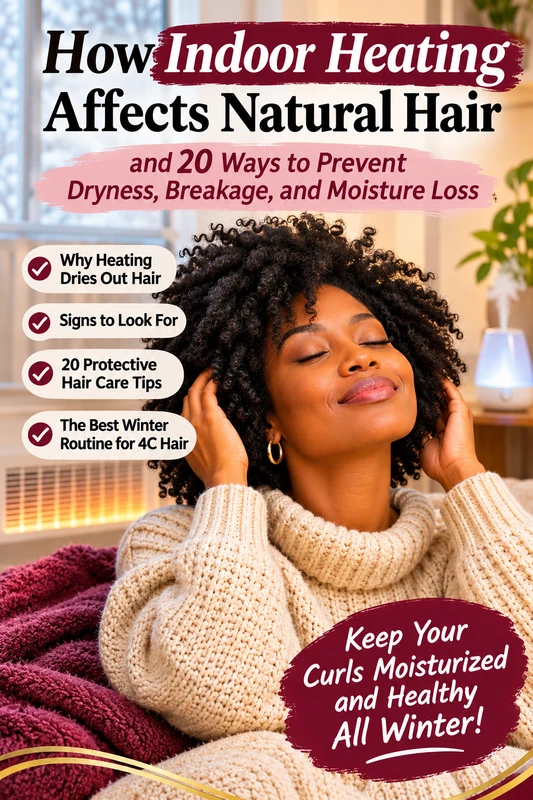
When temperatures begin to drop, most people turn on their indoor heating systems to stay warm and comfortable. While central heating, space heaters, and heated indoor environments make winter more enjoyable, they can also create unexpected challenges for natural hair.
Have you ever noticed that your natural hair feels softer during warmer months but becomes dry, brittle, tangled, or difficult to manage when your heater is running?
Perhaps your curls lose moisture faster than usual, your scalp feels tight, or your ends seem to break more easily despite following the same hair care routine.
If this sounds familiar, indoor heating may be contributing to the problem.
For Black women with natural hair, especially those with tightly coiled 4A, 4B, and 4C textures, maintaining moisture during winter can require additional attention.
Indoor heating can lower relative humidity, creating conditions that encourage hair to lose moisture and feel less flexible. Combined with friction, frequent styling, and inadequate conditioning, this can make natural hair more vulnerable to tangling and breakage.
Fortunately, you don't have to choose between staying warm and maintaining healthy natural hair.
Understanding how heated indoor environments affect your curls can help you develop a routine that supports softness, manageability, scalp comfort, and healthy length retention.
In this complete guide, we'll explain how indoor heating affects natural hair, why 4C hair may feel particularly dry during winter, and 20 practical ways to protect your curls and coils from seasonal moisture loss.
Why Does Indoor Heating Make Natural Hair Dry?
Indoor heating changes the environment surrounding your hair.
When air is warmed without adding additional moisture, its relative humidity decreases. Relative humidity measures how much water vapor the air contains compared with the maximum amount it could hold at that temperature.
This is particularly noticeable during winter because cold outdoor air often contains relatively little water vapor.
Once that air enters your home and becomes heated, indoor humidity can become very low.
Hair naturally exchanges moisture with its surrounding environment.
When humidity is low, the amount of water held within the hair fiber can decrease as the hair adjusts to the surrounding conditions.
This may cause natural hair to feel:
-
Dry and rough
-
Less flexible
-
More difficult to detangle
-
Frizzy or dull
-
Stiff after styling
-
More prone to knots
-
Less manageable between wash days
Indoor heating does not automatically damage healthy hair. However, consistently dry conditions can make existing moisture-retention challenges more noticeable.
For a broader explanation of environmental influences, read our guide on How Weather Affects Natural Hair.
How Indoor Heating Affects 4C Natural Hair
Type 4C natural hair is characterized by tightly packed coils, significant shrinkage, and a curl pattern that may be less visibly defined without styling.
Although 4C hair can be strong and healthy, its tightly curved structure can make moisture management and gentle detangling especially important.
Natural oils do not spread as easily
The scalp naturally produces sebum, which helps lubricate hair.
On straight hair, sebum can move relatively easily along the strands.
On tightly coiled hair, the bends and curves make it more difficult for natural oils to spread evenly from roots to ends.
Consequently, the ends may receive less natural lubrication.
Dryness increases friction
When 4C hair feels rough, neighboring strands may catch on one another more easily.
This can contribute to tangling, particularly when hair shrinks or is manipulated repeatedly.
The ends require additional protection
The ends are the oldest portions of your hair.
They have experienced the most washing, styling, environmental exposure, and friction.
During winter, these areas may feel particularly rough or difficult to manage.
Moisture retention becomes more challenging
Low indoor humidity can change the moisture balance of the hair fiber.
If your conditioning routine is insufficient, your hair may feel dry again shortly after styling.
The solution is not necessarily applying more oil every day.
Instead, focus on effective conditioning, moisture retention, low-manipulation styling, and protecting your ends.
10 Signs Indoor Heating May Be Affecting Your Natural Hair
Your hair may respond differently to indoor heating depending on its porosity, density, texture, condition, and styling routine.
Here are ten signs worth watching.
1. Your hair feels dry shortly after moisturizing
You apply your favorite leave-in conditioner, but your curls begin feeling rough again within a day.
Low indoor humidity may be contributing to the problem.
2. Your ends feel unusually brittle
Your ends may become rough, tangled, or less flexible.
Because ends are older and experience more friction, they often require careful conditioning.
3. Your scalp feels tight
A dry indoor environment can contribute to uncomfortable skin dryness, including on the scalp.
However, persistent tightness or irritation may have other causes.
4. Your hair tangles more frequently
Dry-feeling strands may create more friction, making neighboring curls harder to separate.
5. Your twist-outs lose softness
A twist-out that normally stays soft for several days may begin feeling stiff sooner.
6. Your hair develops static
Low humidity can contribute to static electricity, particularly when hair rubs against certain fabrics.
7. Your scalp becomes flaky
Dry indoor conditions may contribute to scalp dryness.
However, flakes can also result from dandruff, seborrheic dermatitis, eczema, or product irritation.
8. Your hair appears dull
When strands feel rough or have uneven surface texture, they may reflect light less uniformly.
9. You notice additional breakage
If hair becomes difficult to detangle, rough brushing and repeated manipulation can increase mechanical breakage.
10. Your usual routine stops working as well
A routine that performs beautifully during humid weather may require adjustments when indoor humidity drops.
These signs do not prove that heating is the only cause. Hair damage, product buildup, scalp conditions, and changes in styling habits can produce similar symptoms.
20 Ways to Protect Natural Hair From Indoor Heating
The following strategies can help you maintain softer, more manageable curls and reduce unnecessary breakage during the heating season.
1. Monitor Indoor Humidity
One of the easiest ways to understand your indoor environment is to measure humidity.
Purchase an inexpensive hygrometer and place it in a frequently used room.
For general household comfort, indoor relative humidity of approximately 30% to 50% is commonly recommended.
Extremely low humidity may contribute to dry-feeling hair and skin.
However, excessive humidity can encourage condensation and mold.
Monitoring your environment helps you make adjustments based on actual conditions rather than guessing.
2. Consider Using a Humidifier
A humidifier adds water vapor to indoor air.
When your home becomes excessively dry, using a humidifier may help maintain more comfortable humidity levels.
Place it in your bedroom or another room where you spend considerable time.
Avoid directing mist onto your hair or bedding.
Clean the humidifier according to the manufacturer's instructions and monitor humidity to prevent excessive moisture.
Remember that a humidifier does not replace proper hair conditioning.
It simply helps address one environmental factor that may contribute to dryness.
3. Use a Moisturizing Leave-In Treatment
A suitable leave-in treatment can be an important part of your winter natural hair routine.
After shampooing and conditioning, leave-in care helps support softness, manageability, and easier styling.
Look for formulas containing water and conditioning ingredients that work well with your hair.
The Hairobics Leave-In Treatment contains botanical ingredients including aloe vera, avocado oil, jojoba oil, and other plant-derived components.
It can complement a routine focused on conditioning dry-feeling natural hair during winter.
Apply according to the product directions and avoid excessive layering.
Winter hair care tip: Apply your leave-in treatment after washing while your hair is still damp, unless the product instructions specify otherwise.
4. Use Oil-Based Products Strategically
Oils and oil-based hair products can help lubricate strands, improve the feel of dry ends, and complement your conditioning routine.
However, oil is not the same as water.
Applying oil to hair that lacks adequate conditioning may leave it feeling coated without resolving the underlying dryness.
A better approach is to cleanse and condition appropriately, apply suitable leave-in care, and then use a small amount of oil-based product if your hair benefits from it.
The Hairobics Hair & Scalp Booster contains ingredients including coconut oil, jojoba oil, olive oil, wheat germ oil, aloe vera, and vitamin E oil.
This botanical oil-based formula can be incorporated into your winter hair and scalp care routine.
Use sparingly according to directions, especially if your hair is fine or easily weighed down.
5. Deep Condition Regularly
Deep conditioning can help improve the feel and manageability of dry natural hair.
During winter, consider incorporating a richer rinse-out conditioning treatment when your hair needs additional care.
Depending on your routine, this may mean conditioning once a week or during your regular wash day.
Focus on the lengths and ends, where friction and accumulated damage are often most noticeable.
Allow the conditioner to remain on your hair for the time recommended on its label.
Using more heat or leaving a product on much longer than directed does not necessarily improve its performance.
6. Reduce Excessive Shampooing
Washing your hair is essential for removing dirt, sweat, excess oil, and product buildup.
However, frequent cleansing with a shampoo that is too harsh for your hair may leave strands feeling rough.
Choose a shampoo appropriate for your scalp and hair condition.
Adjust washing frequency based on how quickly your scalp becomes oily, sweaty, or uncomfortable.
Some people prefer weekly washing, while others need a different schedule.
Always follow cleansing with suitable conditioning.
The goal is a clean scalp and manageable hair, not avoiding shampoo altogether.
7. Protect Your Hair While Sleeping
Nighttime friction can contribute to tangling and breakage.
Cotton pillowcases, rough bedding, and repeated movement may create friction against your curls.
Consider wearing a comfortable satin or silk bonnet or using a smooth pillowcase.
If your hair is long enough, loosely twisting it into several sections before bed may help reduce tangling.
Avoid tying your bonnet or scarf so tightly that it pulls on your hairline.
Protecting your hair at night can be especially helpful when indoor heating runs continuously while you sleep.
8. Avoid Sitting Directly Under Heating Vents
Warm air blowing directly onto your hair may make it feel uncomfortable and can expose it to continuously moving, relatively dry air.
If possible, avoid positioning your bed, desk, or favorite chair directly beneath a strong heating vent.
Adjust airflow so it does not blow continuously onto your scalp.
This simple environmental change may make your routine more comfortable without requiring additional products.
9. Choose Low-Manipulation Hairstyles
Low-manipulation hairstyles reduce how frequently you need to comb, brush, separate, or restyle your natural hair.
During winter, consider:
-
Loose two-strand twists
-
Medium-sized braids
-
Comfortable flat twists
-
Loose buns
-
Low-tension updos
-
Twist-outs maintained for several days
These hairstyles can help reduce unnecessary handling.
However, protective styling only works when the hairstyle is comfortable and does not create excessive tension.
For more guidance, explore What Is Low-Manipulation Hair Care?.
10. Pay Special Attention to Your Ends
Your ends are especially vulnerable to accumulated wear.
During winter, inspect them regularly for excessive roughness, splits, and knots.
Apply suitable conditioning products and minimize friction against sweaters, coats, and scarves.
If your hair reaches your shoulders, consider loose styles that keep the ends from constantly rubbing against clothing.
Trim visibly split or severely damaged ends when necessary.
Trimming does not increase the rate of growth from the scalp, but removing damaged ends can reduce additional splitting and help maintain a neater appearance.
11. Avoid Excessive Heat Styling
Indoor heating already creates a relatively dry environment in many homes.
Adding frequent flat ironing, blow-drying, or hot curling may increase stress on your strands.
High styling temperatures can damage the hair cuticle and weaken the fiber.
Whenever possible, choose heat-free stretching methods.
If you use a blow-dryer, select a suitable temperature, keep it moving, and avoid prolonged exposure to one section.
Use a heat-protectant product when appropriate.
Remember that no heat protectant completely eliminates the risk of thermal damage.
12. Refresh Your Hair Only When Needed
When natural hair feels dry, it can be tempting to spray it with water or apply additional products several times a day.
However, frequent refreshing is not necessary for everyone.
Some hairstyles maintain softness for several days without additional conditioning.
Others may benefit from a light refresh.
Assess how your hair feels before applying more product.
If your strands feel soft and manageable, leave them alone.
If they feel rough, use an appropriate amount of conditioning product.
Avoid repeatedly saturating styles that are difficult to dry thoroughly.
13. Protect Your Hair From Winter Clothing
Winter clothing can create additional friction.
Wool scarves, thick sweaters, hooded jackets, and rough collars may catch on natural hair.
This is particularly important for shoulder-length curls and fragile ends.
Consider wearing a smooth satin-lined hat or placing a smooth fabric barrier between your hair and rough clothing.
Avoid constantly pulling or brushing hair away from your collar.
Small changes can help reduce unnecessary friction throughout the day.
14. Maintain a Comfortable Scalp
Your scalp is skin, and it requires appropriate care.
During winter, some people experience dryness or discomfort when indoor humidity decreases.
Maintain regular cleansing and avoid scratching or aggressively rubbing the scalp.
For those who prefer botanical oil-based scalp care, the Hairobics Scalp Rejuvenator contains ingredients including olive oil, rosemary oil, lavender oil, tea tree oil, and peppermint oil.
Use it sparingly according to the directions, and patch-test before broader application.
Essential oils can irritate sensitive skin, so discontinue use if redness, burning, or irritation develops.
Persistent itching, thick flakes, sores, or unexplained hair loss should be evaluated by a dermatologist.
15. Detangle Gently
Dry-feeling hair may be more difficult to separate.
Avoid aggressively brushing tightly coiled hair when it is resistant to manipulation.
Instead, divide your hair into manageable sections.
Apply a conditioner or detangling product with sufficient slip.
Begin separating knots near the ends and gradually work toward the roots.
Hold the section above the area being detangled to reduce pulling on your scalp.
Once a section is detangled, place it into a loose twist or braid to prevent strands from mixing together.
For additional techniques, read How to Prevent Hair From Retangling.
16. Avoid Excessive Product Buildup
When hair feels dry, adding more products may seem like the obvious solution.
However, repeatedly layering oils, creams, butters, and gels can create buildup.
This may leave hair feeling sticky, heavy, or difficult to cleanse.
If your strands feel coated but remain rough, consider whether your hair needs washing rather than another application of oil.
Use an appropriate shampoo and follow with conditioner.
Then apply a reasonable amount of leave-in care and optional oil-based conditioning.
A simple, consistent routine often works better than constantly introducing new products.
17. Adjust Your Routine for Hair Porosity
Hair porosity describes how readily hair absorbs and releases water under particular conditions.
Porosity is influenced by the condition of the cuticle and previous damage.
Hair that has experienced coloring, chemical processing, or excessive heat may behave differently from relatively undamaged hair.
If your hair becomes wet quickly but also feels rough after drying, evaluate its condition, styling history, and conditioning routine.
If products seem to sit on your strands, consider whether buildup or product choice is contributing.
Do not rely exclusively on floating-hair tests to determine porosity.
Instead, observe how your hair responds to cleansing, conditioning, and styling.
The best winter routine is the one that consistently leaves your hair soft, manageable, and comfortable.
18. Avoid Tight Protective Styles
Braids, twists, and other protective hairstyles can be convenient during winter.
However, tight styling can cause unnecessary tension.
Excessive pulling around the edges, temples, and nape may contribute to breakage and, over time, traction alopecia.
Choose styles that do not hurt or pull excessively.
Avoid heavy extensions and tight ponytails.
If you notice tenderness, bumps, or persistent pulling, loosen or remove the hairstyle.
Protective styling should reduce stress on your hair, not create additional damage.
19. Support Healthy Hair Through Nutrition
Healthy hair begins with normal biological processes within the hair follicle.
Adequate nutrition supports these processes.
A balanced diet containing sufficient protein, iron, zinc, and other essential nutrients contributes to normal hair health.
However, taking additional supplements does not necessarily improve hair growth when you are not deficient.
Drink enough water for your body's needs.
Hydration supports general health, but drinking extra water alone will not directly moisturize dry hair strands.
For existing hair, external conditioning and gentle handling remain important.
20. Create a Consistent Winter Hair Care Routine
The most effective winter hair routine is one you can maintain consistently.
You do not need to spend hours styling your hair every day.
Focus on a few essential habits:
-
Cleanse your scalp appropriately.
-
Condition your hair thoroughly.
-
Apply suitable leave-in care.
-
Use oil-based conditioning when beneficial.
-
Protect your ends from friction.
-
Choose comfortable, low-manipulation styles.
-
Monitor your indoor humidity.
-
Adjust your routine when your hair's condition changes.
Consistency makes it easier to identify what works and avoid unnecessary product changes.
Can Indoor Heating Cause Natural Hair Breakage?
Indoor heating does not directly break hair simply because the heater is running.
However, low-humidity conditions may contribute to hair feeling drier and less flexible.
When dry-feeling hair is combined with rough detangling, excessive brushing, tight hairstyles, or heat damage, mechanical breakage can become more likely.
This is particularly important for people trying to retain length.
Hair grows from follicles within the scalp, but the length you see depends partly on how well you preserve the existing strands.
If your ends continually break, your hair may appear to remain the same length even while new growth continues.
To reduce breakage, prioritize conditioning, gentle detangling, protecting your ends, and minimizing unnecessary manipulation.
For additional advice, read How to Reduce Breakage While Shampooing.
The Best Winter Moisture Routine for 4C Natural Hair
If your 4C natural hair becomes difficult to manage during the heating season, try this straightforward routine.
Wash Day
Begin by dividing your hair into four to eight manageable sections.
Gently remove accumulated shed hair using conditioner or another product with adequate slip.
Cleanse your scalp with a suitable shampoo.
Apply rinse-out conditioner throughout your hair, concentrating on the lengths and ends.
Rinse thoroughly and gently remove excess water without aggressively rubbing your strands.
Apply a suitable leave-in treatment according to its directions.
If your hair benefits from additional oil-based conditioning, use a small amount of an appropriate product.
Style your hair in loose twists, braids, or another comfortable low-manipulation hairstyle.
Between Wash Days
Check your hair periodically for dryness, tangling, or excessive buildup.
Refresh only when necessary.
Avoid repeatedly brushing or combing hair that does not need restyling.
Protect your ends from rough clothing and reduce unnecessary manipulation.
Before Bed
Place your hair into a comfortable nighttime style.
Wear a satin or silk bonnet or use a smooth pillowcase.
Check that your bedroom humidity is not excessively low.
Avoid positioning your head directly beneath a heating vent.
Weekly Assessment
At the end of the week, evaluate your routine.
Ask yourself:
-
Does my hair still feel soft?
-
Are my ends becoming tangled?
-
Is my scalp comfortable?
-
Am I noticing additional breakage?
-
Do my products feel too heavy?
-
Does my hair need more conditioning or less manipulation?
Use your observations to make small adjustments rather than changing everything at once.
Indoor Heating vs. Outdoor Cold Weather: Which Is Worse for Natural Hair?
Both indoor and outdoor conditions can influence how natural hair feels.
Cold outdoor weather often brings low temperatures, wind, and reduced atmospheric moisture.
Indoor heating can create a different challenge by lowering relative humidity as air is warmed.
Moving repeatedly between these environments may make maintaining a consistent hair routine more difficult.
However, neither cold weather nor indoor heating automatically causes permanent hair damage.
The greatest practical concern is often the combination of environmental dryness, inadequate conditioning, friction, and repeated styling.
For people living in naturally arid regions, these challenges may continue throughout much of the year.
Explore our related guide on Natural Hair Care in Dry Climates for additional moisture-retention strategies.
Frequently Asked Questions About Indoor Heating and Natural Hair
Does indoor heating dry out 4C hair?
Indoor heating can reduce relative humidity, particularly during winter. Because hair exchanges moisture with its environment, very dry indoor conditions may contribute to 4C hair feeling rougher or less manageable.
Proper conditioning, gentle styling, and humidity management can help.
Can central heating cause hair loss?
Central heating is not an established direct cause of hair loss from the follicle.
However, dryness combined with rough handling may contribute to hair shaft breakage.
If you notice significant shedding, bald patches, or progressive thinning, consult a dermatologist to investigate possible causes.
Should I moisturize my natural hair every day during winter?
Not necessarily.
Some people benefit from more frequent conditioning, while others maintain softness for several days.
Pay attention to your hair's condition, porosity, styling routine, and product buildup.
Does a humidifier help natural hair?
A humidifier can help reduce excessively dry indoor conditions.
It may improve environmental comfort, but it does not replace regular conditioning or appropriate hair care products.
Keep the device clean and monitor indoor humidity.
What is the best indoor humidity level for natural hair?
There is no scientifically established humidity level that is ideal for every natural hair texture.
For general household comfort, approximately 30% to 50% relative humidity is commonly recommended.
Hair care needs still vary according to texture, condition, and styling habits.
Is oil enough to protect natural hair from indoor heating?
Oil alone may not provide everything your hair needs.
Oil-based products can help lubricate strands and complement conditioning, but they do not replace water-based care.
Use an appropriate cleanser, conditioner, and leave-in product as the foundation of your routine.
Why does my scalp itch more when the heater is on?
Low indoor humidity may contribute to skin dryness and discomfort.
However, itching can also result from dandruff, irritation, eczema, or other scalp conditions.
Persistent symptoms deserve professional evaluation.
Can indoor heating make natural hair stop growing?
Indoor heating does not normally stop hair follicles from producing hair.
However, repeated breakage may reduce visible length retention.
Protecting existing strands is important when trying to maintain longer natural hair.
Final Thoughts: Keep Your Natural Hair Healthy During Heating Season
Indoor heating can make maintaining soft, manageable natural hair more challenging, especially when winter brings extremely low indoor humidity.
However, dry indoor air does not mean your curls are destined to become brittle, tangled, or damaged.
By understanding how humidity affects the hair fiber, you can make practical adjustments that support moisture retention and reduce unnecessary breakage.
Focus on consistent conditioning, gentle detangling, comfortable protective hairstyles, scalp care, and protecting your ends from friction.
Consider monitoring indoor humidity and using a humidifier when your home becomes excessively dry.
Most importantly, remember that healthy natural hair does not require a complicated routine.
Small, consistent habits can make a meaningful difference.
Give Your Natural Hair Extra Care This Winter
At Hairobics All Natural, we believe natural hair deserves thoughtful care in every season.
Whether you're maintaining 4C coils, caring for dry-feeling hair, or developing a consistent scalp care routine, choosing suitable products can complement your healthy hair habits.
Explore our Hair & Scalp Booster and Leave-In Treatment as part of your winter conditioning routine.
Healthy natural hair starts with consistent care, gentle handling, and understanding what your curls need.
Visit HairobicsAllNatural.com to explore our natural hair care collection.