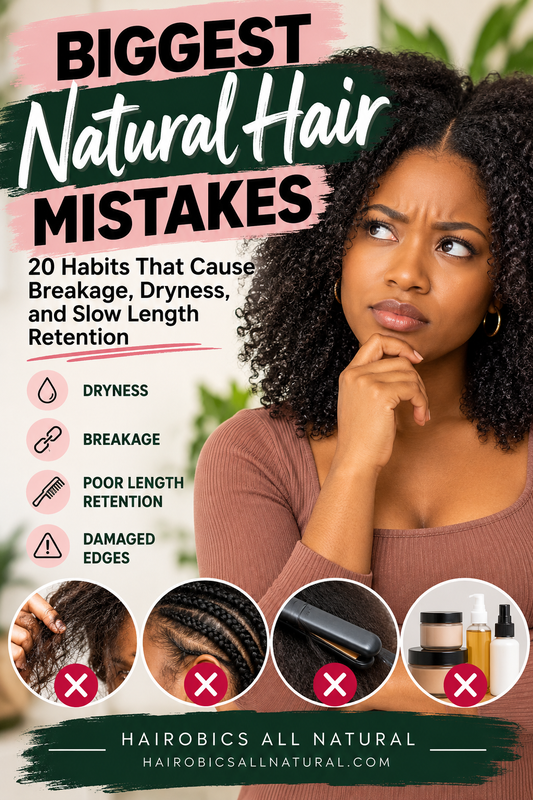
Natural hair is beautiful, versatile, and full of personality. Whether you have loose curls, tight coils, thick 4C hair, or a combination of textures, maintaining healthy natural hair requires understanding what your strands need and avoiding habits that cause unnecessary damage.
Unfortunately, some of the biggest natural hair mistakes happen during everyday routines.
You might be moisturizing your hair regularly, wearing protective styles, purchasing expensive products, and following popular hair growth advice without realizing that certain habits are contributing to dryness, breakage, tangling, or thinning edges.
The truth is that healthy natural hair doesn't require a complicated routine or dozens of products.
It requires consistency, gentle handling, proper cleansing, effective conditioning, and an understanding of how your hair responds to different techniques.
Many people assume their natural hair isn't growing because they don't see significant changes in length. However, hair growth and length retention are two different things.
Your hair may be growing from the scalp while your ends are breaking at nearly the same rate.
This is why identifying and correcting natural hair care mistakes can make such a difference.
In this comprehensive guide, we'll explore 20 of the biggest natural hair mistakes, explain why they can damage your strands, and share practical ways to maintain stronger, softer, healthier-looking hair.
Why Natural Hair Requires Special Attention
Natural hair, particularly curly and coily textures, has bends and curves throughout each strand.
These curves create the beautiful shapes and patterns associated with textured hair, but they can also increase tangling and make it more difficult for natural scalp oils to spread evenly along the hair shaft.
As a result, some natural hair textures are more susceptible to dryness, friction, and mechanical breakage.
However, having tightly coiled hair doesn't automatically mean your hair is unhealthy or weak.
With appropriate care, natural hair can maintain excellent strength, elasticity, shine, and length.
The key is understanding that your hair needs may differ depending on its:
-
Curl pattern
-
Hair density
-
Strand thickness
-
Porosity
-
Length
-
Styling habits
-
History of chemical or heat treatments
-
Scalp condition
Let's examine the most common mistakes that can interfere with healthy natural hair maintenance.
1. Not Moisturizing Natural Hair Properly
One of the biggest natural hair mistakes is allowing your hair to become excessively dry between wash days.
Dry hair often feels rough, stiff, tangled, or brittle.
When strands lack adequate conditioning and lubrication, they may experience increased friction during styling and detangling.
Over time, repeated friction can contribute to breakage.
However, moisturizing natural hair doesn't mean continuously applying thick oils or heavy grease.
Water-based conditioners and moisturizing products help improve the feel and manageability of hair, while certain oils and creams can help reduce friction and slow moisture loss.
How to Fix This Mistake
Start with a consistent conditioning routine.
After washing, apply a suitable conditioner or leave-in product to help maintain softness and manageability.
Pay particular attention to your ends because they are generally the oldest and most weathered portions of your hair.
If your hair becomes dry between washes, consider using a lightweight water-based moisturizer instead of repeatedly layering heavy products.
Avoid assuming that more product automatically means better hydration.
Your goal is hair that feels comfortable, flexible, and manageable without excessive residue.
2. Using Oil Instead of a Moisturizer
Many people believe applying oil alone is enough to moisturize natural hair.
While oils can provide useful conditioning benefits, most oils don't supply the water that dry hair needs.
Applying oil repeatedly to hair that already feels dehydrated may leave the strands greasy without addressing the underlying dryness.
This can be especially frustrating for people with low-porosity hair or fine strands that become weighed down easily.
How to Fix This Mistake
Use a water-based moisturizing product when your hair needs hydration and conditioning.
If your hair benefits from oil, apply a small amount afterward to help reduce friction and improve manageability.
Some people prefer the LOC method, which involves liquid, oil, and cream.
Others prefer the LCO method, which involves liquid, cream, and oil.
Neither method is automatically better for everyone.
Experiment with lightweight combinations until you find a routine that leaves your hair soft without feeling coated.
Remember that oils are optional additions, not replacements for cleansing and conditioning.
3. Detangling Natural Hair Too Aggressively
Aggressive detangling is one of the most damaging habits in many natural hair routines.
Curly and coily strands naturally wrap around one another, creating knots and tangles.
When you force a comb or brush through these tangles, the tension can cause strands to stretch beyond their breaking point.
This is especially problematic when your hair is already dry, damaged, or tangled near the ends.
How to Fix This Mistake
Divide your hair into manageable sections before detangling.
Apply a conditioner or detangling product that provides enough slip to allow strands to separate easily.
Begin near the ends and gradually work upward toward the roots.
Use your fingers to gently loosen stubborn knots instead of pulling harder with a comb.
Avoid rushing.
If your hair begins snapping, stop and reassess your technique.
For additional guidance, read our article on why hair breaks when detangling.
4. Washing Natural Hair Too Infrequently
Some people avoid shampooing because they believe washing natural hair causes dryness or prevents growth.
However, consistently avoiding cleansing can allow sweat, scalp oils, dead skin cells, and styling products to accumulate.
Excessive buildup may contribute to itching, flakes, unpleasant odors, and difficulty keeping hair manageable.
It can also make your hair feel coated or sticky.
How to Fix This Mistake
Develop a shampoo schedule based on your scalp condition, styling habits, and product usage.
Many people find that washing every one to two weeks works well, although some need more frequent cleansing.
If you exercise regularly, use heavy styling products, or experience significant scalp buildup, your scalp may need attention sooner.
Choose a shampoo that cleanses effectively without leaving your hair excessively rough.
Follow with conditioner to restore slip and improve manageability.
A clean scalp is an important part of maintaining a comfortable, sustainable natural hair routine.
5. Using Too Much Heat
Blow dryers, flat irons, hot combs, and curling irons can create beautiful styles, but excessive heat exposure can damage natural hair.
High temperatures may weaken the hair's protective cuticle and alter its internal structure.
Repeated heat damage can lead to:
-
Increased breakage
-
Dryness
-
Reduced elasticity
-
Split ends
-
Rough texture
-
Changes in curl pattern
Severely heat-damaged curls may not return to their original shape.
How to Fix This Mistake
Limit unnecessary heat styling.
When using heated tools, apply an appropriate heat protectant and select the lowest effective temperature.
Avoid repeatedly passing a flat iron over the same section.
Never assume that a heat protectant makes high temperatures completely safe.
Whenever possible, experiment with heat-free styling methods such as twists, braids, rollers, or banding.
These alternatives can create stretched or defined styles without relying on frequent high heat.
6. Wearing Protective Styles That Are Too Tight
Protective styles can help reduce daily manipulation, but they are not automatically protective.
Tight braids, cornrows, ponytails, buns, and extensions may place excessive tension on the scalp and hairline.
Repeated pulling can contribute to broken strands, thinning edges, and traction alopecia.
Traction alopecia is hair loss caused by prolonged or repeated tension on the follicles.
If tension continues, some hair loss may become permanent.
How to Fix This Mistake
Choose styles that feel comfortable immediately after installation.
Pain, headaches, bumps, or excessive scalp tenderness are warning signs that your hairstyle may be too tight.
Avoid repeatedly pulling your edges into tight ponytails or buns.
Ask your stylist to reduce tension around the hairline and avoid heavy extensions.
If a style causes significant discomfort, loosen or remove it rather than waiting for your scalp to adjust.
Protective styling should protect your hair, not place it under continuous stress.
7. Leaving Braids and Extensions in Too Long
Braids and extensions can make natural hair maintenance easier, but leaving them installed for excessive periods may create problems.
Shed hairs can accumulate around the roots, and product buildup can become difficult to remove.
When you eventually take down the style, trapped strands may become tangled or matted.
Aggressive removal can then cause unnecessary breakage.
How to Fix This Mistake
Choose a reasonable wearing period based on your hairstyle, scalp condition, and hair needs.
Many people remove extension braids after approximately four to eight weeks, but this is not a universal rule.
If you experience matting, significant buildup, discomfort, or excessive tension, remove the style sooner.
Continue caring for your scalp and accessible hair while wearing extensions.
Most importantly, take your time during removal and detangle shed hairs before shampooing.
8. Ignoring Split Ends and Damaged Hair
One of the biggest mistakes people make when trying to grow long natural hair is refusing to trim damaged ends.
Your ends are the oldest part of your hair.
They experience repeated exposure to washing, brushing, styling, clothing, and environmental conditions.
Over time, this can cause the protective cuticle to wear down.
Split ends cannot be permanently repaired by oils, conditioners, or hair masks.
Some products temporarily improve their appearance, but they don't restore the original structure of a split strand.
How to Fix This Mistake
Inspect your ends regularly.
Look for excessive splitting, persistent knots, roughness, and thinning.
Trim damaged ends when needed rather than following an unnecessarily rigid schedule.
You don't have to remove large amounts of healthy hair simply because a certain number of weeks has passed.
Protecting your ends between trims is equally important.
Learn more in our guide to protecting natural hair ends and retaining length.
9. Applying Too Many Products
More products don't necessarily produce healthier hair.
Layering multiple leave-in conditioners, creams, oils, gels, and butters may cause buildup.
Hair can become sticky, dull, heavy, or difficult to style.
Fine strands may lose volume, while tightly coiled hair may develop residue that makes detangling harder.
How to Fix This Mistake
Simplify your routine.
Start with a cleanser, rinse-out conditioner, and one suitable leave-in or styling product.
Add products only when they serve a clear purpose.
Pay attention to how your hair feels after application.
If your hair feels greasy, sticky, or coated, reduce the amount of product rather than adding another layer.
Use clarifying shampoo occasionally when needed to remove stubborn buildup, following with appropriate conditioning.
A simple routine is often easier to maintain consistently.
10. Over-Manipulating Natural Hair
Natural hair can be styled in countless ways, but constantly changing hairstyles can create unnecessary stress.
Repeated brushing, combing, twisting, pulling, and stretching may increase mechanical wear.
This is particularly important for fragile ends and areas already experiencing breakage.
Even well-conditioned hair can break when subjected to excessive force.
How to Fix This Mistake
Incorporate low-manipulation hairstyles into your routine.
Loose twists, comfortable braids, twist-outs, and other simple styles may reduce the need for daily combing.
Avoid constantly touching or rearranging your hair throughout the day.
When refreshing a hairstyle, focus on the areas that actually need attention instead of restyling your entire head.
If you notice persistent breakage despite having soft hair, read our article on why natural hair can feel soft but still break.
11. Sleeping Without Protecting Your Hair
Your nighttime routine can influence how your natural hair looks and feels the next morning.
As you move during sleep, your hair rubs against pillows and bedding.
This friction may contribute to frizz, tangling, and mechanical wear.
Loose natural hair may also become compressed and tangled overnight.
How to Fix This Mistake
Consider using a satin or silk bonnet, scarf, or pillowcase.
These smoother surfaces may help reduce friction.
Before sleeping, loosely gather your hair into sections or a comfortable protective arrangement.
Avoid tying your hair so tightly that it places pressure on your edges.
If your bonnet slips off frequently, a satin pillowcase can provide an additional layer of protection.
The goal is to reduce unnecessary friction while keeping your scalp comfortable.
12. Neglecting Your Scalp
Healthy-looking natural hair begins with consistent scalp care.
Ignoring persistent itching, flakes, inflammation, or buildup can make hair maintenance uncomfortable.
Some people respond to scalp dryness or flaking by applying large amounts of oil.
However, not every flaky scalp is caused by dryness.
Dandruff, seborrheic dermatitis, product irritation, and other conditions may require different treatments.
How to Fix This Mistake
Cleanse your scalp regularly using an appropriate shampoo.
Avoid scratching aggressively with your fingernails.
Use scalp oils sparingly if they suit your skin, and discontinue products that cause irritation.
Persistent itching, redness, painful bumps, scaling, or hair loss should be evaluated by a dermatologist.
Remember that a scalp oil is not a substitute for medical treatment when an underlying scalp condition is present.
13. Using Products That Don't Suit Your Hair
A product that works beautifully for one person may not work the same way for another.
Hair density, strand thickness, styling preferences, and the condition of your hair all influence how products perform.
Heavy butters may feel wonderful on some coarse strands while making fine hair limp or greasy.
Lightweight sprays may be sufficient for one person but require additional conditioning support for another.
How to Fix This Mistake
Evaluate your hair's characteristics instead of relying only on curl type.
Pay attention to how quickly your hair becomes weighed down, how easily it tangles, and which products provide lasting manageability.
Introduce new products gradually.
Avoid changing your entire routine every time you see a popular recommendation online.
Consistency makes it easier to identify which products actually benefit your hair.
14. Deep Conditioning Too Often or Incorrectly
Deep conditioning can improve softness, lubrication, and manageability, particularly when hair is dry or damaged.
However, more frequent or longer treatments aren't always more effective.
Some people use deep conditioners multiple times per week or leave rinse-out treatments on overnight without following product directions.
This may lead to unnecessary buildup or scalp irritation.
How to Fix This Mistake
Choose a conditioning schedule that matches your hair's needs.
Use the product according to its instructions.
If your hair feels adequately conditioned with a regular rinse-out conditioner, you may not need an intensive treatment every wash day.
Hair that has undergone coloring, bleaching, or frequent heat styling may benefit from more specialized conditioning treatments.
Avoid assuming that every instance of breakage can be corrected by adding more conditioner.
15. Ignoring Excessive Hair Shedding
Hair naturally sheds as part of its growth cycle.
However, sudden increases in shedding, visible thinning, or bald patches shouldn't automatically be blamed on poor moisturizing habits.
Hair loss can have several causes, including medical conditions, nutritional deficiencies, medication effects, hormonal changes, and certain hairstyles.
Breakage and shedding are also different.
Breakage occurs when strands snap along their length, while shedding involves hairs being released from the follicle.
How to Fix This Mistake
Pay attention to changes in your hair's density and the amount of hair you lose.
If you notice sudden or persistent excessive shedding, patchy loss, or scalp symptoms, consult a healthcare professional or dermatologist.
Avoid relying on cosmetic hair products to treat unexplained hair loss.
Early evaluation can be especially important for certain forms of scarring alopecia.
16. Constantly Comparing Your Hair to Others
Social media can make natural hair growth appear effortless.
You may see someone with waist-length curls and assume their products or routine will produce identical results for you.
However, genetics, age, hair characteristics, health, and styling history all influence hair growth and appearance.
Two people can follow similar routines and experience different results.
How to Fix This Mistake
Focus on the condition of your own hair.
Track improvements in softness, manageability, reduced breakage, and overall hair health.
Take occasional progress photographs under similar lighting conditions if length retention is one of your goals.
Remember that shrinkage can make natural hair appear shorter than its actual stretched length.
Healthy hair doesn't have to look like someone else's hair.
17. Neglecting Your Hair Ends Between Wash Days
Many people focus heavily on their scalp and roots while overlooking their ends.
However, the ends often require the most protection because they have experienced the greatest amount of wear.
When ends become rough or tangled, they may catch on neighboring strands.
This can increase knots and make detangling more difficult.
How to Fix This Mistake
Check your ends regularly.
Use conditioner and suitable leave-in products to maintain manageability.
Keep your ends protected from excessive rubbing against rough clothing, towels, and accessories.
Avoid repeatedly brushing the same fragile areas.
If your hair tangles frequently despite regular conditioning, explore our guide on why hair tangles so easily and how to prevent knots.
18. Believing Hair Growth Products Can Fix Every Problem
Hair growth products are popular, but no cosmetic product can compensate for every damaging hair habit.
If your ends constantly break, simply applying more products to your scalp won't necessarily improve length retention.
Likewise, a moisturizing treatment cannot reverse severe traction-related follicle damage or cure an underlying medical cause of hair loss.
How to Fix This Mistake
Build a strong foundation before expecting results from additional products.
Focus on gentle detangling, proper cleansing, conditioning, scalp comfort, and protecting your ends.
Choose products that support the cosmetic needs of your hair.
At Hairobics All Natural, we believe hair care should be built around consistency, thoughtful product selection, and maintaining healthier-looking strands.
A reliable routine is more valuable than constantly searching for a miracle solution.
19. Ignoring Early Signs of Hair Damage
Hair damage often develops gradually.
You might notice that your ends feel rougher than usual, your hair tangles more frequently, or small broken strands appear during styling.
Ignoring these changes can allow damaging habits to continue.
How to Fix This Mistake
Learn to recognize potential warning signs.
These may include:
-
Persistent dryness
-
Excessive tangling
-
Increasing breakage
-
Split ends
-
Reduced elasticity
-
Changes in curl pattern after heat styling
-
Noticeably thinning edges
-
Increased scalp irritation
Not every change indicates serious damage.
However, repeated problems are a reason to review your routine.
For more detailed guidance, read how to stop natural hair from breaking.
20. Not Having a Consistent Natural Hair Routine
One of the most overlooked natural hair mistakes is constantly changing routines without giving your hair care habits time to become consistent.
You might follow one moisturizing method for a week, switch products the following week, and begin a completely different routine after watching another tutorial.
This makes it difficult to determine what is helping or harming your hair.
How to Fix This Mistake
Develop a manageable routine built around a few essential steps.
Cleanse your hair and scalp when needed.
Condition thoroughly.
Detangle gently.
Apply a suitable leave-in product when appropriate.
Protect your hair during styling and sleep.
Trim damaged ends as necessary.
Adjust your routine based on how your hair responds rather than following every new trend.
Consistency doesn't mean ignoring your hair's changing needs.
It means maintaining reliable habits while making thoughtful adjustments.
How to Correct Natural Hair Mistakes: A Simple Weekly Routine
Now that you understand the biggest natural hair mistakes, the next step is creating a routine that addresses them.
Step 1: Cleanse Your Scalp
Use a suitable shampoo to remove accumulated oil, sweat, and styling residue.
Massage gently with your fingertips rather than scratching with your nails.
Rinse thoroughly.
Step 2: Condition Your Hair
Apply conditioner throughout your strands, focusing on the mid-lengths and ends.
Allow the product to work according to its instructions.
Use the opportunity to assess dryness, tangles, and rough areas.
Step 3: Detangle Carefully
Work in sections.
Use sufficient slip and begin at the ends.
Slowly move toward the roots without forcing your comb through knots.
Step 4: Apply a Leave-In Treatment
If your hair benefits from leave-in conditioning, apply an appropriate amount while the hair is damp.
Distribute the product evenly.
Avoid overloading your hair with unnecessary layers.
Step 5: Style With Minimal Tension
Choose a hairstyle that doesn't pull excessively on your scalp.
Avoid repeated brushing or aggressive manipulation.
Step 6: Protect Your Hair Overnight
Use a satin or silk bonnet, scarf, or pillowcase.
Keep your hair arranged comfortably to reduce tangling.
Step 7: Monitor Your Hair's Condition
Pay attention to how your hair feels throughout the week.
If it becomes dry, refresh it with an appropriate moisturizing product.
If it becomes coated, review how much product you're applying and whether cleansing is needed.
Your routine should remain flexible enough to meet your hair's changing needs.
Frequently Asked Questions About Natural Hair Mistakes
What is the biggest mistake people make with natural hair?
One of the most common mistakes is combining inadequate conditioning with aggressive detangling. Dry, tangled hair may experience significant mechanical stress when pulled or brushed too forcefully.
Gentle detangling and appropriate conditioning can help reduce unnecessary breakage.
Why does my natural hair keep breaking even though I moisturize it?
Moisture alone cannot prevent every form of damage.
Your hair may still break because of excessive heat, aggressive detangling, chemical processing, tight hairstyles, damaged ends, or repeated manipulation.
Review your entire routine rather than assuming you simply need more moisturizer.
What mistakes prevent 4C hair from growing longer?
4C hair can grow normally, but length retention may be affected by breakage.
Common contributors include excessive tension, rough detangling, heat damage, neglecting fragile ends, and frequent manipulation.
Shrinkage can also make healthy growth less visible.
Is it bad to moisturize natural hair every day?
Not necessarily.
Some people benefit from frequent lightweight moisturizing, while others experience buildup from daily applications.
Your ideal frequency depends on your hair's condition, product selection, and styling routine.
Can protective styles damage natural hair?
Yes.
Protective styles can cause damage when they are excessively tight, heavy, poorly maintained, or removed aggressively.
A protective hairstyle should reduce unnecessary manipulation without creating tension or scalp discomfort.
How often should natural hair be washed?
There is no single washing schedule that works for everyone.
Many people cleanse weekly or every other week, but frequency should depend on scalp health, activity level, product buildup, and styling habits.
How can I tell whether my natural hair is damaged?
Possible signs include excessive breakage, rough or splitting ends, increased tangling, loss of elasticity, and changes in curl pattern following heat or chemical treatments.
Persistent hair loss or scalp symptoms should be assessed professionally.
Can natural hair become healthy again after damage?
You can improve the condition and manageability of existing hair through conditioning, gentle handling, and reducing damaging practices.
However, severely damaged portions of the hair shaft cannot fully regenerate.
Trimming damaged ends and protecting new growth are often important parts of recovery.
Final Thoughts: Avoiding Natural Hair Mistakes Starts With Better Habits
Maintaining healthy natural hair doesn't require perfection.
It requires understanding your hair, recognizing harmful habits, and making consistent improvements.
The biggest natural hair mistakes often involve excessive manipulation, poor detangling techniques, inadequate conditioning, tight hairstyles, heat damage, and neglecting the ends.
Fortunately, many of these habits can be corrected.
Start by simplifying your routine and paying closer attention to how your hair responds.
Choose gentle techniques.
Keep your scalp clean and comfortable.
Condition your strands appropriately.
Protect your ends.
Avoid unnecessary tension.
Most importantly, remember that healthy natural hair is about more than length.
Softness, manageability, strength, scalp comfort, and reduced breakage are all meaningful signs of progress.
At Hairobics All Natural, we're passionate about helping you build practical hair care habits that support healthier-looking natural hair.
Explore our natural hair care products and educational guides at Hairobics All Natural and take the next step toward a routine that works for your unique curls and coils.