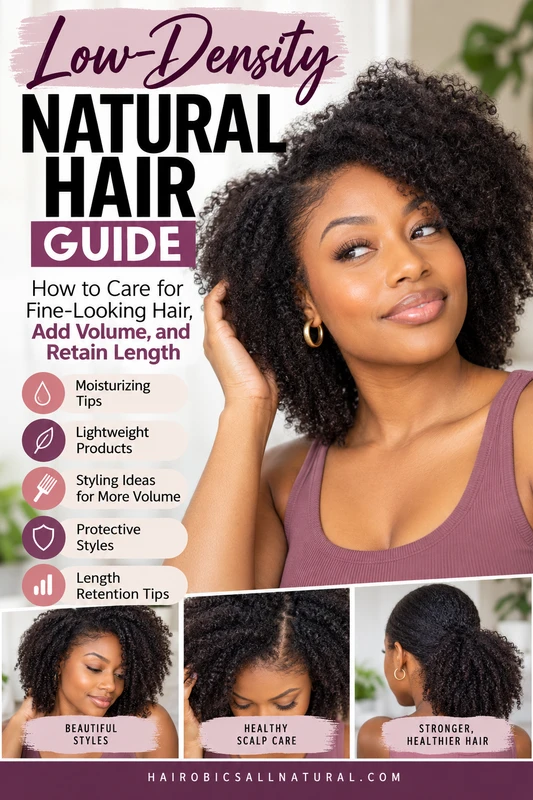
Low-density natural hair can be beautiful, healthy, soft, and full of movement. However, caring for hair with fewer strands per square inch often requires a different approach than caring for thick, high-density natural hair.
If your scalp is easily visible, your ponytail looks smaller than expected, or your twists never seem as full as the hairstyles you see online, you may have low-density natural hair.
Many women with natural hair struggle to understand why their curls appear flat, why certain products make their hair look thinner, or why protective styles don't always create the fullness they want.
The answer may have more to do with hair density than curl pattern.
Whether you have 3C curls, 4A coils, 4B natural hair, or tightly coiled 4C hair, understanding your density can help you develop a routine that supports moisture retention, reduces unnecessary breakage, and creates beautiful hairstyles.
In this complete low-density natural hair guide, you'll learn how to identify your hair density, choose lightweight products, prevent breakage, create more volume, and maintain healthy natural hair without weighing it down.
What Is Low-Density Natural Hair?
Hair density refers to the number of individual hair strands growing within a particular area of your scalp.
Low-density hair means fewer strands are present compared with medium-density or high-density hair.
This doesn't automatically mean your hair is damaged, unhealthy, or falling out.
Some people naturally have fewer hair follicles producing visible strands because of genetics.
Others may notice reduced density because of aging, hormonal changes, certain medical conditions, or hair loss.
Understanding the difference is important.
Someone with naturally low-density hair may have perfectly healthy follicles and strong strands.
Someone experiencing progressive thinning, however, may need a different approach that includes medical evaluation.
Low-Density Hair vs. Fine Hair
One of the biggest misunderstandings in natural hair care is assuming that low-density hair and fine hair are identical.
They aren't.
Hair density describes how many strands grow on your scalp.
Hair thickness describes the diameter of each individual strand.
You can have low-density hair with coarse strands, high-density hair with fine strands, or any combination in between.
For example, a woman with low-density 4C hair may have thick individual strands but fewer of them.
Another woman may have hundreds of very fine curls packed closely together, creating the appearance of fuller hair.
Understanding these differences helps you avoid choosing products based only on how someone else's hair looks.
For a deeper explanation, read our Hair Density vs. Hair Thickness Guide.
7 Signs You May Have Low-Density Natural Hair
Identifying your density can help you make better decisions about hairstyles, moisturizing products, and protective styling.
1. Your Scalp Is Easily Visible
One common characteristic of low-density natural hair is increased scalp visibility.
You may notice your scalp when your hair is loose, parted, stretched, or pulled into a ponytail.
However, scalp visibility alone isn't a definitive test. Lighting, curl pattern, hair color, and styling can influence how much scalp you see.
2. Your Ponytail Looks Small
If your ponytail has a relatively small circumference even when your hair is long, you may have fewer strands contributing to its overall fullness.
This can happen regardless of curl pattern.
3. Your Twists Look Thin
Two-strand twists may appear smaller or less substantial because fewer strands are gathered into each section.
Creating fewer, larger twists may produce a fuller appearance than making many tiny twists.
4. Heavy Products Flatten Your Hair
Thick creams, heavy butters, and excessive oils may cause your strands to clump together and lie closer to your scalp.
This can reduce visible volume.
5. Your Hair Has Limited Overall Fullness
Your natural hair may appear less voluminous even when it is healthy, moisturized, and properly styled.
6. Your Parts Look Wider
Your parts may naturally reveal more scalp than those of someone with higher-density hair.
However, a part that progressively widens can also indicate hair loss and should not automatically be dismissed as natural density.
7. Your Hair Looks Fuller When Fluffed
Separating curls, lifting the roots, or changing your part may dramatically improve your hair's appearance.
This happens because styling can change how your existing strands occupy space.
What Causes Low-Density Natural Hair?
Several factors can influence hair density.
Genetics
Genetics plays a major role in determining your natural follicle distribution.
Some people naturally have lower-density hair throughout their lives.
If your hair has always appeared less dense, genetics may be an important factor.
Aging
Hair characteristics can change as we age.
Some follicles produce finer strands, while others may stop producing visible hair.
This can gradually affect overall fullness.
Hormonal Changes
Hormonal shifts associated with pregnancy, postpartum recovery, menopause, thyroid conditions, and other health changes may influence hair shedding or density.
Traction From Tight Hairstyles
Repeated tension from tight braids, ponytails, extensions, and certain protective styles can damage hair follicles.
Over time, this may contribute to traction alopecia.
Scalp Conditions
Inflammation, certain scalp disorders, and some forms of alopecia may contribute to hair thinning.
If you experience sudden thinning, patchy hair loss, scalp pain, persistent itching, or progressive widening of your part, consult a dermatologist.
Important: Naturally low hair density is not the same thing as a medical hair-loss condition. Hair oils, moisturizers, and styling products cannot reliably create new follicles or reverse every cause of thinning.
How to Care for Low-Density Natural Hair
The best low-density natural hair routine focuses on maintaining healthy strands without overwhelming them.
You don't necessarily need dozens of products or complicated styling techniques.
Instead, concentrate on cleansing, conditioning, gentle detangling, and lightweight moisturizing.
1. Keep Your Scalp Clean
A clean scalp provides a comfortable environment for normal hair growth.
Excessive product buildup may leave hair looking flat, greasy, or separated into thin sections.
For many people, shampooing approximately once every 7–10 days is a useful starting point.
However, washing frequency should depend on your scalp, exercise habits, styling products, and personal needs.
If your scalp becomes oily or uncomfortable sooner, you may benefit from more frequent cleansing.
Choose a shampoo that removes buildup without leaving your hair excessively rough.
Concentrate cleansing on your scalp, allowing the shampoo to move through the lengths as you rinse.
Avoid aggressively scratching your scalp with your fingernails.
2. Use Lightweight Conditioners
Conditioning is important for reducing friction, improving manageability, and helping prevent unnecessary breakage.
However, using too much conditioner can leave certain low-density hairstyles looking flat.
Start with a modest amount and distribute it evenly.
Focus on the mid-lengths and ends, particularly if those areas become dry.
A lightweight rinse-out conditioner may provide enough softness without leaving a heavy coating.
3. Moisturize Without Overloading Your Hair
Low-density natural hair still needs moisture.
The goal is to maintain softness while preserving movement and volume.
Water-based leave-in conditioners, light moisturizing sprays, and small amounts of styling cream may work well.
Apply products gradually instead of saturating your hair with multiple layers.
If your curls look greasy, limp, or unusually separated, you may be using more product than necessary.
For additional guidance, explore our Complete Guide to Hair Porosity.
Porosity matters because low-density hair can also be low-, medium-, or high-porosity.
Your ideal moisturizing routine depends on both characteristics.
4. Avoid Excessive Heavy Oils
Natural oils can help lubricate strands and reduce friction, but they should be used according to your hair's needs.
Applying large amounts of castor oil, coconut oil, or thick oil blends may reduce volume for some people.
This doesn't mean these oils are automatically bad for low-density hair.
It means the amount and application method matter.
Try applying a few drops to your palms, rubbing your hands together, and lightly smoothing the oil over areas that need additional lubrication.
Avoid repeatedly layering oil onto hair that already feels coated.
5. Detangle Carefully
Low-density hair requires gentle handling, especially when the individual strands are fine.
Use a conditioner or detangling product that provides adequate slip.
Separate your hair into manageable sections.
Begin at the ends and gradually work toward the roots.
Use your fingers, a wide-tooth comb, or an appropriate detangling brush.
Avoid pulling aggressively through knots.
If you encounter a stubborn tangle, stop and carefully separate the strands.
Our Complete Guide to Detangling Natural Hair explains techniques for reducing tangles and unnecessary damage.
Best Moisturizing Routine for Low-Density Natural Hair
A good moisturizing routine should leave your hair soft, flexible, and manageable without making it look weighed down.
Step 1: Start With Clean Hair
Clean hair allows you to assess how your strands respond to moisture and styling products.
Remove excessive buildup before applying new layers of moisturizer.
Step 2: Apply a Lightweight Leave-In
Use a small amount of water-based leave-in conditioner.
Distribute it through your hair, paying attention to dry areas.
If you have fine strands, begin with less product than you think you'll need.
You can always add more.
Step 3: Add a Small Amount of Oil if Needed
Oil is optional.
If your hair benefits from additional lubrication, use a small amount on the ends.
Remember that oil does not replace water-based moisture.
Step 4: Style Without Excessive Tension
Choose a style that doesn't pull tightly at the roots.
Avoid stretching delicate hair with excessive force.
Step 5: Refresh Only When Necessary
You don't need to reapply every product daily.
If your hair still feels soft, leave it alone.
If it becomes dry, lightly mist it with water or apply a small amount of leave-in conditioner.
The objective is consistency, not excessive product use.
Best Hairstyles for Low-Density Natural Hair
Choosing the right hairstyle can make a noticeable difference in how full your hair appears.
The goal is to create shape, movement, and volume while avoiding unnecessary stress on your strands.
1. Twist-Outs
Twist-outs can be an excellent option for low-density natural hair.
Instead of making dozens of tiny twists, experiment with larger sections.
Allow your hair to dry completely before unraveling.
Separate each twist carefully to increase visible fullness.
Use a lightweight styling product that provides definition without leaving the hair stiff.
2. Braid-Outs
Braid-outs can create stretched texture and additional volume.
The resulting wave pattern may help strands occupy more space.
Avoid braiding too tightly at the roots.
Once dry, gently separate the sections and lift the roots.
3. Rounded Afros
A rounded afro can make low-density natural hair appear fuller by distributing volume evenly.
Use a pick carefully near the roots without aggressively combing through the ends.
A professional haircut can help create a balanced shape.
4. Layered Natural Haircuts
Strategic layers can add movement and improve the appearance of fullness.
However, excessive layering can make low-density ends appear thinner.
Ask your stylist to preserve enough weight around the perimeter.
5. Side-Part Hairstyles
Changing your part can make a surprising difference.
A deep side part shifts more hair toward one side, creating an asymmetrical, fuller appearance.
Experiment with different directions to find your most flattering shape.
6. Loose Flat Twists
Flat twists can create an attractive protective hairstyle when installed gently.
Avoid pulling tightly along the hairline.
Larger sections may help minimize visible gaps.
7. Defined Wash-and-Go Styles
Wash-and-go hairstyles can work beautifully on low-density curls and coils.
Choose styling products that provide hold without excessive weight.
After your hair dries, gently lift the roots to increase volume.
Avoid repeatedly disturbing curls that are already fragile or prone to frizz.
Protective Styles for Low-Density Natural Hair
Protective styling can reduce daily manipulation, but not every protective style is suitable for every hair density.
Low-density natural hair may be especially vulnerable to styles that concentrate too much weight or tension on relatively small sections.
Lightweight Knotless Braids
Knotless braids may be an option when they are installed loosely and sized appropriately.
However, adding too much extension hair can still create excessive tension.
Avoid very heavy or extremely long braids.
Mini Twists
Mini twists can reduce daily styling and make moisturizing easier.
However, very tiny sections may expose more scalp and increase manipulation during removal.
Choose a twist size that suits your density.
Loose Cornrows
Cornrows can be convenient, but they should never feel painful or excessively tight.
If your scalp becomes tender, develops bumps, or feels pulled, the style may be too tight.
Wigs With Gentle Installation
Wigs can provide styling flexibility without requiring daily heat.
However, tight wig bands, adhesives, and repeated friction around the hairline can contribute to damage.
Keep your underlying hair clean, conditioned, and protected.
Protective Styles to Approach Carefully
Be cautious with heavy extensions, extremely tight ponytails, small braids carrying large amounts of added hair, and styles that repeatedly pull on the temples.
A hairstyle is not truly protective if it causes ongoing tension or breakage.
How to Make Low-Density Natural Hair Look Thicker
You cannot change the number of naturally occurring hair follicles through styling alone.
However, you can make existing hair appear fuller.
Lift Your Roots
Root lifting is one of the simplest ways to improve volume.
Once your hair is completely dry, gently lift the roots using your fingers or a suitable hair pick.
Avoid dragging the tool through your ends.
Use Less Styling Product
Too much styling cream can cause curls to clump into fewer, heavier sections.
Using less product may allow the strands to move more freely.
Try Volumizing Mousse
A lightweight mousse may provide hold and structure without the weight of thick creams.
Look for a formula that suits your hair texture and desired style.
Experiment With Stretching
Braid-outs, twist-outs, banding, and gentle tension methods can reduce shrinkage and create a different silhouette.
Avoid excessive heat or pulling.
Choose a Flattering Haircut
A carefully shaped haircut can create the appearance of thicker hair.
Blunt or softly rounded ends may make the perimeter appear more substantial.
Change Your Part
Switching from a middle part to a side part can redistribute volume.
This is particularly useful when your hair naturally lies flatter in certain areas.
Avoid Over-Separating Curls
Separating curls creates volume, but excessive separation can increase frizz and disrupt definition.
Find a balance between fullness and curl structure.
Low-Density 4C Hair: Special Care Tips
Low-density 4C natural hair combines tightly coiled texture with fewer strands across the scalp.
Because 4C hair can experience substantial shrinkage, its appearance may change dramatically between stretched and unstretched styles.
Low density doesn't mean 4C hair cannot grow long.
Length retention depends heavily on minimizing breakage and maintaining manageable strands.
Prioritize Moisture
Use water-based products that help your hair feel soft and flexible.
Avoid assuming that thick creams are always necessary simply because your hair is 4C.
Some low-density 4C hair responds better to lighter products.
Reduce Unnecessary Manipulation
Repeated combing, brushing, twisting, and restyling can increase wear on fragile strands.
Choose hairstyles that remain manageable for several days.
Protect Your Ends
The ends are the oldest portions of your hair.
Keep them conditioned and minimize friction against clothing.
Trim when necessary to remove damaged ends.
Avoid Tight Protective Styles
Tightly coiled hair is not immune to traction damage.
Choose comfortable hairstyles that don't place excessive stress on the hairline.
Embrace Your Natural Shape
A defined twist-out, softly rounded afro, or carefully shaped tapered cut can highlight the beauty of low-density 4C hair.
You don't need extremely thick hair to create a beautiful natural hairstyle.
Low-Density Hair and Hair Growth
Many people with low-density natural hair wonder whether they can grow longer hair.
The answer is yes.
Hair density and hair length are different characteristics.
Having fewer strands does not automatically prevent your hair from growing.
Hair grows from follicles in the scalp.
The visible length you maintain depends partly on how much of that growth you retain.
If your hair breaks as quickly as it grows, you may struggle to see length progress.
That's why protecting your ends is so important.
Focus on Length Retention
Instead of constantly searching for products that promise rapid hair growth, concentrate on reducing avoidable damage.
Helpful habits include gentle detangling, regular conditioning, minimizing tight hairstyles, reducing excessive heat, and protecting your hair at night.
Support Your Overall Health
Adequate nutrition and addressing any underlying health concerns can support normal hair growth.
If you suspect a nutritional deficiency, seek appropriate medical guidance rather than taking high-dose supplements without testing.
Understand What Hair Products Can Do
Shampoos, conditioners, moisturizers, and oils can improve manageability and help reduce certain forms of hair breakage.
They cannot guarantee increased follicle density or treat every medical cause of hair loss.
If your density is decreasing, identifying the cause is more important than adding more products.
Common Mistakes to Avoid With Low-Density Natural Hair
Mistake 1: Using Too Much Product
Applying several heavy products can make hair look flat and greasy.
Start with small amounts.
Mistake 2: Copying High-Density Hair Routines
A routine designed for someone with very thick hair may involve more product and more sectioning than you need.
Customize your routine.
Mistake 3: Wearing Heavy Extensions
Heavy braids and extensions can place unnecessary stress on follicles.
Choose lightweight styles.
Mistake 4: Excessive Heat Styling
Repeated high-temperature styling can weaken strands and contribute to breakage.
Use appropriate heat protection and limit unnecessary heat exposure.
Mistake 5: Ignoring Your Scalp
Scalp discomfort, inflammation, or unexplained thinning should not be ignored.
Seek professional advice when symptoms persist.
Mistake 6: Detangling Aggressively
Forceful detangling can cause breakage.
Use slip, patience, and gentle techniques.
Mistake 7: Confusing Low Density With Hair Loss
If your hair has always been low density, it may simply be your natural characteristic.
If your density is progressively decreasing, investigate the cause.
Weekly Low-Density Natural Hair Routine
Creating a consistent routine can simplify your hair care journey.
Wash Day
Begin by gently separating your hair into manageable sections.
Cleanse your scalp with shampoo.
Apply conditioner and carefully detangle.
Rinse thoroughly.
Follow with a lightweight leave-in conditioner.
Style your hair using a small amount of mousse, cream, or another suitable styling product.
Allow your hair to dry completely.
Midweek Maintenance
Assess your hair before adding moisture.
If it still feels soft, avoid unnecessary product application.
If your ends feel dry, apply a light mist or small amount of leave-in conditioner.
Gently reshape your hairstyle if necessary.
Nighttime Protection
Sleep on a satin or silk pillowcase or use a comfortable bonnet.
Avoid tight nighttime ponytails.
Keep your hair loosely gathered if necessary.
Monthly Assessment
Check your ends for persistent tangling, splits, or breakage.
Evaluate whether your products are creating buildup.
Notice whether your hair density appears stable.
Consider taking photographs under consistent lighting if you're monitoring changes.
For a broader approach to maintaining healthy natural hair, read our Complete Natural Hair Care Guide.
Frequently Asked Questions About Low-Density Natural Hair
Can low-density natural hair grow long?
Yes. Low-density hair can grow long because density and length are separate characteristics. Gentle care, conditioning, and reduced breakage can help preserve length.
Is low-density natural hair unhealthy?
No. Naturally low-density hair can be completely healthy. However, new or progressive thinning may indicate an underlying condition.
What is the best moisturizer for low-density natural hair?
A lightweight water-based leave-in conditioner or moisturizing spray is often a good starting point. The best formula also depends on porosity, strand thickness, and dryness.
Should low-density natural hair use oils?
Yes, if oils benefit your hair. Apply small amounts and avoid excessive buildup. Oil is optional and does not replace water-based moisture.
Are braids good for low-density hair?
Braids can work when they are lightweight, comfortable, and installed without excessive tension. Heavy extensions and tight braids can increase the risk of damage.
How often should I wash low-density natural hair?
Many people can begin with a weekly routine and adjust based on scalp condition, buildup, activity, and styling habits.
Can low-density 4C hair look full?
Yes. Twist-outs, braid-outs, rounded haircuts, strategic parts, and gentle root lifting can improve the appearance of volume.
Does castor oil increase hair density?
There is insufficient reliable clinical evidence that applying castor oil increases the number of hair follicles or reverses hair loss. It may help lubricate strands, but it is not a proven treatment for thinning.
Does low-density hair need protein treatments?
Not automatically. Protein-containing products may help some damaged hair, but density alone does not determine whether a protein treatment is needed.
Can low-density hair become high-density hair?
Natural follicle density is largely determined by biology. Some forms of acquired hair thinning can improve when the underlying cause is treated, but styling products cannot simply turn naturally low-density hair into high-density hair.
Final Thoughts: Healthy Low-Density Natural Hair Can Be Beautiful
Low-density natural hair deserves a routine designed around its unique characteristics.
You don't have to use heavy products, complicated methods, or tight protective styles to maintain beautiful curls and coils.
Instead, focus on lightweight moisture, gentle detangling, comfortable hairstyles, scalp care, and consistent length-retention habits.
Remember that having fewer strands does not make your natural hair less beautiful or less healthy.
The goal is not to force your hair to behave like someone else's.
The goal is to understand your density, protect your strands, and create a routine that helps your natural hair look and feel its best.
Explore Hairobics All Natural
At Hairobics All Natural, we believe healthy natural hair care begins with understanding what your hair needs.
Explore our natural hair care resources and products to build a simple routine focused on moisture, manageability, and protecting your beautiful curls and coils.