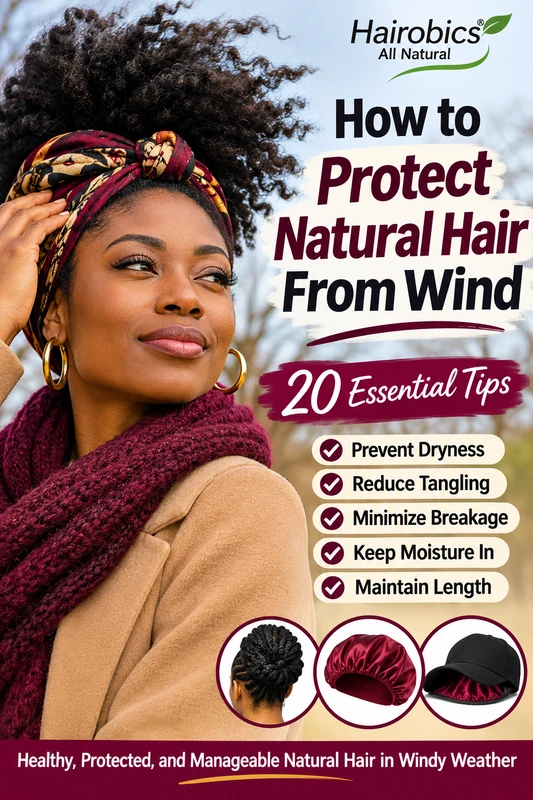
Windy weather can create unexpected challenges for natural hair. You may leave your home with beautifully moisturized, defined curls and return with tangled ends, excessive frizz, dryness, and a hairstyle that looks completely different.
For women with 3C, 4A, 4B, and 4C natural hair, strong winds can make maintaining moisture, protecting fragile strands, and retaining length more challenging.
Although wind does not automatically cause permanent hair damage, repeated exposure combined with dryness, friction, and excessive manipulation can contribute to unnecessary breakage.
Whether you live in a windy city, enjoy outdoor activities, commute regularly, or experience seasonal weather changes, learning how to protect natural hair from wind can make a meaningful difference in your hair care routine.
Fortunately, you do not have to avoid spending time outdoors or completely abandon your favorite natural hairstyles.
With appropriate conditioning products, protective hairstyles, smooth accessories, and gentle maintenance techniques, you can reduce wind-related tangling while maintaining softer, more manageable hair.
In this complete guide, we will explore 20 effective ways to protect natural hair from wind, reduce moisture loss, prevent unnecessary breakage, and support healthy length retention.
Why Does Wind Affect Natural Hair?
Natural hair has a unique structure that makes it particularly susceptible to tangling when exposed to constant movement.
Unlike straight hair, curly and coily strands naturally bend, spiral, and wrap around neighboring strands.
When strong winds repeatedly move these strands in different directions, they may become intertwined.
Wind exposure can contribute to:
-
Increased tangling
-
Frizz and flyaways
-
Single-strand knots
-
Reduced hairstyle definition
-
Dry-feeling ends
-
Increased friction
-
Difficulty detangling
-
Breakage during styling
-
Poor length retention
The effects may become more noticeable when windy conditions are accompanied by low humidity, cold temperatures, or prolonged sunlight.
Understanding how weather affects natural hair can help you develop a flexible hair care routine that works throughout the year.
1. Moisturize Natural Hair Before Going Outside
One of the most important steps in protecting natural hair from wind is maintaining adequate conditioning and moisture.
Hair that already feels rough or brittle may be more difficult to manage after prolonged wind exposure.
Before spending time outdoors, check the condition of your strands, especially the ends.
If your hair feels dry, consider refreshing it with an appropriate leave-in conditioning product.
A simple moisturizing routine may include:
-
Lightly dampening your hair when necessary.
-
Applying a suitable leave-in treatment.
-
Distributing the product evenly.
-
Paying additional attention to fragile ends.
-
Applying a lightweight sealing product if your hair benefits from it.
Avoid heavily saturating your hair immediately before going outdoors.
Excessive moisture may cause unwanted shrinkage or disrupt your hairstyle, particularly when you have tightly coiled natural hair.
The goal is to improve softness and manageability without creating unnecessary buildup.
2. Use a Leave-In Treatment
A suitable leave-in treatment can be a valuable addition to your windy-weather hair care routine.
Unlike rinse-out conditioners, leave-in products remain on the hair or scalp after application, depending on their intended use.
They can help maintain manageability between wash days and complement your regular conditioning routine.
The Hairobics All Natural Leave-In Treatment contains botanical ingredients, natural oils, and aloe vera as part of its hair and scalp conditioning formula.
It can be incorporated into your regular hair care routine according to the product directions.
Always test new products on a small area first, especially if you have a sensitive scalp.
Remember that a leave-in treatment works best as part of a complete routine that includes regular cleansing, conditioning, and gentle styling.
No single product can completely prevent wind-related damage.
3. Wear Protective Hairstyles on Windy Days
Protective hairstyles are among the most practical ways to reduce excessive strand movement during windy weather.
Instead of allowing individual curls to move freely, protective styles help keep your hair organized.
Some excellent options include:
-
Two-strand twists
-
Flat twists
-
Cornrows
-
Loose braids
-
Low-tension buns
-
Tucked updos
-
Bantu knots
-
Halo braids
These hairstyles can reduce tangling while limiting contact between fragile ends and clothing.
However, protective hairstyles should never cause pain, headaches, scalp tenderness, or excessive pulling around the hairline.
A hairstyle that is too tight may contribute to breakage or traction-related hair loss.
For additional styling ideas, explore our complete guide to protective styles.
You do not need an elaborate hairstyle every time you leave home. A few comfortable twists or a loosely secured updo may provide sufficient protection during everyday activities.
4. Keep Your Natural Hair Ends Tucked Away
The ends of your hair are the oldest portions of your strands.
They have experienced more washing, styling, environmental exposure, and manipulation than the newer hair growing near your scalp.
Consequently, they often require additional protection.
When exposed ends constantly move in the wind, they may rub against neighboring strands, clothing, and accessories.
Over time, this friction may contribute to:
-
Split ends
-
Single-strand knots
-
Rough texture
-
Increased tangling
-
Breakage
-
Uneven length
Consider hairstyles that allow you to tuck away your ends without creating excessive tension.
Even wearing a protective updo a few days each week may reduce opportunities for unnecessary damage.
Learn more about how to protect your natural hair ends and develop healthier length retention habits.
5. Use a Satin or Silk-Lined Hat
Hats can provide an effective physical barrier between your natural hair and strong winds.
However, the material touching your hair matters.
Some rough hat linings can create friction, particularly around the edges, crown, and nape.
Repeated rubbing may contribute to tangling and breakage in vulnerable areas.
Consider wearing:
-
Satin-lined baseball caps
-
Silk-lined winter hats
-
Satin-lined beanies
-
Smooth fabric head coverings
-
Satin-lined bucket hats
Choose a hat that fits comfortably without compressing your hair excessively.
If you already own a hat with a rough interior, consider wearing a smooth scarf underneath it.
This simple adjustment can reduce direct contact between your natural hair and abrasive materials.
Make sure your hair and scalp are reasonably dry before covering them for extended periods.
6. Wear a Secure Satin or Silk Scarf
A scarf can protect natural hair when you expect to spend considerable time outdoors.
Scarves are especially useful when walking in windy areas, traveling, visiting the beach, or protecting a recently completed hairstyle.
For best results, organize your hair into a comfortable style before applying the scarf.
Choose a smooth fabric and secure it firmly enough to remain in place without pulling on your edges.
Avoid tying the scarf too tightly around your forehead or nape.
If you frequently wear scarves, wash them regularly to remove accumulated oils, sweat, and styling products.
A clean, smooth head covering can complement your existing hair care routine and help preserve your hairstyle.
7. Avoid Wearing Loose Hair During Extremely Windy Weather
Wearing your natural hair loose is a beautiful way to celebrate your curls, coils, and texture.
However, extremely windy conditions may make loose hairstyles more difficult to maintain.
Afros, wash-and-go styles, twist-outs, and braid-outs can experience considerable movement during strong winds.
The longer your hair is, the more opportunities it may have to become wrapped around neighboring strands or caught against clothing.
You do not have to stop wearing loose hairstyles altogether.
Instead, adjust your styling choices according to the weather.
On particularly windy days, consider keeping your twists or braids installed until you arrive at your destination.
Once indoors, you can gently release them if desired.
This approach allows you to enjoy your favorite hairstyles while reducing unnecessary exposure.
8. Apply an Appropriate Oil-Based Conditioning Product
Some natural hair textures benefit from adding a small amount of an oil-based product after moisturizing.
Oils and oil-based formulations may help lubricate strands, improve softness, and reduce friction.
However, oils do not directly add water to your hair.
They should complement an effective moisturizing and conditioning routine rather than replace it.
The Hairobics Hair & Scalp Booster contains a blend of botanical oils, including coconut oil, jojoba oil, olive oil, almond oil, and rosemary oil.
It is designed to complement a regular hair and scalp conditioning routine.
Apply according to the product directions and begin with a small amount.
Avoid assuming that more oil automatically provides greater protection.
Excessive product buildup can attract dust, leave hair feeling coated, and make cleansing more difficult.
9. Protect Natural Hair From Wind and Dry Air Together
Wind becomes particularly challenging when combined with low humidity.
Dry surrounding air can influence the moisture balance of the hair fiber, while moving air may increase evaporation from damp hair.
This combination may leave some natural hair textures feeling rougher and less manageable.
People living in desert regions or areas with dry seasonal winds may notice that their usual moisturizing routine is no longer sufficient.
Consider adjusting your routine by:
-
Conditioning thoroughly on wash day.
-
Refreshing your hair when necessary.
-
Wearing protective hairstyles more frequently.
-
Reducing unnecessary heat styling.
-
Protecting hair with smooth accessories.
-
Checking your ends regularly.
For additional environmental hair care advice, read our guide to natural hair care in dry climates.
Your hair care routine should respond to your environment rather than remain identical throughout every season.
10. Deep Condition Natural Hair Regularly
Deep conditioning can help improve softness and manageability, especially when your hair experiences frequent environmental exposure.
A suitable deep conditioner may temporarily improve the feel of rough strands and make detangling easier.
Consider deep conditioning weekly or as needed, depending on your hair's condition and the product instructions.
Pay attention to areas that frequently feel dry, such as the crown, nape, and ends.
Allow the conditioner to remain on your hair for the recommended amount of time.
Leaving a product on longer than instructed does not necessarily provide better results.
Consistent conditioning is generally more useful than occasional intensive treatments followed by weeks of neglect.
Remember that conditioners cannot permanently repair split or broken hair fibers, but they can help improve manageability and reduce further unnecessary damage.
11. Prevent Wind-Related Fairy Knots
Fairy knots, also known as single-strand knots, develop when individual strands loop around themselves.
They are particularly common in tightly curled and coily natural hair.
Wind-related movement can create additional opportunities for strands to twist, wrap, and become tangled.
When fairy knots become frequent, they may interfere with detangling and contribute to breakage.
You can reduce excessive knotting by keeping your ends conditioned, minimizing friction, wearing protective hairstyles, and addressing damaged ends when necessary.
Never aggressively pull a knot apart.
If a tightly formed knot cannot be removed safely, carefully trimming the affected strand with appropriate hair-cutting scissors may be preferable to repeatedly pulling on it.
Read our detailed guide on how to reduce fairy knots in natural hair without losing length for additional prevention techniques.
12. Detangle Gently After Wind Exposure
One of the biggest mistakes people make after spending time outdoors is immediately brushing through tangled natural hair.
Forcefully removing wind-created tangles can place considerable stress on individual strands.
Instead, begin by examining your hair and identifying the areas that require attention.
Separate your hair into manageable sections.
Apply a suitable conditioner or detangling product that provides adequate slip.
Use your fingers to loosen larger tangles before introducing a wide-tooth comb or appropriate detangling brush.
Start near the ends and gradually work toward the roots.
If you encounter resistance, stop and gently separate the affected strands.
Avoid repeatedly pulling a tool through the same knot.
For more step-by-step instructions, explore our complete guide to detangling natural hair without breakage or pain.
Gentle detangling is essential for preventing temporary weather-related tangles from becoming permanent hair damage.
13. Protect Your Hairline and Edges
The hairline is often exposed to wind, hats, scarves, and repeated styling.
For people with fine or fragile edges, this combination may increase the risk of unnecessary breakage.
Avoid repeatedly brushing your edges throughout the day simply because the wind has disturbed your hairstyle.
Instead, accept that occasional flyaways and frizz are normal.
Choose accessories that do not rub excessively against your temples.
Avoid tight ponytails, heavy extensions, and tightly secured scarves.
When applying conditioning products around your hairline, use gentle movements rather than aggressive rubbing.
If you experience persistent thinning, bald patches, or scalp discomfort, consult a dermatologist to identify the underlying cause.
Protecting your edges should always take priority over maintaining a perfectly smooth hairstyle.
14. Protect Natural Hair From Clothing Friction
Wind can cause natural hair to repeatedly move against jackets, sweaters, collars, and scarves.
This may become especially noticeable when your hair reaches shoulder length.
Rough clothing materials can catch individual strands and contribute to tangling around the nape and ends.
During windy weather, consider wearing hairstyles that keep your ends above your shoulders.
A loosely secured bun, flat twists, or tucked hairstyle can help reduce contact with clothing.
Smooth scarves may also provide a barrier between your natural hair and rough fabrics.
Be particularly careful when putting on or removing jackets with zippers, buttons, or Velcro fasteners.
These accessories can easily catch loose strands.
Small adjustments to your clothing and hairstyle choices can help reduce repeated mechanical stress.
15. Choose Hairstyles That Work With Your Hair Length
The best windy-weather hairstyle depends partly on your natural hair length.
Short natural hair may benefit from a comfortable head covering, gentle curl shaping, or small twists.
Medium-length natural hair can often be organized into flat twists, loose braids, or protective updos.
Long natural hair may benefit from loosely secured buns, tucked braids, or other hairstyles that limit excessive movement.
Avoid forcing your hair into styles that require uncomfortable stretching or excessive tension.
If your hair is too short for a bun, consider twists or a satin-lined hat instead.
Your hairstyle should accommodate your natural texture and length rather than work against them.
16. Protect Braids and Locs During Windy Weather
Braids and locs already help keep many individual strands organized.
However, they can still experience environmental exposure, friction, and dryness.
Long braids may repeatedly strike clothing or become caught on accessories.
Loose locs may rub against neighboring locs, scarves, or jackets.
During particularly windy conditions, consider loosely securing your braids or locs.
Avoid creating heavy updos that pull on the roots.
Keep your scalp clean and maintain an appropriate moisturizing routine.
Covering your style with a smooth head covering may also reduce exposure to dust and debris.
Avoid excessively layering oils and heavy styling products, which may contribute to buildup.
If your braids or locs become damp from rain or mist, allow them to dry thoroughly before covering them for extended periods.
Protective styles still require regular maintenance.
17. Reduce Excessive Manipulation During Windy Days
It can be tempting to constantly fix your hair when windy weather creates frizz or changes the appearance of your hairstyle.
However, repeatedly brushing, combing, pulling, and rearranging your curls can create more stress than the wind itself.
Instead of attempting to maintain perfect definition throughout the day, focus on preserving the overall condition of your hair.
Carry a comfortable hair tie or scarf so you can temporarily secure loose strands if necessary.
Use your fingers for minor adjustments rather than repeatedly introducing styling tools.
Avoid adding multiple layers of gel, oil, or holding spray every time your hairstyle changes.
Learning to accept some natural frizz can reduce unnecessary manipulation and support healthier hair care habits.
18. Protect Your Hair While Driving or Exercising Outdoors
Certain activities expose natural hair to particularly strong or continuous airflow.
These may include driving with the windows down, cycling, running, walking along the beach, or riding in a convertible.
Before beginning these activities, consider securing your hair in a comfortable style.
Use a smooth head covering when appropriate and ensure that it does not interfere with required safety equipment, such as a bicycle helmet.
After exercising, check your scalp for accumulated sweat and assess whether your hair needs refreshing or cleansing.
Do not aggressively brush through tangled or sweat-dampened strands.
Preparing your hair before outdoor activities is generally easier than correcting extensive tangling afterward.
19. Maintain a Consistent Nighttime Hair Routine
Protecting your natural hair does not end when you return indoors.
After spending time in windy conditions, your hair may contain loose tangles that become more difficult to manage overnight.
Before going to bed, gently inspect your strands.
Separate minor tangles when necessary and refresh dry areas with an appropriate conditioning product.
Organize your hair into loose twists, braids, or another comfortable nighttime style.
Sleep with a satin bonnet, silk scarf, or smooth pillowcase.
Avoid tight nighttime hairstyles that pull on your scalp.
Protecting your hair overnight can reduce additional friction and make your morning routine easier.
20. Check Your Natural Hair for Signs of Damage
Regularly examining your hair can help you identify problems before they become more difficult to manage.
Possible signs of excessive mechanical damage include:
-
Increasing numbers of short broken hairs
-
Rough or uneven ends
-
Frequent single-strand knots
-
Visible split ends
-
Excessive snagging during detangling
-
Hair that breaks during gentle handling
Frizz alone does not necessarily indicate damage.
Natural hair can remain healthy even when it does not look perfectly smooth or defined.
If your hair continues breaking despite gentle care, consider whether heat styling, chemical treatments, nutritional issues, or an underlying hair or scalp condition may be contributing.
Seek professional evaluation for persistent or unexplained hair loss.
Best Windy-Weather Hair Care Routine for 4C Hair
Because 4C natural hair has a tightly coiled structure, it may experience significant shrinkage and tangling when worn loose.
A practical windy-weather routine should focus on moisture, organization, and gentle handling.
Morning Routine
Check whether your hair requires additional conditioning.
Lightly refresh dry areas when necessary.
Keep your hair organized in twists, braids, or a comfortable protective hairstyle.
Wear a satin-lined hat or scarf if you expect prolonged exposure to strong winds.
Evening Routine
Remove your head covering gently.
Inspect the ends and areas that may have rubbed against clothing.
Use an appropriate conditioning product if detangling is necessary.
Organize your hair before sleeping and protect it with smooth nighttime accessories.
Weekly Routine
Cleanse your scalp and hair as needed.
Condition thoroughly and detangle in manageable sections.
Inspect your ends for split strands and excessive knotting.
Choose hairstyles that reduce daily manipulation.
Consistency is more important than applying numerous products or following an unnecessarily complicated routine.
Common Windy-Weather Hair Care Mistakes
Even with a good natural hair routine, certain habits can increase the likelihood of tangling and breakage.
Avoid these common mistakes:
-
Brushing through dry, tangled hair.
-
Wearing excessively tight protective hairstyles.
-
Applying large amounts of oil without proper conditioning.
-
Constantly restyling wind-created frizz.
-
Wearing rough hats without protective linings.
-
Ignoring damaged ends.
-
Leaving long hair loose during prolonged exposure to strong winds.
-
Covering damp hair for extended periods.
-
Neglecting nighttime protection.
-
Assuming every weather-related change indicates permanent damage.
Correcting these habits can help make your natural hair more manageable throughout changing weather conditions.
Frequently Asked Questions About Protecting Natural Hair From Wind
Can wind permanently damage natural hair?
Occasional wind exposure does not necessarily cause permanent damage. However, repeated friction, severe tangling, and aggressive detangling may contribute to mechanical damage and breakage over time.
Does wind dry out 4C hair?
Wind may accelerate evaporation from damp hair. When combined with low humidity, it can contribute to dry-feeling strands and reduced manageability.
What is the best hairstyle for windy weather?
Loose twists, braids, flat twists, low-tension buns, and tucked updos are practical choices because they reduce uncontrolled strand movement.
Should I oil my hair before going outside?
A small amount of an appropriate oil-based conditioning product may help reduce friction. However, oil should complement proper moisturizing and conditioning rather than replace them.
Does wearing a hat prevent wind damage?
A comfortable hat can reduce direct wind exposure. Satin-lined hats are particularly useful for minimizing friction between the hat and your natural hair.
Can wind cause hair loss?
Ordinary wind exposure is unlikely to cause hair loss directly from the follicles. However, tangling and rough manipulation may contribute to hair shaft breakage.
Why does my natural hair become frizzy in the wind?
Wind disrupts the arrangement of individual curls and moves strands away from their original pattern. Humidity and existing hair condition may also influence frizz.
Should I wash my hair after a windy day?
Not necessarily. Wash your hair according to your usual cleansing needs. If substantial dust, sand, sweat, or debris has accumulated, cleansing may be appropriate.
Is a satin scarf better than a cotton scarf?
Satin generally provides a smoother surface than many cotton fabrics, which can help reduce friction and snagging.
Can protective hairstyles improve length retention?
Properly maintained, low-tension protective hairstyles may reduce manipulation and breakage, helping you retain more of the hair you naturally grow.
Final Thoughts: Protecting Natural Hair From Wind
Learning how to protect natural hair from wind is an important part of maintaining healthy hair throughout the year.
Strong winds can increase tangling, interfere with hairstyle definition, and create additional friction. When combined with dryness or aggressive grooming, these effects may contribute to unnecessary breakage.
Fortunately, protecting your hair does not require an expensive or complicated routine.
Focus on appropriate conditioning, gentle detangling, comfortable protective hairstyles, smooth accessories, and consistent nighttime care.
Pay particular attention to your fragile ends and avoid unnecessary tension around your hairline.
Remember that growing longer natural hair is not simply about encouraging new growth. It is also about protecting and retaining the length you already have.
At Hairobics All Natural, we believe that healthy hair care begins with consistency, patience, and understanding your natural texture.
Give your curls, coils, and textured hair the care they deserve, regardless of the weather.
Explore our natural hair and scalp conditioning products at HairobicsAllNatural.com and build a hair care routine that supports softer, more manageable natural hair throughout every season.