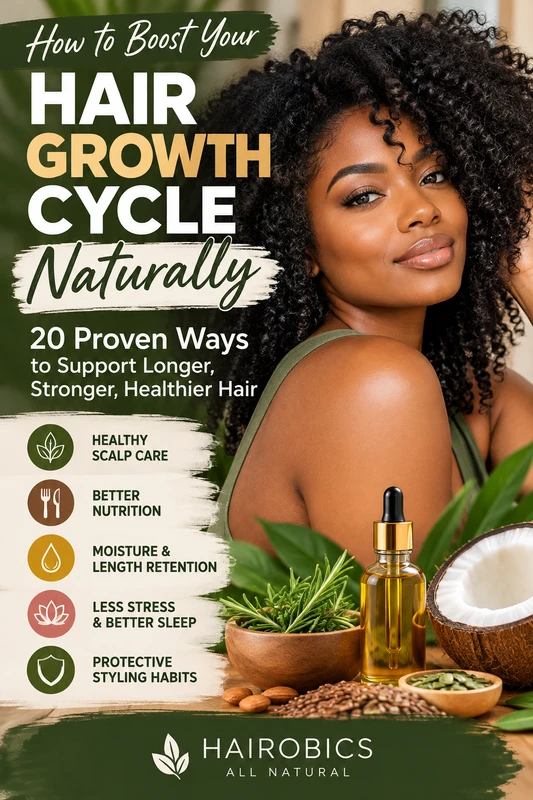
Growing longer, stronger, healthier hair is a goal shared by millions of people. Whether you have tightly coiled 4C hair, loose natural curls, relaxed hair, braids, twists, or locs, understanding how your hair grows can make a major difference in your hair care journey.
Perhaps you have noticed that your hair grows quickly for several months before appearing to stop. Maybe your edges are thinning, your crown looks less full, or your hair keeps breaking before reaching your desired length.
These experiences can be frustrating, especially when you are consistently moisturizing, conditioning, and protecting your hair.
However, healthy hair growth is more complicated than simply applying oil or using a hair growth product.
Your hair follows a natural biological growth cycle influenced by genetics, nutrition, hormones, overall health, and the condition of your scalp.
While you cannot completely control this cycle, you can develop habits that support healthy follicle function, address factors that contribute to excessive shedding, and protect your existing hair from unnecessary breakage.
For people with natural Black hair, understanding the difference between actual hair growth and length retention is especially important.
Tightly coiled hair can experience significant shrinkage, tangling, and friction. This means your hair may be growing normally even when it does not appear to be getting longer.
In this comprehensive guide, we will explore 20 practical ways to support your hair growth cycle naturally, improve scalp care, reduce breakage, and create a routine that encourages healthier-looking hair over time.
Understanding the Natural Hair Growth Cycle
Before discussing how to improve your hair care routine, it helps to understand what happens beneath your scalp.
Every hair strand begins inside a tiny structure called a hair follicle.
Hair follicles contain living cells responsible for producing the hair shaft. As these cells multiply and form keratin, the hair grows outward through the scalp.
However, hair follicles do not produce hair continuously without interruption.
Instead, they move through a repeating series of growth, transition, resting, and shedding stages.
These stages collectively form the hair growth cycle.
Stage 1: Anagen — The Active Growth Phase
Anagen is the stage during which your hair actively grows.
During this phase, cells inside the follicle divide and produce the hair shaft.
For many people, the scalp hair growth phase lasts approximately two to seven years, although individual variation is considerable.
The longer a follicle remains in its growth phase, the greater the potential length of the hair it produces.
Most scalp hairs are normally in anagen at any given time.
On average, scalp hair grows approximately half an inch per month, although growth rates differ between individuals.
This means that someone who retains most of their new growth may gain approximately six inches of hair length in a year.
However, actual visible progress depends on how much hair breaks off along the way.
Stage 2: Catagen — The Transition Phase
Catagen is a short transitional period that generally lasts approximately two to three weeks.
During this stage, active hair production stops and the lower portion of the follicle changes structure.
Only a small percentage of scalp follicles are typically in catagen at one time.
This is a normal part of hair biology and does not automatically indicate a scalp problem.
Stage 3: Telogen — The Resting Phase
During telogen, the follicle rests before beginning another growth cycle.
This phase commonly lasts several months.
The existing hair remains in place for part of this period while the follicle prepares for renewed activity.
Certain health conditions, major stressors, illness, or nutritional deficiencies can cause more follicles than usual to enter the resting phase.
This may contribute to excessive shedding several months later.
Stage 4: Exogen — The Shedding Phase
Exogen describes the release of a hair strand from the follicle.
Shedding is a normal biological process.
Many people naturally shed approximately 50 to 100 hairs daily, although the number varies.
People who wear braids, twists, or other styles for several weeks may notice a larger collection of shed hairs when taking down the hairstyle.
This does not necessarily mean all those hairs fell out at once.
They may simply have accumulated while the hair was styled.
For a more detailed explanation of these biological stages, read our Complete Black Hair Growth Cycle Explained.
Can You Really Boost Your Hair Growth Cycle Naturally?
The phrase "boost your hair growth cycle" is commonly used in the natural hair community.
However, it is important to understand what this actually means.
There is no proven home remedy that reliably forces every follicle to remain in the growth phase longer or dramatically accelerates hair growth beyond its biological potential.
What you can do is create conditions that support normal hair growth.
These include maintaining adequate nutrition, treating scalp conditions, reducing unnecessary tension, avoiding excessive heat, and addressing medical issues that may contribute to hair loss.
You can also improve length retention by protecting the hair that has already grown.
This distinction matters because hair growth and hair length are not exactly the same thing.
Hair growth happens inside the follicle. Length retention depends on how well you preserve the hair shaft after it emerges.
A successful natural hair routine should support both.
1. Build a Consistent Scalp Care Routine
Your scalp is the foundation of your hair care routine.
Healthy follicles exist within living scalp tissue, making scalp health an important part of maintaining normal hair growth.
When your scalp becomes irritated, inflamed, or affected by an untreated skin condition, your hair may suffer.
Common scalp concerns include dandruff, seborrheic dermatitis, excessive itching, dryness, and product accumulation.
Although ordinary product buildup does not automatically stop follicles from growing, it can make the scalp uncomfortable and complicate proper cleansing.
A healthy scalp routine should include regular washing, gentle handling, and products suited to your scalp's needs.
How to Maintain a Healthier Scalp
-
Cleanse your scalp regularly according to oiliness, sweat, styling habits, and buildup.
-
Avoid scratching your scalp with fingernails.
-
Rinse shampoo thoroughly.
-
Use conditioning products without excessively coating the scalp.
-
Avoid tight hairstyles that cause pain or tenderness.
-
Seek treatment for persistent itching, redness, scaling, or inflammation.
Some people prefer washing weekly, while others need more frequent cleansing.
There is no single shampoo schedule that works for everyone.
The goal is to keep the scalp comfortable and clean without unnecessarily drying the hair.
For additional guidance, explore our Best Scalp Care Routine for Natural Hair Growth.
2. Eat Enough Protein to Support Hair Production
Hair is primarily composed of a protein called keratin.
Your body needs amino acids from dietary protein to produce and maintain normal hair structures.
When protein intake becomes inadequate, hair growth and shedding patterns may be affected.
This is particularly important for people following restrictive diets or experiencing significant weight loss.
Protein-Rich Foods for Healthy Hair
Consider incorporating foods such as:
-
Eggs
-
Salmon
-
Chicken
-
Turkey
-
Greek yogurt
-
Lentils
-
Black beans
-
Tofu
-
Nuts and seeds
Protein requirements vary based on body size, age, activity level, and health conditions.
Rather than consuming excessive protein in hopes of accelerating growth, focus on meeting your nutritional needs consistently.
A balanced diet supports overall health, including normal hair production.
3. Pay Attention to Iron, Zinc, and Vitamin D
Certain nutrient deficiencies are associated with hair shedding and other hair concerns.
Iron is particularly important because iron deficiency can contribute to hair loss in some individuals.
Zinc and vitamin D are also involved in normal biological processes relevant to hair follicle function.
However, taking extra vitamins when you are not deficient does not necessarily improve hair growth.
In some cases, excessive supplementation can cause harm.
Foods That Provide Important Nutrients
Iron: Lean meats, lentils, beans, spinach, and fortified cereals.
Zinc: Seafood, pumpkin seeds, meat, chickpeas, and dairy products.
Vitamin D: Fatty fish, fortified foods, and other dietary sources.
Vitamin C: Citrus fruits, strawberries, bell peppers, and broccoli.
Vitamin C can help the body absorb iron from plant-based foods.
If you experience unexplained shedding, fatigue, or significant thinning, a healthcare professional can determine whether nutritional testing is appropriate.
Avoid taking high-dose supplements without a clear reason.
4. Stay Properly Hydrated
Water is essential for normal cellular function throughout your body.
Your hair follicles, like other living tissues, depend on adequate hydration and circulation.
However, drinking excessive water does not make hair grow faster.
It is also important to distinguish between hydration inside the body and moisture in the hair shaft.
Drinking water supports general health, while conditioners and moisturizing products help manage the feel and flexibility of existing hair.
Healthy Hydration Habits
Drink fluids regularly throughout the day.
Increase fluid intake when necessary because of heat, exercise, or other circumstances.
Include water-rich foods such as fruits and vegetables.
Avoid relying on sugary beverages as your primary source of hydration.
The ideal amount of water varies by individual.
Focus on maintaining normal hydration rather than following extreme water-drinking challenges promoted online.
5. Use Gentle Scalp Massage
Scalp massage is a popular practice among people trying to improve hair growth.
A gentle massage may help relaxation and make scalp care more enjoyable.
Small studies have explored whether regular scalp massage influences hair thickness, but the evidence remains limited.
It has not been established as a reliable treatment for significant hair loss.
Nevertheless, gentle massage can be part of a comfortable scalp care routine.
How to Massage Your Scalp
-
Begin with clean hands.
-
Place your fingertips gently against your scalp.
-
Move the skin using small circular motions.
-
Avoid scratching or pulling your hair.
-
Continue for approximately three to five minutes if comfortable.
You can massage your scalp without oil.
If you prefer using a scalp oil, apply only a small amount.
Stop if you experience irritation, pain, or increased shedding.
The goal is gentle care, not aggressive stimulation.
6. Manage Chronic Stress
Stress can affect several biological systems, including those involved in hair growth.
Significant physical or emotional stress may contribute to a condition called telogen effluvium.
This occurs when more follicles than usual enter the resting stage, often leading to noticeable shedding several months after the triggering event.
Potential triggers include major illness, surgery, childbirth, rapid weight loss, and substantial emotional stress.
Not every stressful experience causes hair loss, and not every case of hair shedding is stress-related.
However, developing sustainable stress-management habits may support overall health.
Natural Stress-Management Strategies
Try incorporating regular physical activity, adequate sleep, relaxing hobbies, and consistent meals.
Meditation, breathing exercises, and time outdoors may also help some people manage daily stress.
If stress is severe or persistent, professional support may be useful.
When shedding is related to a temporary stressor, hair often begins recovering after the underlying cause resolves, although visible improvement can take months.
7. Prioritize Quality Sleep
Sleep plays an important role in general health, tissue maintenance, and hormonal regulation.
Poor sleep does not automatically cause hair loss, but chronic sleep disruption can affect well-being and may coexist with conditions that influence hair health.
Most adults benefit from approximately seven to nine hours of sleep per night.
Ways to Improve Your Sleep Routine
Maintain a consistent bedtime.
Limit excessive caffeine late in the day.
Create a comfortable sleeping environment.
Reduce stimulating activities before bed.
Avoid repeatedly sacrificing sleep to maintain complicated beauty routines.
Healthy hair care should fit into a sustainable lifestyle rather than create additional stress.
8. Moisturize Natural Hair to Reduce Breakage
One of the most important strategies for growing visibly longer natural hair is preventing breakage.
Tightly coiled and curly hair often experiences dryness because scalp oils do not travel as easily along curved strands.
This can leave the hair feeling rough, tangled, or fragile.
Moisturizing products can improve manageability, reduce friction, and help protect the hair shaft during styling.
However, moisturizing the hair does not directly accelerate growth inside the follicle.
Its greatest benefit is often improved length retention.
How to Moisturize Natural Hair
Start with clean or lightly damp hair.
Apply a suitable water-based leave-in conditioner.
Distribute the product through the hair in sections.
Focus on areas that feel dry or become tangled easily.
Use an oil or conditioning product sparingly when additional lubrication is needed.
Avoid repeatedly layering heavy products without cleansing.
Your ideal routine depends on your hair's density, porosity, texture, and styling habits.
If your hair feels sticky, coated, or weighed down, you may be using more product than necessary.
A consistent, manageable moisturizing routine is usually more useful than applying numerous products every day.
9. Protect Your Hair Ends
Your ends are the oldest portion of your hair.
Unlike living follicles, the visible hair shaft cannot biologically repair itself after significant damage.
Over time, hair ends experience friction from clothing, manipulation, heat, brushing, and environmental exposure.
This can lead to splitting, tangling, and breakage.
If your hair grows half an inch each month but repeatedly loses a similar amount through breakage, you may see little visible progress.
Ways to Protect Your Ends
Use gentle detangling techniques.
Avoid excessive heat.
Condition your hair regularly.
Choose hairstyles that minimize friction.
Protect hair from rough fabrics when possible.
Trim split or severely damaged ends as needed.
There is no universal requirement to trim every six or eight weeks.
Trimming should depend on the condition of your hair.
Learn more in our guide to How to Protect the Oldest Part of Your Hair.
10. Choose Low-Tension Protective Hairstyles
Protective hairstyles can reduce daily manipulation and help preserve length.
Popular options include loose twists, braids, buns, and other styles that keep hair organized.
However, a hairstyle is not automatically protective simply because it is called a protective style.
Styles that place excessive tension on the scalp can contribute to traction alopecia.
This form of hair loss is associated with repeated pulling on follicles.
Signs a Hairstyle Is Too Tight
-
Pain during or after installation
-
Tenderness around the hairline
-
Small bumps near the roots
-
Persistent scalp discomfort
-
Hair breaking around the temples
-
Increasingly thin edges
Protective styles should feel comfortable.
Avoid excessive added hair weight, especially around fragile edges.
Do not keep hairstyles installed so long that cleansing, moisturizing, or detangling becomes difficult.
Most importantly, remove or loosen any hairstyle that causes persistent pulling.
A comfortable protective style can help preserve existing length, but it does not automatically make follicles grow faster.
11. Reduce Heat Damage
Heat styling can make natural hair easier to stretch or temporarily straighten.
However, excessive heat can damage the hair cuticle and weaken the internal structure of the strand.
Repeated high-temperature styling may contribute to brittleness, breakage, and changes in curl pattern.
Heat damage affects the hair shaft rather than directly changing the biological growth cycle.
Nevertheless, preventing heat-related breakage can make a significant difference in visible length.
Healthier Heat Styling Practices
Use a heat protectant when appropriate.
Avoid applying high heat repeatedly to the same section.
Keep styling temperatures as low as practical.
Limit unnecessary passes with flat irons.
Avoid using hot tools on hair that is already severely damaged.
Consider heat-free stretching methods such as loose twists, braids, or banding.
Healthy hair growth requires protecting both the scalp and the strands.
12. Understand the Difference Between Growth and Length Retention
Many people believe their hair has stopped growing when the real issue is breakage.
Hair growth happens at the root.
Length retention describes how much of that growth remains attached over time.
Consider this example.
Your hair produces approximately six inches of new growth during one year.
During that same period, you lose four inches through breakage and trimming.
Your visible length increase is approximately two inches.
The follicles may be functioning normally even though your hair appears to grow slowly.
This is especially relevant for highly textured natural hair.
Shrinkage can also conceal significant length.
A tightly coiled strand may look much shorter in its natural state than when gently stretched.
Instead of judging progress only by appearance, compare your hair using consistent methods.
For a deeper explanation, read Length Retention vs. Hair Growth.
13. Be Careful With Essential Oils
Rosemary, peppermint, lavender, and other botanical oils are popular ingredients in natural hair products.
Some preliminary research has examined rosemary oil for certain types of hair loss.
However, evidence remains limited, and results from small studies should not be interpreted as proof that every rosemary-containing product stimulates substantial regrowth.
Peppermint oil has also attracted interest, but strong clinical evidence supporting its use for human hair regrowth is lacking.
Essential oils can cause allergic reactions or scalp irritation.
They should not be applied undiluted directly to the scalp.
Safer Botanical Oil Practices
Choose appropriately formulated products.
Patch-test new products before widespread use.
Avoid applying oils to broken or inflamed skin.
Use small amounts rather than saturating your scalp.
Stop using any product that causes burning, persistent redness, or discomfort.
Remember that a tingling sensation does not prove that hair follicles are growing faster.
Botanical oils can be useful conditioning ingredients, but they are not substitutes for diagnosing and treating medical hair loss.
14. Address Hormonal Changes That Affect Hair
Hormones influence hair follicle activity.
Changes involving thyroid hormones, androgens, estrogen, and other hormonal systems can affect hair growth or shedding patterns.
Some people notice hair changes during pregnancy, after childbirth, around menopause, or while experiencing thyroid disorders.
Certain medications may also influence hair growth.
When Hormonal Factors May Matter
Consider medical evaluation if you notice sudden diffuse shedding, unexplained thinning, changes in your menstrual cycle, or hair loss accompanied by other symptoms.
A healthcare professional may recommend testing based on your medical history.
Lifestyle habits such as adequate sleep, balanced nutrition, and regular activity support general health.
However, they cannot reliably correct every hormonal disorder.
Persistent hormonal hair loss may require targeted medical treatment.
15. Avoid Over-Manipulating Your Hair
Natural hair can experience considerable mechanical stress from daily styling.
Repeated brushing, tight ponytails, aggressive detangling, and constant restyling can contribute to breakage.
The more frequently fragile strands are pulled or stretched, the greater the opportunity for damage.
This is especially important for fine hair, tightly coiled textures, and previously processed strands.
How to Reduce Manipulation
Style your hair in manageable sections.
Use a conditioner with sufficient slip when detangling.
Work from the ends toward the roots.
Avoid forcing a comb through knots.
Choose comfortable styles that do not require daily reconstruction.
Use accessories that minimize snagging.
Reducing unnecessary manipulation can help preserve length without requiring complicated techniques.
16. Pay Attention to Hair Density and Porosity
Not all natural hair responds to products in the same way.
Hair density describes how many strands grow within a given area of the scalp.
Hair porosity refers to how readily the hair shaft absorbs and releases water.
Both characteristics can influence how you care for your hair.
Low-Porosity Hair
Low-porosity hair may resist wetting and become coated when too many heavy products are applied.
Lightweight conditioning products and thorough cleansing may help improve manageability.
High-Porosity Hair
High-porosity hair may absorb water readily but can also lose moisture quickly.
Conditioning products that reduce friction and improve the feel of the cuticle may be especially helpful.
Low-Density Hair
Low-density hair may appear weighed down by heavy styling products.
Using smaller amounts can help maintain movement and volume.
High-Density Hair
High-density hair often benefits from sectioning to ensure products reach all areas.
Understanding your hair characteristics can help you choose products more effectively.
However, porosity and density alone do not determine your biological hair growth rate.
17. Maintain a Balanced Wash-Day Routine
Wash day is an important opportunity to cleanse, condition, detangle, and inspect your scalp.
Unfortunately, wash day can also become a major source of breakage when hair is handled aggressively.
A successful wash-day routine should leave your scalp clean and your strands manageable.
A Simple Wash-Day Routine
Step 1: Prepare your hair.
Separate heavily tangled hair into manageable sections.
Use a pre-shampoo conditioner if it helps reduce tangling.
Step 2: Cleanse your scalp.
Apply shampoo primarily to the scalp and massage gently.
Allow the cleanser to move through the lengths as you rinse.
Step 3: Condition thoroughly.
Apply conditioner to the hair shaft, focusing on dry and fragile areas.
Step 4: Detangle carefully.
Use fingers or an appropriate detangling tool while the hair has enough slip.
Step 5: Apply leave-in conditioning.
Use a suitable leave-in treatment to improve softness and manageability.
Step 6: Style gently.
Choose a hairstyle that does not create excessive tension.
A consistent wash-day routine can help minimize accumulated damage.
18. Protect Your Hair While Sleeping
Nighttime friction is an often-overlooked source of hair damage.
Hair may rub against pillows, bedding, and clothing while you sleep.
For fragile natural hair, repeated friction can contribute to tangling and breakage.
A satin or silk bonnet, scarf, or pillowcase may help reduce friction compared with rougher fabrics.
Nighttime Hair Protection Tips
Gather your hair loosely before bed.
Avoid tight elastic bands.
Use a comfortable satin or silk covering if desired.
Make sure your scalp is not trapped beneath a damp, uncomfortable covering.
Avoid sleeping with styles that pull tightly around the hairline.
Nighttime protection will not change your follicle growth cycle, but it may help preserve the length you already have.
19. Recognize When Hair Loss Needs Medical Attention
Not every hair problem can be solved with oils, conditioners, or protective hairstyles.
Some types of hair loss are associated with medical conditions that require professional treatment.
This is especially important when thinning develops around the crown, temples, or hairline.
For example, central centrifugal cicatricial alopecia, or CCCA, is a form of scarring hair loss that commonly affects the central scalp and disproportionately affects Black women.
Early evaluation matters because scarring hair loss can permanently damage follicles.
Warning Signs to Watch For
-
A widening part
-
Rapidly thinning crown
-
Smooth or shiny bald areas
-
Persistent scalp tenderness
-
Burning or itching with hair loss
-
Sudden patchy hair loss
-
Significant shedding lasting several weeks
-
Receding edges that continue worsening
If you notice these changes, consider scheduling an appointment with a board-certified dermatologist.
Do not wait months while repeatedly trying different home remedies.
Early diagnosis may improve treatment options.
20. Track Your Hair Growth Progress Consistently
Hair growth is gradual.
Because daily changes are small, it can be difficult to recognize progress without a consistent tracking method.
Taking photographs every month can help you observe changes in length, density, and overall appearance.
Use similar lighting, hairstyles, and camera angles whenever possible.
What to Track
Record your wash-day routine, styling habits, and products used.
Take monthly photographs of your hairline, crown, and overall length.
Notice whether shedding seems different from your normal pattern.
Monitor how easily your hair detangles.
Pay attention to split ends and breakage.
Track changes over several months rather than expecting dramatic results in a few days.
For realistic expectations, read our Hair Growth Timeline Month by Month.
Natural Hair Growth Routine for 4C Hair
Type 4C hair is known for its tight coil pattern and significant shrinkage.
These characteristics can make hair appear shorter than it actually is.
The primary challenge for many people with 4C hair is not necessarily slow follicle growth.
Instead, dryness, tangling, friction, and breakage may interfere with visible length retention.
A practical routine should emphasize moisture management, gentle detangling, and low-tension styling.
Daily Routine
Check whether your hair feels dry or tangled.
Avoid unnecessary brushing.
Use a small amount of moisturizing product when needed.
Keep hairstyles comfortable and protect fragile edges.
Weekly Routine
Cleanse as needed based on scalp condition and buildup.
Condition thoroughly.
Detangle in sections.
Apply leave-in conditioner.
Choose a low-manipulation hairstyle.
Monthly Routine
Inspect your ends.
Take progress photographs.
Evaluate whether your products are helping.
Adjust your routine if you notice excessive dryness, buildup, or breakage.
Consistency matters more than using an excessive number of products.
How Hairobics All Natural Fits Into a Healthy Hair Routine
A good hair care routine should include products that support scalp comfort, conditioning, manageability, and protection against unnecessary breakage.
Hairobics All Natural offers botanical hair and scalp products that can complement these practices.
Hairobics Hair & Scalp Booster
The Hairobics Hair & Scalp Booster is an oil-rich conditioning product containing ingredients such as coconut oil, jojoba oil, olive oil, wheat germ oil, rosemary oil, and vitamin E oil.
It can be incorporated into a hair and scalp care routine for people who prefer richer conditioning products.
Apply according to the product instructions and begin with a small amount.
Avoid assuming that applying more product will lead to faster hair growth.
Hairobics Leave-In Treatment
The Hairobics Leave-In Treatment contains botanical and conditioning ingredients designed to support softer, more manageable hair.
Leave-in conditioning can be especially helpful for natural hair that frequently feels dry, rough, or difficult to detangle.
Improving manageability may help reduce damage during styling.
Hairobics Scalp Rejuvenator
Hairobics also offers a Scalp Rejuvenator oil formulated with botanical ingredients.
This product may be useful as part of an oil-based scalp conditioning routine for people who tolerate its ingredients.
Always patch-test and follow label directions.
These products should complement healthy hair habits rather than replace medical treatment for persistent hair loss.
Common Mistakes That Can Interfere With Hair Growth Progress
Even when you are committed to growing healthier hair, certain habits can make progress more difficult.
Applying Too Much Oil
More oil does not automatically mean more moisture.
Excessive oil application may leave the scalp coated and make cleansing more difficult.
Use the amount your hair and scalp actually need.
Ignoring Scalp Irritation
Persistent itching, tenderness, or inflammation should not be dismissed.
These symptoms may indicate a scalp condition requiring treatment.
Wearing Tight Braids Repeatedly
Repeated tension can damage follicles and contribute to traction alopecia.
Choose comfortable styles and give sensitive areas relief from pulling.
Constantly Switching Products
Changing products every few days makes it difficult to understand how your hair responds.
Use a consistent routine long enough to evaluate softness, manageability, and breakage.
Taking Excessive Hair Vitamins
More vitamins do not necessarily produce more hair.
Excessive intake of certain nutrients may actually contribute to hair loss.
Expecting Overnight Results
Hair grows gradually.
A few days of scalp massage or conditioning cannot produce several inches of new growth.
Realistic expectations help you maintain consistency.
A Realistic 90-Day Natural Hair Growth Plan
A 90-day plan can help you establish healthier habits and evaluate your hair's response.
It is not a guarantee of regrowth, but it can create a structured approach.
Days 1–30: Establish Your Foundation
Focus on scalp cleansing, balanced nutrition, adequate sleep, and gentle styling.
Choose products suited to your hair.
Reduce unnecessary heat and tension.
Take photographs of your hair before beginning.
Pay attention to persistent scalp symptoms that may require medical care.
Days 31–60: Improve Length Retention
Continue your established routine.
Evaluate whether your hair feels softer and easier to detangle.
Reduce styling practices that cause breakage.
Inspect your ends and trim damaged sections if necessary.
Avoid introducing multiple new products simultaneously.
Days 61–90: Evaluate Your Progress
Compare your photographs under similar conditions.
Look for changes in manageability, breakage, and scalp comfort.
Remember that hair growth rates vary and that meaningful density changes can take longer to evaluate.
If thinning or excessive shedding continues, seek professional assessment rather than simply extending the same routine indefinitely.
Frequently Asked Questions About the Hair Growth Cycle
How can I naturally support my hair growth cycle?
Focus on adequate nutrition, healthy scalp care, gentle styling, sufficient sleep, and treatment of underlying medical conditions when present.
These practices support normal hair health and can help reduce avoidable breakage.
Can I make my hair stay in the anagen phase longer?
The length of the anagen phase is strongly influenced by biology and genetics.
Certain medical treatments can influence follicle activity in specific hair-loss conditions, but ordinary home remedies have not been proven to reliably extend the growth phase.
How fast does natural Black hair grow?
Hair growth rates vary among individuals.
Many people grow approximately half an inch of scalp hair per month, but this is only an average.
Tight curls and shrinkage can make growth less visible.
Why does my hair grow but never get longer?
Breakage may be preventing you from retaining new length.
Excessive heat, friction, tangling, tight hairstyles, and rough detangling can contribute.
Can scalp massage regrow thinning hair?
Evidence for scalp massage as a hair-regrowth treatment is limited.
Gentle massage may be relaxing, but persistent thinning requires evaluation of the underlying cause.
Does rosemary oil really help hair grow?
Some preliminary research suggests potential benefits in certain circumstances, but the evidence is not strong enough to guarantee results.
Rosemary oil can also irritate sensitive skin.
Can protective styles increase hair growth?
Protective styles may reduce daily manipulation and improve length retention.
They do not automatically accelerate biological growth.
Tight protective styles can actually contribute to hair loss.
How often should I moisturize natural hair?
Moisturizing frequency depends on your hair's condition, styling habits, environment, and products.
Some people benefit from more frequent conditioning, while others experience buildup when products are applied too often.
How long does it take to see healthier hair?
Improvements in softness and manageability may occur relatively quickly.
Changes involving growth, shedding, or density generally require more time.
Depending on the cause, meaningful improvement may take several months.
Can damaged follicles grow hair again?
It depends on the cause and whether the follicle remains viable.
Some forms of hair loss are reversible, while scarring conditions can permanently damage follicles.
A dermatologist can help determine the cause.
Final Thoughts: Support Your Hair Growth Cycle With Consistency
Achieving longer, stronger, healthier hair does not require chasing every new hair growth trend.
The most useful approach is to understand how your hair grows and develop habits that support normal follicle function while protecting the strands you already have.
Start with the fundamentals.
Maintain a clean, comfortable scalp.
Eat a balanced diet.
Avoid excessive tension and heat.
Condition your hair regularly.
Protect your ends.
Pay attention to unusual shedding or thinning.
Most importantly, understand that visible length is the result of both new growth and successful length retention.
For people with natural Black hair, minimizing breakage can make a substantial difference in how much progress becomes visible over time.
Your hair growth journey is personal, and the best routine is one you can maintain consistently.
Healthy hair growth begins with healthy habits—and longer-looking hair often comes from protecting every inch you grow.
Explore botanical hair and scalp care products at Hairobics All Natural and build a routine focused on moisture, manageability, scalp comfort, and healthier hair over time.